
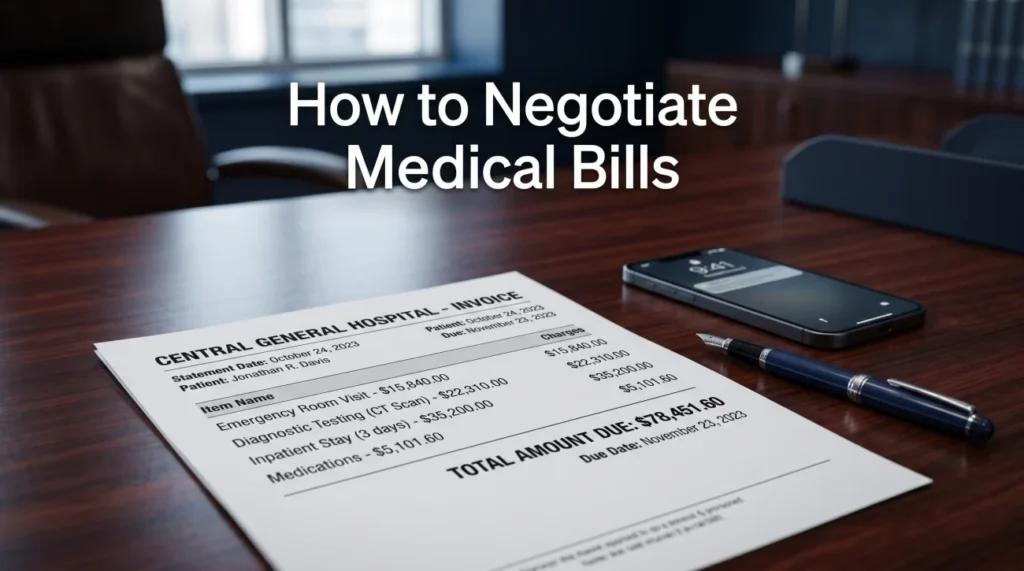
- Most hospital bills are generated using an inflated “chargemaster” rate that almost nobody actually pays.
- Nonprofit hospitals are required to have financial assistance programs, but billing departments rarely initiate that conversation with patients.
- Saying “I cannot afford this” often stalls the process; asking to “discuss financial assistance and settle the account” routes you to the right personnel.
- Negotiating a bill directly with the hospital requires a different approach than negotiating a medical bill that has already been sold to collections.
The Trap of the First Statement
The bill arrived. Maybe it was $4,200 for an emergency room visit that lasted less than an hour. Maybe it was a staggering $31,000 for a surgery your insurance only partially covered. Either way, you are looking at a number you cannot pay. You may have heard that you can negotiate medical bills, but the hospital’s paperwork makes it look like a rigid, final demand.
That rigid presentation is intentional. The truth is, the number printed at the bottom of your statement is rarely the final floor. I have sat on the billing department’s side of thousands of patient accounts, and the gap between what is billed and what the hospital will actually accept is significant. The problem is that patients do not know the rules of the negotiation ecosystem. Here is what is actually happening behind the scenes, and how to approach the process.
When patients open a massive hospital bill, the immediate reaction is usually panic. The statement demands payment within a short window, creating an artificial urgency. Because of this pressure, many patients make the critical mistake of agreeing to a multi-year payment plan for the full amount before they even ask how to negotiate medical bills down. They commit to years of financial strain simply because they did not realize the first bill is an opening offer, not a final verdict.
The Chargemaster Reality: Why the Starting Price is Inflated
To understand how to negotiate medical bills with a hospital, you first have to understand where the number on your bill came from. Every hospital maintains a master list of prices for every possible service, supply, and procedure. This is called the chargemaster.
The chargemaster rate is the absolute highest price the hospital sets. Insurance companies do not pay this rate; they negotiate steep discounts. Medicare and Medicaid do not pay this rate; they mandate their own lower reimbursement levels. The only people who are routinely billed the full chargemaster rate are patients who are uninsured, or patients receiving out-of-network care.
From inside the billing department, the most frustrating thing to watch was an uninsured patient setting up a payment plan for the full chargemaster rate. The hospital would have accepted a fraction of that amount, but the patient assumed the printed number was final and never questioned it.
When you are trying to figure out how to negotiate medical bills without insurance, your primary leverage comes from knowing that the hospital already expects to discount this inflated starting price. Your goal is simply to move your account down to a realistic settlement tier.
Charity Care and Financial Assistance: The Conversation They Skip
When patients wonder if they can you negotiate medical bills with hospitals, they usually picture a tense haggling session. In reality, the most effective “negotiation” is often just applying for programs the hospital is already required to offer.
Nonprofit hospitals are legally required to maintain financial assistance programs (often called charity care) to maintain their tax-exempt status. Many for-profit systems offer similar programs. These policies provide sliding-scale discounts based on your income compared to the Federal Poverty Level. Depending on your situation, this can mean a 20%, 50%, or even 100% reduction in your bill.
However, billing departments rarely initiate this conversation. The patient has to ask for it. Most of these programs cover both uninsured patients and those struggling to negotiate medical bills after insurance has paid its portion. To apply, you generally only need to provide proof of income, such as tax returns or recent pay stubs. Once you submit that application, the hospital is typically required to pause aggressive collection efforts while they review your eligibility.
I have watched countless patients start a financial assistance application, hit a documentation requirement they found confusing, and give up. The billing department will not chase you down to finish the paperwork. Completing this application is the single most powerful step in reducing a hospital balance.
The Framing and Timing That Actually Works
If you do not qualify for financial assistance, or if you still have a balance afterward, you have to engage with the billing staff directly. How you frame the conversation dictates whether you get routed to someone with the authority to reduce your bill, or someone whose only job is to collect payments.
This statement is heard hundreds of times a day. It triggers a standard script from the representative, who will immediately offer to set you up on a payment plan for the full balance.
This signals that you understand the process. It forces the representative to look beyond the payment plan screen and discuss settlement authority.
Timing is your other major point of leverage. Engaging early in the billing cycle (within the first 30 to 60 days) keeps you in the hospital’s internal system, where the goal is simply resolving the account. If you wait past 90 days, the hospital begins preparing to offload the debt. You can still negotiate, but the pressure and the tone of the conversation will change.
Instead of relying on a pre-written script to negotiate medical bills, stick to a formula. Acknowledge the bill, state clearly that you do not qualify for the financial assistance program but cannot pay the full balance, and then offer a specific lump sum to settle the account today. A lump sum in hand, even if it is smaller than the total balance, is your strongest negotiating tool.
⚠️ Warning: Never make a settlement offer over the phone and immediately hand over your credit card. If they agree to a reduced amount, you must request that the agreement be sent to you in writing before you process the payment.
But what if that initial window has already closed, and the hospital no longer owns your account? That requires a completely different strategy.
How to Negotiate Medical Bills in Collections
The rules change entirely once a hospital gives up on collecting the debt and sells or transfers it to a third-party collection agency. At this stage, you are no longer dealing with a healthcare provider; you are dealing with a financial recovery firm.
When wondering how to negotiate medical bills in collections, the key is understanding the economics of the debt buyer. Hospitals sell medical debt portfolios for pennies on the dollar. A collector may have purchased your $2,000 bill for $100. Because their baseline cost is so low, they have significant room to negotiate, but their tactics will be much more aggressive.
| Negotiating with the Hospital | Negotiating with a Collector |
|---|---|
| Goal is usually recovering costs or meeting charity care quotas. | Goal is maximizing profit margins on purchased debt. |
| Will often accept payment plans without adding heavy interest. | Will push for immediate lump sums but have deep discount authority. |
| Focuses on your income and financial assistance eligibility. | Focuses on account age and whether they can legally sue you. |
From inside the industry, I can tell you that collectors do not treat all accounts equally. The accounts most likely to settle quickly and favorably are old, mid-size, have no legal judgment attached, and involve a debtor who is engaging seriously. If your debt fits that profile, the collector knows that taking a guaranteed 30% today is far better than chasing 100% for another two years.
With collectors, starting low is expected. However, anything you do with them must be meticulously documented. Keep a log of every call, request debt validation before negotiating, and never grant them electronic access to your checking account.
What Hospitals and Collectors Will Actually Accept
Patients constantly ask exactly how low can you negotiate medical bills. There is no universal percentage, because every hospital system and collection agency operates under different financial pressures. However, these ranges reflect what I consistently saw play out across thousands of accounts based on the status of the debt.
- 📌 Recent hospital bills (0-90 days): Direct hospital negotiations usually yield modest reductions of 10% to 30% for a lump sum payment, unless you qualify for the charity care program (which can reduce it much further).
- 📌 Older hospital bills (90-180 days): As the debt ages and the hospital prepares to send it to collections, they become more motivated. Reductions of 30% to 50% for a lump sum are not uncommon.
- 📌 Accounts in collections: Because the collector bought the debt cheaply, settlements typically land between 20% and 60% of the original balance, depending heavily on the age of the debt and whether they have initiated legal action.
These are operational patterns, not guarantees. A massive corporate health system will negotiate differently than a small regional hospital. A debt buyer holding a portfolio of five-year-old debt will settle differently than an agency working on behalf of the hospital.
Final Thoughts: Moving Forward With Your Account
Understanding those realistic ranges changes the power dynamic. You are no longer guessing; you are operating with the same baseline knowledge the billing department has. Whether you are dealing with an inflated chargemaster rate or a collection agency trying to maximize its return, there is almost always a path to a more realistic number.
The open question is what your specific bill can realistically be reduced to, and whether you qualify for assistance that wipes it out entirely. That depends heavily on your current income, the specific hospital system’s internal policies, and the exact status of your account.
If your bill is recent and you want to negotiate directly, consider seeking out a patient financial advocate who can help you navigate the hospital’s specific charity care bureaucracy. If the bill is already in collections and the amount is overwhelming, it is often wise to explore structured debt relief options before attempting to negotiate with aggressive agencies on your own.
❓ FAQ
🏥 Can you negotiate medical bills after insurance has already paid?
Yes. Even after your insurance pays their portion, the remaining out-of-pocket balance (like a high deductible or coinsurance) can often be negotiated with the hospital, especially if you can offer a lump sum payment.
📉 How do I negotiate medical bills down if I have zero income?
If you have no income, you should immediately request the hospital’s financial assistance or charity care application. Nonprofit hospitals frequently forgive 100% of the balance for patients who fall well below the Federal Poverty Level.
📞 Should I call the hospital or wait for the bill to go to collections?
It is almost always better to address the bill while it is still with the hospital. Once it goes to collections, it can negatively impact your credit report and limit your access to the hospital’s internal financial assistance programs.
📝 Is there a perfect script to negotiate medical bills?
There is no magic script, but the most effective approach is stating clearly that you are evaluating your financial assistance options and want to know what terms are available to settle the account in full today.
⚖️ Do hospitals ever sue over unpaid medical bills?
Yes, some hospital systems and many third-party collection agencies will file lawsuits for unpaid medical debt. This is why ignoring the bills is a dangerous strategy; a lawsuit can lead to a default judgment and wage garnishment.
The Full Topic Map
Five content areas covering every part of medical billing and debt collection.
- The full legal framework: five federal laws governing what collectors can and cannot do
- Step-by-step guide to challenging a hospital bill from itemization to formal dispute
- Every option for resolving medical debt including forgiveness, relief programs, and settlement
- How medical debt gets reported, what the current rules allow, and what protects you
- State-by-state: statute of limitations, collection limits, and consumer protections
Where Most People Need Help
Five situations most people dealing with medical debt eventually face.
- How to identify and use a HIPAA violation against a medical debt collector
- How to negotiate a medical bill down from what the hospital originally billed
- What collectors will actually accept when settling medical debt in collections
- Whether national debt relief programs actually help with medical bills
- What actually works for removing medical debt from your credit report
Disclosure: The content on this site reflects direct experience inside hospital billing and medical debt collection, and is grounded in federal law and regulation. It is informational in nature. Reading it does not constitute legal advice and does not create any professional relationship. If you are facing a lawsuit, a judgment, or a legal deadline, consult a licensed attorney in your state before taking action.