
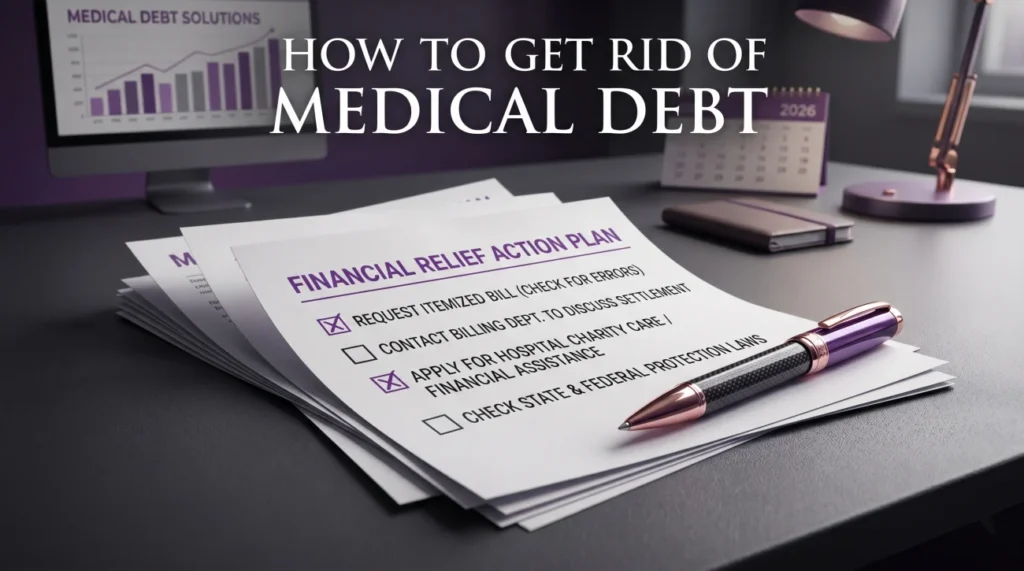
- Most patients try to manage medical debt the wrong way by immediately putting it on high-interest credit cards, completely bypassing legal protections and forgiveness programs.
- Nonprofit hospitals are federally required to offer financial assistance, and approximately $14 billion in charity care goes unclaimed every year simply because patients do not ask for the application.
- Your strategy depends entirely on where the bill currently sits. Options like charity care work best when the bill is with the hospital, while debt settlement becomes viable only after the account is sold to a collector.
The Reality of the Medical Billing Landscape
Right now, over 100 million Americans owe a collective $220 billion in medical debt. If you are reading this, you are likely holding a piece of that number. Whether it is a single staggering emergency room bill or a stack of statements from different specialists that you can no longer keep track of, the pressure feels identical. You are looking for a way out, and you want to know how to get rid of medical debt using methods that actually work in the real world.
The problem is that the healthcare billing system does not hand you a map. When I sat on the inside of hospital billing departments, reviewing patient accounts and managing the flow of files to outside collection agencies, I saw the exact same pattern repeat daily. Patients were trying to manage their balances, but they were doing it blindly. They were paying bills they did not actually have to pay, missing application windows for forgiveness programs, and making strategic errors that locked them into years of unnecessary financial strain.
There are legitimate ways to get rid of medical debt. Some paths involve complete forgiveness mandated by federal law. Others involve aggressive negotiation, structured relief programs, or long-term management. To choose the right path, you have to understand the full landscape before you make a single payment.
The Most Expensive Mistake You Can Make Today
Before we look at the solutions, we have to address the panic response. When a massive hospital bill arrives, the immediate instinct is to make it go away as fast as possible to avoid collections. Patients will look at a $4,000 balance, panic about their credit score, and immediately pay the bill in full using a high-interest credit card. They think this is how to pay off medical debt fast and protect their financial standing.
This is the most destructive financial decision you can make in this space.
By putting a medical bill on a Visa or Mastercard, you are converting healthcare debt into consumer credit card debt. You instantly lose every single protection afforded to medical patients. Credit card companies do not care if you experienced a medical hardship. They do not offer hospital charity care programs. They will charge you 24 percent interest, and if you miss a payment, it will immediately damage your credit.
“I have watched accounts flagged in our system as highly likely to qualify for 100 percent financial assistance suddenly zero out because the patient paid it online with a credit card. Once that payment posted, the hospital’s obligation to offer charity care ended. The patient took on thousands of dollars in commercial debt to pay a bill the hospital was legally prepared to write off.”
Never convert medical debt into credit card debt until you have exhausted every single option for forgiveness, assistance, and negotiation. You must keep the debt in the healthcare system for as long as possible to leverage the rules designed to protect you. The options below are arranged in a specific logical sequence, starting with paths that cost you nothing and completely erase the debt, moving through negotiation strategies, and ending with legal shields of last resort. Always start at the top.
Option 1: Charity Care and Hospital Financial Assistance
If you want to know how to eliminate medical debt completely, you must start here. Charity care is the most underused and most powerful option available to patients. It is not a scam, and it is not just for the absolute poorest individuals. It is a federal requirement.
Under IRS Section 501(r), nonprofit hospitals must maintain and provide financial assistance programs to qualifying patients in order to keep their tax-exempt status. This means they are legally obligated to forgive some or all of your bill if your income falls below certain thresholds. According to analysis by patient advocacy groups like Dollar For, an estimated $14 billion in charity care goes unclaimed annually. It goes unclaimed because hospitals rarely advertise it effectively, and patients assume they make too much money to qualify.
How Eligibility Actually Works
Hospitals base their forgiveness tiers on the Federal Poverty Level. While every hospital sets its own specific policy, the baseline is often much higher than people expect. It is common for a nonprofit hospital to offer 100 percent complete bill forgiveness for patients making up to 200 percent of the Federal Poverty Level. For a family of four, that often means earning up to roughly $60,000 a year qualifies for a total wipeout of the debt.
Even if you make more than that, hospitals frequently offer sliding-scale discounts. A family making up to 400 percent of the poverty level might qualify for a 50 to 80 percent reduction in their total balance.
Looking at your gross income, deciding you probably make too much money for “charity,” and ignoring the financial assistance application entirely.
Requesting the hospital’s specific financial assistance policy, looking at their exact income grid, and submitting an application if you are anywhere near the upper limits.
To use this option, you must act while the debt is still with the hospital. Most facilities have a 240-day window from the date of the first billing statement to accept applications. If you wait until the account is sold to a third-party collector, getting charity care applied retroactively becomes significantly more difficult. If your bill is still with the original provider, your absolute first step is to understand how to apply for hospital financial assistance and force the billing department to evaluate your file.
Option 2: State and Nonprofit Forgiveness Programs
If you are past the hospital’s application window, or if you were treated at a for-profit facility that denied your assistance request, there is a secondary layer of forgiveness occurring at the state and nonprofit level. This approach is changing how to clear medical debt for millions of people, but it operates very differently from standard hospital charity care.
Organizations like Undue Medical Debt operate by functioning essentially as a collection agency, but with a completely different motive. They raise donor and government funds to buy massive portfolios of defaulted medical debt on the secondary market for pennies on the dollar. However, instead of harassing patients to collect the money, they simply abolish the debt.
The Passive Nature of Portfolio Forgiveness
This is where many patients get confused. You cannot call these nonprofits and ask them to buy your specific hospital bill. The process is entirely passive. If your debt happens to be in a portfolio they purchase, and if you meet their criteria (usually earning less than 400 percent of the poverty level or having medical debt that exceeds 5 percent of your annual income), the debt is erased.
You will simply receive a letter in the mail stating that your specific account has been forgiven and the reporting bureaus have been notified. Currently, several states and local governments are partnering with these nonprofits to execute massive debt erasure programs. For example, North Carolina’s program has cleared over $6.5 billion in medical debt, and Illinois has erased more than $400 million. Keep a close eye on letters from unfamiliar debt buyers. Not all of them are asking for money. Some are writing to tell you the debt is gone.
Option 3: Debt Settlement in Collections
What happens when the hospital has officially given up, your charity care window has closed, and the account has been sold to a third-party debt collector? Many patients assume that once a debt hits collections, they are trapped into paying the full amount listed on the threatening letters. In reality, the moment a debt is sold to a third party, the rules of leverage shift entirely in your favor.
To understand medical debt solutions at this stage, you have to understand the math of a collection agency. When a hospital sells a defaulted account to a debt buyer, they do not sell it for face value. They sell it for a fraction of the cost, often mere pennies on the dollar. If a collector bought your $2,000 ER bill for $80, they do not need you to pay $2,000 to make a profit. They just need you to pay more than $80.
💡 Pro Tip: Collection agencies have built-in margins for settlement. Their first representative will demand the full balance, but their system is designed to accept significantly less if you know how to push back.
The Negotiation Reality
Settling a debt means you offer a lump sum payment that is less than the total balance, and in exchange, the collector agrees to consider the account closed and satisfied. If you have some available cash but cannot pay the full amount, this is a highly effective way to get out of medical debt.
You can often settle medical debts in collections for 40 to 50 percent of the original balance, and sometimes much lower if the debt is very old. However, you must get the settlement agreement in writing before you hand over any bank details. If you are dealing with aggressive third-party agencies, you need a specific strategy for how to settle medical debt in collections without accidentally resetting the statute of limitations or falling victim to a verbal promise the agency later denies.
Subject: Settlement Offer for Account #[Number]
To Whom It May Concern,
I am writing regarding the account referenced above. I am currently experiencing severe financial hardship and cannot pay the balance claimed. However, I am able to borrow a small amount of money from family to resolve this matter entirely.
I am offering a one-time lump sum payment of [Dollar Amount, usually 30% of total] as full and final settlement of this account. If you accept this offer, you must provide a written agreement stating that upon receipt of this payment, the account will be considered satisfied in full and you will not pursue the remaining balance.
I look forward to your written response.
Sincerely,
[Your Name]
Option 4: Structured Debt Relief Programs
If you are overwhelmed by multiple medical accounts scattered across different hospitals, imaging centers, and collection agencies, handling each one individually can become a full-time job. This is where structured debt relief programs enter the picture. Companies like National Debt Relief or Freedom Debt Relief operate by consolidating your negotiation process.
These programs are not free, and they are not charity. They are commercial services. When you enroll, you stop paying your creditors and instead make a single monthly payment into a dedicated savings account managed by the program. As funds build up in that account, the company approaches your collectors one by one to negotiate settlements on your behalf. Once a settlement is reached, they use your saved funds to pay the collector, and they take a fee for their service.
Key Point: Debt relief companies typically charge a fee ranging from 15 to 25 percent of the enrolled debt amount. You are paying them for the leverage and administrative heavy lifting.
This option is not for someone with a single $800 clinic bill. It is designed for patients facing high volumes of debt, usually totaling $7,500 or more, who are already in financial distress. Before signing a contract that commits a percentage of your money to fees, you must understand exactly what debt relief programs can and cannot do with medical accounts. They can be highly effective at clearing the board, but you have to survive the initial period where your accounts continue to age and collectors continue to call while your settlement funds build up.
Option 5: Direct Negotiation with the Provider
What to do about medical debt when you do not qualify for financial assistance, but the bill is still sitting with the hospital billing department? You negotiate. Most patients assume a hospital bill is a fixed, non-negotiable retail price. It is not. The chargemaster price you see on your statement is an inflated baseline designed for insurance negotiations, not for cash-paying individuals.
If you are uninsured, or if you have a massive high-deductible plan that left you holding the bag, you have the right to ask for a reduction based on what the hospital actually accepts from other payers.
- 📌 The Prompt-Pay Discount: If you have access to cash, call the billing department and offer to pay the bill immediately over the phone in exchange for a discount. Hospitals hate the administrative cost of chasing payments for months. They will frequently knock 10 to 30 percent off the top if you can settle the account the same day.
- 📌 The Medicare Multiplier: Hospitals routinely accept drastically lower rates from Medicare than what they charge private patients. You can ask the billing supervisor to adjust your bill to match the Medicare allowable rate for the exact same procedures.
- 📌 The Self-Pay Adjustment: Almost all hospitals have an automatic discount policy for uninsured patients. Ensure this was actually applied to your account before you start further negotiations.
Negotiating directly requires patience and a willingness to escalate past the first-level customer service representative. The front-line phone agents rarely have the authority to slash a bill in half. You must know how to frame your negotiation request to reach a supervisor who actually has the administrative power to adjust the balance down to a realistic number.
Option 6: Hospital Payment Plans
When you cannot negotiate the balance down and you cannot secure a lump sum to settle, the focus shifts to how to manage medical debt safely over time. The safest harbor for a medical bill you cannot pay today is a formal hospital payment plan. Most major health systems offer interest-free payment arrangements that stretch over 12, 24, or even 36 months.
The core benefit of a hospital payment plan is protection. As long as the plan is formalized and you make your agreed-upon monthly payment, the hospital will not send the account to a collection agency, and it will not appear on your credit report. It keeps the debt quarantined safely inside the healthcare system.
⚠️ Warning: Do not rely on “informal” payments. Many patients just mail in $50 a month thinking this proves good faith and stops collections. It does not. The automated billing system only looks for the full minimum amount due. If you do not have a formal agreement logged in the system, the computer will eventually escalate the account to collections regardless of your $50 checks.
When setting up a plan, be honest about what you can afford. Hospitals usually have a minimum monthly threshold they want to hit, but if that number will break your budget, ask for a financial hardship review. It is far better to establish a $40 a month plan you can maintain than a $150 a month plan you will default on in three months.
Option 7: Medical Debt Consolidation Loans
We discussed earlier why putting a medical bill on a standard credit card is a terrible idea. Medical debt consolidation loans fall into a similar, though slightly less destructive, category. A consolidation loan involves going to a bank or online lender, taking out an unsecured personal loan, using that money to pay the hospital in full, and then making one monthly payment to the bank.
This option only makes sense in very narrow circumstances. If you have dozens of bills from different providers and the administrative chaos is causing you to miss payments and face collections, consolidating them into one loan cleans up the mess. However, you are trading a massive financial advantage to do so.
Hospital debt is generally interest-free. When you take out a consolidation loan, you are agreeing to pay interest, often between 8 and 15 percent depending on your credit. A $10,000 medical debt paid over five years on a hospital payment plan costs $10,000. That same debt rolled into a 12 percent personal loan will cost you an extra $3,300 in interest alone. You must run the math very carefully before you voluntarily add interest to a healthcare balance.
Option 8: Bankruptcy
If consolidation still does not close the gap, or if the total debt load is simply too overwhelming to manage even with a payment plan, you have to look at legal protections. When the numbers simply do not work, when your wages are being threatened with garnishment by aggressive collectors, and when the debt load vastly exceeds your ability to ever pay it back, bankruptcy is the final legal shield. Medical debt is the leading cause of personal bankruptcy in the United States. It is a recognized, legal mechanism for hitting the reset button.
Medical bills are considered general unsecured debt, exactly like credit card balances. If you qualify for Chapter 7 bankruptcy, medical debt is almost entirely dischargeable. This means the court legally wipes the slate clean, and creditors are permanently barred from attempting to collect it.
This is the nuclear option. It will severely impact your credit profile for up to ten years, making it harder to rent an apartment, secure a mortgage, or get an auto loan. It should never be used for a $3,000 clinic bill, but if you are facing a $150,000 catastrophic hospital stay with no assets to cover it, consulting a bankruptcy attorney is a necessary step to protect your future income.
How to Choose Your Path
You now have the full map of ways to get rid of medical debt. The choice you make depends entirely on three specific factors: where the debt lives, how much you make, and how many accounts you are juggling. Use this logic to dictate your next move:
- If the debt is still with the hospital and your income is limited: Do nothing else until you have requested and submitted the financial assistance application. Charity care must be your first attempt.
- If the debt is still with the hospital and you have cash: Call the billing department, ask for the billing supervisor, and negotiate a prompt-pay discount or a reduction to the Medicare rate.
- If the debt is already with a collection agency: The charity care window is likely closed. Shift your strategy to debt settlement. Offer a lump sum of 30 to 40 percent to close the account permanently.
- If you have a massive, unmanageable volume of accounts in collections: Look into structured debt relief programs to consolidate the negotiation process, or consult a legal professional regarding bankruptcy if the total threatens your basic livelihood.
Your Immediate Next Steps
If you think you might qualify for forgiveness: Explore whether your medical debt can be forgiven before you make any other financial moves.
If your bill is still with the hospital: Learn exactly how to apply for hospital financial assistance and force the billing department to evaluate your file.
If your debt is already in collections: Find out if a structured debt relief program can help you negotiate a reduced settlement.
Final Thoughts: Taking Control of the Timeline
The medical billing system is designed to be confusing, intimidating, and exhausting. It relies on patients giving up and either paying more than they have to or ignoring the problem until it severely damages their credit. You do not have to follow their timeline.
Whether you choose to aggressively pursue hospital charity care, negotiate a settlement with a third-party collector, or formalize a long-term payment plan, the key is to take action deliberately and in writing. Never assume a balance is final until you have pushed back, and never let a billing department dictate your financial future without exploring every protection the law provides.
Your Complete Map to Medical Debt Relief
The eight options outlined above provide the overarching strategy for handling healthcare balances. However, executing these strategies successfully requires specific knowledge tailored to your exact situation. Whether you are navigating the nuances of hospital charity care, trying to understand recent legislative changes, or deciding between a personal loan and a debt settlement program, the detailed guides below provide the exact steps and requirements for every scenario.
| Resource Guide | Overview |
|---|---|
| Medical Debt Relief: What It Actually Means | An orientation to the three categories of medical debt relief (forgiveness, settlement, and management) and how to determine which applies to you. |
| Can Medical Debt Be Forgiven? | A breakdown of exactly who qualifies to have their medical debt completely eliminated and the specific paths to secure full forgiveness. |
| Medical Debt Forgiveness Programs | A comprehensive directory of organized programs that erase debt, including federal hospital requirements, state-level initiatives, and Undue Medical Debt. |
| Medical Debt Relief Programs | How to choose between non-profit programs that forgive debt entirely and commercial programs that negotiate reduced settlements for a fee. |
| Hospital Bill Forgiveness | The specific income thresholds, federal 501(r) rules, and application timing needed to force a hospital to write off your bill. |
| Medical Debt Forgiveness in 2025 and 2026 | The latest updates on credit reporting rule reversals, expanding state programs, and what is actually happening right now in medical debt relief. |
| The Medical Debt Forgiveness Act | Clarification on the stalled federal legislation and a look at what actual protections have passed at the state level instead. |
| Medical Bill Help for Low Income | Specific assistance programs, Medicaid retroactive coverage rules, and exact income thresholds for patients at or near the poverty level. |
| Medical Bill Financial Assistance | A complete map of financial aid sources beyond the hospital, including disease-specific foundations, pharmaceutical assistance, and government programs. |
| How to Pay Off Medical Debt | A realistic strategy for setting up written payment plans and prioritizing multiple accounts when you cannot afford to pay everything at once. |
| Medical Debt Consolidation Loan | The honest math on when converting zero-interest medical debt into a high-interest personal loan makes sense, and when it is a costly trap. |
❓ FAQ
🗑️ Can I just ignore my medical bills until they go away?
Ignoring medical bills does not make them disappear. After a certain period, the hospital will sell the account to a collection agency, which can lead to aggressive phone calls, negative marks on your credit report, and potentially a lawsuit if the balance is high enough.
⏱️ How long does it usually take for a medical bill to go to collections?
Most hospitals operate on a 90 to 120-day billing cycle. If a bill remains unpaid and no formal payment plan or financial assistance application is established within that window, the automated system will typically transfer the account to an outside collection agency.
📅 Does medical debt legally go away after 7 years?
Medical debt falls off your credit report after 7 years, meaning it will no longer impact your credit score. However, depending on your state’s statute of limitations, you may still legally owe the debt, though collectors may lose the ability to sue you for it.
💬 Can I still negotiate a hospital bill after my insurance pays their portion?
Yes. You can negotiate the remaining patient responsibility portion (your deductible, copay, or coinsurance). Hospitals would often rather accept a reduced lump sum payment from you immediately than spend months trying to collect the full balance.
💸 Will paying a little bit each month keep me out of collections?
Only if you have a formal, written payment plan approved by the hospital. Mailing in random, informal partial payments will not stop the automated billing system from sending your account to collections for failing to meet the minimum amount due.
📄 What happens if I ask the hospital for an itemized bill?
Requesting an itemized bill forces the billing department to provide a detailed breakdown of every single charge and fee. More importantly, this request often pauses the collection timeline temporarily while they gather the required documentation.
🏥 Can a hospital deny me future care if I currently owe them money?
Emergency departments are generally required to treat patients in life-threatening situations regardless of outstanding balances. However, a hospital or affiliated clinic can refuse to schedule non-emergency, elective procedures or routine visits until previous balances are resolved.
⚖️ Is medical debt treated differently than credit card debt?
Yes. Medical debt has unique protections, including mandatory financial assistance requirements for nonprofit hospitals and stricter credit reporting rules (debts under $500 are not reported). Converting it to a credit card strips away these specific healthcare protections.
📋 How do I know if I actually qualify for hospital charity care?
You must look up the specific hospital’s financial assistance policy online and compare your household income to their grid, which is based on the Federal Poverty Level. Do not assume you make too much money without checking their exact numbers first.
🏦 Should I drain my savings account to pay off a massive medical debt?
Generally, no. Depleting your emergency savings to pay a zero-interest medical bill leaves you vulnerable to future financial crises. Always explore forgiveness programs, negotiation, or interest-free hospital payment plans before liquidating your personal safety net.
The Full Topic Map
Five content areas covering every part of medical billing and debt collection.
- The full legal framework: five federal laws governing what collectors can and cannot do
- Step-by-step guide to challenging a hospital bill from itemization to formal dispute
- Every option for resolving medical debt including forgiveness, relief programs, and settlement
- How medical debt gets reported, what the current rules allow, and what protects you
- State-by-state: statute of limitations, collection limits, and consumer protections
Where Most People Need Help
Five situations most people dealing with medical debt eventually face.
- How to identify and use a HIPAA violation against a medical debt collector
- How to negotiate a medical bill down from what the hospital originally billed
- What collectors will actually accept when settling medical debt in collections
- Whether national debt relief programs actually help with medical bills
- What actually works for removing medical debt from your credit report
Disclosure: The content on this site reflects direct experience inside hospital billing and medical debt collection, and is grounded in federal law and regulation. It is informational in nature. Reading it does not constitute legal advice and does not create any professional relationship. If you are facing a lawsuit, a judgment, or a legal deadline, consult a licensed attorney in your state before taking action.