
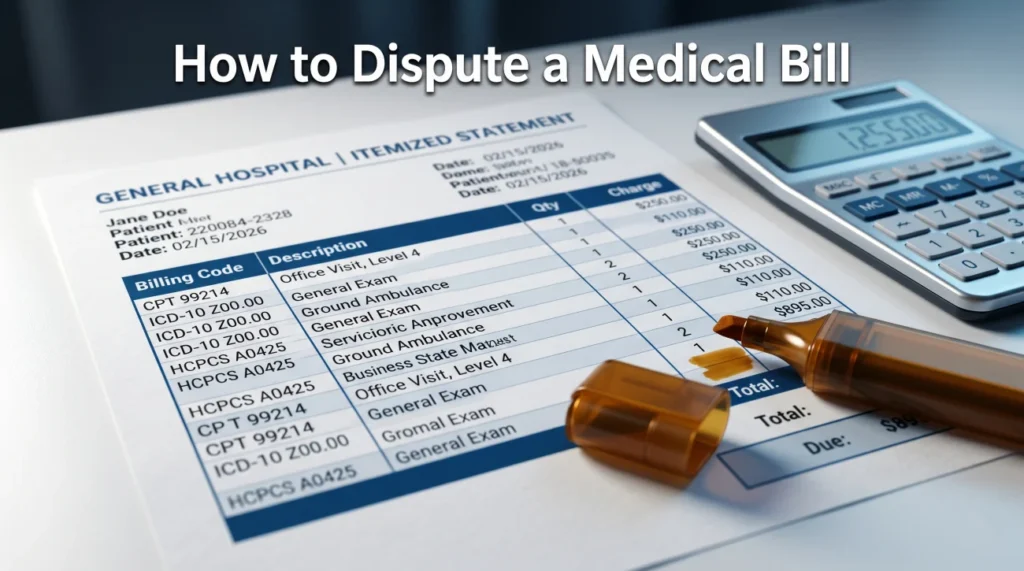
- Statistically, a massive percentage of hospital bills contain errors. Disputing them is not just about complaining; it is a formal administrative process of demanding accurate coding.
- Before you dispute anything, you must obtain an itemized bill and compare it line-by-line with your insurance Explanation of Benefits (EOB).
- The entity you dispute with matters. Disputing a coding error with the hospital is a completely different process than appealing a coverage denial with your insurance company.
- A written dispute with specific billing codes forces the hospital to open a formal review, whereas verbal complaints are rarely tracked.
The Reality of Hospital Invoicing
There is a specific moment when a patient realizes their medical bill is wrong. It usually happens right after they open the envelope, look at the bottom-line total, and feel a sudden drop in their stomach. The number seems impossible. The immediate reaction is to pick up the phone, call the billing department, and say, “This has to be a mistake.”
I have sat on the other end of those phone calls. Working inside hospital billing departments, I watched thousands of patient accounts move through the system: from initial coding to insurance processing, to patient billing, and eventually to collections. The uncomfortable truth is that the average hospital bill contains errors. Not maybe. Statistically, probably. A widely cited JAMA Health Forum study found that roughly 74% of patients who formally disputed billing errors successfully got the mistake corrected.
If you are looking at a high balance and wondering should I dispute medical bills, the data suggests it is often worth the time. The gap between knowing a bill is wrong and actually getting the balance reduced is where hospitals collect millions of dollars they are not entitled to.
Most patients fail because they treat a billing dispute like a customer service complaint. But medical billing is not customer service; it is a rigid system of codes, contracts, and compliance rules. To win, you have to speak their language. You must understand what counts as a valid error, what documentation forces their hand, and what the process looks like step by step.
Who Are You Actually Disputing With?
Before you send a single letter or make a phone call, you must identify the correct target. One of the most common reasons disputes stall is that patients send their complaints to the wrong entity. Healthcare billing is a layered system, and your approach changes entirely depending on where the error occurred.
Generally, you will be dealing with one of three primary entities:
- 📌 The Healthcare Provider (Hospital or Clinic): You dispute with them if there is a factual error in what was billed. This means they billed you for something you did not receive, charged you twice, or used the wrong billing code.
- 📌 Your Health Insurance Company: You dispute with them if the hospital billed everything correctly, but the insurer refused to pay their fair share based on your policy. This is not a billing error; it is an insurance processing error.
- 📌 A Third-Party Collection Agency: You dispute with them if the hospital has already written off the debt and sold or transferred it. If you need to know how to dispute a medical bill in collections, you are no longer arguing about medical codes; you are demanding validation of a debt under a completely different set of consumer rules.
To keep your dispute moving forward, it helps to understand the standard escalation path. If you are dealing with a standard hospital billing error, the sequence generally looks like this:
- The Provider’s Billing Department: Your first point of written contact to correct coding errors.
- Your Insurance Company: Engaged if the hospital coded correctly but the plan processed it wrong.
- Hospital Patient Advocate: The internal escalation point if the billing department is unresponsive.
- State Insurance Commissioner: Your external escalation if the insurer refuses a valid claim.
The Five Situations Where Disputing Makes Sense
Many patients ask me, “can medical bills be disputed just because they are too expensive?” The hard answer is no. “Too expensive” is not a valid dispute ground; it is a negotiation ground. A dispute requires a factual, procedural, or legal error. To understand exactly what qualifies, you should review the complete list of reasons to dispute a medical bill. Here are the five primary situations where a formal dispute is necessary.
1. Hard Billing Errors
This is the most common scenario. A hard billing error means the data entered into the hospital’s computer system does not match the reality of your medical visit. This includes duplicate charges (being billed twice for the same blood test), upcoding (being billed for a complex physician visit when the doctor only saw you briefly), or unbundling (charging separately for surgical supplies that should be included in the main fee).
2. Services Not Rendered
Being billed for something that never happened gives you the strongest possible leverage. If a hospital bills you for a service, they must have clinical documentation proving it occurred. If you were billed for an MRI that was canceled, or a medication you refused, the hospital cannot sustain that charge during an audit.
3. Insurance Processing Errors
Sometimes the provider codes everything perfectly, but your insurance company’s automated system misreads the claim. They might apply an out-of-network penalty to an in-network doctor, incorrectly state that you have not met your deductible, or deny a covered treatment.
4. Surprise Billing Violations
If you went to an in-network hospital for an emergency, or scheduled a surgery at an in-network facility but were unknowingly treated by an out-of-network anesthesiologist, federal surprise billing protections generally mean you cannot be balance-billed for out-of-network care. The provider and your insurer must work out the difference.
5. Estimate Discrepancies
If you are uninsured or paying out-of-pocket, federal patient protections mean most providers are expected to give you a good faith estimate before your scheduled care. If your final bill comes in substantially higher than that estimate, you have access to a federal dispute resolution process.
Deep Dive: Specific Dispute Paths
Because the dispute process differs significantly depending on whether you are facing a structural coding error or a network coverage issue, I have broken down the exact steps for each path below. Choose the guide that best matches your situation.
| Medical Bill Dispute Guides | What You Will Learn |
|---|---|
| Hospital Bill Overcharge | How to spot upcoding, duplicate charges, unbundled fees, and read an itemized bill like an auditor. |
| Dispute Surprise Medical Bill | Your protections when an out-of-network doctor treats you at an in-network hospital. |
Before You Dispute Anything: Gather the Evidence
You cannot fight a data system with feelings. You need documents. When you receive a standard hospital bill in the mail, it usually shows a summary total minus whatever insurance paid. This summary document is entirely useless for a dispute.
The documentation you need before contacting anyone includes:
- The Itemized Bill: Hospitals are required to provide this upon request. It breaks down every pill, bandage, and minute of physician time, accompanied by a specific 5-digit billing code.
- Explanation of Benefits (EOB): This document from your insurance says “This is not a bill” at the top. It shows exactly what the hospital submitted and what insurance agreed to cover.
- A Detailed Call Log: Written notes of all calls you make, including the date, the representative’s name, and exactly what was said.
Every discrepancy between what the itemized bill shows and what the EOB authorizes is a potential dispute. If the hospital bill says you owe $500, but your EOB says your patient responsibility is only $150, you have found your target.
The “Official Document” Trap That Costs Patients Thousands
The most heartbreaking pattern I witnessed in hospital billing was seeing patients pay bills they did not actually owe, simply out of fatigue. The system is incredibly disorienting. The invoices look highly official, printed on heavy paper with stern warnings about due dates.
When patients try to investigate, they get trapped in phone menus. They wait on hold for forty minutes, only to speak with an outsourced representative who has no authority to change a billing code. The representative will politely explain that “the charges are correct according to the system.”
This is where the majority of people give up. They assume that if the computer says it, and the representative confirms it, it must be legally binding. They put the bill on a high-interest credit card just to make the anxiety go away.
⚠️ Warning: The billing department’s initial job is to collect the balance, not to audit your medical chart. When a frontline representative says “the bill is correct,” they merely mean the math adds up based on the codes entered. They are not confirming that the codes themselves are medically accurate.
Do not let the official look of the invoice intimidate you. A hospital bill is essentially an initial asking price generated by fallible human coders and automated software. You have every right to challenge it.
How to Dispute Hospital Bills: The Step-by-Step Process
If you have identified a factual error on your itemized bill, you must initiate a formal dispute with the hospital or clinic’s billing department. Knowing how to approach this effectively requires creating a paper trail that the hospital cannot ignore.
Step 1: Stop Calling and Start Writing
Verbal disputes do not exist in the eyes of a hospital auditing team. When you call, the representative might type a brief note on your account, but this rarely pauses the collection clock. A written dispute, however, must be scanned into your Electronic Health Record (EHR) and assigned to a reviewer. It forces accountability.
Step 2: Draft a Specific, Code-Based Dispute Letter
Drafting the letter is about logic, not emotion. Your letter should not contain a history of your medical trauma; it needs to be dry, factual, and strictly focused on the billing codes. A complaint describes your feelings; a dispute identifies a specific error, cites the billing code, and requests a specific action.
If you want to know how do you dispute a medical bill successfully, the secret is in the framing. You must explicitly reference the disputed line item. For a detailed breakdown of the exact structure, logic, and what to include in your mailing, see our complete guide on crafting a medical bill dispute letter.
Step 3: Track, Follow Up, and Escalate
Send your dispute letter via certified mail with a return receipt, and also email it if a billing address is provided. If you get no response after a reasonable timeframe, you escalate. Every mid-to-large hospital has a Patient Advocate or Patient Relations Department. Forwarding your unanswered dispute letter to the Patient Advocate office is often the magic key. They bypass the frontline billing queue and walk the file directly to a senior revenue cycle manager for review.
How to Dispute a Medical Bill With Insurance
If your hospital bill is high because your insurance company denied the claim or paid less than expected, disputing the hospital will get you nowhere. You have to fight the insurer by navigating their formal appeals process.
“From my desk in the billing department, I regularly saw patients submit angry disputes to us demanding we fix their $3,000 out-of-pocket balance. But when I looked at the file, the issue was clearly that their insurance had denied the claim for lack of pre-authorization. We could not fix it because we did not cause it. The patient had wasted a month fighting the hospital when they needed to be appealing the denial with their insurer.”
Most insurers give you a specific window to file an Internal Appeal. Do not guess this deadline: check your EOB, as it is usually printed right on the document. You must write a letter to the insurer stating why the claim should be covered, attaching supporting documents from your doctor.
If the internal appeal fails, you generally have the right to request an External Review from an independent third party. When patients ask how to beat an insurance denial, the secret is securing your doctor’s help. An insurance company will easily ignore a patient’s opinion on medical necessity, but they have a much harder time ignoring clinical peer-to-peer documentation from the treating physician.
Inside the Billing Department: What Happens Next?
Once your written dispute lands on a billing specialist’s desk, the dynamic shifts. Understanding exactly what happens when you dispute a medical bill on the inside helps you track your progress.
First, the specialist will often place a “dispute flag” on your account. In many hospital systems, this temporarily freezes the aging cycle of the bill and stops the automated software from sending your account to a third-party collection agency while the investigation is pending.
Next, the specialist will open your Electronic Health Record and look at the clinical notes logged by the nurses and doctors. If you claimed a service was not rendered, the specialist searches the chart for proof. If there is no clinical documentation that the service occurred, the billing rule is absolute: if it is not documented, it cannot be billed. The specialist will route a correction request to the coding department, the charge is backed out, and a new statement is generated.
The Realistic Outcomes and Your Next Steps
After your dispute is reviewed, you will face one of several realistic outcomes:
- The error is confirmed and corrected. You receive a revised bill with a lower balance.
- The insurance is forced to reprocess. The hospital realizes they submitted the wrong code to your insurer, corrects it, and resubmits the claim.
- The dispute is denied, and the bill stands. The hospital provides documentation proving the charge is valid according to their coding rules.
If the bill stands, and you still cannot afford it, you have reached the end of the dispute path and must pivot to the negotiation path. Remember, a hospital confirming a bill is accurate does not mean you have to pay the full sticker price.
You can apply for the hospital’s financial assistance program, or you can learn how to negotiate medical bills directly by offering a lump-sum settlement or requesting the “self-pay” rate. Hospitals would rather accept a reduction directly from you than sell the debt to a collector for pennies on the dollar.
Final Thoughts: Protecting Your Financial Health
Disputing a medical bill is an administrative chore that nobody wants to do, especially when recovering from an illness. But the healthcare system places the burden of auditing squarely on the shoulders of the patient. If you do not check their math, nobody else will.
Remember the golden rules: never ignore the bill, always demand the itemized statement, and communicate in writing. If you find yourself overwhelmed, or if a hospital has improperly shared your sensitive medical history with a collection agency during a dispute, you may need to look into whether there has been a medical debt collection HIPAA violation. Stay calm, keep your paperwork organized, and treat the process exactly for what it is: a business transaction.
❓ FAQ
📞 Can I dispute a medical bill over the phone?
You can start the process by requesting an itemized bill, but a formal dispute should always be submitted in writing. Verbal complaints do not create a reliable audit trail.
⏳ How long do I have to dispute a hospital bill?
Hospital billing policies vary, but you generally have a few months from the billing date to dispute an error with the facility. If you are appealing an insurance denial, check your EOB for your specific internal appeal deadline.
📄 What documents do I need to dispute medical charges?
You must have the itemized hospital bill (showing CPT codes) and your insurance Explanation of Benefits (EOB). Depending on the error, you may also need your clinical medical records.
🛑 Can a disputed medical bill be sent to collections?
It generally should not be. Most hospital systems pause the aging cycle of an account once a formal, written dispute is logged. Furthermore, many nonprofit hospitals suspend collections while reviewing your account for assistance.
🏥 Can you dispute a medical bill if you already paid it?
Yes, you can request a post-payment refund if you discover a billing error. However, the process is much slower because the money must be routed back through accounts payable, and you must still provide proof of the coding error.
⚖️ Is a misdiagnosis considered a billing error?
Usually, no. If a doctor diagnosed you incorrectly but legitimately performed the tests and treatments billed, that is a medical judgment issue, not a billing coding error. Billing disputes only cover factual errors in how services were invoiced.
👩⚕️ How do I fight a surprise out-of-network bill?
If you were treated at an in-network facility but billed by an out-of-network provider, federal protections generally apply. File a dispute stating the bill violates surprise billing rules, and consider escalating to the federal help desk if the provider refuses to adjust it.
💵 What if the bill is accurate but I just cannot afford it?
If there are no billing errors, you cannot “dispute” the bill, but you can negotiate it. Apply for the hospital’s financial assistance program, ask for a self-pay discount, or offer a lump-sum settlement.
📉 How do I dispute a medical bill on my credit report?
If an inaccurate medical debt appears on your credit report, that is a separate consumer protection process. You will need to dispute the error directly with the credit bureaus, not the hospital. Learn more about navigating medical debt on your credit report.
🕵️♂️ Will a hospital lower my bill if I ask for an itemized statement?
Simply asking for the statement does not automatically lower the bill. However, asking for the itemized statement gives you the exact data you need to find the errors that will force them to lower the bill.
The Full Topic Map
Five content areas covering every part of medical billing and debt collection.
- The full legal framework: five federal laws governing what collectors can and cannot do
- Step-by-step guide to challenging a hospital bill from itemization to formal dispute
- Every option for resolving medical debt including forgiveness, relief programs, and settlement
- How medical debt gets reported, what the current rules allow, and what protects you
- State-by-state: statute of limitations, collection limits, and consumer protections
Where Most People Need Help
Five situations most people dealing with medical debt eventually face.
- How to identify and use a HIPAA violation against a medical debt collector
- How to negotiate a medical bill down from what the hospital originally billed
- What collectors will actually accept when settling medical debt in collections
- Whether national debt relief programs actually help with medical bills
- What actually works for removing medical debt from your credit report
Disclosure: The content on this site reflects direct experience inside hospital billing and medical debt collection, and is grounded in federal law and regulation. It is informational in nature. Reading it does not constitute legal advice and does not create any professional relationship. If you are facing a lawsuit, a judgment, or a legal deadline, consult a licensed attorney in your state before taking action.