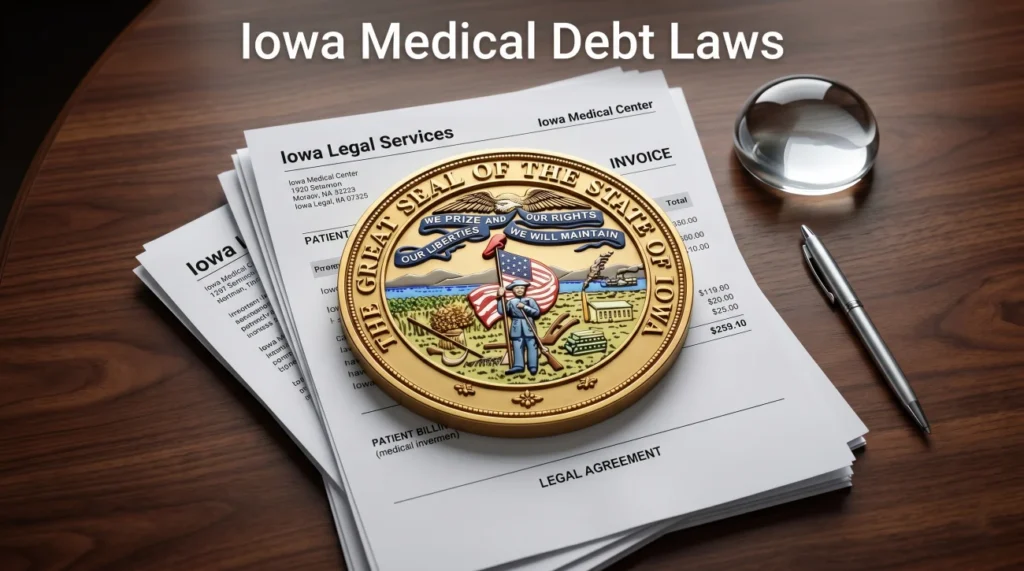
- The statute of limitations on medical debt in Iowa is 5 years, after which a collector can no longer legally sue you.
- Making a payment or written acknowledgment can restart this 5-year clock, reviving old debt.
- If a collector wins a judgment, Iowa allows wage garnishment, but protects 75% of your disposable earnings under federal default rules.
- Unlike wages, bank account levies in Iowa can potentially reach the full balance of your account if the funds are not from protected sources.
Understanding Your Legal Exposure in Iowa
When you are facing unpaid medical bills in Iowa, knowing the state-specific rules is just as important as understanding federal law. Iowa’s five-year statute of limitations dictates how long a collector has to take you to court. However, the less-discussed issue is how Iowa handles bank account levies after a judgment, which operate under completely different rules than wage garnishment.
During my time reviewing patient accounts, I frequently saw individuals assume that if their paycheck was safe from severe garnishment, their savings account was too. That assumption often leads to devastating financial surprises. While Iowa defaults to federal protections for your wages, bank accounts are far more vulnerable once a collector secures a court judgment.
Understanding the difference between these collection methods, knowing exactly when your debt becomes time-barred, and recognizing what actions can accidentally restart the clock will give you the leverage you need to handle collectors safely.
The 5-Year Window to Sue
Under Iowa Code § 614.1(4), the statute of limitations on medical debt in Iowa is five years. This means a debt collector or hospital has exactly five years from the date of your last payment or the date the debt first became delinquent to file a lawsuit against you.
Once that five-year window closes, the debt is considered time-barred. A collector can no longer successfully sue you to obtain a judgment. They are also prohibited by federal law from threatening to sue you on time-barred debt.
What Time-Barred Actually Means
Many patients mistakenly believe that once the statute of limitations expires, the debt is forgiven and disappears. It does not. The debt still legally exists. The collector can still call you, send letters, and ask you to pay it. They can also still report the account to credit bureaus, provided it falls within the seven-year reporting window allowed by the Fair Credit Reporting Act.
The Danger of Restarting the Clock
The statute of limitations is not a permanent shield if you interact with the debt incorrectly. The clock can be reset to day one.
- ⚠️ Making any payment: Paying even five dollars toward a five-year-old medical bill will instantly restart the statute of limitations, giving the collector another full five years to sue you.
- ⚠️ Written acknowledgment: Sending a letter or email agreeing that the debt is yours and promising to pay it can also revive the legal window.
“I saw countless accounts where a patient, trying to do the right thing, sent a twenty-dollar check for a debt that was already past the statute of limitations. That single payment revived the account, and the collector filed a lawsuit two months later. If a debt is old, verify its age before you open your wallet.”
Wage Garnishment vs. Bank Levies
If a collector sues you within the five-year window and wins a judgment, they gain access to aggressive collection tools. In Iowa, there is no state-level ban on medical debt collection tactics like there is in a handful of other states. Before they can touch your money, however, they must navigate a specific legal process.
The Procedural Steps to Collection
Collectors cannot simply decide to take funds from your account or paycheck. They must complete these steps:
- File a Lawsuit: They must formally sue you in an Iowa court.
- Obtain a Judgment: They must win the case, often by default if you do not respond.
- Request Execution: They must return to the court to request a specific writ of execution for garnishment or levy.
Each of these steps requires court action, meaning there are multiple points where you can intervene, assert exemptions, or negotiate a settlement before your funds are seized.
Protecting Your Paycheck
For wage garnishment, Iowa relies on the federal baseline protections. A collector cannot take your entire paycheck. They are legally limited to taking 25% of your disposable earnings, or the amount by which your disposable earnings exceed thirty times the federal minimum wage, whichever is less. Your disposable earnings are what remains after mandatory deductions like taxes.
The Risk to Bank Accounts
Bank account levies are entirely different. If a collector locates your bank account after obtaining a judgment, they can instruct the bank to freeze the funds and turn them over. Unlike wages, which are capped at 25%, a bank levy can potentially reach the full balance of your account to satisfy the judgment.
Certain funds are exempt from bank levies, such as Social Security benefits, veterans’ benefits, and certain pensions. However, it is entirely up to you to prove to the court that the frozen funds came from a protected source. If your account contains a mix of protected income and regular disposable earnings, sorting it out can be a lengthy legal headache while your money remains inaccessible.
Assuming that because your disposable earnings are mostly protected from garnishment, the cash sitting in your checking account from last month’s paychecks is also automatically safe from a levy.
Understanding that once a judgment is entered, any non-exempt cash in a bank account is highly vulnerable, and keeping exempt funds in a separate, clearly identifiable account can prevent them from being unjustly frozen.
The Broader State Law Picture
When evaluating medical debt laws in Iowa, it is clear that the state relies heavily on federal minimums.
- Credit Reporting: Iowa does not have state-level bans restricting medical debt from appearing on credit reports. You must rely on federal FCRA rules, which protect paid debts and debts under five hundred dollars from reporting.
- Charity Care: Iowa does not impose state-specific charity care mandates that exceed the federal IRS 501(r) rules for nonprofit hospitals.
Because Iowa does not offer expansive state-level consumer protections for medical debt, your primary defense strategies must rely on federal rights. This means rigorously checking for billing errors, demanding validation under the Fair Debt Collection Practices Act, and ensuring the collector respects the statute of limitations.
When Collectors Exploit the Bank Levy Threat
Because Iowa lacks the robust state-level wage garnishment protections found in some other states, the threat of a bank levy becomes a collector’s most potent weapon. Many patients in Iowa face aggressive tactics centered around this specific vulnerability without realizing when the collector is actually breaking federal law.
For example, a collector might call and claim they are going to “freeze your bank accounts by Friday” to force a panicked payment over the phone. If they have not yet sued you and obtained a judgment, this is an illegal threat under the FDCPA. They are threatening an action they cannot legally take at that moment.
Collectors lean heavily on this fear in states like Iowa, knowing that the prospect of a frozen savings account is enough to make many people ignore their right to validate the debt or dispute an incorrect balance. Documenting these interactions – keeping a log of calls, saving letters, and noting exactly what was threatened – turns their illegal intimidation tactics into leverage for your defense.
Final Thoughts: Act Before the Judgment
The Iowa medical bill statute of limitations gives you a clear five-year boundary, but within that window, you must be proactive. The stark difference between wage garnishment limits and the severe risk of bank account levies means you cannot afford to ignore a lawsuit.
👉 Next Step: If a collector is threatening legal action, or if you suspect they are violating your rights by pursuing time-barred debt, you need to understand how to hold them accountable. Review how to identify a medical debt collection HIPAA violation or FDCPA breach to stop aggressive tactics.
If you know the debt is valid and within the five-year window, your best defense against a bank levy is to negotiate a resolution before they file a lawsuit. Learn how to settle medical debt in collections for less than the full balance.
For a complete overview of how your state compares to others, check the full medical debt statute of limitations by state guide or explore the broader landscape of medical debt laws by state.
❓ FAQ
⏱️ What is the statute of limitations on medical debt in Iowa?
The statute of limitations for medical debt in Iowa is five years, governed by Iowa Code § 614.1(4).
📅 When does the statute of limitations clock start ticking?
The five-year clock generally starts on the date of your last payment or the date the debt first became delinquent, whichever is most recent.
🔄 Can I accidentally restart the statute of limitations?
Yes. Making any payment, even a partial one, or acknowledging the debt in writing can reset the five-year clock back to day one.
⚖️ Can a collector sue me after five years in Iowa?
No. Once the five-year statute of limitations has expired, the debt is time-barred and a collector can no longer successfully sue you for it.
📞 Will collectors stop calling after the debt is time-barred?
Not necessarily. While they cannot sue you, federal law still allows collectors to contact you and ask for payment on time-barred debt, unless you send a written cease communication request.
💼 How much of my paycheck can be garnished for medical debt in Iowa?
Iowa follows the federal default, meaning a maximum of 25% of your disposable earnings can be garnished once a collector secures a court judgment.
🏦 Can collectors take money directly from my bank account?
Yes. With a court judgment, a collector can levy your bank account. Unlike wages, a bank levy can potentially reach the full balance of non-exempt funds in the account.
🛡️ Are any funds in my bank account protected from a levy?
Yes, certain funds like Social Security benefits, veterans’ benefits, and some pensions are exempt from levies. However, you must prove the source of the funds to the court.
📝 Does Iowa have a state law banning medical debt from credit reports?
No. Iowa does not have a state-level ban. Medical debt reporting is governed by federal rules, which prohibit reporting paid debts and unpaid debts under five hundred dollars.
🏥 Are Iowa hospitals required by state law to offer charity care?
Iowa does not have state-specific charity care mandates that exceed the federal requirements placed on nonprofit hospitals under IRS section 501(r).
Medical Debt Laws
The state-by-state legal framework that determines how long collectors can pursue you.
- State-by-state: statute of limitations, collection limits, and consumer protections
- Virginia Medical Debt Laws: What Applies in Virginia
- South Dakota Medical Debt Laws: Statute of Limitations and Collection Rules
- Oregon Medical Debt Statute of Limitations: 6 years
- Colorado Medical Debt Statute of Limitations: 6 Years and New Protections
Turning Legal Knowledge Into Action
State law gives you leverage. These pages explain how to use it.
- How federal HIPAA law creates leverage you can use against a medical debt collector
- Your legal right to negotiate any medical bill and what providers cannot refuse
- How to settle medical debt within the window your state laws still allow
- How debt relief programs interact with your state collection laws and protections
- Removing medical debt from your credit report under the current federal reporting rules
Disclosure: The content on this site reflects direct experience inside hospital billing and medical debt collection, and is grounded in federal law and regulation. It is informational in nature. Reading it does not constitute legal advice and does not create any professional relationship. If you are facing a lawsuit, a judgment, or a legal deadline, consult a licensed attorney in your state before taking action.