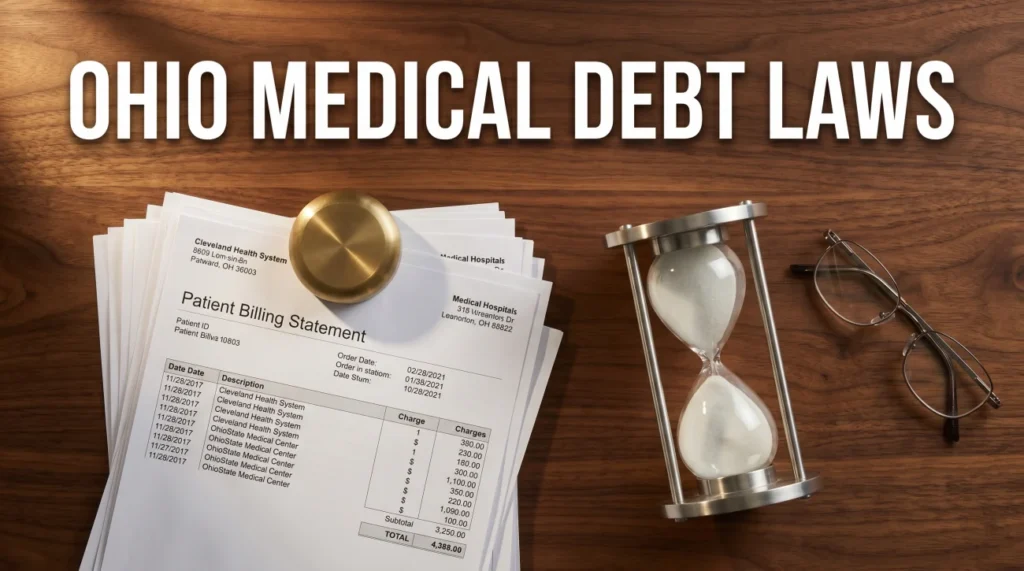
- The Ohio medical debt statute of limitations is 6 years, giving debt collectors a long window to pursue legal action against you.
- Making a partial payment or acknowledging an old debt in writing can completely restart this six-year clock from day one.
- Under current law, collectors with a court judgment can garnish a significant portion of your disposable wages.
- The proposed HB 257 Medical Debt Fairness Act aims to ban wage garnishment for medical debt, cap interest at 3 percent, and prohibit medical debt credit reporting.
- Once a debt is time-barred, a collector can still contact you but loses the legal authority to sue you or threaten you with a lawsuit.
Understanding Your Exposure to Ohio Medical Bills
When you are staring at a stack of past due medical bills in Ohio, the timeline is often the most confusing part of the puzzle. Patients frequently assume that collection agencies have unlimited time and power to force a payment. Having sat on the billing side of thousands of patient accounts, I can tell you that the system relies heavily on you not knowing your rights or your deadlines. The Ohio medical debt statute of limitations is 6 years. While this gives collectors a significant amount of time to act, it is a hard legal boundary that they cannot cross in court.
However, the landscape in Ohio is currently shifting. While collectors have traditionally relied on aggressive wage garnishment to collect judgments, proposed legislation known as the HB 257 Medical Debt Fairness Act could completely reshape how medical debt is handled in the state. If passed, it would strip collectors of their most powerful tools, including garnishment and credit reporting.
I have watched patients panic and empty their limited savings because a collector threatened them over a bill that was legally too old to enforce in court. Knowing exactly how the Ohio medical debt statute of limitations works, combined with an understanding of current and pending state laws, changes how you respond to every collection letter.
The Pressure of the Collection Cycle
The standard collection process is engineered to create urgency and fear. Months after you receive care, after the hospital billing department has exhausted its internal efforts, the account is sold or transferred to a third-party agency. Suddenly, the letters become more demanding, and the phone calls start disrupting your day.
The greatest source of anxiety for patients is the threat of a lawsuit. Under current Ohio law, collectors know they can reach up to 25 percent of your paycheck if they successfully sue you. Because of this, they use formal, intimidating language designed to imply that a lawsuit is imminent. The reality from inside the billing industry is that many of these threats are automated bulk mailings. The collector is banking on the fact that you do not know the age of the debt, or worse, that you will make a panic payment that accidentally extends their legal window to sue you.
The 6-Year Legal Window: ORC Section 2305.07
In Ohio, medical bills are classified as contracts. Under the Ohio Revised Code (ORC Section 2305.07), the legal window a creditor has to file a lawsuit against you for this type of debt is six years. Once that six-year period expires, the debt officially becomes “time-barred.”
A time-barred debt does not vanish from the original creditor’s system. It simply means the collector has lost their ultimate leverage. They can no longer use the court system to get a judgment against you. If a collector does attempt to file a lawsuit after those six years have passed, you have an absolute defense. By responding to the court and pointing out the expired timeline, the judge will usually dismiss the case.
To see how this six-year timeframe fits into the larger national picture, you can read our foundational guide on the medical debt statute of limitations. The most important thing to remember is that the collection agency will never volunteer the information that your debt is expiring. Tracking the timeline is your responsibility.
When Does the Clock Actually Start?
The six-year countdown does not begin on the day you were admitted to the hospital. It typically starts on the date of your last payment or the date the account first became delinquent, whichever is more recent. If you made monthly payments directly to the hospital for a year before falling behind, the clock begins from the date of that final payment.
The Reset Trap: Reviving Dead Debt
This is the exact point where patients lose their leverage. Collection agencies working older accounts are highly motivated to secure any payment from you, even just five dollars. They will often frame this as a “good faith” payment to temporarily stop the phone calls.
“When I reviewed aging accounts in the billing office, I routinely saw patients make a $20 payment on a five-year-old debt just to get the collector to leave them alone. They did not realize that making that tiny payment completely restarted the six-year statute of limitations from day one.”
Any payment, or even a written acknowledgment that the debt belongs to you, will reset the timeline under the Ohio medical bill statute of limitations. If your debt is five and a half years old, and you pay ten dollars, the collector now has a brand new six-year window to sue you for the remaining balance. You must verify the exact date of your last payment before you ever agree to pay anything on an older account.
Paying $50 to a collector over the phone to stop them from calling about a hospital bill from five years ago.
Refusing to make any payment until you have requested debt validation in writing to confirm exactly when the account first went delinquent.
What Happens When the Debt is Time-Barred?
Once the six years have passed without a lawsuit being filed, your position becomes significantly stronger. However, it is vital to understand that a time-barred debt can still be pursued in other ways. Collection agencies can still call you and send you letters requesting payment. The critical distinction is that they cannot sue you, and under federal law, they cannot even threaten to sue you.
If an agency explicitly threatens legal action over a seven-year-old medical bill, they are violating the Fair Debt Collection Practices Act. If a collector uses improper information or illegal threats to force a payment on an expired debt, you should explore your options for reporting a medical debt collection HIPAA violation or FDCPA violation. You can issue a written cease and desist letter to stop all communication permanently.
⚠️ Warning: Never ignore a court summons, even if you are absolutely certain the debt is decades old. If you do not show up or file an answer to point out that the statute of limitations has expired, the collector can win a default judgment against you.
Current Law vs. HB 257 Medical Debt Fairness Act
To fully grasp your exposure during that six-year window, you must understand both the current collection laws and the pending changes. Right now, Ohio law relies heavily on the federal baseline for collection activities. If a collector secures a court judgment against you, they can attempt to garnish your paycheck. Current law strictly protects 75 percent of your disposable earnings, meaning the collector can seize the remaining 25 percent.
However, the proposed HB 257 Medical Debt Fairness Act would radically change this dynamic. Currently pending in the state legislature and moving through committee review, this legislation proposes some of the strongest consumer protections in the country, significantly limiting what a collector can do even if they sue you within the six-year statute of limitations.
| Legal Area | Current Ohio Law | Proposed by HB 257 |
|---|---|---|
| Wage Garnishment | Collector can garnish up to 25% of disposable earnings | Complete ban on wage garnishment for medical debt |
| Interest Rates | Standard statutory interest rates apply to judgments | Strict 3% interest cap on medical debt balances |
| Credit Reporting | Subject to federal FCRA rules and bureau voluntary policies | Complete prohibition on reporting medical debt to credit bureaus |
If HB 257 passes, the practical value of a collector suing you drops dramatically. Without the ability to garnish wages or damage your credit, their leverage is severely reduced. For a broader view of how these pending laws compare to neighboring states, you can review our full guide on medical debt laws by state. Additionally, if you need a deep dive into all collection rules specific to this state, see our comprehensive breakdown of Ohio medical debt laws.
Taking Control: The Validation Strategy
Whether your debt is two years old or ten years old, your first step when contacted by a collector should always be to demand proof. Collectors cast wide nets, and the paperwork they buy is often incomplete. Before you ever discuss your assets or a potential payment, you must force them to provide the exact timeline so you can determine if the six-year window has closed.
Knowing how the statute of limitations operates is crucial for anyone trying to figure out how to settle medical debt in collections effectively. If the debt is close to the six-year mark, your negotiating power is completely different than if the debt is only six months old. Use the following template to request validation via certified mail. Never make this request over the phone.
To Whom It May Concern,
I am writing in response to your recent communication regarding account number [Insert Number]. I am requesting complete validation of this debt.
Please provide:
1. An itemized statement of the original hospital charges.
2. The exact date the original creditor claims this account became delinquent.
3. The name and address of the original creditor to whom this debt is owed.
Until this documentation is provided, I dispute this debt in its entirety. Do not contact me by phone. All future communication must be in writing.
Sincerely,
[Your Name]
For a side-by-side comparison of how your timeline compares to residents across the border, you can check the complete list of the medical debt statute of limitations by state.
Final Thoughts on Handling Your Account
Navigating an aggressive collection effort does not require a legal background; it requires patience and a clear understanding of your timeline. The six-year statute of limitations in Ohio provides a definitive timeline for your financial exposure. As the state legislature considers HB 257, the landscape is leaning heavily toward consumer protection, potentially stripping collectors of wage garnishment entirely.
Your strategy should always be defensive. Force the collection agency to prove they have the right to collect, use the calendar to your advantage, and remember that a threat to sue is often a bluff designed to force a fast payment. When you approach the situation knowing exactly where the legal boundaries are drawn in Ohio, you take the control back from the collector.
❓ FAQ
⏳ Does medical debt expire in Ohio?
The debt itself does not magically disappear, but the legal right for a collector to sue you expires after 6 years under the Ohio statute of limitations. Once that window closes, they cannot force you into court.
📅 How do I know if my medical debt is past the statute of limitations?
You must determine the exact date of your last payment or the date the account first went delinquent. Count six years forward from that specific date. You can request written debt validation to force the collector to provide this date.
💳 Will paying a little bit keep me out of court?
Making a small partial payment is a massive risk. In Ohio, paying even a few dollars on an old account can completely restart the six-year statute of limitations, giving the collector a brand new window to sue you.
💸 How much of my paycheck can they garnish in Ohio?
Under current law, if a collector successfully sues you, they can garnish a maximum of 25 percent of your disposable earnings. However, pending legislation (HB 257) proposes a complete ban on medical debt wage garnishment.
⚖️ What happens if I ignore a collection lawsuit?
Ignoring a court summons is one of the biggest mistakes you can make. If you do not respond, the judge will likely issue a default judgment against you, giving the collector the legal right to pursue wage garnishment or bank levies.
📞 Can a collector still call me after 6 years?
Yes. Even after the statute of limitations expires, a collection agency can still call you and send letters asking you to pay. However, they are legally prohibited from threatening to sue you.
🛑 How can I stop a collector from calling me?
Under federal law, you have the right to send the collection agency a written cease and desist letter. Once they receive it, they must stop contacting you, except to confirm they are ending communication or taking specific legal action.
🏦 Can collectors drain my bank account?
If they win a court judgment, they can request a bank levy to freeze funds. However, certain funds, such as Social Security or disability payments, are exempt. You must be prepared to prove the source of the funds to lift the freeze.
📊 Does Ohio ban medical debt from credit reports?
No, there is no state-level ban in effect right now. While major national credit bureaus have voluntarily stopped reporting paid medical collections and debts under $500, Ohio law does not currently forbid it. However, the pending HB 257 would create a strict state-level prohibition.
📝 What is HB 257 in Ohio?
HB 257 is the Medical Debt Fairness Act. If passed, it would ban wage garnishment for medical debt, cap interest rates on medical debt at 3 percent, and stop medical debt from being reported to credit bureaus.
Medical Debt Laws
The state-by-state legal framework that determines how long collectors can pursue you.
- State-by-state: statute of limitations, collection limits, and consumer protections
- Illinois Medical Debt Statute of Limitations: The 5-Year Rule and State Forgiveness
- Delaware Medical Debt Statute of Limitations: The 3-Year Window
- Maryland Medical Debt Laws: What Applies in Maryland
- Missouri Medical Debt Laws: Statute of Limitations and Collection Rules
Turning Legal Knowledge Into Action
State law gives you leverage. These pages explain how to use it.
- How federal HIPAA law creates leverage you can use against a medical debt collector
- Your legal right to negotiate any medical bill and what providers cannot refuse
- How to settle medical debt within the window your state laws still allow
- How debt relief programs interact with your state collection laws and protections
- Removing medical debt from your credit report under the current federal reporting rules
Disclosure: The content on this site reflects direct experience inside hospital billing and medical debt collection, and is grounded in federal law and regulation. It is informational in nature. Reading it does not constitute legal advice and does not create any professional relationship. If you are facing a lawsuit, a judgment, or a legal deadline, consult a licensed attorney in your state before taking action.