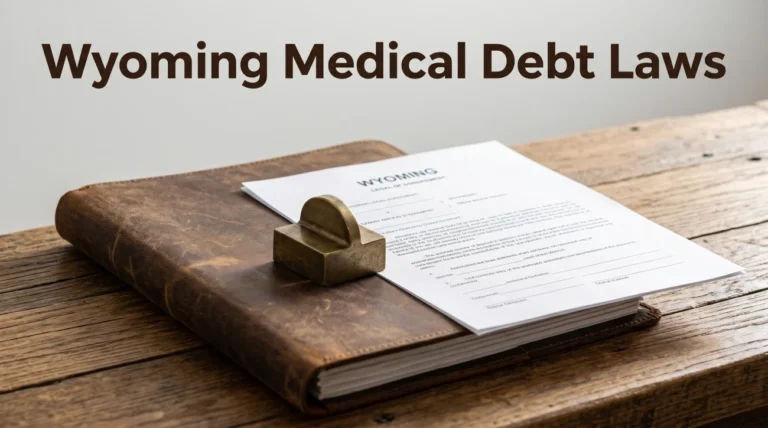

- The Wyoming medical debt statute of limitations is 8 years, giving collectors one of the longest windows in the country to file a lawsuit against you.
- Making a partial payment or acknowledging an old debt in writing can reset this 8-year clock entirely back to day one.
- Despite the long timeline to sue, Wyoming offers strong property and wage exemptions that severely limit what a collector can actually take if they win a judgment.
- Because wage garnishment and property liens are difficult to execute in Wyoming, patients often have significant leverage to negotiate a settlement out of court.
The Wyoming 8-Year Medical Collection Window
Navigating the Wyoming medical debt statute of limitations requires understanding a massive contradiction in the state’s legal code. On one hand, Wyoming grants creditors 8 years to file a lawsuit over a written contract. This is the third-longest collection window in the entire country. On the other hand, Wyoming provides robust asset and wage exemptions that make actually extracting money from a patient incredibly difficult.
I have spent years working inside hospital billing departments, reviewing accounts, and interacting directly with the third-party collection agencies that purchase old medical debt. One of the most consistent patterns I see is how out-of-state collection agencies use the threat of an 8-year timeline to panic patients. They emphasize how much time they have to sue you, but they intentionally leave out how thoroughly Wyoming law protects your paycheck and your home if they actually do take you to court.
Understanding exactly how long a collector has to sue you, how that 8-year clock is calculated, and what assets are legally protected is the foundation of your defense strategy. If you are dealing with an aggressive collection agency over an aging hospital bill in Wyoming, you need to know exactly where the collector’s power ends and your legal leverage begins.
The Heavy Burden of a Long Timeline
There is a unique kind of dread that accompanies medical debt in a state with a long legal window. You go to the hospital for an unexpected emergency, and after the confusing insurance adjustment process finally settles, you receive a balance you cannot afford. You might ignore it out of sheer overwhelm, and the account goes quiet. Five or six years pass, and you naturally assume the hospital wrote it off or the issue was resolved. Then, a highly formal letter arrives from an agency you have never heard of, demanding immediate payment and suddenly threatening your current financial stability with a crisis from half a decade ago.
Defining the 8-Year Legal Window
The statute of limitations is the absolute legal deadline a creditor or collection agency has to file a formal lawsuit against you in civil court to force repayment. Once this specific time period expires, the debt becomes legally classified as “time-barred.”
In Wyoming, the statute of limitations for medical debt is 8 years under Wyo. Stat. § 1-3-105. Medical bills are overwhelmingly treated as written contracts in the state (based on the admission paperwork you sign at the hospital), which places them firmly under this extended 8-year window.
Eight years is a massive amount of time in the collection industry. It allows an agency to sit on a dormant account without any urgency. They often wait for the broader economy to improve, or for an indicator on your credit report to show that you have secured a mortgage or a better-paying job, before they decide the account is finally worth the cost of filing a lawsuit.
“When I handled collections liaison work, I saw agencies intentionally park accounts in states with long timelines. They wait until year six or seven, hoping the patient feels safe and has built up enough savings to make a bank levy profitable. The 8-year window gives collectors the luxury of extreme patience.”
How to Calculate the Clock Start Date
Knowing that the window is 8 years is only half the battle. You also need to know the exact day the timer began. Collectors will frequently try to calculate this date in a way that benefits their timeline, but the law requires specific triggers.
The clock typically starts on the date of your last payment or the date the debt first became officially delinquent, whichever is most recent. To figure out this exact date, do not ask the collection agency over the phone. Instead, pull your free credit report and look for the “date of first delinquency” listed on that specific tradeline. Alternatively, you can request the original itemized billing statement directly from the hospital to verify the date of service and the last recorded payment.
If you need to understand how this specific 8-year period compares to what patients face in neighboring regions, you can review the standard medical debt statute of limitations rules that outline the federal framework for collection timelines across the country.
The Severe Danger of Resetting the Clock
One of the most critical administrative mistakes a patient can make in Wyoming is unintentionally resetting the statute of limitations. When you are dealing with an aggressive, highly trained collector on the phone, the natural human instinct is to try to make them go away by offering a tiny token payment.
📌 Note: If a debt is 7 years old and you make a single $20 payment just to get the collector to stop harassing your cell phone, you do not just owe the remaining balance; you have likely reset the 8-year clock entirely back to day one.
This exact scenario creates what the debt collection industry calls “zombie debt.” It is an old, nearly uncollectible account that is suddenly brought back to life because the patient made a partial payment or signed a written acknowledgment that the debt is valid. Before you agree to any payment plan on a historically old medical bill, you must verify exactly how old the delinquency actually is.
Answering a call from a collector about a 6-year-old hospital bill and saying, “I know I owe this bill, but I only have $50 right now. Let me send that to you so you stop calling my job.”
Stating clearly, “I do not acknowledge this debt. Send me written validation of the account, including the date of the original service and the exact date of the last payment on record.”
Script: Requesting Written Validation
If you are contacted about an aging account, you need to demand absolute proof of the debt without accidentally taking ownership of it. You can send a formal written validation request. Keep your language completely neutral and clinical.
To Whom It May Concern:
I am writing in response to your communication regarding account number [Insert Account Number]. I do not acknowledge this debt, nor do I admit to any legal liability for it.
Under federal law, I am requesting full validation of this account. Please provide the name of the original medical creditor, the date of the original medical service, a complete itemized statement of the charges, and the exact date of the last payment or account activity on your record.
Until this debt is fully validated in writing, I request that you cease all further collection activity.
Sincerely,
[Your Name]
The Dangerous 7-to-8 Year Credit Report Gap
Because Wyoming’s lawsuit window stretches to 8 years, it creates a unique and dangerous blind spot for patients regarding their credit reports.
Under the federal Fair Credit Reporting Act (FCRA), medical debt can only remain on your credit report for 7 years. This means that in year seven, the collection account will automatically vanish from your Equifax, Experian, and TransUnion files. Your credit score will likely rebound, and you will look perfectly clean on paper to new lenders.
However, the statute of limitations does not expire at year seven. Collectors still have one full year to file a lawsuit against you. Many patients in Wyoming mistakenly assume that because the debt is off their credit report, they are safe from any legal action. Collectors know this, and they will absolutely file a lawsuit in year eight, catching the patient completely off guard.
Navigating Time-Barred Debt in Wyoming
If the full 8-year window passes and you have successfully avoided resetting the clock, the debt safely becomes time-barred. This legal status does not mean the debt magically disappears from the hospital’s internal ledgers, nor does it mean the collector has to formally forgive the balance. It simply strips the collection agency of their most powerful weapon (the civil court system).
Once the Wyoming medical bill statute of limitations expires, a collector can no longer successfully sue you to obtain a judgment. If they actively threaten to sue you over a debt they know is time-barred, they are committing a direct violation of the federal Fair Debt Collection Practices Act (FDCPA).
However, they can still legally call you or send letters asking you to pay voluntarily. If you find that an agency is using aggressive or misleading tactics regarding an expired account, you should look into using privacy rules to dispute improper collection tactics to force the agency to close your file.
But what if the 8-year clock has not expired yet, and the collector actually follows through on their threat to sue? This brings us to why collectors often hesitate to take that step in Wyoming.
The Wyoming Contradiction: Strong Exemptions
If a collector has 8 years to sue you, why do they often agree to settle accounts for pennies on the dollar? The answer lies in Wyoming’s property and wage exemptions. A court judgment is just a piece of paper; to turn that paper into cash, the collector has to seize your assets. Wyoming law makes that exceedingly difficult.
Even if a collector sues you within the 8-year window and wins, state and federal laws protect the assets you need to survive.
Wage Garnishment Limits
Wyoming defaults to the federal baseline for wage garnishment. This means 75% of your disposable earnings are strictly exempt from garnishment. A collector can only legally request up to 25% of your take-home pay. For families living paycheck to paycheck, pulling 25% out of a salary is a painfully slow recovery method for a debt collector.
The Homestead Exemption
Your primary residence is heavily protected in Wyoming. The state offers a homestead exemption that protects up to $25,000 of equity in your home for a single filer, and up to $50,000 for a married couple filing jointly. Because of these limits, it is exceptionally rare and legally complex for a medical debt collector to force a foreclosure on a primary residence in Wyoming.
Personal Property Exemptions
Wyoming also protects a vehicle up to $5,000 in equity, up to $4,000 in clothing and household furniture, and up to $4,000 for the tools of your trade per person. A collector cannot show up at your house and take your couch or your work truck to satisfy a hospital bill.
Key Point: Out-of-state collectors rely on the intimidation of the 8-year lawsuit window, but they fear Wyoming’s strong exemptions. If you have no unprotected assets, you are considered “judgment proof,” rendering their lawsuit completely useless.
What a Collector Can Realistically Reach
Because taking your home is practically impossible and taking your wages is a slow drip, collectors holding Wyoming medical debt look for the path of least resistance. The most vulnerable asset you possess is typically a standard checking or savings account.
If a collector wins a judgment, they can request a bank levy. Unlike wage garnishment (which is capped at 25%), a bank levy allows a collector to freeze and seize funds directly from your account, up to the full amount of the judgment. While funds like Social Security and VA benefits are federally protected from levies, mixing those funds with standard payroll deposits can create a messy legal battle to unfreeze your money.
This reality dictates the collector’s behavior. They know lawsuits are expensive and collecting on a judgment in Wyoming is restricted by broad exemptions. Because their legal path to your money is obstructed, they are often highly motivated to discuss options for resolving a delinquent medical balance for a significantly reduced lump sum out of court.
Costly Mistakes During the 8-Year Window
Surviving an 8-year collection window requires strict administrative discipline. Over the years, I have watched patients make simple procedural errors that handed all their legal leverage right back to the collection agency. Avoid these common operational missteps:
- ❌ Ignoring a court summons. If you receive an official summons to appear in a Wyoming court, you absolutely must respond, even if you know with certainty the debt is 10 years old. The statute of limitations is an affirmative defense, meaning you must show up and explicitly tell the judge the time has expired. If you stay home, the collector wins an automatic default judgment.
- ❌ Taking legal advice from the collector. The representative calling you is highly trained to maximize financial recovery. They will quote the 8-year timeline to scare you, but they will never tell you about the homestead exemption protecting your house.
- 📋 Failing to log collector communications. Every single time an agency calls, write down the date, the exact time, the name of the representative, and what they demanded. If they threaten to sue you on an account that is 9 years old, your call log is the evidence required to file a federal complaint.
- ❌ Assuming the hospital coding was correct. Just because a medical bill survived in the system for seven years does not mean the clinical coding was accurate. Always demand the complete itemized statement before discussing any payment terms.
The documentation formula for handling aging medical debt is straightforward, but it requires absolute consistency:
- Demand all proof in writing.
- Save every postmarked envelope to track exact timelines.
- Never acknowledge the balance verbally.
Your Wyoming Medical Debt Defense Strategy
Handling a medical collection account in Wyoming requires balancing the incredibly long 8-year timeline against the state’s robust consumer asset protections. Before you negotiate, pay, or promise anything to a collector, you must force them to provide written proof that the account is legally yours and still within the 8-year lawsuit window.
If the account is valid, you can use Wyoming’s property and wage exemptions as massive negotiation leverage. Collectors know that securing a judgment is only the first step; enforcing it against protected assets is a miserable process for them. Use that difficulty to push for a favorable settlement.
To fully understand your standing, you must look at both state and federal rules. While checking out a resource comparing medical lawsuit deadlines across the country provides valuable national context, mastering your local protections is critical. Reviewing the full scope of state medical debt protections alongside specific Wyoming medical debt laws is essential for understanding exactly what collectors can and cannot do to your finances.
❓ FAQ
📅 How long is the statute of limitations on medical debt in Wyoming?
In Wyoming, the statute of limitations for medical debt is 8 years. This lengthy timeline applies to written contracts, which covers nearly all standard hospital billing agreements and clinic invoices.
🛑 Does a medical bill simply expire after 8 years in Wyoming?
The actual debt does not disappear or expire. However, once 8 years have passed since your last payment or the date of delinquency, the collector permanently loses the legal right to sue you in court to force repayment.
💸 Can paying $10 restart the clock on an old Wyoming medical bill?
Yes. Making any partial payment, even a tiny amount, will completely reset the 8-year statute of limitations back to the first day. Never make a token payment on an old bill without verifying the timeline first.
🛡️ How much of my paycheck is protected from garnishment in Wyoming?
Wyoming follows the federal default rule, which protects 75% of your disposable earnings from garnishment. A collector who wins a judgment can only take a maximum of 25% of your take-home pay.
🏠 Can a collection agency take my house for a medical bill in Wyoming?
It is highly unlikely. Wyoming provides a homestead exemption that protects up to $25,000 of equity for a single person (or $50,000 for a married couple), making it exceptionally difficult for collectors to force a foreclosure over a medical debt.
🏛️ Do I still have to appear in court if the debt is 9 years old?
Yes. The statute of limitations is an affirmative defense. If a collector files a lawsuit, you must appear in court to prove the 8-year window has expired. If you ignore the summons, the collector will win by default.
📞 Are collectors allowed to call me after the 8 years have passed?
Yes, collection agencies can still legally contact you to request voluntary payment on time-barred debt. However, federal law prohibits them from threatening lawsuits or wage garnishment once the statute has expired.
📉 How long does medical debt stay on my credit report in Wyoming?
Medical debt credit reporting is governed by federal rules. Unpaid medical debt over certain limits can stay on your report for up to 7 years. Because Wyoming’s lawsuit window is 8 years, you could face a lawsuit even after the debt falls off your credit report.
✉️ How do I force an aggressive collector to stop calling my job?
You can mail a formal “cease and desist” letter via certified mail. Under the federal Fair Debt Collection Practices Act (FDCPA), once a third-party collection agency receives this written request, they are legally required to stop contacting you.
🏦 Can a medical debt collector in Wyoming freeze my bank account?
Yes. If a collector successfully sues you within the 8-year window, they can request a bank levy to freeze your checking or savings account. Bank levies are often easier for collectors to execute than wage garnishments.
Medical Debt Laws
The state-by-state legal framework that determines how long collectors can pursue you.
- State-by-state: statute of limitations, collection limits, and consumer protections
- California Medical Debt Statute of Limitations: The 4-Year Rule Explained
- Maryland Medical Debt Statute of Limitations: 3 years
- Idaho Medical Debt Laws: Statute of Limitations and Collection Rules
- State Medical Debt Laws: What Your State Adds Beyond Federal Protections
Turning Legal Knowledge Into Action
State law gives you leverage. These pages explain how to use it.
- How federal HIPAA law creates leverage you can use against a medical debt collector
- Your legal right to negotiate any medical bill and what providers cannot refuse
- How to settle medical debt within the window your state laws still allow
- How debt relief programs interact with your state collection laws and protections
- Removing medical debt from your credit report under the current federal reporting rules
Disclosure: The content on this site reflects direct experience inside hospital billing and medical debt collection, and is grounded in federal law and regulation. It is informational in nature. Reading it does not constitute legal advice and does not create any professional relationship. If you are facing a lawsuit, a judgment, or a legal deadline, consult a licensed attorney in your state before taking action.