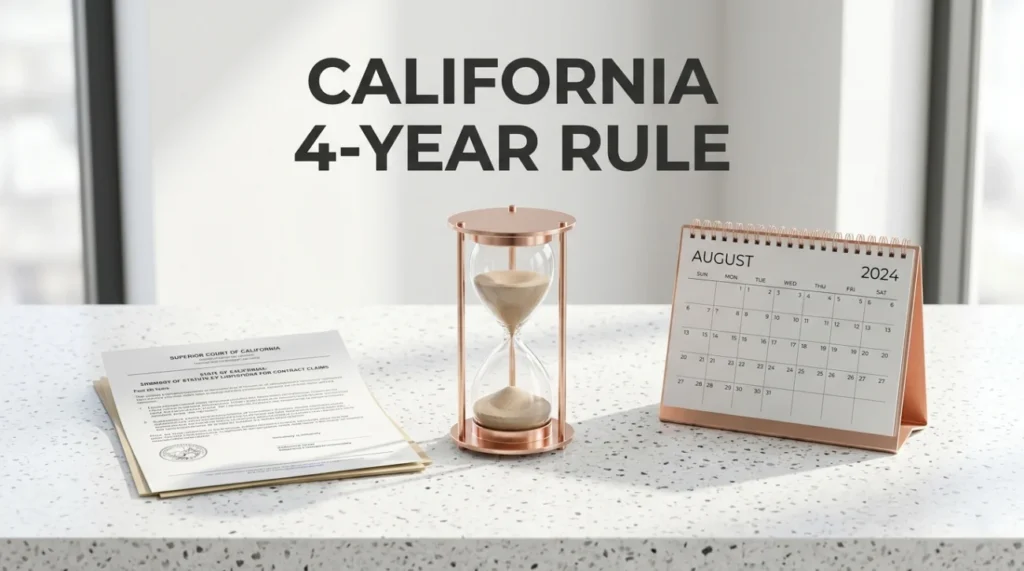
- The California medical debt statute of limitations is generally 4 years from the date of your last payment or first delinquency.
- California offers a unique protection: a verbal promise to pay does not restart the legal clock on your debt. Only a written agreement or a partial payment will reset it.
- Under the Rosenthal Act, California hospitals and original creditors are held to the same strict collection rules as third-party debt collectors.
- As of 2025, medical debt cannot be reported on your credit file in California, removing one of the primary threats collectors use.
Understanding California’s 4-Year Legal Window
When an old hospital bill resurfaces years after you received treatment, the immediate reaction is usually panic. Having worked inside hospital billing departments and handled accounts as they moved through the collection cycle, I know exactly why these letters are sent. They rely on the fact that most patients do not know how the California medical debt statute of limitations protects them.
California is uniquely consumer-friendly for two distinct reasons: the legal window to sue you is significantly shorter than in most states, and a law called the Rosenthal Act makes original hospitals play by the exact same strict rules as third-party debt collectors. Understanding this specific 4-year timeframe and your state rights is the first step when a debt buyer tries to collect on an account that has legally expired.
The Confusion of Outdated Collection Notices
The most common point of frustration for patients happens around the five-year mark. You visit an emergency room, deal with the insurance paperwork, pay what you think is your portion, and move on. Years later, a third-party debt buyer purchases a massive portfolio of old, unpaid accounts from that hospital for pennies on the dollar. Suddenly, your phone is ringing.
This is where the information imbalance works against you. The person calling you sounds authoritative, sometimes implying that a lawsuit is imminent. When caught off guard, human nature makes you want to resolve the conflict immediately to make the harassment stop. But in the billing world, engaging the wrong way can revive a dead account.
“From my side of the screen reviewing account histories, the saddest notes to read were from patients who had successfully aged out a debt, only to panic when a secondary collection agency called. By paying just $25 to get the collector off the phone, they unintentionally reset the entire legal clock, turning a dead account back into an active liability.”
Before you engage with any collector regarding an old bill, you must understand exactly where you stand under state law. If you are exploring a safe approach to resolving an account, your leverage changes completely depending on whether the legal window has closed.
The 4-Year Baseline: Code of Civil Procedure 337
In California, the statute of limitations on written contracts is four years, governed by California Code of Civil Procedure (CCP) Section 337. Because almost all hospital admissions and clinical visits require you to sign financial responsibility paperwork before receiving care, medical bills are classified as written contracts.
This means a collector has exactly four years to file a lawsuit against you to obtain a court judgment. Once that window closes, the debt becomes what is known as time-barred. The debt does not simply disappear, but the legal mechanism to force you to pay through wage garnishment or bank levies is permanently removed.
If you are looking at state-level medical debt protections across the United States, a four-year window is on the shorter end of the spectrum, providing California residents with significant shelter from aggressive litigation on old accounts.
When Does the Clock Actually Start?
Knowing that you have four years is helpful, but the most disputed aspect of any old account is determining day one. When evaluating a statute of limitations on medical debt, California billing rules do not start the clock on the day you received the medical treatment.
Instead, the clock generally begins on the date the debt first became delinquent or the date of your last payment, whichever is later. From a hospital billing perspective, this is usually 30 days after the first statement is generated and mailed to you indicating a patient-responsible balance.
- 📌 Date of Service: Not the start date. Insurance processing can take months.
- 📌 Insurance Adjustment: Not the start date. This is an administrative step between the provider and the payer.
- 📌 First Statement Due Date: This is typically the trigger. If the bill is due on October 1st and you do not pay, October 2nd is day one of the delinquency.
- 📌 Last Partial Payment: If you made a $50 payment six months later, the four-year clock restarts entirely from the date that specific payment was processed.
If you are trying to piece together the timeline, never rely on the date a collection agency acquired the account. Debt buyers often try to use the date they purchased the portfolio to make the debt look newer than it is. You must always trace the timeline back to the original hospital ledger.
The California Advantage: Protecting Against Accidental Resets
In many parts of the country, simply answering the phone and saying “I know I owe it, I just cannot pay right now” is enough for a collector to claim you acknowledged the debt and reset the timeline. This is a common trap for patients who are just trying to be polite.
California provides a massive shield against this tactic. Under CCP Section 360.5, a verbal promise to pay is not sufficient to restart the statute of limitations. To revive a time-barred debt based on acknowledgment in California, the acknowledgment must be in writing and signed by the debtor.
Assuming that because you admitted to the debt on a recorded phone call, the collector has legally revived the account and can now sue you.
Knowing your rights under California CCP Section 360.5: a verbal promise alone does not restart the legal timeline. Only a written agreement or a new partial payment will trigger a reset.
While understanding how the statute of limitations works federally is important, this specific written-requirement rule is what saves many California residents from predatory debt buyer tactics. Furthermore, while CCP Section 360.5 protects you from accidental verbal resets with debt buyers, California goes a step further by applying strict rules to the original hospitals themselves.
The Rosenthal Act: Holding Hospitals Accountable
There is a massive loophole in federal consumer protection law. The Fair Debt Collection Practices Act (FDCPA) prevents third-party debt collectors from using abusive, deceptive, or unfair practices. However, the federal FDCPA generally does not apply to original creditors. This means a hospital’s internal billing department can often get away with aggressive tactics that a standard collection agency cannot.
California closed this loophole with the Rosenthal Fair Debt Collection Practices Act. Under the Rosenthal Act, original creditors are held to the same standards as third-party debt buyers. If a hospital billing representative calls you relentlessly at work, uses profane language, or threatens legal action they do not intend to take, they are violating state law just as much as a shady collection agency would be.
If you are experiencing harassment from either a hospital or an agency, especially regarding an expired debt, you might need to look into using privacy rules to stop aggressive tactics and hold the facility accountable for improper disclosures.
The 2025 Credit Reporting Ban
When a debt collector realizes a debt is past the California medical bill statute of limitations, they know they cannot sue you. Historically, their backup weapon was your credit report. They would park the unpaid bill on your credit file, knowing that eventually, you would try to buy a car or rent an apartment, and the underwriter would force you to pay the old medical bill to get approved.
As of 2025, California has prohibited medical debt from being reported to consumer credit bureaus. This legislation fundamentally changes the leverage dynamics. If an old medical debt cannot be reported to your credit file, and it is too old for a lawsuit, the collector is left with almost zero enforcement tools. Their only remaining option is to ask you nicely to pay it voluntarily.
What to Know When a Collector Contacts You
If you receive a letter or phone call regarding a medical bill that you suspect is older than four years, a disciplined approach is helpful. While ignoring correspondence within the first 30 days is risky (as it can result in the collector assuming the debt is valid), engaging in long phone debates is rarely beneficial.
A common strategy patients use to protect their timeline is keeping the conversation brief: answering the call, stating they only communicate in writing, requesting the agency’s mailing address, and hanging up.
Once you have their address, you can send a written request for debt validation. If you are certain the debt is beyond the four-year mark based on your own records, some consumers choose to send a specific cease communication letter regarding the time-barred account.
Subject: Written request to cease communication regarding time-barred debt
To Whom It May Concern,
I am writing in response to your recent communication regarding account number [Insert Number]. I am formally requesting that you cease all communication with me regarding this account.
Furthermore, based on my records, the statute of limitations on this account has expired. I will not be making any payments on this time-barred account, nor do I acknowledge any validity to this balance.
Any further attempts to collect this expired debt, or any threats of litigation regarding this account, will be documented as a violation of my consumer rights.
Sincerely,
[Your Printed Name – Do Not Sign with a Pen]
⚠️ Warning: Never physically sign a letter to a debt collector with a pen. Type your name. Unscrupulous agencies have been known to lift signatures to use on forged payment agreements.
Final Thoughts: Protecting Your Financial Future
Navigating old hospital accounts requires a calm and methodical approach. The four-year limit in California is a powerful shield, but it only works if you understand how to maintain it. Keep your records organized, never make panic payments on old accounts, and remember that verbal threats from a collector hold no weight if the legal window has closed.
If you have recently relocated or receive care out of state, comparing time limits across the country is essential, as the rules change the moment you cross state lines. However, as long as you are dealing with the full scope of California debt rules, you are operating in one of the safest consumer environments in the nation. Protect your timeline, demand everything in writing, and do not let artificial urgency dictate your financial decisions.
❓ FAQ
⚖️ Does a medical debt ever completely disappear in California?
Legally, the debt still exists even after the four-year statute of limitations expires. However, it becomes “time-barred.” This means the collector permanently loses the right to sue you in court or garnish your wages for that specific account.
📞 Can a debt collector still call me after 4 years have passed?
Yes, they can legally still contact you to ask for voluntary payment unless you send them a formal, written “cease and desist” letter. Once they receive that letter, federal law prohibits them from contacting you again regarding the debt.
📝 What if a collector sues me for a medical bill that is 5 years old?
You must respond to the lawsuit. If you ignore it, the collector can get a default judgment against you. You must file a response with the court stating that the debt is time-barred, which raises a statute of limitations defense against the collector’s claim.
💳 If I pay $10 on a massive old hospital bill, what happens?
In California, making even a partial payment on an expired debt legally restarts the entire four-year statute of limitations clock from the day that payment is processed. You should never pay a small amount just to get a collector to leave you alone.
🏥 Does the Rosenthal Act apply to my local California hospital?
Yes. Unlike federal law which only targets third-party agencies, California’s Rosenthal Act applies directly to the original creditor. The hospital’s own internal billing staff must follow the same strict fair debt collection practices as an outside agency.
📊 Can this old medical debt still drop my credit score?
No. Under new California state laws enacted in 2025, medical debt can no longer be reported to consumer credit bureaus, meaning it cannot negatively impact your credit score or appear on your credit report.
Medical Debt Laws
The state-by-state legal framework that determines how long collectors can pursue you.
- State-by-state: statute of limitations, collection limits, and consumer protections
- How Long Is the Statute of Limitations on Medical Debt? The Range and Rules
- Maine Medical Debt Statute of Limitations: The 6-Year Rule Explained
- Georgia Medical Debt Statute of Limitations and State Collection Rules
- State Medical Debt Laws: What Your State Adds Beyond Federal Protections
Turning Legal Knowledge Into Action
State law gives you leverage. These pages explain how to use it.
- How federal HIPAA law creates leverage you can use against a medical debt collector
- Your legal right to negotiate any medical bill and what providers cannot refuse
- How to settle medical debt within the window your state laws still allow
- How debt relief programs interact with your state collection laws and protections
- Removing medical debt from your credit report under the current federal reporting rules
Disclosure: The content on this site reflects direct experience inside hospital billing and medical debt collection, and is grounded in federal law and regulation. It is informational in nature. Reading it does not constitute legal advice and does not create any professional relationship. If you are facing a lawsuit, a judgment, or a legal deadline, consult a licensed attorney in your state before taking action.