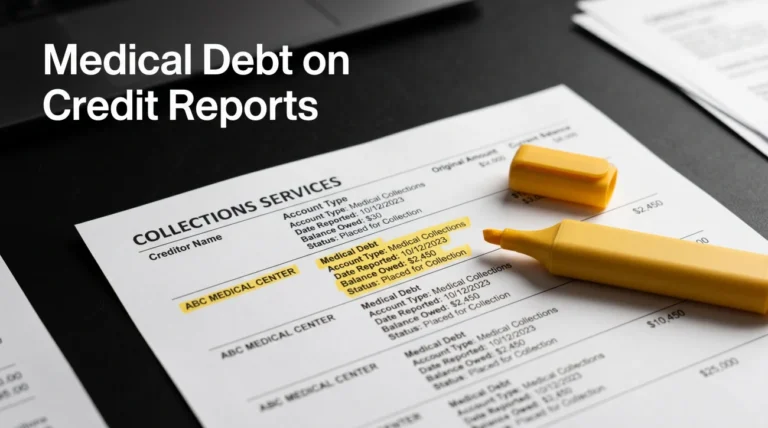

- Medical debt under $500 is not reported to credit bureaus. This is a voluntary policy adopted by Equifax, Experian, and TransUnion, not a federal law.
- The threshold is precise. A debt of exactly $500.00 is reportable. The balance must be strictly under $500 to be excluded from your credit report.
- Multiple small bills (like three $200 accounts) are protected individually. However, if a collector legally combines them into a single $600 account, the combined balance can be reported.
- The rule only protects your credit score. It does not forgive the debt, and collectors can still legally call you, send letters, and demand payment for sub-$500 balances.
- Even after the federal court struck down the CFPB medical debt rule in July 2025, this specific $500 threshold survived because it is an independent credit bureau policy.
The Hidden Mechanics of the $500 Threshold
If you are looking at a stack of small hospital bills and wondering how a $500 medical debt on credit report affects you, you are not alone. The rules around small medical balances have shifted significantly over the last few years, creating a massive amount of confusion for patients trying to protect their financial health.
From my time working inside hospital billing departments, I can tell you that the cutoff line between what damages your credit and what stays hidden is completely rigid. When a revenue cycle system exports unpaid accounts to a collection agency, the software does not care about your personal story. It looks at the balance. If your medical debt is under $500, the three major credit bureaus have agreed not to place it on your credit report, regardless of how long it has been sitting in collections.
However, this protection comes with several blind spots. Many patients misunderstand how the rule works when they have multiple small accounts or when collectors add interest. Understanding exactly what this threshold protects – and more importantly, what it leaves exposed – is critical if you want to navigate the complete landscape of medical debt credit reporting without making a costly mistake.
What the $500 Medical Debt Credit Report Rule Actually Is
To use this rule to your advantage, you first need to understand its legal foundation. Many people assume this protection is a federal law passed by Congress. It is not.
In 2022, the three major credit reporting agencies – Equifax, Experian, and TransUnion – voluntarily announced a joint policy change. They agreed that their systems would no longer accept or display medical collection accounts with an original balance under $500. While this is technically just a corporate policy, it carries the practical force of law because these three bureaus control virtually all consumer credit reporting in the United States.
This means if a collection agency tries to report a $350 emergency room co-pay to Experian, the bureau’s automated system will simply reject the data file. The collection agency cannot force the bureau to list it.
“When I reviewed accounts scheduled for collection transfer, the $500 line was absolute. Software automatically flagged anything $500.00 or above for credit reporting eligibility, while keeping everything $499.99 and below off the bureau export lists. Collectors know this, which changes how aggressively they pursue smaller balances.”
If you are trying to determine exactly how the reporting process operates from hospital to bureau, knowing that the bureaus act as a hard filter for these small balances is the most important piece of the puzzle.
The Borderline: What Happens at Exactly $500?
Patients frequently ask if their smaller balances are completely safe. The short answer is yes, but the exact wording of the policy matters deeply.
The policy specifically protects medical debt under $500. It does not say “$500 and under.”
If your statement shows a balance right at the $500 mark, you need to look at the exact pennies on your original bill. A balance of $499.99 is protected and will not appear on your credit report. A balance of exactly $500.00, or $500.01, crosses the threshold and becomes fully reportable (provided it has also been in collections for more than one year).
This precision is why you should never guess your balance. Always request an itemized statement from the original hospital or clinic to verify the exact amount before it went to collections.
The Multiple Account Trap: How Small Bills Get Reported
This is where the system catches most patients off guard. This sub-$500 protection applies to individual collection accounts, not to your total overall medical debt.
If you have three separate medical bills from the same hospital – one for $200, one for $150, and one for $180 – each account is evaluated independently. Since each individual balance is under the threshold, none of them should be reported to the credit bureaus.
However, there is a major loophole that collection agencies sometimes exploit. If the original hospital or the collection agency officially consolidates those three distinct bills into a single new account totaling $530 before attempting to report it, the combined balance now exceeds the $500 limit.
Ignoring multiple small bills from the same provider because you assume that since each is under $500, your credit is safe forever.
Keeping strict documentation of each distinct date of service and its original balance. If a collector tries to report a consolidated balance over $500, you can dispute the reporting by proving the original individual debts were below the threshold.
What Happens When Debt Under $500 Grows?
Another common scenario occurs when your original bill was under $500, but the collection agency adds fees or interest over time, pushing the total balance above the threshold.
Under the intent of the credit bureau policy, the original balance of the debt is what should determine threshold eligibility. If your original emergency room co-pay was $450, and a collector adds $75 in late fees bringing the total to $525, it generally should still be protected based on the original principal amount.
Furthermore, you should always question whether the collector has the right to add interest in the first place. Collectors do not automatically have the authority to inflate your balance with extra fees. You should check your original billing agreement to see if interest or collection penalties were actually part of the terms you signed. If they were not, those added charges may be invalid.
What the Threshold Does NOT Protect
If you are researching what amount of medical debt is reported to credit bureaus, it is easy to confuse a credit reporting protection with a collection exemption. They are entirely different things.
The $500 threshold does not forgive your debt. It does not wipe the slate clean. It only stops the debt from appearing on your Equifax, Experian, and TransUnion files.
Because the debt still legally exists, collection agencies can still engage in standard collection practices. They can call your phone, send demand letters to your home, and attempt to secure payment. Technically, they can even file a lawsuit against you to collect a $250 debt. In reality, the economics of litigation mean it is exceptionally rare for a collector to pay filing fees and attorney costs to sue someone over a sub-$500 balance, but they legally retain the right to do so.
Because these small accounts cannot be weaponized against your credit score, collectors have significantly less leverage. If a collector is crossing the line and harassing you over a small balance, you should evaluate how to use federal laws to force debt collectors to back down.
The 2025 Federal Rule Context
To fully understand your rights right now, you must understand what happened in the federal courts in 2025.
In January 2025, the Consumer Financial Protection Bureau (CFPB) finalized a massive federal rule that would have removed all medical debt from credit reports, regardless of the balance size. However, in July 2025, a federal court struck down this CFPB rule, meaning it is not currently in effect at the federal level.
This reversal caused widespread panic among patients who thought their protections were gone. But here is the crucial detail: the federal court struck down the CFPB rule, but it did not touch the voluntary credit bureau policies.
The protection for sub-$500 medical debt survived the 2025 legal battles because it was an independent corporate policy enacted by the credit bureaus back in 2022, completely separate from the CFPB’s mandate. If you are trying to verify what medical accounts are legally allowed to show on your report today, rest assured that the sub-$500 protection remains fully active.
🚨 The Confusion Point: Why Small Debts Still Cause Huge Problems
The biggest problem I see with the $500 threshold is that it creates a false sense of security. Many patients read a headline stating “medical debt under $500 is protected” and assume that means they can completely ignore the hospital bills.
When you ignore a $300 hospital bill, the credit bureau policy protects your credit score, but it does not stop the administrative machinery of the billing department. The hospital will still sell the account to a debt buyer. The debt buyer will still run your phone number through automated dialers. You will still receive threatening letters.
Worse, if you move and miss a notification, or if a collector improperly reports the debt anyway (which happens frequently due to automated software errors), you might not realize the account slipped onto your credit report until you are sitting in a bank trying to get a car loan.
You must actively monitor these accounts. If you find a sub-$500 medical collection that somehow made it onto your Equifax, Experian, or TransUnion report, you need to run a thorough legitimacy check on your credit file to prepare your dispute.
Taking Action on Small Medical Balances
If you have medical debt under $500 in collections, you are in a relatively strong position. Your credit score is insulated by the bureaus’ voluntary policy, which removes the collector’s most powerful threat.
Your response strategy for these accounts should be calm and methodical. You do not need to panic-pay a collector just to protect your credit. Instead, demand written validation of the debt, verify that the original balance was genuinely under the threshold, and keep all documentation. If an agency violates the policy and reports the small balance anyway, you have the right to force the removal of the medical debt from your credit report by disputing it directly with the credit bureaus, citing their own established policy.
❓ FAQ
📉 Will a $450 medical bill drop my credit score?
No. Under the current policies of Equifax, Experian, and TransUnion, medical collection accounts with an original balance under $500 are not reported to your credit file and therefore will not impact your credit score.
📞 Can debt collectors still call me for a $200 medical bill?
Yes. The $500 threshold only prevents the debt from being reported to credit bureaus. It does not erase the debt, and collectors can legally continue to call and send letters to request payment.
⚖️ Does exactly $500 count under the credit reporting protection?
No. The policy explicitly protects medical debt “under” $500. If your original balance is exactly $500.00, it is eligible to be reported to the credit bureaus once it has been in collections for more than one year.
➕ If a collector adds late fees to a $400 bill, can it be reported?
Generally, no. The credit bureau policy is based on the original balance of the debt. If the original medical bill was under $500, a collector adding fees or interest should not make the account reportable.
🏥 Do multiple small hospital bills get combined to cross the $500 limit?
They should not be. Each distinct medical account is evaluated individually. Three separate $200 accounts are all protected. However, if a collector formally consolidates them into a single new account, you may need to dispute the reporting by showing the original separate balances.
🏛️ Did the July 2025 court ruling eliminate the $500 protection?
No. The federal court struck down a broad CFPB rule, but the $500 threshold survived because it is an independent, voluntary policy enacted by the credit bureaus themselves in 2022.
📝 What should I do if a $300 medical bill shows up on my credit report?
You should immediately file a dispute directly with the credit bureau (Equifax, Experian, or TransUnion) that is displaying it. Cite their own policy that medical debt under $500 must not be reported, and provide proof of the original balance.
Medical Debt and Credit
How medical debt affects your credit and what the current rules allow you to do about it.
- How medical debt gets reported, what the current rules allow, and what protects you
- Which States Ban Medical Debt From Credit Reports? The Complete Landscape
- New Law Medical Debt Credit Report: What Has Passed and What Failed
- Why Is Medical Debt on My Credit Report? What Put It There and What You Can Do
- Medical Debt on Credit Report in 2025 and 2026: What Changed, What Didn’t, and Where Things Stand
Fixing the Credit Damage
Understanding the rules gives you context. These pages cover what to actually do with it.
- How a HIPAA violation in the collection process can lead to removing an account from your report
- Negotiating the underlying bill to reduce the balance that is currently affecting your credit
- Settling the collection account that is pulling down your credit score
- Relief programs that can resolve the collection accounts currently appearing on your report
- The removal methods that actually work under the current credit reporting rules
Disclosure: The content on this site reflects direct experience inside hospital billing and medical debt collection, and is grounded in federal law and regulation. It is informational in nature. Reading it does not constitute legal advice and does not create any professional relationship. If you are facing a lawsuit, a judgment, or a legal deadline, consult a licensed attorney in your state before taking action.