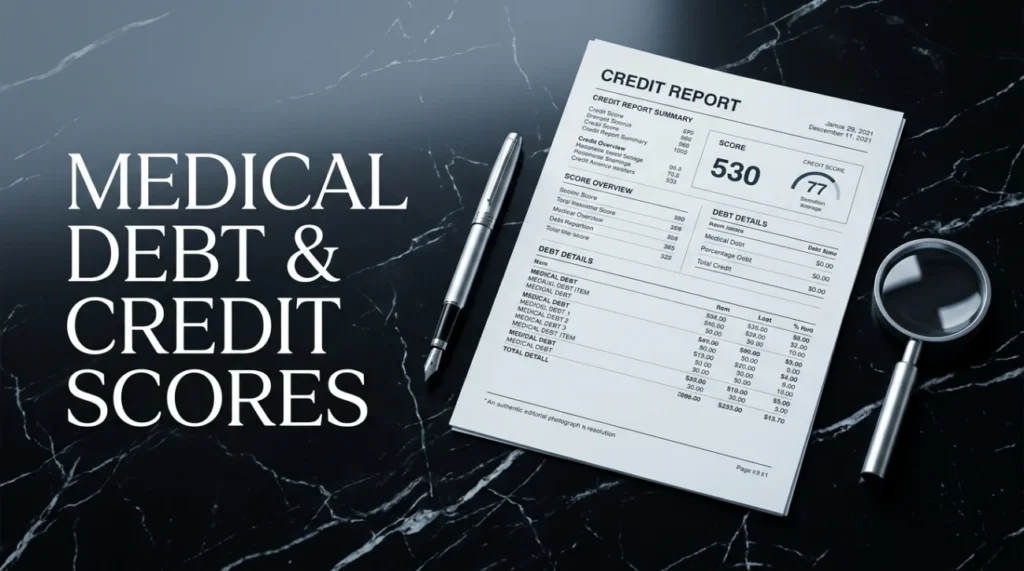
- The impact of a medical collection on your score is not a simple yes or no. It depends heavily on which FICO model a lender is using to check your credit.
- Mortgage lenders typically use older scoring models (like FICO 8) which still penalize you heavily for medical collections, while newer models (FICO 9 and 10) are more forgiving.
- A medical collection can drop an excellent credit score by 50 to 75 points, while someone with an already low score might see a drop of less than 25 points.
- Since April 2023, paying a medical collection removes it from your credit report entirely. This is a massive shift from how other types of debt are handled.
The Reality of Medical Collections and Your Credit
If you have an unpaid hospital bill that has been sent to an agency, the first question you likely have is: will medical debt affect credit score calculations? The short answer is yes, medical debt in collections can and does lower your score. But the extent of that damage varies widely based on factors that most people, and even some loan officers, do not fully understand.
When I was reviewing accounts inside hospital billing departments, I frequently spoke with patients who were terrified that a single medical bill was going to destroy their financial life forever. On the flip side, I also spoke with patients who assumed new laws meant medical debt could no longer hurt them at all. Neither extreme is entirely accurate.
The reality is that how much a medical collection hurts you depends on your starting score, the age of the debt, and most importantly, the specific algorithm a lender uses to look at your profile. Let us break down exactly how this works and what you can expect.
Factor 1: The Credit Model Your Lender Uses
To understand if will medical debt affect my credit score, you first have to understand that you do not have just one credit score. You have dozens. Different lenders pull different versions of your FICO score depending on what kind of credit you are applying for.
Newer scoring models, specifically FICO Score 9 and FICO Score 10, were designed to be more forgiving of medical debt. In these newer models, medical collections carry significantly less weight than non-medical collections like a defaulted credit card. If you are applying for a personal loan or a new credit card, the lender might use one of these newer models.
“A common trap I see patients fall into is reading online that ‘medical debt doesn’t hurt your credit anymore’ because of FICO 9. They relax, ignore the collection, and then go to apply for a house. That is when they hit a brick wall.”
Here is why: the mortgage industry moves slowly. Most mortgage lenders are still required to use older scoring models, primarily FICO Score 8. And FICO 8 treats a medical collection exactly like any other collection. It does not give you a discount because the debt was for an emergency room visit instead of a shopping spree. If you are trying to buy a house, that medical collection is going to be a major obstacle under FICO 8.
⚠️ Warning: Never assume a medical collection is harmless just because you heard about new scoring models. Always ask your lender which version of your FICO score they will be pulling before you apply.
Factor 2: Your Starting Score Before the Collection
People constantly ask: how much does medical debt affect credit score exactly? The math behind credit scoring is complex, but one of the most reliable rules is that the higher your score is before the collection hits, the harder it will fall.
Credit scoring models evaluate risk. If you have a pristine 780 credit score with no missed payments, a new collection account is a massive red flag that your financial situation has suddenly changed. The algorithm reacts aggressively. If your score is already a 620 with multiple late payments, a new medical collection just confirms what the algorithm already thinks, so the point drop is smaller.
| Starting Credit Profile | Estimated FICO 8 Point Drop |
|---|---|
| Good to Excellent (700+) | 50 to 75+ points |
| Fair (640 – 700) | 25 to 50 points |
| Poor (Below 640) | Less than 25 points |
Factor 3: The Balance Amount
The balance of the collection also matters, though not as much as you might think. A $5,000 medical collection will generally have a slightly larger impact than a $600 collection. However, remember that under current voluntary bureau policies, medical debt under $500 is not reported at all. If a collector is threatening to report a $250 lab bill, they are making an empty threat under current reporting standards. You can read our full breakdown of the current rules for medical debt on credit reports to see exactly what balances are protected.
Factor 4: The Recency of the Collection
Will medical collections affect credit score calculations forever? No. The impact of a collection account diminishes over time. The algorithm cares most about what you have done recently.
A medical collection that was added to your report two months ago is going to drag your score down to its maximum potential. However, as that collection ages, its weight in the calculation decreases. A collection that is four or five years old has significantly less impact on your current score than a brand new one, even though both are technically still visible on your report.
This is why understanding the worst-case credit scenarios requires looking at the timeline. It takes a severe, recent hit to completely derail an otherwise healthy credit profile.
Factor 5: The Game-Changing 2023 Payment Rule
If there is one piece of operational reality you need to know about how does medical debt affect your credit score today, it is this: paying a medical collection now erases the damage.
Before April 2023, if you paid a medical collection, the credit bureaus would simply update the status to “paid collection.” A paid collection still dragged down your score. It looked slightly better to a manual underwriter, but the algorithm still penalized you for having a collection at all.
That changed completely. The three major credit bureaus voluntarily agreed that paid medical collections will be removed from credit reports entirely. Not updated. Deleted.
You pay the collector. The account stays on your report for 7 years as a “paid collection” and continues to hurt your score.
You pay the collector. The collector notifies the bureaus, and the entire account is wiped from your report, allowing your score to bounce back.
This means the traditional “pay for delete” negotiation tactic, where you beg a collector to remove the tradeline in exchange for your money, is no longer necessary for medical debt. It happens automatically. You can review the exact timeline of how paid medical collections are treated if you are waiting for a recent payment to process.
⚠️ Warning: There is a crucial caveat here. The automatic removal policy applies strictly to accounts paid in full. If you negotiate a settlement, meaning you pay less than the full balance, the collection agency might just report it as “settled” instead of removing it entirely. Before you pay a settlement amount, explicitly confirm exactly how they will report the account.
When a Medical Collection is Blocking Your Mortgage or Lease
Knowing the mechanics of how scores are calculated is helpful, but understanding the rules means nothing if you are sitting across from a loan officer right now.
The most stressful calls I handled in the billing office were from patients who were told they could not close on a house because a two-year-old hospital bill had just popped up on their report.
When you are in this situation, wondering will medical debt in collections affect credit score enough to ruin a life event, time is your biggest enemy. You do not have months to wait for a collection to naturally age, and you cannot afford the FICO 8 penalty.
If a medical collection is actively blocking a major financial step, you have two distinct paths:
- 📌 Path 1: The fast removal via payment. If you have the funds, paying the debt will trigger the automatic removal policy mentioned above. If you need step-by-step guidance on this process, see our instructions on how to urgently remove a medical collection.
- 📌 Path 2: The dispute for errors. If the debt is not yours, the balance is wrong, it was billed to insurance incorrectly, or it is under $500, you should not pay it just to make it go away. You need to dispute it directly with the credit bureaus.
Before you hand over money out of panic, take a breath and check whether the collection is actually legitimate. If you find discrepancies, or if you believe the collector shared more medical information than necessary to validate the debt, you may want to check for reporting violations that could force a deletion without you having to pay an invalid bill.
Final Thoughts: Controlling the Damage
Medical debt collections affect credit score calculations, but they are no longer a permanent financial death sentence. The impact is significant if you are dealing with older mortgage scoring models, but time naturally lessens the blow.
If you are looking at your credit report right now and seeing a medical collection, do not assume you just have to live with a suppressed score. Take the time to understand your overall medical debt credit score impact, verify the account’s legitimacy, and focus your energy on the removal paths that actually work.
❓ FAQ
📉 How many points will my credit score drop for a medical collection?
It depends on your starting score. An excellent score could drop 50 to 75 points or more under FICO 8. If your score is already low, the drop might be 25 points or less because the algorithm has already factored in your credit risk.
🏠 Does medical debt affect buying a house?
Yes. Most mortgage lenders use older credit scoring models, like FICO Score 8, which still heavily penalize medical collections. A new collection can lower your score enough to increase your interest rate or deny you the loan.
💳 Will medical debt ruin my credit forever?
No. By federal law, collection accounts must be removed 7 years from the date you first went delinquent. Additionally, the impact on your score decreases significantly as the account ages, long before it falls off completely.
💵 If I pay the medical collection, does my score go back up?
Yes. Thanks to a 2023 policy change by the three major credit bureaus, paid medical collections are completely removed from your credit report. Once it is removed, your score will recover as if the collection was never there.
🏥 Can a hospital put a bill on my credit report right away?
No. Hospitals rarely report directly to credit bureaus. They send it to a collection agency. Even then, the bureaus have a 1-year grace period rule, meaning the agency cannot report the debt until it has been in collections for at least a full year.
⚖️ Does a $200 medical bill hurt my credit score?
It should not. The credit bureaus instituted a policy in 2022 that medical debt under $500 is no longer reported to credit files. If a sub-$500 balance is on your report, you should dispute it for immediate removal.
⏱️ How fast does my score improve after I pay a medical collection?
Once you pay the collection agency, it typically takes them 30 to 60 days to report the paid status to the credit bureaus. After the bureau processes it and removes the tradeline, you will see the score improvement.
🤷♂️ What if my medical debt went to collections but isn’t on my credit report?
This is common. It might be under the 1-year grace period, it might be under the $500 threshold, or the collection agency simply has not reported it yet. Not all collection agencies report to all three bureaus.
Medical Debt and Credit
How medical debt affects your credit and what the current rules allow you to do about it.
- How medical debt gets reported, what the current rules allow, and what protects you
- When Does Medical Debt Fall Off Your Credit Report? The Timeline You Need to Know
- Paid Medical Debt Credit Report Rules: What Happens When You Pay
- Can Medical Debt Ruin Your Credit? The Realistic Answer (Not the Scary One)
- When Does Medical Debt Get Reported to Credit Bureaus? The Exact Timeline
Fixing the Credit Damage
Understanding the rules gives you context. These pages cover what to actually do with it.
- How a HIPAA violation in the collection process can lead to removing an account from your report
- Negotiating the underlying bill to reduce the balance that is currently affecting your credit
- Settling the collection account that is pulling down your credit score
- Relief programs that can resolve the collection accounts currently appearing on your report
- The removal methods that actually work under the current credit reporting rules
Disclosure: The content on this site reflects direct experience inside hospital billing and medical debt collection, and is grounded in federal law and regulation. It is informational in nature. Reading it does not constitute legal advice and does not create any professional relationship. If you are facing a lawsuit, a judgment, or a legal deadline, consult a licensed attorney in your state before taking action.