- A billing department cannot overrule a doctor’s clinical judgment. If the doctor ordered a test based on what they thought was wrong, the bill is technically correct even if the diagnosis was later proven wrong.
- You can successfully challenge the bill only if the provider’s own records show the treatment was not medically necessary for the corrected diagnosis, or if the wrong medical code was used.
- If a wrong diagnosis resulted in physical harm or unnecessary surgery, that is a medical malpractice issue requiring legal counsel, not a standard billing dispute.
The Disconnect Between Clinical Errors and Hospital Billing
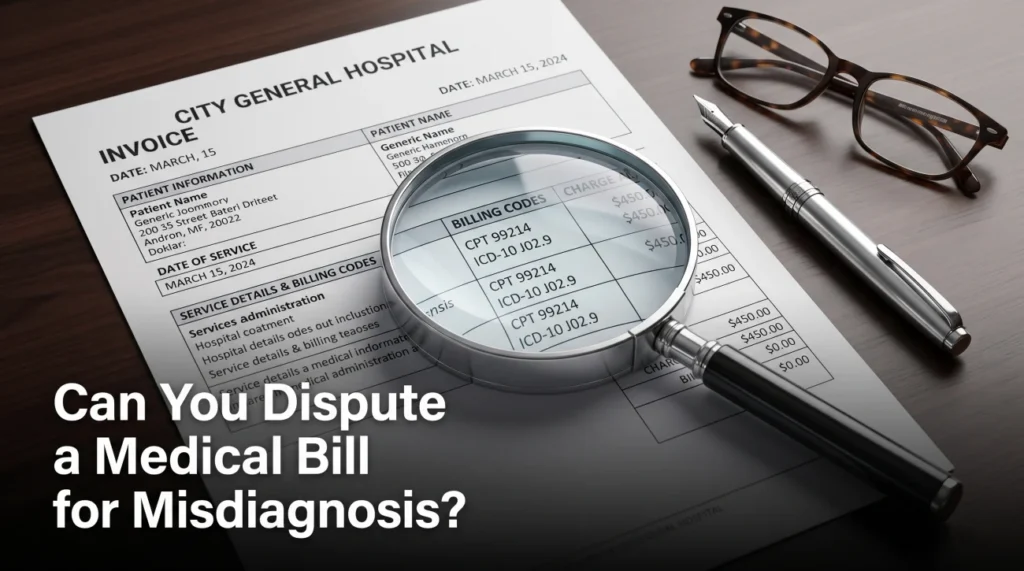
One of the most emotionally exhausting questions patients ask is whether can you dispute a medical bill for misdiagnosis. You went to the hospital, received treatment for a condition you did not actually have, and now you are staring at a massive invoice for procedures that were entirely useless to you. It feels like a fundamental breach of trust. You naturally assume that if the doctor was wrong, you should not have to pay.
From my experience sitting inside hospital billing departments, I have to be brutally honest with you: the billing system does not care if the doctor was wrong. The billing system only cares if the billing codes match the doctor’s orders. When you call a revenue cycle representative to argue about a clinical error, you are speaking two completely different languages.
However, this does not mean you have zero options. There is a very specific, narrow path where a clinical misdiagnosis crosses over into a valid billing error. To use that path, you have to stop arguing about the quality of the care and start arguing about the documentation rules.
What a Billing Dispute Actually Covers
To understand why most misdiagnosis complaints get rejected by the finance department, you have to understand what a billing reviewer actually does: data validation.
A true billing dispute happens when there is a mechanical error in how your care was translated into numbers. It covers situations where you were charged twice for the same medication, where an incorrect billing code was applied to a standard procedure, or where you need to learn how to dispute a medical bill for services not rendered because the test never actually happened. In all of these cases, the paperwork itself is wrong.
“I have watched patients write four-page letters explaining how the doctor completely ignored their symptoms and guessed the wrong illness. The billing reviewer will read that letter, look at the CPT code on the screen, see that it matches the doctor’s written order, and deny the dispute in under sixty seconds. They simply do not have the authority to overrule a licensed physician’s clinical decisions.”
If you are trying to understand the full landscape of what reviewers can actually fix, you should review the standard reasons to dispute a medical bill. You will notice that clinical competence is never on that list.
The Most Frustrating Part of Getting Billed for the Wrong Diagnosis
The situation that drives patients to the edge is receiving treatment, suffering through side effects or wasted time, and then finding out a week later from a different specialist that the first diagnosis was completely incorrect. Now, you have a bill from the first facility for treatment you feel you should never have needed.
The instinct is to call the first hospital and say, “Your doctor was wrong, so I am not paying this.” But doing this triggers a standard defensive mechanism inside the hospital. The customer service representative will likely tell you that you signed a financial responsibility form when you checked in, agreeing to pay for all services rendered. They will log your call as a refusal to pay rather than a formal dispute.
This is where patients lose leverage. By framing the problem as a medical complaint rather than a documentation issue, the account continues to age. Eventually, the hospital will send it to a debt collector. You are left trying to figure out your misdiagnosis medical bill rights while collection letters pile up.
When Misdiagnosis Does Not Create a Billing Dispute
This rapid escalation to collections often happens because, from an administrative standpoint, a misdiagnosis is not always considered a mistake. If a doctor makes a genuine, good-faith diagnosis based on the symptoms you presented and the information available at the time, the resulting tests are considered valid charges. Medicine is often a process of elimination. Doctors order tests to rule out dangerous conditions.
For example, if you go to the emergency room with severe chest pain and shortness of breath, the standard protocol is to rule out a heart attack. They will run an EKG, blood tests for cardiac enzymes, and perhaps a chest X-ray. If all those tests come back clear, and the doctor determines you were having a severe panic attack, you were technically misdiagnosed initially. However, the tests were medically necessary at the moment they were ordered to ensure you were not dying. The hospital will not remove those charges, and no billing dispute will succeed.
⚠️ Warning: Do not confuse “tests that came back negative” with a “billing error.” Negative tests are a normal part of clinical diagnostics. You are billed for the execution of the test, not the result.
When Misdiagnosis DOES Create Billing Grounds
There is a narrow window where you can successfully dispute a medical bill for misdiagnosis. You cannot win by arguing the doctor was a bad doctor. You win by arguing that, based on the corrected medical record, the treatment failed the test of “medical necessity.”
Medical necessity is a specific term in insurance and hospital billing. Providers are only supposed to bill for services that are medically necessary for the documented diagnosis. If the diagnosis is officially changed in your chart, the justification for the prior treatments might collapse.
Here is how this works in practice. Suppose you were admitted with severe stomach pain. The emergency room doctor documents a diagnosis of acute appendicitis and prepares you for surgery, running multiple specialized pre-surgical tests. Before surgery happens, the attending surgeon reviews your chart, realizes it is actually a severe gastrointestinal infection, cancels the surgery, and changes your primary diagnosis code in the system.
If the hospital billing system is slow, it might still generate a bill containing charges for the pre-surgical prep that were tied exclusively to the appendicitis diagnosis. In this highly specific scenario, the medical bill dispute misdiagnosis argument is valid. You are not asking the billing department to play doctor. You are pointing out that their own updated records show the prior tests were not medically necessary for the final, corrected diagnosis.
“I am not paying for this CT scan because Dr. Smith is incompetent and thought I had a tumor when it was just a cyst. The test was a waste of time.”
“I am disputing the charge for the CT scan on my itemized bill. The final medical record from the attending physician confirms my diagnosis was a benign cyst, not a tumor. I am requesting a review of whether this specific scan meets the criteria for medical necessity based on my corrected clinical documentation.”
The Documentation Required to Force a Review
You cannot simply call and tell them the diagnosis was wrong. You must provide clinical proof. If you are asking yourself, can I dispute a bill because of misdiagnosis, the answer depends entirely on whether a physician has put the correction in writing.
Here is the exact documentation list that actually moves a file out of the general queue and onto a reviewer’s desk.
- 📌 Request your complete medical records from the facility. You are entitled to request these documents, and you must specifically ask for the clinical notes, not just the itemized bill.
- 📌 Find the exact moment in the records where the diagnosis was corrected. You need the date, the time, and the name of the physician who made the change.
- 📌 Request an amendment to your medical record if the original facility refuses to acknowledge the error. If a second specialist at a different hospital caught the mistake, you must provide the second specialist’s clinical notes to the first hospital.
- 📌 Submit a written dispute identifying specific line items that are no longer medically necessary based on the updated paperwork.
This is a slow, bureaucratic process. But it is the only way to speak the language that a hospital revenue cycle manager understands.
The Malpractice Path vs The Billing Path
There is a hard line where a billing issue ends and a legal issue begins. If a misdiagnosis caused you physical harm, prolonged suffering, or resulted in you undergoing an invasive surgery you did not need, you are no longer in the realm of a billing dispute.
That is a medical malpractice issue. A billing reviewer cannot assess damages, determine negligence, or settle a liability claim. I have seen countless patients accidentally sabotage their own billing dispute by using the word “lawsuit” in a standard letter; the moment that word appeared, our department was required by policy to freeze the account and send it straight to legal risk management. Once risk management is involved, standard customer service channels close.
If a situation crosses into malpractice, it generally requires professional legal review. This is where patients typically seek guidance from a medical malpractice attorney, as lawyers can advise on whether the provider breached the standard of care. Sometimes, as part of a malpractice settlement, the hospital will wipe out the outstanding balances. But that happens through lawyers negotiating with lawyers, not patients arguing with billing clerks.
Practical Steps to Take Right Now
Assuming your situation falls under a billing dispute rather than a legal malpractice claim, you need a strategy to protect your credit while you sort out the facts. You need to understand the complete guide on how to dispute a medical bill so you follow the correct administrative steps.
If you want to keep the billing department from automatically escalating your account to collections while you fight this, here is the exact order of operations we needed to see on our end to put a hold on the bill:
- Step 1: Get everything in writing. Request both your itemized bill and the corrected clinical notes. Do not rely on phone calls where a representative promises to “look into it.”
- Step 2: Check your insurance Explanation of Benefits (EOB). Your insurance company might deny payment for the misdiagnosed treatments if they determine those treatments lacked medical necessity based on the updated records. If your insurer denies the claim, the hospital might try to bill you for the balance. If they do, you might need to know how to handle a surprise medical bill or an improper balance billing situation.
- Step 3: File a written dispute. Submit your formal dispute letter grounded entirely on “medical necessity,” using the updated clinical notes as your proof.
If your account has already been sent to a third-party debt collector while you were trying to fight the diagnosis, the strategy shifts. Collectors do not care about your medical history; in fact, they are not supposed to have detailed clinical information about your diagnosis. If a collector knows specific details about your misdiagnosis, you should investigate whether your collector is using information improperly.
Final Thoughts: Controlling What You Can
Whether you are dealing with the hospital directly or fighting off a debt collector, being billed for a doctor’s mistake feels incredibly unjust. But trying to force a hospital billing department to admit a doctor was incompetent is a losing battle. As reviewers, we simply never had the power to make that call.
After watching thousands of these accounts play out, I can tell you that your best strategy is to shift the battleground. If you have clinical proof that a diagnosis was changed, use that proof to attack the “medical necessity” of the resulting charges. If the hospital refuses to adjust the bill and a malpractice claim is not viable, your final option is to step away from the dispute process and simply negotiate the remaining balance down to a fraction of the original cost. Hospitals know that collecting on an account where the patient feels wronged is difficult, and they will often accept a lower settlement just to close the file.
❓ FAQ
🩺 If a doctor gave me the wrong diagnosis, do I still have to pay the bill?
In most cases, yes. The billing system charges you for the services that were actually performed based on the doctor’s orders at the time. A clinical mistake does not automatically void the financial cost of the tests or treatments you received.
🏥 Who do I call to complain about a wrong diagnosis on my bill?
Calling the billing department to complain about a clinical error will not work. You should contact the hospital’s Patient Advocate or Patient Relations department. They handle grievances related to the quality of care and can sometimes mediate with the billing office.
⚖️ Can a billing department fix a medical error?
No. A billing reviewer is an administrative employee, not a medical professional. They cannot alter a medical record or decide that a doctor made a mistake. They can only fix mechanical errors, like duplicate charges or wrong billing codes.
📝 What happens if the medical record has the wrong condition listed?
You have the right to request an amendment to your medical record. You must contact the provider’s health information management (medical records) department and submit a formal request to correct the clinical documentation.
💸 Will insurance pay for a treatment if the diagnosis was incorrect?
Insurance companies pay based on the diagnosis codes submitted on the claim. If the submitted code justified the treatment, they will likely pay. If the provider later corrects the diagnosis code to something that does not match the treatment, the insurer may retroactively deny the claim.
👨⚕️ Do doctors charge you to fix a misdiagnosis in your chart?
No, a provider cannot charge you a fee simply to correct a factual error in your medical record. However, if correcting it requires a new, separate consultation or examination, they may bill you for that new visit.
🚫 Can I refuse to pay a hospital bill because the treatment didn’t work?
Refusing to pay because a treatment was ineffective will result in your account being sent to collections. Medicine does not come with a money-back guarantee for outcomes. You are billed for the delivery of the service, regardless of whether it cured you.
📂 How do I get my medical records to prove a wrong diagnosis?
You must contact the hospital’s medical records department and sign a release form. Ask specifically for the physician’s progress notes, attending notes, and discharge summary, not just the itemized financial statement.
📞 Does telling a debt collector about a misdiagnosis stop the collection?
No. Debt collectors are not authorized to resolve medical disputes or judge clinical errors. If you tell them the doctor was wrong, they will simply note that you are refusing to pay and continue their collection efforts.
⏱️ Is there a time limit to challenge a bill based on a wrong diagnosis?
Hospital billing dispute windows vary, but most facilities require you to file disputes within 90 to 180 days of the bill date. If your issue involves medical malpractice, legal claims regarding medical care also have strict, separate deadlines depending on where you live.
Medical Bill Dispute
How to challenge a hospital bill from the initial dispute through the collections process.
- Step-by-step guide to challenging a hospital bill from itemization to formal dispute
- How to Dispute a Medical Bill With Insurance: The Appeal Process That Most Patients Skip
- What Happens When You Dispute a Medical Bill? The Process and Possible Outcomes
- How to Dispute an Incorrect Medical Bill: The Steps That Actually Get Errors Corrected
- Should I Dispute Medical Bills? How to Decide Before You Invest the Time
When Disputing Is Not Enough
A successful dispute resolves some situations. These cover when the bill or the collector remains.
- Using a HIPAA violation to challenge how your bill was transferred to the collector
- Negotiating the bill you are disputing and what hospitals are actually willing to reduce
- Settling the remaining balance when a dispute does not fully resolve the account
- Debt relief programs that can handle disputed and overbilled medical accounts
- How a successful bill dispute can result in removing the collection from your credit report
Disclosure: The content on this site reflects direct experience inside hospital billing and medical debt collection, and is grounded in federal law and regulation. It is informational in nature. Reading it does not constitute legal advice and does not create any professional relationship. If you are facing a lawsuit, a judgment, or a legal deadline, consult a licensed attorney in your state before taking action.