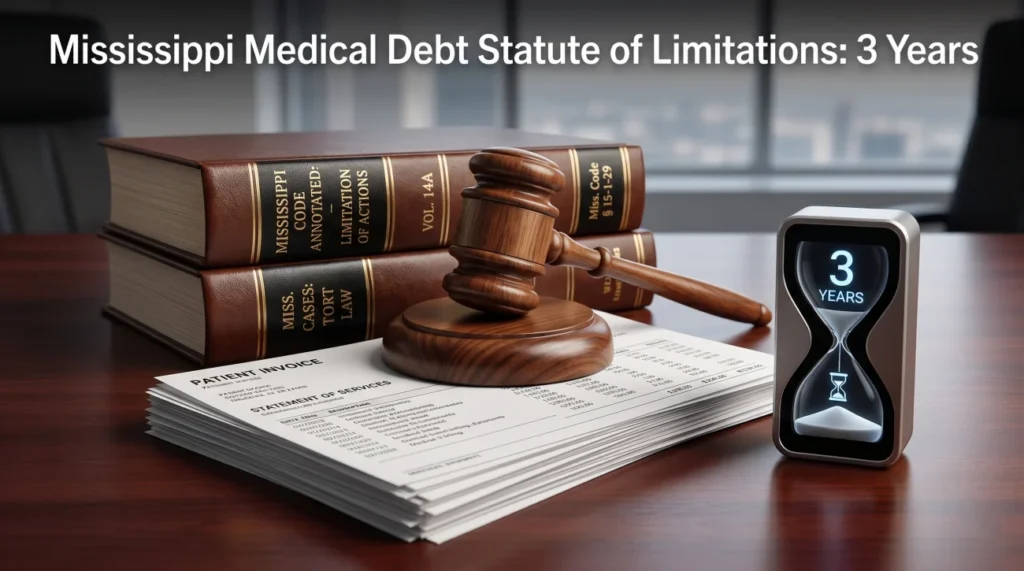
- The Mississippi medical debt statute of limitations is only 3 years, making it one of the shortest legal windows for collectors in the country.
- Once a medical debt is older than 3 years from the date of default, collectors lose the legal right to sue you or garnish your wages over it.
- Making even a small partial payment on an old medical bill can legally restart the 3-year clock, reviving a dead debt.
- Mississippi offers no state-level bans on wage garnishment or credit reporting, meaning your primary defense is strictly the federal baseline.
The Hidden Protection of Mississippi’s 3-Year Deadline
Mississippi residents carry some of the highest rates of medical debt in the nation. It is common to feel overwhelmed when collection letters start arriving for hospital visits you barely remember. But there is a massive piece of leverage most patients do not know they have: the Mississippi medical debt statute of limitations is strictly capped at three years.
During my time reviewing accounts inside hospital billing departments, I watched thousands of accounts age out of their legally enforceable window. I have seen patients panic over a four-year-old emergency room bill, call the agency, and make a $20 goodwill payment just to get the collector off the phone. By doing so, they unknowingly handed the collector the legal right to sue them.
You have to understand how the system is designed. Collectors know the timeline. They know exactly when their right to force you into court expires. But they have no legal obligation to inform you that a debt is too old for a lawsuit. The burden is entirely on you to recognize when the clock has run out, and to know how to assert your rights when it does.
How the Statute of Limitations Works in Mississippi
In legal terms, the statute of limitations is a countdown clock that dictates exactly how long a collector has to file a lawsuit against you to recover an unpaid balance. Under Mississippi Code Annotated § 15-1-49, the window for open accounts and unwritten contracts, which is how almost all medical debt is classified, is exactly three years.
This is a remarkably short window. In many other states, collectors have six, eight, or even ten years to drag you into court. In Mississippi, the math is straightforward: if your last payment or the date your account first went into default was more than three years ago, the debt is legally classified as “time-barred.”
“From the billing side, we treated the 3-year mark as a hard wall for litigation. Once an account passed that date, it was usually bundled and sold off for pennies on the dollar to junk debt buyers. These buyers know they cannot sue you. Their entire business model relies on hoping you don’t know the law.”
When Does the Clock Actually Start?
The biggest point of confusion I see with patients is calculating day one of that three-year countdown. The clock does not start on the day you went to the hospital. It does not start on the day you were discharged.
The clock starts on the date the debt first became delinquent (usually 30 to 90 days after the final invoice was due) OR the date of your last payment, whichever is most recent. If you went to the ER in January 2021, the bill was due in March 2021, and you made your last payment on a payment plan in June 2021, the three-year clock started ticking in June 2021.
What “Time-Barred” Actually Means for You
If a debt is past the three-year mark in Mississippi, it is time-barred. But you need to understand precisely what that means, because collectors will intentionally blur the lines to keep you off balance.
Time-barred means the collector has lost the ultimate weapon: the court system. They cannot file a successful lawsuit against you. They cannot obtain a judgment. And because they cannot get a judgment, they cannot legally garnish your wages or place a levy on your bank account.
However, time-barred does not mean the debt disappears.
- 📌 Collectors can still call you and send you letters asking for payment.
- 📌 The hospital still has a record of the unpaid balance.
- 📌 The debt can still remain on your credit report for up to seven years under the federal Fair Credit Reporting Act (FCRA).
This creates a dangerous four-year gap in Mississippi. Between year three and year seven, a medical debt is too old for a lawsuit, but fresh enough to tank your credit score. This gap is where collection agencies apply the most psychological pressure, because credit damage is their only remaining leverage.
The Zombie Debt Trap: Accidentally Restarting the Clock
One of the most heartbreaking scenarios in medical billing is watching a patient revive a dead debt. In Mississippi, the three-year clock is not permanently frozen once it expires. If you take certain actions, the clock resets back to day one.
This is commonly referred to as zombie debt. A collector buys a five-year-old medical bill. They cannot sue you. But they call you and offer a “hardship program” where you only have to pay $5 today to stop the phone calls. The moment you make that $5 payment, you have acknowledged the debt. The three-year statute of limitations restarts entirely, and they now have the legal right to sue you for the full remaining balance.
“I know I owe that hospital bill from 2020, but I just don’t have the full amount right now. Can I send you $20 on Friday so you stop calling my job?”
“I do not acknowledge this debt. Please send full written validation of this account, including the date of the original service and the date of the last transaction, to my mailing address. Do not contact me by phone again.”
If you suspect a debt is near or past the three-year mark, your only response should be requesting written validation.
Mississippi Medical Debt Laws: The Broader Picture
While the short statute of limitations is a massive advantage, the rest of the Mississippi medical debt laws landscape is notably sparse. Unlike states that have recently passed aggressive consumer protections, Mississippi relies almost entirely on the federal baseline.
If you are looking at how state law adds to federal baseline protections across the country, Mississippi falls into the category of states that offer very little extra padding. For example, some states have outright banned medical debt from appearing on credit reports, or banned wage garnishment entirely. Mississippi has done neither.
Key Point: Because Mississippi does not offer extended state-level medical debt protections, knowing your federal rights under the Fair Debt Collection Practices Act (FDCPA) and the Fair Credit Reporting Act (FCRA) is your primary line of defense.
To see how this compares to neighboring states, you can view the full 50-state statute of limitations reference table to check exactly where Mississippi stands. The lack of state-level shields means that if a collector does file a lawsuit within that valid three-year window, you have genuine financial exposure.
Wage Garnishment: What Happens if They Sue in Time
If a collector files a lawsuit against you within the three-year window, and you ignore the court summons, they will win a default judgment. With that judgment in hand, they can petition a Mississippi court for a wage garnishment order.
Because Mississippi does not have a state-specific garnishment ban for medical bills, it defaults to the federal limits. Under federal law, a collector can take whichever is less:
- 25% of your disposable earnings (your paycheck after legally required tax deductions).
- The amount by which your weekly disposable earnings exceed 30 times the federal minimum wage.
Losing 25% of a paycheck is devastating for most households. This is why ignoring a lawsuit is the single most destructive mistake a patient can make. Even if you know the bill is accurate, forcing the collector to prove their case, negotiating a payment plan, or simply showing up to court to demonstrate financial hardship is infinitely better than allowing a default judgment that targets your employer.
What to Do When a Collector Contacts You in Mississippi
When a collection agency reaches out, the timeline is critical. Under federal law, you have 30 days from their initial communication to request debt validation. If you miss this window, the debt is assumed valid by default, making it much harder to fight later.
Here is the exact order of operations you should follow to protect yourself and identify whether the debt is time-barred.
Receive notice + Do not admit validity + Send validation request
Step 1: Send a Written Validation Request
If you receive a phone call, tell the collector to put the notice in writing and hang up. Once you have the written notice, you need to demand proof of the debt. The goal here is to force them to reveal the date of first delinquency so you can check the three-year clock.
Subject: Demand for Debt Validation
To Whom It May Concern,
I am responding to your communication regarding account #[Insert Number]. I am requesting full written validation of this debt as is my right under the Fair Debt Collection Practices Act.
Please provide the following documentation:
- An itemized breakdown of all charges from the original healthcare provider.
- Proof that you are authorized to collect this debt, including chain of assignment if applicable.
- The exact date of the original medical service.
- The exact date this account first became delinquent.
Until this validation is provided, you must cease all collection activities. Furthermore, I request that all future communications regarding this matter be made in writing only.
Sincerely,
[Your Name]
Step 2: Evaluate Your Options Based on the Timeline
Once the collector responds with the documentation, look strictly at the dates. If the date of first delinquency is more than three years ago, send a certified letter stating that the debt is time-barred under Mississippi Code § 15-1-49 and demand they cease all contact.
If the documentation proves the debt is valid and the three-year window is still open, you need to shift to a negotiation strategy. Collectors buy medical debt for fractions of a penny. They have massive margins to accept a lower payoff. If you are evaluating settlement options for debts still within the legal window, start by offering 20% to 30% of the total balance in exchange for a “pay for delete” agreement.
In some cases, the collector’s paperwork will be missing critical HIPAA authorizations, or they will have shared your medical information improperly during the collection process. If you spot dates of service or specific medical procedures exposed on mailing envelopes or discussed inappropriately, you need to understand when collection tactics cross into potential privacy violations, as this can give you significant leverage during negotiations or grounds to dispute the collection.
Final Thoughts on Navigating the System
Mississippi’s medical debt landscape is heavily weighted in favor of the hospitals and collectors, with one glaring exception: the three-year statute of limitations. That timeline is your strongest shield.
The billing system is opaque by design. Collectors will use the threat of lawsuits, the threat of credit damage, and aggressive phone tactics to make you feel cornered. They will almost never volunteer the fact that their legal window to sue you closed two years ago. Keep your communications in writing, verify every single date on the account, and never make a blind payment just to relieve the immediate pressure.
❓ FAQ
⏳ Does medical debt expire in Mississippi?
Medical debt does not technically “expire” or disappear, but Mississippi limits the time collectors have to sue you to three years. After three years, the debt is time-barred, meaning they cannot force you to pay through a court judgment, though they can still ask you for the money.
🗓️ What is the statute of limitations on medical debt in Mississippi?
The statute of limitations for medical debt in Mississippi is exactly three years, starting from the date of the last payment or the date the account first became delinquent.
⚖️ Can a medical debt collector sue me after 3 years in MS?
No. Under Mississippi law, if the three-year statute of limitations has passed, a collector cannot successfully sue you. If they threaten to sue you on a time-barred debt, it is a violation of federal law.
💰 What happens if I make a small payment on an old medical bill?
If you make any payment on a time-barred medical bill in Mississippi, you legally acknowledge the debt. This instantly resets the three-year statute of limitations clock, giving the collector the right to sue you for the full remaining balance.
📈 Can medical bills older than 3 years stay on my credit report?
Yes. The state statute of limitations controls lawsuits, but the federal Fair Credit Reporting Act controls credit bureaus. Under federal rules that apply in all states, including Mississippi, medical debt over $500 can remain on your credit report for up to seven years from the original delinquency date.
🏥 Does Mississippi ban wage garnishment for medical bills?
No. Mississippi does not have a state-level ban on wage garnishment for medical debt. If a collector sues you within the three-year window and wins, they can garnish up to 25% of your disposable earnings.
📞 How do I stop a collection agency from calling me?
You can stop phone calls by sending a written “Cease and Desist” letter to the collection agency. Under federal law, once they receive this written request, they must stop calling you and can only contact you to confirm they are stopping or to inform you of a specific legal action.
🏦 Can a hospital empty my bank account for a bill?
Not without a court order. A hospital or collector must first file a lawsuit within the three-year window, win a judgment against you, and then petition the court for a bank levy before they can touch funds in your checking or savings accounts.
📝 Should I ignore a medical debt collection letter?
No. Ignoring a letter assumes the debt is valid by default. You should always send a written debt validation request within 30 days of receiving the first notice to force the collector to prove they have the legal right and correct timeline to pursue you.
🛡️ Are there charity care laws in Mississippi that protect me?
Mississippi does not have expansive state-level charity care mandates beyond the federal rules. Non-profit hospitals must still follow IRS 501(r) guidelines, which require them to have a financial assistance policy and screen patients before engaging in extraordinary collection actions.
Medical Debt Laws
The state-by-state legal framework that determines how long collectors can pursue you.
- State-by-state: statute of limitations, collection limits, and consumer protections
- New York Medical Debt Laws: What Applies in New York
- Arkansas Medical Debt Laws: Statute of Limitations and Collection Rules
- Washington State Medical Debt Laws: What Applies in Washington State
- Oregon Medical Debt Laws: What Applies in Oregon
Turning Legal Knowledge Into Action
State law gives you leverage. These pages explain how to use it.
- How federal HIPAA law creates leverage you can use against a medical debt collector
- Your legal right to negotiate any medical bill and what providers cannot refuse
- How to settle medical debt within the window your state laws still allow
- How debt relief programs interact with your state collection laws and protections
- Removing medical debt from your credit report under the current federal reporting rules
Disclosure: The content on this site reflects direct experience inside hospital billing and medical debt collection, and is grounded in federal law and regulation. It is informational in nature. Reading it does not constitute legal advice and does not create any professional relationship. If you are facing a lawsuit, a judgment, or a legal deadline, consult a licensed attorney in your state before taking action.