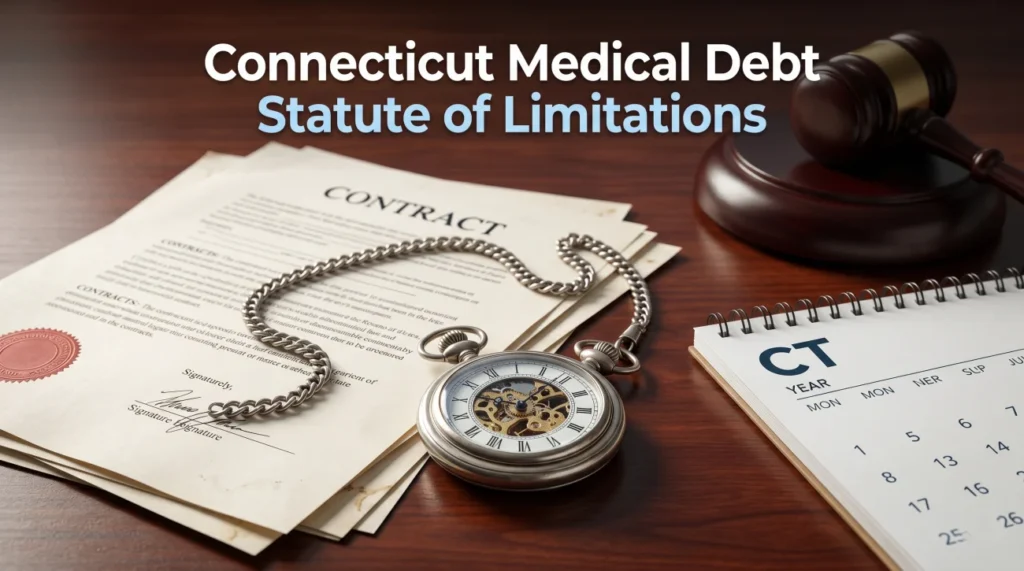
- The Connecticut medical debt statute of limitations is 6 years, giving collectors a significant window to file a lawsuit for unpaid balances.
- Recent Connecticut legislation banned medical debt from being reported to credit bureaus, removing a major leverage point for collection agencies.
- Making even a small partial payment on an old hospital bill can completely reset the 6-year legal clock.
- Once a debt is time-barred, a collector can still contact you to ask for money, but threatening legal action violates federal law.
The Six-Year Window for Hospital Collections
Connecticut gives collectors 6 years to file a lawsuit for unpaid medical bills, but recent legislation completely eliminated one of their most effective weapons. As of mid-2024, medical debt can no longer be reported to credit bureaus in the state. This shifts the entire collection landscape. The Connecticut medical debt statute of limitations is now the primary timeline that matters, establishing exactly how long a creditor has to take you to court over an unpaid balance.
When I worked inside hospital billing departments, I saw how collection agencies strategically managed older accounts. Because Connecticut gives them a relatively long timeframe compared to states that cap the window at three years, collectors have no immediate urgency. They can afford to let an account age, periodically sending letters, waiting for you to make a mistake that either resets the legal clock or results in a default judgment. Understanding how this timeline works is your strongest defense against aggressive recovery tactics.
The Anxiety of the Aging Hospital Bill
The deepest frustration with old medical debt is the uncertainty. You might assume an account from four years ago was resolved by insurance or written off by the hospital’s financial assistance department, only for a new collection agency to suddenly send a demand letter with an inflated balance. This creates a paralyzing situation.
If you call to argue, you risk making a statement that makes you legally responsible. If you ignore the letters, you worry about wage garnishment. This information gap is entirely by design. The billing system relies on your assumption that the collector holds all the power. But the law places specific limits on what they can enforce, and knowing how to navigate those limits changes the entire dynamic of the conversation.
Defining the Connecticut Medical Bill Statute of Limitations
Under Connecticut General Statutes (CGS § 52-576), the legal timeframe to file a lawsuit for a written contract or legally binding agreement is 6 years. Because you almost always sign a financial responsibility form when you are admitted to a hospital or seen in a clinic, medical debts are generally treated as written contracts under the medical debt collection Connecticut statute.
This 6-year period is a strict boundary on the court system. It means that if a collector wants to force you to pay by garnishing your wages or placing a lien on your property, they must formally file a lawsuit against you before that six-year window closes. If they fail to do so, they lose the ability to use the state’s legal apparatus to take your money.
“A common pattern I noticed in billing operations was the sudden flurry of legal activity right around the five-and-a-half-year mark. Debt buyers who purchased old hospital accounts for pennies on the dollar would run bulk automated reports to identify accounts nearing the statute expiration. They would aggressively file lawsuits at the last possible moment, knowing that most patients would be too intimidated to show up to court, resulting in an easy default judgment.”
It is important to remember how this compares nationally. If you are trying to compare the legal window across different states, you will find that six years is slightly longer than the national average. This longer exposure period means Connecticut residents must be extremely vigilant about keeping records of past hospital visits.
When Does the Collection Clock Actually Start?
The most disputed aspect of any old debt is not the length of the statute, but exactly when the clock began ticking. The 6-year period does not start on the day you were discharged from the hospital. It typically begins on the date the debt first became delinquent, or the date of your very last payment, whichever is most recent.
For example, if you had a procedure in January 2018, made a payment arrangement, and made your final payment in June 2019 before experiencing financial hardship, your 6-year clock likely started in July 2019 when you missed the next scheduled payment. This means the debt would become legally time-barred in July 2025.
Assuming a bill from seven years ago is automatically safe from lawsuits without verifying the date of your last payment or the date the hospital officially deemed the account default.
Requesting a full itemized ledger from the original healthcare provider to definitively prove the date of last activity before responding to a third-party collector.
The Danger of Resetting Your Connecticut Timeline
One of the most critical things for any patient to understand is that the statute of limitations on medical debt Connecticut residents face is not a permanent expiration date. It is a running clock that you can accidentally restart. This is a concept known in the collection industry as “zombie debt” because it brings a dead account back to life.
If you make even a five-dollar payment on an account that is five years and eleven months old, the 6-year clock resets entirely from the date of that new payment. In some situations, even acknowledging the debt in writing can reset the clock, giving the collector a brand new six years to pursue a lawsuit against you.
- ❌ Never agree to a “good faith” partial payment over the phone just to get a collector to stop calling you.
- ❌ Do not sign any document acknowledging the balance is accurate without consulting a consumer protection professional.
- ✅ Keep meticulous logs of every call, noting that you are requesting validation, not acknowledging ownership of the balance.
- 📋 Send all correspondence via certified mail so you have an undeniable paper trail of your exact words.
The 2024-2025 Credit Reporting Bans in Connecticut
To fully understand your leverage, you have to look at the full landscape of Connecticut medical debt rules beyond just the litigation timeline. Under Public Act 23-145, which took effect on July 1, 2024, Connecticut enacted sweeping legislation that fundamentally altered how collectors operate. Specifically, the law prohibits healthcare providers, hospitals, and the collection agencies representing them from reporting medical debt to consumer credit reporting agencies. This law specifically covers debt arising from healthcare services, meaning hospital bills, clinic visits, and related balances, rather than financial products like medical credit cards.
Historically, the threat of ruining your credit score was a collector’s most effective weapon. It was much cheaper to place a negative mark on your credit report and wait for you to apply for a mortgage or car loan than it was to hire an attorney and sue you. With this tool now illegal in Connecticut, collectors are left with fewer options. They can call you, they can send letters, or they can sue you.
Because their toolkit has shrunk, collectors handling large balances might move toward litigation faster within that 6-year window. This makes understanding the medical debt statute of limitations even more vital, as the courtroom is now their primary method of forced recovery.
What Happens When the Debt Becomes Time-Barred?
When the 6-year mark passes without a lawsuit being filed, the debt is officially considered “time-barred.” This status provides you with significant legal protection, but it does not mean the debt magically disappears or that the hospital forgives the balance.
Under federal law, a debt collector can still contact you to ask for voluntary payment on a time-barred debt. However, they are strictly prohibited from suing you, and they cannot even threaten to sue you. Threatening legal action on an expired statute is a direct violation of the Fair Debt Collection Practices Act (FDCPA).
| Collection Action | Within 6-Year Window | After 6 Years (Time-Barred) |
|---|---|---|
| Call or send demand letters | Allowed | Allowed |
| File a lawsuit against you | Allowed | Prohibited |
| Threaten wage garnishment | Allowed (if factual) | Prohibited |
| Request voluntary payment | Allowed | Allowed |
If a collector crosses the line and threatens a lawsuit or garnishment on an out-of-statute hospital bill, you may need to look closely at whether they are also mishandling your private data or collectors improperly accessing your protected health data to pressure you.
How to Handle an Aging Account in Connecticut
If you are contacted about a debt that you suspect is approaching or has passed the 6-year mark, your immediate goal is to establish the timeline without accidentally resetting it. You must demand validation of the debt entirely in writing.
Standard procedure: Receive initial notice → Draft FDCPA validation request → Send via certified mail → Log response timeline.
⚠️ Warning: Do not use this correspondence to explain why your insurance failed to pay or why the hospital billing department was incompetent. Extraneous details can sometimes be twisted into an acknowledgment of the debt. Keep your request clinical and purely procedural.
Sample Debt Validation Request
Use a clear, emotionally detached template to force the collector to prove their legal standing and the exact dates associated with the account.
To Whom It May Concern,
I am writing in response to your recent communication regarding account number [Insert Account Number]. I am requesting full validation of this alleged debt under the Fair Debt Collection Practices Act.
Please provide me with the name and address of the original creditor, the date of the original service, the date of the alleged first delinquency, and a complete itemized accounting of how the current balance was calculated.
I do not acknowledge owing this debt. I am simply requesting validation of your claim. Until this information is provided in writing, please cease all other communication with me.
Sincerely,
[Your Name]
If they provide validation and the debt is still within the 6-year window, but you cannot afford the balance, you must act before they file a lawsuit. You should evaluate settlement strategies before the deadline to resolve the account on your own terms rather than waiting for a court order.
Common Mistakes Patients Make With Aging Bills
Working in billing compliance showed me that the system relies heavily on patient errors. The most common mistake is completely ignoring a formal court summons. Many patients mistakenly believe that if they know the debt is older than 6 years, they do not need to show up to court. This is dangerously false. The statute of limitations is an “affirmative defense.” This means the court assumes the lawsuit is valid unless you show up and prove the clock has expired. If you do not show up, the collector wins by default.
Another frequent error is trying to negotiate a settlement over the phone without having the collector’s offer in writing first. Verbal promises from collection agents are incredibly difficult to enforce. If they offer to settle a $4,000 bill for $1,000, you must demand that offer on company letterhead before you provide any bank account or credit card information.
Final thoughts: Your Protection Requires Participation
Connecticut gives you a clear boundary line with its 6-year statute of limitations, and the recent restrictions on credit reporting have shifted the balance of power slightly back toward the consumer. However, these laws only protect you if you actively enforce them. To understand how state law adds to federal baseline protections, you must recognize that collectors will always push right up to the edge of what is legal. By keeping precise records, refusing to reset the clock with unverified partial payments, and forcing the agency to prove its claims on paper, you strip them of their primary advantages and ensure they play strictly by the rules.
❓ FAQ
🕒 How long can a hospital legally chase me for a bill in Connecticut?
A hospital or their third-party collection agency has exactly 6 years from the date of your last payment or first delinquency to file a lawsuit against you to force payment.
🛑 Can a debt collector still call me after 6 years?
Yes. Even after the statute of limitations has expired, collectors can legally contact you to ask for voluntary payment. However, they cannot sue you or threaten to sue you.
⚖️ What should I do if I am sued for a medical bill older than 6 years?
You must respond to the lawsuit and formally assert the expired statute of limitations as your defense. If you ignore the court summons, the collector will likely win a default judgment against you.
📈 Will this old hospital bill affect my credit score in Connecticut?
Under recent Connecticut legislation, medical debt resulting from healthcare services is prohibited from being reported to consumer credit bureaus, severely limiting a collector’s ability to damage your credit profile.
🏥 Does the 6-year limit apply if the hospital never billed my insurance?
The 6-year litigation window still applies to the balance, but if the hospital failed to bill your insurance in a timely manner, you have entirely different grounds to dispute the validity of the bill itself before the statute ever becomes an issue.
🗣️ Can a verbal promise to pay reset the statute in Connecticut?
While written agreements and payments are the most common triggers, certain verbal acknowledgments or promises to pay can complicate your defense. It is always safest to communicate with collectors purely in writing.
📄 How do I prove the 6-year timeline has expired?
The most concrete proof is an itemized ledger from the original healthcare provider showing the exact date of your very last payment or the date the account was officially marked delinquent.
✉️ What is the fastest way to get a collector to stop calling about old debt?
Send a written “Cease and Desist” letter via certified mail. Under federal law, once they receive this written request, they must stop contacting you except to confirm they are stopping or to notify you of a specific legal action.
Medical Debt Laws
The state-by-state legal framework that determines how long collectors can pursue you.
- State-by-state: statute of limitations, collection limits, and consumer protections
- Alabama Medical Debt Laws: Statute of Limitations and Collection Rules
- Minnesota Medical Debt Laws: What Applies in Minnesota
- Missouri Medical Debt Laws: Statute of Limitations and Collection Rules
- Pennsylvania Medical Debt Laws: What Applies in Pennsylvania
Turning Legal Knowledge Into Action
State law gives you leverage. These pages explain how to use it.
- How federal HIPAA law creates leverage you can use against a medical debt collector
- Your legal right to negotiate any medical bill and what providers cannot refuse
- How to settle medical debt within the window your state laws still allow
- How debt relief programs interact with your state collection laws and protections
- Removing medical debt from your credit report under the current federal reporting rules
Disclosure: The content on this site reflects direct experience inside hospital billing and medical debt collection, and is grounded in federal law and regulation. It is informational in nature. Reading it does not constitute legal advice and does not create any professional relationship. If you are facing a lawsuit, a judgment, or a legal deadline, consult a licensed attorney in your state before taking action.