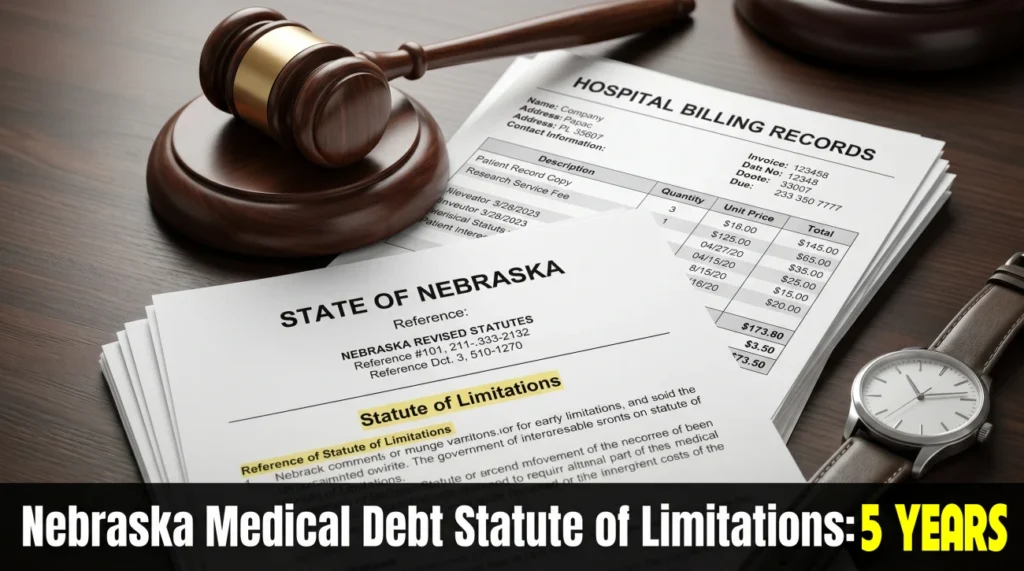
- The Nebraska medical debt statute of limitations is 5 years from the date of your last payment or first delinquency.
- Nebraska law provides a strong head of family wage exemption that can protect up to 85 percent of a primary earner’s disposable wages from garnishment.
- You must actively claim the head of family exemption when a garnishment is attempted, as it is not always applied automatically.
- Making even a small payment on an old medical bill can restart the 5-year clock, reviving a collector’s legal right to sue you.
- Nebraska does not have state-specific bans on medical debt credit reporting, meaning federal FCRA rules act as your baseline protection.
Understanding the 5-Year Window in Nebraska
If you are dealing with unpaid hospital bills in Nebraska, you need to understand both the clock running on your account and the shields available to protect your income. Working inside hospital billing departments, I processed accounts from across the country. Every state has its own rhythm for how aggressively accounts are pursued. In Nebraska, collectors have a 5-year window to take legal action. However, the real story here is not just the timeline. It is the head of family exemption, a powerful protection that many working people completely overlook.
Federal law provides a baseline of rights for patients everywhere. But knowing how state medical debt laws build on federal rules is what actually protects your paycheck. This guide walks you through the exact statute of limitations on medical debt in Nebraska, how state garnishment rules operate, and what you need to do to assert your rights before a collector escalates your account.
The 5-Year Statute of Limitations Rule
Under Nebraska law (Neb. Rev. Stat. § 25-205), the statute of limitations for written contracts, which typically includes medical debt, is 5 years. This is the exact legal window a hospital or third-party collection agency has to file a lawsuit against you to force payment.
If you want to understand the foundational mechanics of how the statute of limitations works, the most important detail is the starting line. The clock generally starts on the date of your last payment or the date the debt first became delinquent. Once that 5-year period expires, the debt becomes “time-barred.”
Knowing the start date is only half the battle; you also need to know what resets it. In Nebraska, making any payment on the debt, even a partial one, restarts the 5-year clock from day zero. Additionally, signing a written agreement acknowledging the debt can also trigger a reset. This is how old, uncollectable accounts suddenly become active lawsuits again.
“From my side of the desk, the most frustrating thing to witness was a patient accidentally reviving a dead account. A debt buyer would acquire a 6-year-old Nebraska hospital bill. They could not legally sue anymore. But they would call, act incredibly sympathetic, and ask for a $10 good faith payment. The moment the patient paid that $10, the 5-year clock reset to zero, and the lawsuit threat became real again.”
When an account is time-barred in Nebraska, it does not mean the debt magically disappears or that you are forbidden from paying it. It simply means the collector has lost their most powerful weapon: the ability to drag you into court and win a judgment. They can still call you and send letters, but any threat to sue you over time-barred debt is a direct violation of federal collection laws.
If you have lived in multiple places or received care across state lines, you might want to compare this 5-year window against the statute of limitations periods in other states to ensure you are applying the correct timeline to your specific account.
Wage Garnishment and the Head of Family Exemption
If a collector successfully sues you within that 5-year window and gets a judgment, their next step is usually trying to garnish your wages. The federal default protects 75 percent of your disposable earnings. However, Nebraska law offers something much stronger for primary earners.
Under Nebraska Revised Statute 25-1558, if you are the “head of a family” (meaning you provide the primary support for your household), you can protect up to 85 percent of your disposable earnings from garnishment. This leaves a significantly smaller slice of your paycheck vulnerable compared to the standard federal rules.
The definition of a head of family in Nebraska courts is broader than many people assume. It generally includes anyone who provides primary support for dependents living with them. This is not limited to traditional two-parent households. It frequently covers single parents, individuals supporting an elderly parent who lives in the home, or even parents providing primary support for an adult child still in college.
During my years reviewing files that escalated to legal action, the most heartbreaking pattern I saw involved this exact exemption. Patients who clearly qualified as the head of their family would have their wages heavily garnished simply because they did not file the exemption paperwork. They assumed the court automatically knew they had children to feed. The reality is that the court only knows what you formally file. If you ignore the garnishment notices, you forfeit the protection entirely.
Here is the difference between what most people do and what actually works:
Receiving a garnishment notice and assuming the court automatically knows you support three children, resulting in the maximum allowable amount being pulled from your check.
Immediately filing the proper exemption claim forms with the court upon receiving a garnishment notice, formally asserting your status as head of family to secure the 85 percent protection limit.
Bank Account Levies Operate Differently
It is crucial to understand that wage garnishment and bank account levies are two different enforcement actions. While Nebraska protects a large portion of the wages actively coming out of your paycheck, the rules change once that money lands and sits in your bank account.
If a collector levies your bank account, they are attempting to freeze and seize the existing funds. While certain types of income are federally exempt from seizure regardless of where they sit (like Social Security benefits or VA payments), standard wages that have accumulated in a checking account do not always enjoy the exact same percentage protections as the active payroll garnishment.
Once you understand how collectors target your income and assets, the next question is usually about how they affect your credit score and what protections exist before they even bill you.
Credit Reporting and Charity Care in Nebraska
Beyond the statute of limitations and garnishment limits, medical debt laws in Nebraska largely lean on the federal baseline. When it comes to your credit report, Nebraska does not have a state-specific ban preventing medical debt from being listed. This means you are relying entirely on the federal rules and the voluntary agreements made by the major credit bureaus. Currently, paid medical collections, collections under a specific dollar threshold, and accounts less than one year old should not appear on your credit file.
On the hospital side, concerning charity care, there is no statewide mandate forcing facilities to provide specific levels of financial assistance. However, nonprofit hospitals in Nebraska must still follow federal IRS 501(r) regulations. These rules require them to screen patients for financial assistance before taking extraordinary collection actions. If a nonprofit facility skipped this screening process and sent you straight to collections, you have strong grounds to push back on the validity of the collection attempt.
Handling Escalations Within the 5-Year Window
If your account is still well within the 5-year window, collectors have leverage, and ignoring them will likely lead to a lawsuit. The most effective strategy is to engage them on your terms before they file court documents.
⚠️ Warning: If you receive an official court summons, the situation has moved beyond a standard billing dispute. You have a strict deadline to file an answer with the court. Ignoring a summons almost guarantees a default judgment against you, giving the collector the right to pursue your wages.
Before it reaches that point, your best option is often to negotiate a settlement before a lawsuit is filed. Once a collector has to spend money on court filing fees and attorney time, their profit margin shrinks, and they become far less willing to accept a steep discount on the balance.
Conversely, if a collector is threatening to sue you on a 7-year-old debt, or if they are calling your employer and revealing details about your medical bills to your coworkers, they are breaking federal law. You need to know how to use debt collection violations to stop the process and protect yourself.
Final Thoughts: Use Your Protections
Navigating Nebraska medical debt laws comes down to knowing your timeline and asserting your exemptions. The 5-year statute of limitations is a firm boundary, provided you do not accidentally restart the clock with a token payment.
If the debt is recent and valid, do not wait for a judgment. Engage with the collector in writing, request full validation, and explore settlement options. If it escalates to court, never ignore the paperwork. The head of family exemption is incredibly powerful, but it only works if you show up and tell the court that you qualify.
❓ FAQ
⚖️ Does medical debt expire in Nebraska?
Medical debt does not magically expire, but the legal right to sue you for it does. In Nebraska, the statute of limitations is 5 years. After that, collectors cannot force payment through the courts.
💳 Can a hospital garnish my wages in Nebraska?
Yes, but only after they file a lawsuit and win a court judgment. They cannot simply take money out of your paycheck based on an unpaid invoice alone.
👨👩👧 What is the head of family exemption?
It is a Nebraska state law that protects up to 85 percent of a primary earner’s disposable wages from garnishment, offering stronger protection than the federal standard.
🔄 Can making a payment restart my debt clock?
Yes. Making a payment, even a small partial payment, on an old debt will generally restart the 5-year statute of limitations clock in Nebraska.
🏦 Are my Social Security benefits safe from a bank levy?
Yes. Federal law protects Social Security benefits from being seized by private debt collectors, even if they have a court judgment against you.
🏥 Do Nebraska hospitals have to offer financial assistance?
Nebraska does not have a strict state-level charity care law, but nonprofit hospitals operating in the state must adhere to federal IRS rules requiring them to screen patients for financial aid.
📞 Can a collector call my boss about my medical bill?
No. Under federal law, collectors can only contact your employer to verify your employment status or location. They cannot discuss the details of your medical debt with your boss.
📝 What should I do if I get a court summons?
Do not ignore it. You must file a formal written answer with the court within the deadline specified on the summons, ideally after consulting with a local consumer rights attorney.
Medical Debt Laws
The state-by-state legal framework that determines how long collectors can pursue you.
- State-by-state: statute of limitations, collection limits, and consumer protections
- Massachusetts Medical Debt Laws: What Applies in Massachusetts
- Wyoming Medical Debt Laws: What Applies in Wyoming
- Maryland Medical Debt Laws: What Applies in Maryland
- Alabama Medical Debt Laws: Statute of Limitations and Collection Rules
Turning Legal Knowledge Into Action
State law gives you leverage. These pages explain how to use it.
- How federal HIPAA law creates leverage you can use against a medical debt collector
- Your legal right to negotiate any medical bill and what providers cannot refuse
- How to settle medical debt within the window your state laws still allow
- How debt relief programs interact with your state collection laws and protections
- Removing medical debt from your credit report under the current federal reporting rules
Disclosure: The content on this site reflects direct experience inside hospital billing and medical debt collection, and is grounded in federal law and regulation. It is informational in nature. Reading it does not constitute legal advice and does not create any professional relationship. If you are facing a lawsuit, a judgment, or a legal deadline, consult a licensed attorney in your state before taking action.