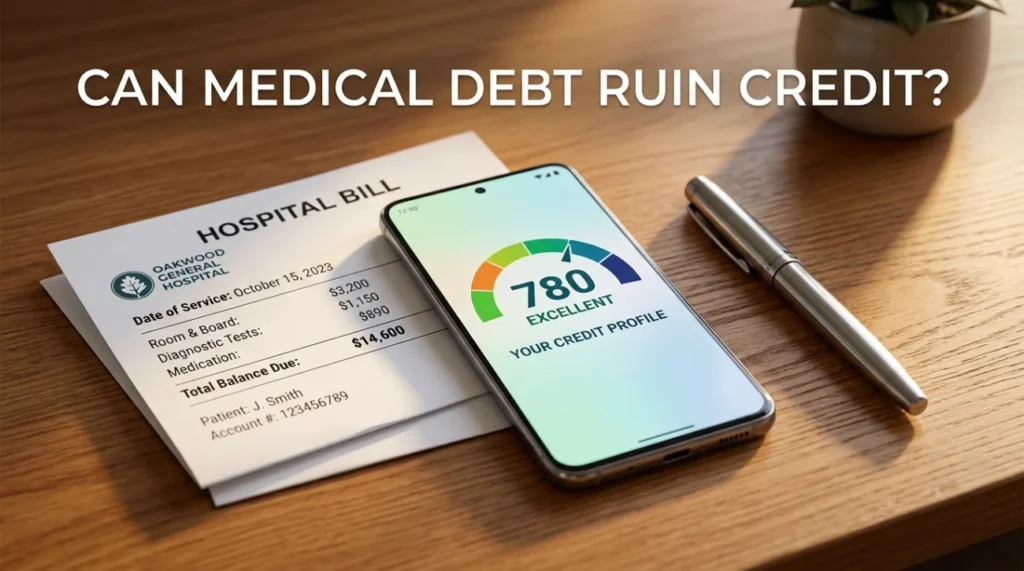
- Medical debt can cause a significant drop in your credit score, but it will not permanently ruin your credit profile.
- A worst-case scenario typically involves a drop of well over 100 points, but it takes multiple large, unpaid collections combined with other financial negatives to push a score into the “ruined” territory (the low 500s).
- New credit reporting policies enacted in 2023 provide massive protection. Paid medical collections are now completely removed from your report.
- Medical debt under $500 is no longer reported to the major credit bureaus, meaning small bills cannot damage your score at all.
- If an active collection is blocking your ability to get a mortgage or auto loan, resolving it will trigger its deletion, leading to rapid score recovery.
The Difference Between Credit Damage and Credit Ruin
Getting a notification that an account has been sent to collections is a uniquely terrifying experience. You log into your credit monitoring app, watch your score drop by 75 points overnight, and immediately assume the worst. For many patients, this moment sparks a massive wave of financial panic. They wonder if they will ever be able to buy a house, finance a reliable car, or even pass a background check for an apartment lease.
If you are frantically searching to find out if your current situation means permanent financial disaster, you need a realistic baseline. Can medical debt ruin your credit? The honest answer is no. It can damage it significantly, it can delay your financial plans, and it can be incredibly frustrating to resolve. But “ruin” implies permanent, catastrophic destruction from which you cannot recover.
When I worked inside hospital billing departments, coordinating the transfer of unpaid accounts to third-party collection agencies, I spoke with countless patients who believed their financial lives were over because of a single emergency room visit. The reality on the other side of the system is very different. Medical debt is treated uniquely by credit scoring models, and the rules governing how it is reported have undergone massive, consumer-friendly changes in the last few years.
To understand exactly what you are facing, we have to look past the scary collection letters. We need to break down the absolute worst-case scenario, the timeline for recovery, and the new rules that protect you from permanent credit damage.
The Realistic Worst-Case Scenario
To reduce the fear, we first have to look the worst-case scenario directly in the eye. What actually happens when a large, unpaid medical bill hits your credit report?
Let us assume you have a $5,000 hospital bill that has been sitting unpaid for over a year. The hospital assigns it to a collection agency. The agency waits the mandatory one-year grace period, and then they report the unpaid balance to Equifax, Experian, and TransUnion.
If you had an excellent credit score before this happened, perhaps around 780, the appearance of a new collection account is going to hurt. You might see a drop of well over 100 points. Your score could fall into the low 600s. This is a severe impact. If you apply for a loan in this state, you will likely be approved, but you will not get the prime interest rate.
This score drop is the mechanism that makes people ask if will medical debt affect credit score models permanently. It feels like a punishment. However, a score in the low 600s is not ruined. It is dented.
The Mortgage Lending Factor (FICO 8)
The severity of the damage often depends on who is looking at your credit. Newer scoring models like FICO 9 and FICO 10 treat medical collections much more leniently than credit card defaults. The algorithm recognizes that medical debt is usually involuntary. You do not choose to have a heart attack the way you choose to max out a credit card on a vacation.
However, the pain point for most consumers comes from the mortgage industry. Most mortgage lenders still use older models, specifically FICO 8 or earlier versions, to evaluate home loans. These older models treat a medical collection just like any other default. This is why a single medical collection can temporarily stall a home purchase, forcing you to delay until the issue is resolved.
The Highest Risk Group: If you are planning to apply for a mortgage within the next 12 months and have a recent, large medical collection, you are in the highest risk category. This specific combination is what actively blocks loan approvals, and assuming it will just fade away on its own is a mistake.
“The most panicked phone calls I ever took in the billing office were from patients sitting in a mortgage broker’s office. They were a week away from closing on a house, only to have the underwriter flag a two-year-old medical collection they never knew existed. They thought the house was gone forever. It wasn’t. They just needed the right mechanism to remove it.”
The Actual “Ruin” Threshold
If a large drop does not equal ruined credit, what does? In the credit industry, a ruined profile usually means a score in the low to mid 500s. At this level, traditional lenders will deny almost all applications, and even securing a high-fee credit card becomes difficult.
Can unpaid medical bills ruin your credit to this severe extreme? On their own, almost never. It is incredibly rare for a single medical collection to drag a healthy 750 score down to a 520.
Reaching that level of credit damage almost always requires a combination of negative factors. It usually involves multiple large collections from different sectors, a history of 60-day and 90-day late payments on active credit cards, auto loan defaults, or a recent bankruptcy. If your only negative financial mark is a medical bill, you are dealing with an isolated issue, not a systemic credit failure.
Furthermore, the damage from a collection account diminishes over time. A medical collection that is four years old has significantly less impact on your daily credit score than a collection added last month. The algorithm weighs recent behavior heaviest. Time is a natural healer for credit damage, but you do not necessarily have to wait years for relief anymore. New industry-wide policies provide immediate safeguards.
The Three Rules That Protect Your Score Today
The biggest reason you do not need to panic is that the landscape of how medical debt on your credit report functions has changed drastically. Consumer advocates spent years proving that medical collections are not accurate predictors of a person’s willingness to repay standard loans. In response, the three major credit bureaus instituted massive, voluntary policy changes.
1. The $500 Floor Protection
As of 2022, the credit bureaus will not accept reporting for any medical collection under $500. This is a massive shield. The vast majority of surprise medical bills, leftover lab fees, and forgotten copays fall under this limit. If a collector is threatening to ruin your credit over a $250 urgent care bill, they are making an empty threat. The credit bureaus literally will not allow that data to be added to your profile.
2. The Disappearing Paid Debt Rule
This is the most critical change for anyone worried about permanent damage. Prior to April 2023, if you paid off a medical collection, the account stayed on your report. The status simply updated to “Paid Collection.” Because the derogatory mark remained, your score barely improved. You were punished for years even after doing the right thing.
That is no longer true. Today, paying a medical collection forces the credit bureaus to delete the tradeline entirely. It vanishes. It is as if the collection never happened. This policy change completely neutralizes the idea that medical debt can destroy your credit forever. If you have the means to resolve the debt, you have the means to erase the credit damage completely.
3. The 15-State Reporting Bans
State governments are stepping in where federal regulations have stalled. As of right now, 15 states have passed legislation that restricts or completely bans medical debt from being reported to credit bureaus. If you live in one of these protective states, you have a powerful shield, though you must confirm your specific health plan falls under state regulation rather than federal employer laws.
💡 Pro Tip: If you find an unpaid medical collection on your report that has an original balance of $350, you do not even need to pay it to get it off your report. It is there in violation of bureau policy. You simply dispute it directly with the credit bureau for immediate removal.
The Clear Path to Credit Recovery
Knowing that your credit is not ruined is comforting, but you still need a strategy to repair the dent. Your path forward depends entirely on the size of the debt, your ability to pay, and how long the debt has been sitting there.
If you have an overwhelming amount of medical debt across multiple high-balance accounts, and paying them off is mathematically impossible, you need to look at specialized options. This is the scenario where people often wonder if debt relief programs can actually help with medical bills. Sometimes, organized intervention is necessary when the balances are catastrophic.
However, if you are dealing with a single collection account that you just want gone, the recovery process is straightforward.
- 📌 Prevent It With a Payment Plan: If the bill has not yet been sent to a third-party collector, setting up a payment plan directly with the hospital prevents it from ever being reported. Hospitals do not report active payment plans to credit bureaus.
- 📌 Validate the Debt First: Never pay a collector blindly. Force them to prove they own the debt, that the balance is accurate, and that they have the right to collect it. Medical billing has a staggering error rate.
- 📌 Check the Age: Medical debt does not haunt you forever. By law, it must fall off your report seven years from the date of your first missed payment to the original provider. You need to know the exact timeline for when medical debt falls off your credit report to decide if it is even worth engaging with the collector. If a debt is six and a half years old, waiting it out is often the smartest strategy.
- 📌 Settle or Pay for Deletion: Because paid medical debt is now deleted automatically, the old “pay for delete” negotiation tactic is no longer required as a special favor. If you settle the account with the collection agency, they must report it as resolved to the bureaus, which triggers the deletion.
- 📌 Rebuild While You Wait: You do not have to wait for the collection to fall off to improve your score. Positive credit activity, like making on-time payments on existing credit cards and keeping your utilization low, actively rebuilds your score even while the collection remains. Adding new positive history dilutes the impact of the old medical debt.
Final Thoughts on Protecting Your Future
It is easy to let the fear of a ruined credit score paralyze you. Collection agencies bank on this fear. They use the threat of credit reporting to pressure patients into making payments they cannot afford, often for bills that contain billing errors in the first place.
Take a deep breath and look at the facts. Can medical collections ruin your credit? No. They can cause a temporary, frustrating drop. But the consumer protections now in place give you more leverage than ever before to fight back and recover.
Your credit score is a fluid number. It goes up and it goes down. If a medical collection is actively blocking you from a major life goal, you have a direct path to fix it. Understand the rules, understand how medical debt interacts with your credit score specifically, and take methodical steps to clear the hurdle.
If a medical collection is stubbornly sitting on your report when it shouldn’t be, you do not have to wait for the system to catch up. You can force the issue by learning exactly what steps to take to remove medical debt from your credit report today.
❓ FAQ
📉 Will medical debt ruin my credit if it is under 500 dollars?
No. Under current voluntary policies by the three major credit bureaus, medical collections with an original balance under $500 cannot be reported to your credit file at all. It will not affect your score.
⏳ Can unpaid medical bills ruin your credit forever?
No. Under credit reporting rules, a collection account must fall off your credit report seven years after the date of your first missed payment. The negative impact decreases significantly as the account ages during those seven years.
💳 Does medical debt ruin credit as much as a credit card default?
On newer scoring models like FICO 9, medical debt has much less impact than credit card defaults. However, older models like FICO 8 (often used for mortgages) treat them similarly. Regardless, a single collection rarely ruins a profile completely.
🏛️ Can medical collections ruin your credit if you live in a state with new protections?
Several states have passed laws banning or restricting medical debt from credit reports for certain state-regulated health plans. If your insurance falls under these state-level protections, the debt may not legally be reported. You should check your specific state’s current laws.
📈 How fast does your score bounce back after you pay a medical collection?
Since paid medical collections are now deleted entirely, your score should recover shortly after the deletion is processed. This typically takes 30 to 60 days from the time the collector reports the payment to the bureau.
🏥 Can a hospital put a bill on my credit report directly?
Generally, no. Hospitals almost never report directly to credit bureaus. They assign or sell the unpaid debt to a third-party collection agency, and that agency is the entity that places the mark on your report after a one-year grace period.
📄 Does applying for financial assistance stop credit damage?
Many nonprofit hospitals have financial assistance policies that pause extraordinary collection actions, which can include credit reporting, while your application is being actively reviewed. You should check your specific hospital’s policy to confirm this protection.
🤝 What happens to my credit if I settle the debt for less than I owe?
If you reach a settlement agreement and the collection agency considers the account resolved, they must report it as such to the bureaus. Under the new policies, a resolved medical collection should be deleted from your report.
❌ Can medical debt hurt your credit if the insurance company made the mistake?
Unfortunately, yes. If the bill goes unpaid because you are fighting with insurance, it can still be sent to collections. This is why you must formally dispute the bill in writing with the provider to pause collection activity while the insurance issue is resolved.
Medical Debt and Credit
How medical debt affects your credit and what the current rules allow you to do about it.
- How medical debt gets reported, what the current rules allow, and what protects you
- Are Medical Bills Reported to the Credit Bureaus? How the Reporting Process Actually Works
- Paid Medical Debt Credit Report Rules: What Happens When You Pay
- Will Medical Debt Affect My Credit Score? How Much, When, and How Long
- Should Medical Debt Be on My Credit Report? How to Tell If It’s Legitimate
Fixing the Credit Damage
Understanding the rules gives you context. These pages cover what to actually do with it.
- How a HIPAA violation in the collection process can lead to removing an account from your report
- Negotiating the underlying bill to reduce the balance that is currently affecting your credit
- Settling the collection account that is pulling down your credit score
- Relief programs that can resolve the collection accounts currently appearing on your report
- The removal methods that actually work under the current credit reporting rules
Disclosure: The content on this site reflects direct experience inside hospital billing and medical debt collection, and is grounded in federal law and regulation. It is informational in nature. Reading it does not constitute legal advice and does not create any professional relationship. If you are facing a lawsuit, a judgment, or a legal deadline, consult a licensed attorney in your state before taking action.