
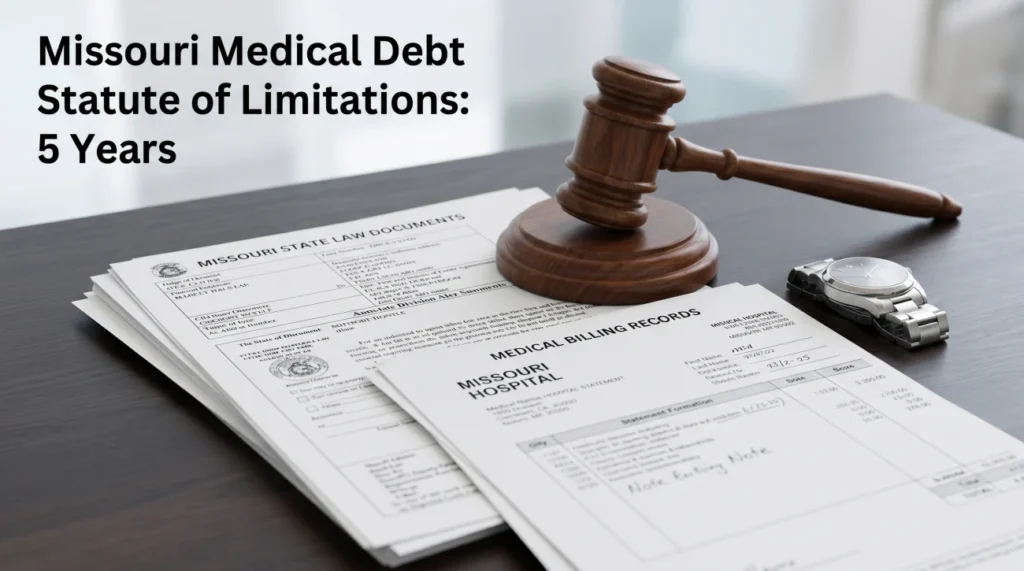
- The Missouri medical debt statute of limitations is five years, giving collectors a strict legal window to file a lawsuit against you.
- Making a partial payment or acknowledging an old debt in writing can completely restart this five-year clock.
- Garnishing wages in Missouri requires a multi-step court process, which gives patients several procedural opportunities to respond and negotiate.
- Missouri offers a “head of family” exemption that can protect up to 90 percent of a primary earner’s wages from medical debt garnishment.
Understanding Your Legal Timeline in Missouri
When you receive a collection letter threatening legal action over an old hospital bill, the natural response is panic. You want to know if the threat is real and how much time you actually have. For residents dealing with aggressive collection agencies, knowing the exact Missouri medical debt statute of limitations is the strongest defense you can build.
During my time working inside hospital billing departments, I saw exactly how accounts were handled once they moved into the collection pipeline. Collectors know the five-year legal window in this state intimately. They also know that the court process required to actually take your money is long and complicated. Because most patients do not understand these procedural steps, collectors often rely on urgency and fear to extract payments before a judge is ever involved.
To navigate this safely, you have to separate the psychological pressure from the actual Missouri medical debt laws. There is a baseline of federal protection that applies to everyone, but state laws determine exactly how long a collector can sue you and what they can take if they win. Once you understand the rules of the game, you immediately regain your leverage.
The 5-Year Window to File a Lawsuit
Under Missouri law (RSMo § 516.120), the legal timeframe to sue someone for a written contract is five years. Because most hospital admission forms and financial responsibility agreements are classified as written contracts, the statute of limitations on medical debt Missouri patients face is almost always five years.
This five-year clock usually starts on the date of your first delinquency or your last payment, whichever is most recent. If five years pass without a lawsuit being filed, the debt becomes “time-barred.” This means the collector has permanently lost their right to take you to court to force payment. They can still call you and send letters, but their most powerful tool has been removed.
Collectors will sometimes try to imply they can still sue you on a time-barred debt. Threatening legal action on a debt that is past the statute of limitations is a direct violation of federal law. If a collector crosses this line, it is important to know what your options are if a collector is using illegal threats or improper information to pressure you.
The Multi-Step Court Process
One of the biggest misconceptions patients have is that a collection agency can simply decide to garnish their wages. In reality, reaching your paycheck requires a multi-step court process. In Missouri, the collector must first file a lawsuit, serve you with the paperwork, win a judgment in court, and then separately apply for a continuing wage garnishment order.
“Inside the billing department, I regularly saw accounts escalated to litigation simply because the patient ignored the initial court summons. The debt buyer did not always have the documentation to win a contested trial, but they knew a default judgment would be granted automatically if the patient never showed up to challenge it.”
Each of these steps requires formal court action. This structure gives you procedural opportunities that most debtors never use. When you receive a summons, you have a specific window of time to respond, demand validation of the debt, or negotiate. To see how these deadlines fit into the broader federal picture, you can read our guide on how the medical debt statute of limitations works federally.
The Missouri medical bill statute of limitations is just the first hurdle for the collector. If you respond to a lawsuit rather than ignoring it, you force the collector to prove they have the legal right to collect the exact amount they claim, which debt buyers often struggle to do.
What If You Already Have a Default Judgment?
Many patients only realize they have been sued when their employer notifies them of a pending garnishment. If you missed the initial court summons and a default judgment was already entered against you, you might assume all your options are exhausted. That is not always true.
Missouri law (specifically Rule 74.05) allows defendants to file a Motion to Set Aside a Default Judgment. You typically have a limited window to file this motion if you can demonstrate “good cause” for missing the original summons (such as improper service) and a “meritorious defense” against the debt itself (such as billing errors or an expired statute of limitations). This is a highly specific procedural lifeline that can stop a garnishment in its tracks and force the collector back to the negotiating table.
Protecting Your Paycheck: The Head of Family Exemption
If a collector does successfully secure an active judgment against you, Missouri law dictates what they can and cannot take. The state follows the federal baseline for standard wage garnishment, meaning 75 percent of your disposable earnings are automatically exempt. The collector can only touch the remaining 25 percent.
However, Missouri offers a powerful additional protection known as the “head of family” exemption. If you are a Missouri resident and you provide the primary financial support for a family, you can claim this exemption to protect up to 90 percent of your disposable earnings from wage garnishment. This drastically reduces the financial incentive for a collector to pursue your paycheck.
Assuming the court will automatically apply the head of family exemption to your paycheck because you have children listed on your tax returns.
Actively filing the necessary exemption claim paperwork with the court as soon as you receive notice of a garnishment attempt.
It is important to note that bank account levies follow different rules than wage garnishments. Once exempt wages are deposited into a checking account and mixed with other funds, protecting that money becomes much more difficult. If you are comparing your situation to other regions, you can review how state medical debt protections compare across the country to see where Missouri stands.
The Reality of Dealing with Collectors
Even with strong procedural options and wage exemptions available, receiving a collection notice referencing a medical debt collection Missouri statute will always look threatening. Instead of reacting to the aggressive tone, force the collector to operate on your timeline.
If they call, shut down the conversation immediately to prevent accidental verbal admissions or emotional reactions. You must ensure all communication is documented.
“I have no information regarding this account and I do not acknowledge this debt. Please send all validation and future communication in writing to my mailing address. Do not call me again.”
Once you force them to communicate in writing, you can calmly assess whether the debt is within the five-year window. If you verify the debt is legitimate, legally actionable, and you simply cannot afford it, you need to explore how to settle the account before it escalates to a lawsuit. Debt buyers are often willing to accept a fraction of the total balance to close the file without the expense of a trial. You can also check your specific timeline on a state by state basis to confirm your exact window of exposure.
Final Thoughts: Using Missouri Law to Your Advantage
Missouri’s legal framework gives you more room to maneuver than collectors want you to believe. The five-year statute of limitations acts as a hard boundary on their ability to sue. If they do decide to litigate, the requirement to separately apply for a continuing wage garnishment order means you have multiple chances to respond, including setting aside a default judgment. And if you are the primary earner, the head of family exemption can shield almost your entire paycheck.
Stop waiting for the next threatening letter. By verifying your timeline and understanding these state-specific protections, you can actively dismantle a collector’s leverage and force a resolution on your terms.
❓ FAQ
⏱️ What is the statute of limitations on medical debt in Missouri?
In Missouri, the statute of limitations for written contracts, which covers almost all medical debt, is five years. After five years from the date of your last payment or first delinquency, a collector cannot legally sue you.
⚖️ Can a hospital sue me after 5 years in Missouri?
No. Once the five-year statute of limitations expires, the debt becomes time-barred. If a hospital or collection agency tries to file a lawsuit after this window, you have an absolute legal defense to have the case dismissed.
💳 Will making a small payment restart my medical debt clock?
Yes. Making any payment toward the balance, even a few dollars, will legally reset the five-year statute of limitations from the date of that payment, giving the collector a brand new window to sue you.
💸 How much of my paycheck can a medical collector take in Missouri?
Under the standard rule, a collector with a court judgment can garnish up to 25 percent of your disposable earnings. The remaining 75 percent is automatically protected by law.
👨👩👧👦 What is the head of family exemption for medical bills?
If you provide the primary financial support for a family in Missouri, you can claim the head of family exemption. This protects up to 90 percent of your disposable wages from being garnished, leaving only 10 percent vulnerable.
🏦 Can medical debt collectors empty my bank account in Missouri?
If a collector wins a judgment, they can request a bank levy to freeze and seize funds in your account. Bank accounts do not have the same automatic percentage protections as wages, making them more vulnerable.
📉 How long does a medical collection stay on my credit report?
Under federal law, a medical collection can remain on your credit report for seven years from the original date of delinquency. This credit reporting timeline is completely separate from the five-year Missouri statute of limitations.
🏥 Do Missouri hospitals have to offer financial assistance?
Nonprofit hospitals in Missouri are required by federal law to offer financial assistance programs to eligible low-income patients. You must usually apply for these programs actively to receive the charity care discounts.
⚠️ What happens if I ignore a medical debt lawsuit summons?
If you ignore a summons and fail to appear in court or file an answer, the judge will almost certainly grant the collector a default judgment. This gives them the immediate legal right to begin the garnishment process.
📞 Are verbal promises to pay legally binding for medical debt?
Unlike a written acknowledgment or a partial payment, a verbal promise to pay over the phone does not legally restart the five-year statute of limitations in Missouri. However, collectors may still try to use a recorded call as leverage. To keep your legal timeline protected, never agree to anything verbally and demand all communication in writing.
Medical Debt Laws
The state-by-state legal framework that determines how long collectors can pursue you.
- State-by-state: statute of limitations, collection limits, and consumer protections
- New Hampshire Medical Debt Laws: Statute of Limitations and Collection Rules
- State Medical Debt Laws: What Your State Adds Beyond Federal Protections
- Wyoming Medical Debt Statute of Limitations: 8 years
- Rhode Island Medical Debt Statute of Limitations: 10 Years
Turning Legal Knowledge Into Action
State law gives you leverage. These pages explain how to use it.
- How federal HIPAA law creates leverage you can use against a medical debt collector
- Your legal right to negotiate any medical bill and what providers cannot refuse
- How to settle medical debt within the window your state laws still allow
- How debt relief programs interact with your state collection laws and protections
- Removing medical debt from your credit report under the current federal reporting rules
Disclosure: The content on this site reflects direct experience inside hospital billing and medical debt collection, and is grounded in federal law and regulation. It is informational in nature. Reading it does not constitute legal advice and does not create any professional relationship. If you are facing a lawsuit, a judgment, or a legal deadline, consult a licensed attorney in your state before taking action.