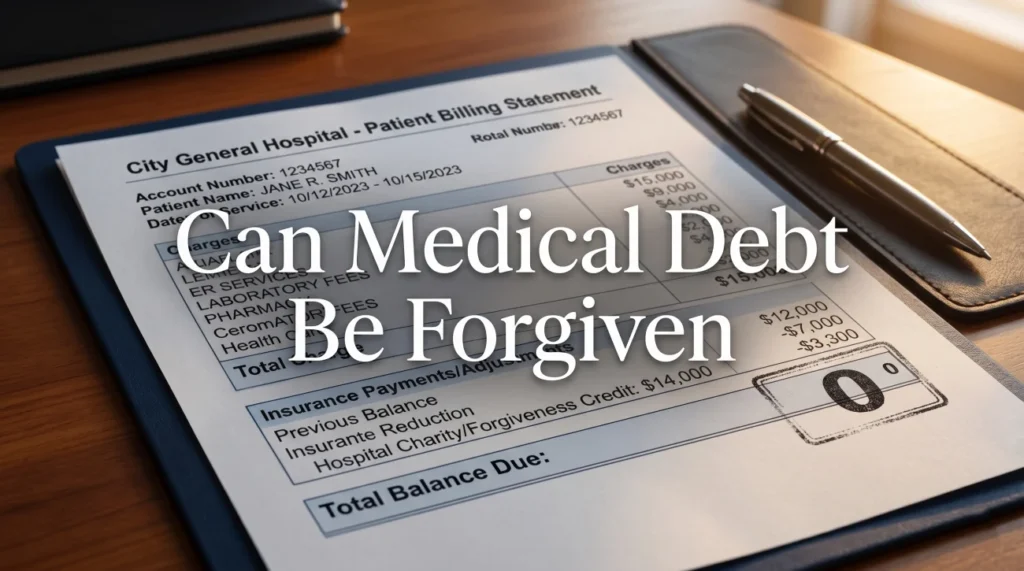
- Yes, medical debt can be completely forgiven, but it depends on who holds the account, your income, and your geographic location.
- Nonprofit hospitals are required by federal law to offer financial assistance, which can forgive 100% of the bill for families making up to $96,000 a year.
- Unlike credit card debt, forgiven medical debt is generally not treated as taxable income by the IRS.
- The biggest mistake patients make is letting the bill go to collections before applying for hospital forgiveness programs.
The Reality Behind Erasing Hospital Bills
I get asked this question more than almost any other. When patients are staring at a massive balance after a hospital stay, they want to know if there is a way to just make it go away. As someone who worked inside hospital billing departments and processed thousands of patient accounts, I can tell you the answer is yes. You absolutely can get medical debt forgiven.
But it does not happen by accident, and it is rarely automatic. Whether your medical debt is forgiven depends entirely on learning the specific rules of the system before the hospital transfers your account to an outside agency. There is no single federal program that erases all healthcare debt for everyone. Instead, there are four very distinct paths. Knowing which one applies to your specific situation is the difference between writing a check you cannot afford and having the balance zeroed out completely.
The Window You Cannot Afford to Miss
Before we look at the specific programs, we have to talk about timing. The most common reason patients fail to get their medical bills forgiven has nothing to do with their income. It has to do with when they finally decide to ask for help.
Hospitals have a very rigid timeline. From the moment your first statement is generated, a clock starts ticking. If you ignore the mail because you cannot pay it, the billing system will eventually flag the account as delinquent and ship it off to a third-party collection agency. Once that happens, the easiest and most powerful forgiveness option is usually taken off the table.
Field Note: In my review of patient accounts, the most frustrating pattern I saw was a patient who clearly qualified for 100% financial assistance, but they ignored the first three statements out of fear. By the time they called us, the system had already transferred the account to collections, and we could no longer just erase it internally.
If you are wondering if medical debt gets forgiven after a certain number of years of ignoring it, the answer is no. The statute of limitations may eventually stop them from suing you, but the debt still exists. True forgiveness requires action.
Path 1: Hospital Charity Care Programs
This is the most common and accessible way to have medical debt forgiven. Under federal law, specifically IRS Section 501(r), every nonprofit hospital in the United States must offer a financial assistance program. This is the trade-off they make for not paying taxes.
Most patients assume these programs are only for the unemployed or those living in extreme poverty. That is a massive misconception. Depending on the hospital, families of four with an annual household income up to approximately $96,000 can qualify for some level of assistance. According to data analysis from patient advocacy groups like Dollar For, some hospitals will completely forgive bills for patients earning up to 200% of the Federal Poverty Level, and offer steep discounts for those earning up to 400%.
- 📌 What it covers: Debt that is still held by the hospital.
- ✅ How it works: You submit an application with proof of income (pay stubs, tax returns).
- ❌ The limitation: It usually only applies if you apply within 240 days of the date of service.
If your bill is still with the original provider, do not wait. You need to learn how to apply for hospital financial assistance to see if you qualify. Once you understand the thresholds, you can confidently determine when a hospital is required to write off your balance entirely.
Path 2: Nonprofit Debt Purchase Programs
Sometimes, patients who never applied for hospital assistance suddenly receive a letter in the mail stating their debt has been paid and erased. This is usually the work of nonprofit organizations like Undue Medical Debt (formerly known as RIP Medical Debt).
These organizations operate differently. They buy massive portfolios of defaulted medical debt from hospitals and collection agencies for pennies on the dollar. But instead of collecting on that debt, they simply forgive it.
Trying to call Undue Medical Debt to apply for their program so they can pay your specific bill.
Understanding that this is a passive program. You cannot apply. They analyze massive data files and forgive accounts that meet their criteria automatically.
To qualify for this type of forgiveness, you generally must earn less than four times the federal poverty level, or your medical debt must be equal to 5% or more of your annual household income. While you cannot proactively trigger this process, it is one of the main ways legacy medical debt is wiped out for thousands of Americans every year.
Path 3: State-Level Forgiveness Initiatives
While the federal government has not passed a universal forgiveness act, individual states are taking matters into their own hands. If you are asking will medical debt be forgiven across the board, the answer depends heavily on your zip code.
States like North Carolina, Illinois, and specific counties like Los Angeles County have started using public funds to partner with nonprofits to erase medical debt for their residents. In North Carolina alone, programs have been structured to erase billions of dollars in past-due medical bills for eligible low-income and middle-income residents.
💡 Pro Tip: State programs are expanding rapidly. If you live in a participating state, you may not need to do anything to receive this relief, but you should always check the exact list of active medical debt forgiveness programs in your area. Keeping track of what changed recently in state-level medical relief can save you from paying a debt that your state was about to erase for you.
Path 4: Partial Forgiveness Through Settlement
What happens if your debt is already in collections and the hospital refuses to pull it back for a charity care application? Can you get medical debt forgiven at that point? The answer is yes, but usually only partially.
When a collection agency buys your debt, they often pay a tiny fraction of the original balance. This gives them massive profit margins, which means they have room to negotiate. If you owe a collection agency $5,000, you might be able to settle the account for $2,000. The remaining $3,000 is legally forgiven and written off.
If you take this route, the process involves three distinct steps:
- First, formally verify that the debt is valid and belongs to you.
- Second, offer a realistic lump-sum settlement to the collection agency.
- Third, get the forgiveness and settlement agreement in writing before you pay a single dollar.
This path requires you to have some cash on hand to make a lump-sum offer. If you have multiple accounts or thousands of dollars already sitting with collection agencies, you may want to look into how structured debt relief programs handle medical bills to force a settlement on your behalf.
Regardless of which path applies to your situation, one question almost always comes up next: will you owe taxes on the amount that gets forgiven?
The IRS Reality: Is Forgiven Medical Debt Taxable?
This is a detail that terrifies many patients. If you get a $10,000 credit card debt settled and forgiven, the IRS treats that forgiven amount as taxable income. You will receive a 1099-C tax form, and you will owe taxes on that $10,000 as if you earned it at a job.
Medical debt is treated differently. In most cases, forgiven medical debt is not treated as taxable income. The IRS generally excludes debt canceled through hospital financial assistance policies or nonprofit medical debt relief programs from your gross income. This is a massive distinction that makes pursuing medical forgiveness far safer than negotiating other types of consumer debt.
⚠️ Warning: If you use a credit card to pay your medical bill, and then later try to settle that credit card debt, it is no longer medical debt. The IRS will treat it as standard consumer debt, and the forgiven amount will likely be taxable. Never put a medical bill on a credit card if you plan to seek forgiveness.
Final Thoughts: Act While You Have Options
There are very real mechanisms designed to erase healthcare balances, but they require you to be proactive. Do not let the billing cycle run out while you hope the hospital simply forgets about your account. Call the billing department, ask for an itemized bill, and request the financial assistance application today, which can help you avoid the account being transferred to collections while the application is under review.
If you want to view the entire landscape of your options, review the comprehensive ways to get rid of medical debt to map out your next step. Taking action early is your strongest leverage in this system. Do not surrender it by waiting.
❓ FAQ
🏥 Does medical debt get forgiven automatically?
No, in most cases you must submit a formal application to the hospital’s financial assistance department. The only exception is if your debt is purchased by a nonprofit like Undue Medical Debt.
⏱️ How long before medical debt is forgiven?
Medical debt is not forgiven simply because time passes. The statute of limitations may eventually prevent a collector from suing you, but the debt remains active until it is formally resolved.
💰 Can you get medical debt forgiven if you have a job?
Yes. Hospital financial assistance is based on the federal poverty level, and many middle-income families with full-time jobs still qualify for partial or complete forgiveness.
🏛️ Will the government forgive my medical bills?
There is no federal law that automatically forgives individual medical bills, but several states have launched their own funded programs to erase legacy medical debt for their residents.
💳 Can medical bills be forgiven if paid with a credit card?
No. Once you pay a medical provider using a credit card, the debt transfers to the credit card issuer. You lose all hospital charity care rights and patient protections.
📉 Is there medical debt forgiveness for seniors?
While Medicare covers a significant portion of healthcare costs, any remaining out-of-pocket balance billed by the hospital is subject to the same charity care rules as anyone else.
🚑 Are ambulance bills eligible for forgiveness?
Ambulance services are often run by municipal governments or private companies, meaning they are rarely bound by the federal charity care rules that apply to nonprofit hospitals.
📑 How do I know if my hospital is a nonprofit?
You can check the hospital’s official website for a “Financial Assistance Policy” page, look them up in the IRS tax-exempt organization search, or simply call the billing department and ask.
⚖️ Can a collection agency forgive my debt?
A collection agency will rarely forgive a debt entirely for free, but they will frequently agree to settle the account for much less than you owe, effectively forgiving the remaining balance.
📝 What happens to my credit if my medical debt is forgiven?
If a hospital forgives your bill through charity care, it is never sent to collections and will never appear on your credit report. If it was already on your report, settling it will update the status.
Medical Debt Relief
Every option for resolving medical debt that you cannot pay in full.
- Every option for resolving medical debt including forgiveness, relief programs, and settlement
- The Medical Debt Forgiveness Act 2024: What Passed, What Didn’t, and Your Options Now
- Medical Debt Relief: What It Actually Means and Which Options Are Available to You
- Medical Debt Consolidation Loan: When It Makes Sense (And When It Doesn’t)
- Medical Bill Financial Assistance: Every Type and Where to Find It (caHow to Pay Off Medical Debt: A Realistic Strategy When You Can’t Pay All at Onceopy)
Programs That Can Help Right Now
Relief, negotiation, settlement, and credit repair. How each option actually works in practice.
- Using a HIPAA violation to reduce or eliminate what you owe before a relief program starts
- Negotiating directly with the hospital and what providers will reduce before collections
- How medical debt settlement works and what collectors will accept on accounts in collections
- How structured relief programs work for medical balances and what they actually cost you
- Cleaning up your credit report after using a relief program or settling medical debt
Disclosure: The content on this site reflects direct experience inside hospital billing and medical debt collection, and is grounded in federal law and regulation. It is informational in nature. Reading it does not constitute legal advice and does not create any professional relationship. If you are facing a lawsuit, a judgment, or a legal deadline, consult a licensed attorney in your state before taking action.