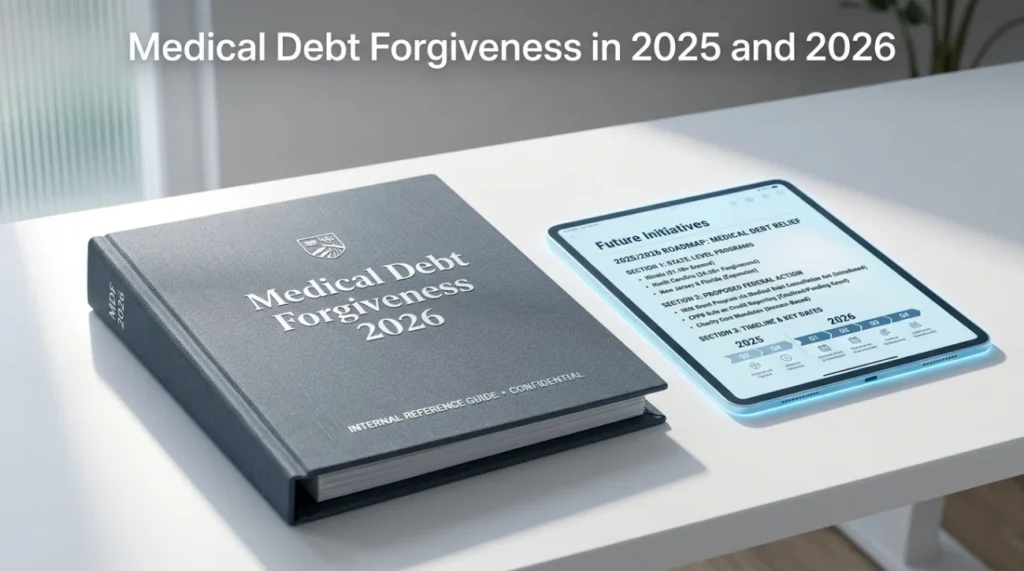
- Despite widespread rumors, there is still no federal law that automatically forgives medical debt. Any advertisement claiming a national forgiveness act has passed in 2025 or 2026 is highly misleading.
- The Biden administration’s CFPB rule that would have removed all medical debt from credit reports was struck down by a federal court in July 2025, leaving the standard 500-dollar threshold and one-year delay in place federally.
- Real progress is happening entirely at the state level. States like North Carolina, Illinois, and Louisiana have successfully erased billions in medical debt for residents using state funds and nonprofit partnerships.
- Hospital charity care remains the most reliable form of forgiveness. With inflation adjustments to the Federal Poverty Level in 2025 and 2026, a family of four earning up to roughly 132,000 dollars may now qualify for significant discounts at nonprofit hospitals.
- Waiting for news about new federal laws before handling a medical bill is the biggest mistake patients make. While you wait, your account will age past the 240-day window to apply for hospital financial assistance.
The Current Landscape of Hospital Bill Relief
Patients constantly ask me about medical debt forgiveness 2025 updates, hoping to hear that a sweeping new federal law has finally wiped their balances clean. The headlines over the past year have been incredibly contradictory. One week, the news announces that medical debt is being banished from credit reports. The next week, a court ruling strikes that initiative down. Meanwhile, social media is flooded with advertisements promising instant government relief.
Sitting inside a hospital billing compliance department, I watched exactly how this chaos impacted real people. I saw patients who were perfectly eligible for the hospital’s internal charity care program actively choose to ignore their bills. When I managed to get them on the phone, they would tell me they were just waiting for the new federal forgiveness act to take effect. By the time they realized the news was misleading, their accounts had already been sold to third-party collection agencies, completely destroying their chance to use the hospital’s internal assistance programs.
If you want to know medical debt forgiveness 2026 realities, you have to separate the political proposals from what is actually enforceable today. The landscape of medical debt relief updates 2025 brought us a year of major legal setbacks at the federal level, combined with massive, unprecedented victories at the state and municipal levels. Knowing exactly what changed, what stayed the same, and where to look right now is the only way to protect yourself.
What Did Not Change: The Federal Legislation Myth
The most common piece of misinformation circulating right now is that the federal government enacted a blanket forgiveness law. If you are searching for what is happening with medical debt forgiveness on a national scale, you need to understand the current legislative reality.
There is still no federal Medical Debt Forgiveness Act signed into law. Multiple bills with similar names have been introduced in the House and the Senate over the past few years. Some proposed canceling debt through government grants, while others proposed strict federal bans on aggressive collection tactics. None of these comprehensive packages have passed both chambers of Congress and received a presidential signature.
“The hardest conversations I had were with patients who brought printed screenshots of proposed bills into the financial counselor’s office, demanding we clear their account based on a law that never actually passed. The billing software does not pause for proposed legislation. It only recognizes active laws and signed payment agreements.”
If you see a commercial or a social media post claiming that a new federal act has wiped out medical debt, it is typically a marketing tactic used by commercial debt settlement companies to generate leads. To understand exactly what those federal proposals actually contained and why they stalled, you have to look closely at what the Medical Debt Forgiveness Act proposed versus what passed. The short answer is that waiting for Washington to clear your specific hospital bill is not a viable financial strategy.
The CFPB Credit Reporting Reversal (July 2025)
While broad legislative forgiveness never passed, the federal government did attempt a massive regulatory change regarding how medical debt affects your credit score. This is where the latest medical debt forgiveness news gets complicated.
In early 2025, the Consumer Financial Protection Bureau (CFPB) finalized a highly anticipated rule that would have effectively banned medical debt from appearing on consumer credit reports, regardless of the balance amount. This was celebrated as a massive victory for patients. However, that victory was extremely short-lived.
In July 2025, following intense legal challenges from the collection and financial services industries, a federal court struck down the CFPB rule. The court ruled that the agency had overstepped its regulatory authority. Because of this reversal, federal credit reporting rules for medical debt reverted back to the previous voluntary industry standards.
Here is what the federal credit reporting reality looks like right now:
- 📌 The 500-Dollar Threshold: Unpaid medical collections under 500 dollars cannot be reported to the three major credit bureaus. This is a voluntary policy maintained by Equifax, Experian, and TransUnion.
- 📌 The One-Year Delay: For medical debts over 500 dollars, collectors must wait a full 365 days from the date of the original delinquency before they can report the account to the credit bureaus.
- 📌 Paid Debts Are Removed: If a medical collection account is paid or settled, the credit bureaus will remove the tradeline from your report entirely, rather than just updating it to a zero balance.
It is critical to note that while the federal ban failed, multiple individual states have successfully enacted their own laws restricting or completely banning medical debt from state residents’ credit reports. This growing divide means your zip code now heavily dictates your credit protections.
The Massive Shift to State-Level Programs
Because federal efforts stalled or were struck down in court, state governments took matters into their own hands. This is where the new medical debt relief 2025 initiatives actually took root and achieved concrete results.
Instead of passing regulatory bans, several states decided to simply buy their residents’ debt and destroy it. They accomplished this by partnering with nonprofit organizations, most notably Undue Medical Debt (formerly known as RIP Medical Debt). A major highlight of 2025 was the rapid expansion of Undue Medical Debt into new territories. Several new municipal and county-level programs launched this year alone, drastically increasing the volume of debt purchased across the country.
The scale of these state-level interventions has been historic. As of late 2025 and moving into 2026, the numbers are staggering:
- North Carolina: The state implemented a massive incentive program that resulted in hospitals forgiving more than 6.5 billion dollars in medical debt for low and middle-income residents.
- Illinois: The state allocated targeted funds to purchase and erase over 400 million dollars in resident medical debt.
- Los Angeles County (California): A localized initiative successfully erased 363 million dollars in regional medical debt.
Beyond direct forgiveness, 2024 and 2025 saw Colorado, Connecticut, Minnesota, and New Jersey pass rigorous new laws strengthening patient protections. These laws force hospitals to drastically improve their financial assistance screening processes and heavily restrict the aggressive tactics that collection agencies can use.
💡 Pro Tip: You cannot submit an application to Undue Medical Debt or most state portfolio-purchase programs. They operate passively. If your debt is part of a portfolio they purchase, you simply receive a branded letter in the mail informing you that your specific account has been forgiven. Do not pay companies that claim they can apply for these specific state programs on your behalf.
Because these initiatives change month by month, tracking what is currently active in your specific region is essential. You can map out exactly which current medical debt forgiveness programs are operating in your state right now to see if local relief applies to you.
The Constant Baseline: IRS Section 501(r)
While the news cycle focuses heavily on new state laws and court battles, the most reliable and most powerful form of medical debt forgiveness has not changed at all. It remains quietly buried in the federal tax code.
Under IRS Section 501(r), every nonprofit hospital in the United States is required by federal law to maintain a financial assistance program (often called charity care). In exchange for paying no taxes, these hospitals must provide free or heavily discounted care to patients who meet certain income criteria.
This is not a recent development. It is the established baseline. However, what makes this crucial for 2025 and 2026 is inflation. Hospitals calculate eligibility based on the Federal Poverty Level (FPL), which is updated annually by the Department of Health and Human Services.
Because the FPL guidelines have adjusted upward to account for inflation, the income limits to qualify for hospital forgiveness are higher now than ever before. This means families who might have been denied assistance in 2023 could easily qualify in 2026.
| Assistance Level | Typical FPL Threshold | Est. 2025-2026 Income (Family of 4) |
|---|---|---|
| 100% Full Forgiveness | Up to 200% FPL | Under ~$62,400 |
| Significant Discounts | 201% to 300% FPL | $62,400 to ~$94,800 |
| Partial Sliding Scale | 301% to 400% FPL | $94,800 to ~$132,000 |
A household earning 120,000 dollars a year might assume they make far too much money to qualify for hospital charity care. Yet, at many major nonprofit healthcare systems, that income level falls comfortably within the 400 percent FPL threshold, qualifying them for a partial write-off that could slice thousands of dollars off a surgical bill.
If you have an outstanding bill with the original provider, you need to understand if your specific medical debt can be forgiven based on these updated brackets. For a practical walkthrough of the paperwork required, learning how to apply for hospital financial assistance correctly is always your safest first step.
The Danger of Waiting for Federal Action
The single most destructive trend I witnessed regarding medical debt was the “wait and see” approach. Patients would read a headline about a politician promising to cancel medical debt, so they would stop answering calls from the billing department. They assumed the problem would soon be solved for them.
This is a fundamental misunderstanding of how the billing timeline works. Hospital financial assistance applications are strictly time-bound. Under the law, nonprofit hospitals generally give you 240 days from the date of your first billing statement to apply for charity care. Once that 240-day window expires, the hospital has the legal right to permanently deny your application, sell your account to a third-party debt buyer, and wash their hands of the situation.
Ignoring a hospital bill because you read that the government is working on a new relief package, assuming the hospital will automatically pause your account while Congress debates.
Immediately calling the billing department to request a financial assistance application. Filing the application legally forces the hospital to pause all collection activity while they review your documents, buying you guaranteed safety.
If your 240-day window has already expired, or if your debt has already been sold to a commercial debt buyer, you can no longer rely on hospital charity care. Your account has transitioned from a healthcare billing issue into a standard debt collection issue. At that point, you have to look at the broader map of how to get rid of medical debt using settlement tactics.
For patients who are overwhelmed by multiple accounts that have already crossed over into third-party collections, navigating settlement negotiations alone can be daunting. In those specific scenarios, evaluating whether structured programs like National Debt Relief can help with your medical bills becomes a necessary part of the strategy.
What to Watch for in 2026: Act on What Exists Today
The core lesson from the updates of the past two years is that relying on sweeping national change is a gamble you cannot afford to take with your financial health. The CFPB reversal proved that even finalized federal rules can be dismantled overnight in a courtroom.
As we move deeper into 2026, the pipeline of relief is heavily focused on the state level. Expect to see additional municipalities partnering with nonprofits for debt purchases, and keep an eye on active legislative sessions in states proposing new wage garnishment limits and consumer protections.
However, the lack of a universal federal bailout does not mean you lack options. The expansion of state-level forgiveness programs and the inflation-adjusted power of hospital charity care offer massive, tangible relief to millions of patients right now. Your strategy must be built on the policies that are active today. Verify your state’s current programs, calculate your household income against the updated Federal Poverty Level guidelines, and force the hospital to process your application before your time runs out.
❓ FAQ
🏛️ Did the federal government pass a medical debt forgiveness law in 2025?
No. Despite numerous legislative proposals and widespread rumors, no federal Medical Debt Forgiveness Act has been signed into law. Broad, automatic forgiveness at the national level does not currently exist.
📉 Is medical debt still being removed from credit reports in 2026?
The sweeping federal rule was struck down in July 2025. However, the 500-dollar threshold and the one-year delay remain active nationwide. If you need larger debts completely removed, you now have to rely on state-specific laws or attempt to negotiate a pay-for-delete agreement with the collector.
🏥 Does the July 2025 CFPB ruling affect hospital financial assistance?
No. The CFPB court ruling only affected credit reporting regulations. It did not alter IRS Section 501(r), meaning nonprofit hospitals are still federally required to offer charity care and financial assistance programs.
🗺️ Which states have active medical debt relief programs right now?
As of late 2025, states like North Carolina, Illinois, and Louisiana have executed massive medical debt cancellation programs. Connecticut, Colorado, Minnesota, and New Jersey have also passed strong new consumer protection laws.
✉️ How do I know if the Undue Medical Debt program erased my bill?
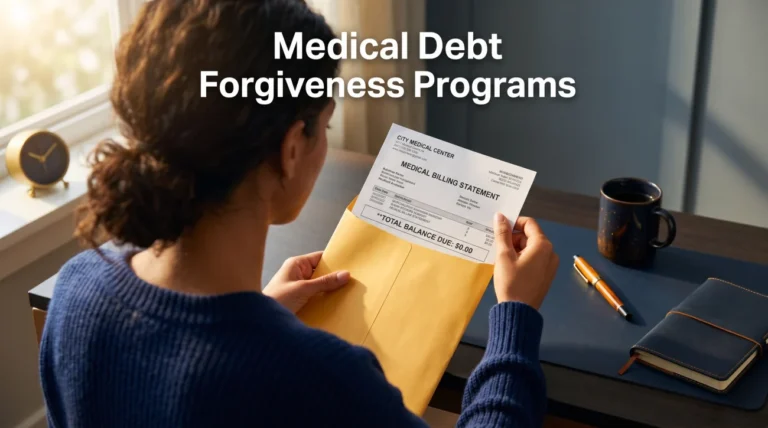
Since you cannot apply directly, patients often wonder how they will find out. If a nonprofit purchases and forgives your debt, you will simply receive a branded letter in the mail, often in a recognizable yellow envelope, stating that the account is paid in full. There is no portal to check your status beforehand.
💰 What are the 2025 and 2026 income limits for hospital charity care?
Because limits are based on the Federal Poverty Level (FPL), which adjusts for inflation, the thresholds are higher than ever. Many nonprofit hospitals offer partial discounts to a family of four earning roughly up to 132,000 dollars annually.
⏳ What is the biggest risk of pausing payment while waiting for government relief?
The biggest risk is crossing the timeline where your account is legally transferred to a third-party debt buyer. Once sold to an outside buyer, you typically lose access to the hospital’s internal charity care programs and face a much more aggressive collection process.
⚖️ Did any new states ban medical debt wage garnishment recently?
While a handful of states maintain complete bans on medical wage garnishment, the bigger trend in 2025 and 2026 is states passing legislation to lower garnishment caps. This means even if a collector wins a judgment, the percentage of your paycheck they can legally take is shrinking in many jurisdictions.
📰 Why do I keep seeing ads for new medical debt relief 2025 updates?
Commercial debt settlement companies frequently use headlines about proposed government legislation to generate leads. If an ad promises instant government cancellation, it is likely a marketing hook for a paid settlement service.
🏦 Are for-profit hospitals included in these new state forgiveness programs?
It depends on the state. For example, North Carolina’s massive 6.5 billion dollar relief program specifically incentivized all hospitals in the state, including some large health systems, to participate in erasing eligible debt.
Medical Debt Relief
Every option for resolving medical debt that you cannot pay in full.
- Every option for resolving medical debt including forgiveness, relief programs, and settlement
- Medical Debt Consolidation Loan: When It Makes Sense (And When It Doesn’t)
- Medical Bill Help for Low Income: Programs That Can Reduce or Erase What You Owe
- The Medical Debt Forgiveness Act 2024: What Passed, What Didn’t, and Your Options Now
- Medical Bill Financial Assistance: Every Type and Where to Find It
Programs That Can Help Right Now
Relief, negotiation, settlement, and credit repair. How each option actually works in practice.
- Using a HIPAA violation to reduce or eliminate what you owe before a relief program starts
- Negotiating directly with the hospital and what providers will reduce before collections
- How medical debt settlement works and what collectors will accept on accounts in collections
- How structured relief programs work for medical balances and what they actually cost you
- Cleaning up your credit report after using a relief program or settling medical debt
Disclosure: The content on this site reflects direct experience inside hospital billing and medical debt collection, and is grounded in federal law and regulation. It is informational in nature. Reading it does not constitute legal advice and does not create any professional relationship. If you are facing a lawsuit, a judgment, or a legal deadline, consult a licensed attorney in your state before taking action.