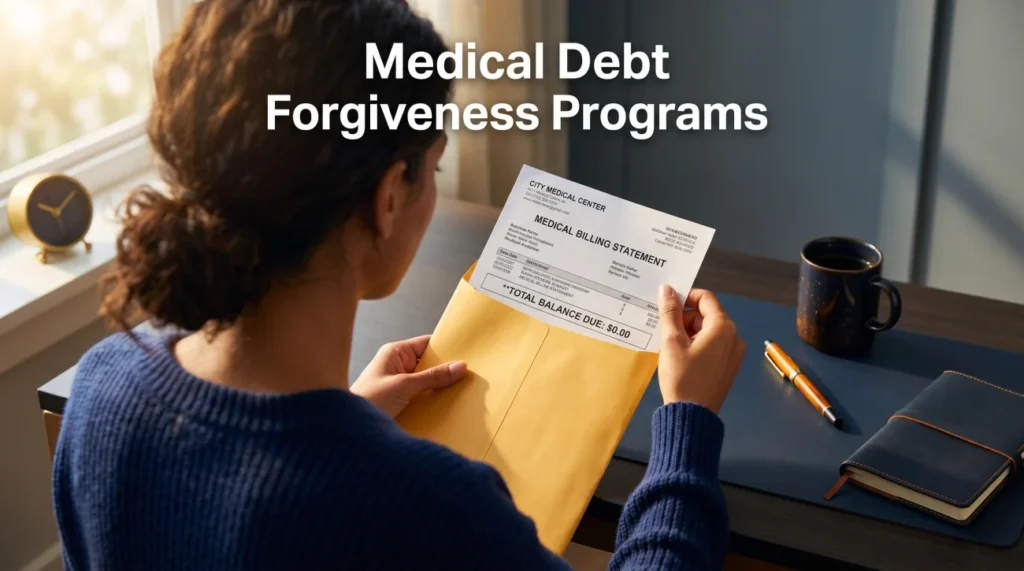
- There is no single federal program that erases medical bills, but a patchwork of hospital policies, state laws, and nonprofit initiatives forgive billions in medical debt every year.
- Nonprofit hospitals are required by federal law to offer financial assistance. If you qualify based on income, they must forgive all or part of your bill.
- You typically have a strict 240-day window from the date of your first billing statement to apply for hospital-based forgiveness.
- National nonprofits like Undue Medical Debt operate passively. You cannot apply to them directly; they buy debt portfolios and send letters to patients whose debt they have erased.
- An estimated $14 billion in charity care goes unclaimed annually because the system requires patients to ask for help, and most do not know these programs exist.
The Hidden Landscape of Medical Debt Relief
If you are drowning in hospital bills, searching for medical debt forgiveness programs can feel like chasing a ghost. You hear on the news that billions of dollars in medical debt are being erased, but when you look for a simple government website to apply for help, you find nothing. There is no single federal portal to submit your bills and have them wiped clean.
However, that does not mean forgiveness is a myth. During my time working inside hospital billing departments, I saw thousands of accounts zeroed out completely. The money to erase these bills exists, and the programs that forgive medical debt are very real. The catch is that they are fragmented across individual hospitals, state governments, and independent nonprofits. Knowing where to look – and knowing the deadlines – changes everything.
Most patients assume that if they qualified for free medical debt help, the hospital would have told them. In reality, the burden is almost always on you to find the program, ask for the application, and prove you qualify. If you want to know other legitimate ways to eliminate medical debt, understanding the forgiveness landscape is your mandatory first step.
Category 1: Hospital Financial Assistance (Charity Care)
This is the largest and most accessible source of medical bill forgiveness programs in the country. If you were treated at a nonprofit hospital, they do not just offer financial assistance out of the goodness of their hearts – they are required to do so by federal law.
Under IRS Section 501(r), tax-exempt hospitals must maintain a formal financial assistance policy. These programs forgive bills entirely for low-income patients and offer sliding-scale discounts for middle-income households.
Who Qualifies for Hospital Forgiveness?
Hospitals base their eligibility on the Federal Poverty Level (FPL). Every facility sets its own cutoffs, but the typical structure is surprisingly generous. Many hospitals offer 100% forgiveness for households earning up to 200% of the FPL. For a family of four, that means you could earn up to $62,400 a year and still qualify to have your entire bill erased.
Households earning between 200% and 400% of the FPL can often receive discounts ranging from 50% to 80% off their balance. If you want to dive deeper into the specific mechanics of whether your income qualifies, you should review medical bill assistance for low-income households.
“When I reviewed accounts for compliance, I saw hundreds of patients who clearly qualified for 100% forgiveness but were set up on payment plans they couldn’t afford. The billing software does not automatically screen your income. If you do not explicitly ask for the financial assistance application, the system treats you like a patient who can pay in full.”
The 240-Day Rule
This is the insider detail that catches most patients off guard. Federal guidelines require hospitals to give you 240 days from the date of your first post-discharge billing statement to submit a financial assistance application.
In most hospital billing systems, this is a hard stop. On day 241, the system locks out the charity care adjustment code. If you wait until a debt collector is actively calling you months later, you may have permanently lost your right to force the hospital to forgive the bill. This is why you must apply for hospital financial assistance the moment you realize you cannot pay the balance.
Script: Requesting the Application
“Hello, I am calling about account number [Number]. I cannot afford this balance and I want to apply for your hospital’s financial assistance program. Please mail me the application packet and place a 30-day administrative hold on my account so it does not escalate to collections while I gather my documentation.”
Category 2: Undue Medical Debt (Formerly RIP Medical Debt)
If you have seen news headlines about millions of dollars in medical debt being erased overnight, they are likely talking about Undue Medical Debt. This national nonprofit operates differently than any other program.
Undue Medical Debt acts like a debt buyer, but instead of trying to collect the money, they forgive it. Because medical debt loses value over time, collection agencies and hospitals sell old portfolios of debt for pennies on the dollar. Undue uses donor money to buy these portfolios and completely erases the balances for qualifying individuals.
How It Works in Practice
The most important thing to understand about this program is that it is entirely passive. You cannot visit their website and apply for help. You cannot submit your bills to them for review.
Instead, they analyze massive data sets of debt. If your account happens to be in a portfolio they purchase, and you earn less than 400% of the Federal Poverty Level or your medical debt exceeds 5% of your annual income, they forgive it. If you are selected, you will simply receive a yellow envelope in the mail stating that your debt has been erased and the credit bureaus have been notified.
Category 3: State-Level Forgiveness Initiatives
Because federal legislation has stalled, state governments have stepped in to create their own programs to help with medical debt. Many states are using American Rescue Plan funds or state budgets to partner directly with nonprofits like Undue to relieve debt for their residents.
As of 2025 and 2026, the scale of these state programs is massive. North Carolina’s initiative has erased over $6.5 billion in medical debt. Illinois has cleared more than $400 million for its residents, and local programs like the one in Los Angeles County have wiped out over $363 million.
Furthermore, states like Connecticut, Minnesota, and New Jersey have passed aggressive new laws that strengthen patient protections and mandate better financial assistance screening. If you are tracking what changed with medical debt forgiveness in 2025, the shift toward state-level action is the biggest development.
To see if your state has an active program, search your state’s official government website (.gov) using the phrase “medical debt relief program.” Just like the Undue program, many of these state initiatives do not require an application – they happen automatically on the backend between the state and the hospital systems.
Category 4: Disease-Specific and Patient Advocacy Organizations
If your medical debt stems from a chronic illness, cancer, or a specific rare disease, general hospital forgiveness is not your only option. Several national organizations provide targeted financial grants that do not just forgive debt, but actively pay it off or cover your ongoing premiums.
- Patient Advocate Foundation (PAF): This organization provides case management and small grants for patients dealing with chronic or life-threatening illnesses. Crucially, they can sometimes help with non-medical costs related to your care, such as transportation or housing.
- HealthWell Foundation: They focus heavily on underinsured patients, providing grants to help cover insurance premiums, copays, and deductibles for specific disease funds. You must have a qualifying diagnosis to apply.
- Disease-Specific Foundations: Organizations like the American Cancer Society, the National Multiple Sclerosis Society, and the Leukemia & Lymphoma Society often have emergency financial assistance funds for patients actively undergoing treatment.
Category 5: Dollar For (The Application Navigators)
Dollar For is a unique nonprofit that addresses the biggest flaw in the system: the application process itself. They do not pay your medical bills. Instead, they act as navigators to help you force the hospital to forgive your debt.
Hospital charity care forms are notoriously complex. They require tax returns, bank statements, and proof of dependents. Many patients start the process, get overwhelmed by a documentation request, and simply give up. Dollar For has built a free online tool that checks your eligibility across thousands of hospital policies. If you qualify, their team helps you fill out the paperwork and advocates on your behalf to ensure the hospital processes it correctly.
💡 Pro Tip: If you are unsure whether your hospital is a nonprofit or what their specific income limits are, running your numbers through the Dollar For eligibility tool is the fastest way to get a realistic answer without calling the billing department directly.
How to Find Medical Debt Forgiveness Programs Near Me
When you are in a crisis, digging through federal regulations and nonprofit databases is the last thing you want to do. You need local, actionable help. Here is the exact process to locate programs available in your specific county.
Step 1: Dial 2-1-1. This is the United Way’s essential community services number. When you call, you are connected with a local resource navigator. You do not need to know the names of the programs; you just need to say, “I have overwhelming medical bills and I need to know what local financial assistance programs or community action agencies exist in this county.”
Step 2: Check your County Health Department. Many local health departments administer safety-net grants for uninsured or underinsured residents. Visit their website and look for sections labeled “Patient Resources” or “Financial Assistance.”
Step 3: Audit the Hospital’s Website. Go to the website of the facility where you were treated. Scroll to the very bottom footer and look for links titled “Financial Assistance,” “Charity Care Policy,” or “Billing and Insurance.” Federal law requires them to make their policy easily accessible online.
🚨 The $14 Billion Problem: Why Programs Go Unclaimed
The most frustrating reality of medical debt is that the money to fix the problem is already there, but the system is designed to keep it out of reach. A comprehensive analysis by Dollar For revealed a staggering statistic: hospitals fail to provide an estimated $14 billion annually in charity care to patients who clearly qualify for it.
Why does this happen? Because the system relies entirely on patient initiation.
If you want to know whether your specific bill can be forgiven, you have to understand that the hospital is not going to do the math for you. If you receive a $4,000 emergency room bill, the hospital will mail you statements, call your phone, and eventually send you to collections without ever once checking if your income qualifies you for a 100% write-off. The $14 billion goes unclaimed because patients assume the bill is absolute. It is not.
Forgiveness vs. Debt Relief Companies: A Critical Distinction
As you search for programs, you will inevitably encounter advertisements for debt relief companies. It is crucial to understand that commercial debt relief is entirely different from debt forgiveness. Forgiveness programs are free and erase your debt because you meet specific financial criteria. Commercial debt relief companies, on the other hand, charge a fee to negotiate a settlement for less than the full balance. You should always exhaust free forgiveness options first. If those don’t apply and you decide settlement is your only path, you need to understand exactly how structured debt relief programs work for medical bills before signing a contract.
Choosing the Right Path Forward
The landscape of medical debt forgiveness programs is complex, but the order of operations is simple. Your very first step is always to contact the original healthcare provider and demand their financial assistance policy. Do not let the 240-day window expire while you hope for a federal bailout or wait for a letter from a nonprofit.
Gather your tax returns, print your recent pay stubs, and submit the paperwork. The system is flawed and the applications can be tedious, but pushing through that administrative friction is the single most reliable way to get your medical debt erased.
❓ FAQ
🏥 Are hospitals required to forgive medical debt?
Nonprofit hospitals are federally required under IRS 501(r) to have a financial assistance policy that reduces or forgives bills for qualifying low-income patients. For-profit hospitals are not federally required to do so, though many offer similar programs voluntarily.
🗓️ What is the 240-day rule for medical bills?
Federal guidelines give patients 240 days from the date of their first post-discharge billing statement to apply for hospital charity care. Once this window closes, the hospital can deny the application and proceed with aggressive collection actions.
💌 How do I apply for Undue Medical Debt forgiveness?
You cannot apply. Undue Medical Debt purchases large portfolios of unpaid accounts directly from hospitals and collection agencies. If your account is in a purchased portfolio and you meet their income criteria, they forgive it automatically and send you a notification letter.
🔎 How do I find medical debt forgiveness programs near me?
The fastest local route is to dial 2-1-1 to speak with a United Way community resource navigator. You should also check your specific hospital’s website for their “Financial Assistance Policy” and search your state’s official government website for active relief initiatives.
💰 Do I have to pay taxes on forgiven medical debt?
In most cases, no. Unlike forgiven credit card debt, the IRS generally excludes medical debt forgiven under a hospital’s charity care policy or through a nonprofit organization from your taxable gross income.
🚫 Can I get forgiveness if my bill is already in collections?
It is much harder, but sometimes possible. If you are still within the 240-day window, a nonprofit hospital must process your application and pause collections. If you are past the window, your best option is usually negotiating a reduced settlement with the debt collector.
🤝 Are there free programs to help with medical debt?
Yes. Hospital charity care, state-level forgiveness programs, and advocacy help from nonprofits like Dollar For and Patient Advocate Foundation are completely free. You should never pay a fee to apply for financial assistance.
Medical Debt Relief
Every option for resolving medical debt that you cannot pay in full.
- Every option for resolving medical debt including forgiveness, relief programs, and settlement
- Medical Bill Financial Assistance: Every Type and Where to Find It
- Medical Debt Relief: What It Actually Means and Which Options Are Available to You
- Can Medical Debt Be Forgiven? Yes: Here’s Who Qualifies and How
- Medical Bill Help for Low Income: Programs That Can Reduce or Erase What You Owe
Programs That Can Help Right Now
Relief, negotiation, settlement, and credit repair. How each option actually works in practice.
- Using a HIPAA violation to reduce or eliminate what you owe before a relief program starts
- Negotiating directly with the hospital and what providers will reduce before collections
- How medical debt settlement works and what collectors will accept on accounts in collections
- How structured relief programs work for medical balances and what they actually cost you
- Cleaning up your credit report after using a relief program or settling medical debt
Disclosure: The content on this site reflects direct experience inside hospital billing and medical debt collection, and is grounded in federal law and regulation. It is informational in nature. Reading it does not constitute legal advice and does not create any professional relationship. If you are facing a lawsuit, a judgment, or a legal deadline, consult a licensed attorney in your state before taking action.