- Hospital bill forgiveness is not just for the extremely poor. A family of four earning up to $62,000 commonly qualifies for entirely free care, and those earning up to $96,000 often qualify for heavy discounts.
- Nonprofit hospitals do not erase debts out of kindness. They are required by the federal government to maintain financial assistance programs as a condition of keeping their tax-exempt status.
- You must apply within a specific timeframe, usually 240 days from your first billing statement. The facility will not automatically apply the discount for you.
Hospital Bill Forgiveness: The Hidden Administrative Reality
Hospitals forgive medical bills much more often than patients realize. This is not a rare lottery or a special favor granted to a lucky few. It is a highly structured, everyday process in billing offices across the country. The biggest barrier to getting a zero balance is not eligibility. The barrier is that patients simply do not know they are allowed to ask.
During my time inside hospital billing departments, I processed thousands of these accounts. I can tell you that the forgiveness of hospital bills follows a rigid set of guidelines based heavily on your income and family size. If you meet the criteria and submit the correct two-page form on time, the facility has to honor it. Understanding how this internal mechanism works allows you to navigate the system without fear.
The Income Thresholds for Free and Discounted Care
You do not need to be completely destitute to qualify for hospital bill forgiveness programs. In fact, the average income threshold covers families well into the middle class. Facilities use the Federal Poverty Level to determine who qualifies, and the cutoff points are surprisingly high.
According to a recent CBS News analysis of hospital policies, households making under 204% of the poverty level typically qualify for entirely free care. Those making up to 322% often qualify for discounted care. In practical terms for 2025, a family of four making under $62,000 commonly qualifies to have their balance completely erased. That same family could make up to roughly $96,000 and still receive partial relief. If you fall into these brackets, your next immediate step is to submit a formal application for hospital financial assistance.
The Fourteen Billion Dollar Mistake
This brings us to the most frustrating pattern I witnessed on the administrative side of healthcare. A patient would incur a massive emergency room bill, look at their salary, and assume they had to pay the full amount because they were employed. They would drain their savings or put the balance on a high-interest credit card, entirely unaware that a safety net existed.
“I regularly saw patients set up grueling $300 monthly payment plans for emergency room visits. When I checked their registration data, their stated income clearly placed them in the tier for 100% forgiveness. But because they did not explicitly ask for the application, the billing system just let them keep paying.”
The nonprofit advocacy group Dollar For estimates that facilities fail to provide $14 billion annually in charity care to qualifying patients. This money is left on the table because the system is not designed to automatically detect financial hardship. If you are struggling, you must look into programs designed specifically to help lower and middle-income patients before you pay a single dime. Understanding why hospitals are legally obligated to offer this helps explain why the system works the way it does, and why your application has real force behind it.
Why Facilities Are Required to Erase Balances
It helps to understand the motivation behind hospital charity care forgiveness. Nonprofit hospitals are granted tax-exempt status by the federal government. As a strict legal condition of keeping that tax-free status, they are required to maintain and offer financial assistance policies. They must provide free or discounted care to patients who meet their documented criteria.
It is a mandated trade-off. They avoid paying millions in property and income taxes, and in exchange, they absorb the cost of care for community members who cannot pay. When your balance is written down to zero, the account does not go to collections and it does not damage your credit report. This is why determining whether your specific medical debt can be completely forgiven is the most important first step in the entire process.
What About For-Profit Hospitals?
If you were treated at a for-profit facility, the rules change slightly. For-profit hospitals are not bound by the same federal tax-exemption requirements, meaning they are not legally forced to offer charity care in the exact same way. However, you should not assume you are out of options.
Almost all major for-profit health systems maintain internal financial assistance policies or offer significant uninsured discounts. From an operational standpoint, collecting a smaller, manageable amount from a patient is always better for their bottom line than writing off a total loss to a collection agency. Even if the hospital is for-profit, you must still explicitly ask their billing department for a hardship application.
Handling Multiple Bills from One Visit
One of the most confusing elements of medical billing is the fragmentation of charges. A single trip to the emergency room often generates three or four separate bills. You will receive one bill from the hospital facility, but you might receive completely separate bills from the independent ER physician group, the radiologist, and the anesthesiologist.
If the hospital approves your financial assistance application, that forgiveness usually only applies to the facility fee. Independent physician groups have their own separate billing operations and their own policies. Once the hospital approves your charity care, you must proactively send a copy of that approval letter to the other billing entities and ask them to match the hospital’s forgiveness determination.
The Crucial 240-Day Application Window
Timing is the one factor that catches most patients off guard. The right to ask for forgiveness does not last forever. You generally have a 240-day window to apply, starting from the date the hospital sends your very first post-discharge billing statement.
Ignoring the bills for a year because you cannot afford them, waiting until a collection agency threatens a lawsuit to finally ask the hospital for help.
Requesting the financial assistance application the exact same week you receive a bill you know you cannot afford, freezing the collection clock immediately.
Once you submit a completed application, the hospital must pause any extraordinary collection actions while they review your file. If you miss this window, your options shrink considerably, though you may still find help through broader state and nonprofit debt forgiveness programs that operate outside the hospital system.
What to Do After a Charity Care Denial
Receiving a denial letter is not the end of the line. In the billing office, applications are routinely denied simply because a single piece of documentation was missing, not because the patient made too much money. If you receive a denial, read the letter carefully to identify the exact reason.
Almost every hospital has an internal appeal process. If you were denied because of missing proof of income, gather the required documents and submit a formal written appeal. If you were denied because your income is slightly over the limit, write a letter detailing your monthly living expenses to demonstrate extreme financial hardship. An appeal forces a supervisor to manually review your account.
What If the Account Is Already in Collections?
If your appeal fails, or if the account has already moved to a collection agency before you even applied, the situation becomes more urgent but not hopeless. A common myth is that once an account leaves the billing department, you have lost your chance at free care. This is false. If you are still within the 240-day application window, you can still apply. If you are approved, the collection agency is required to return the account and cease their efforts.
If you are past the application window and the bill is firmly with an outside agency, full charity care is highly unlikely. At this stage, your best strategy shifts. You will need to negotiate the medical bill directly for a reduced settlement, focusing on paying a lower lump sum to close the account permanently.
Final Thoughts: Preparation is Everything
Navigating hospital bill forgiveness requires organization more than anything else. When you are ready to apply, you will need concrete proof of your financial situation. Have these documents ready before you call the billing department:
- Your two most recent pay stubs
- Your most recent federal tax return
- The last two months of your bank statements
- Proof of dependents living in your household
Gathering this paperwork takes an afternoon, but making the effort to apply with a complete file is the single most effective way to get rid of your medical debt safely without draining your family’s resources.
❓ FAQ
📝 How do I get a hospital to forgive a bill?
You must contact the hospital’s billing department directly and ask for their financial assistance or charity care application. Fill out the form completely, attach your proof of income, and submit it within 240 days of your first billing statement.
🏥 Can a hospital write off a medical bill completely?
Yes. If your household income falls below a certain percentage of the Federal Poverty Level, nonprofit hospitals are required to write off the balance to zero. This is a standard procedure, not a rare exception.
💰 Do for-profit hospitals forgive medical bills?
While not legally required by the federal government to offer charity care, many for-profit hospitals still maintain internal hardship policies or offer large uninsured discounts. You should always ask the billing office for their specific financial assistance form.
⏳ How long does the hospital forgiveness process take?
Once you submit a complete application with all required income documents, the billing department usually takes between 14 and 30 days to process your file and mail you a determination letter.
💳 Do I need good credit to qualify for assistance?
No. Hospital financial assistance is based almost entirely on your current household income and family size. Your credit score is not a factor in determining whether you qualify for charity care.
📞 What happens when a hospital bill is written off?
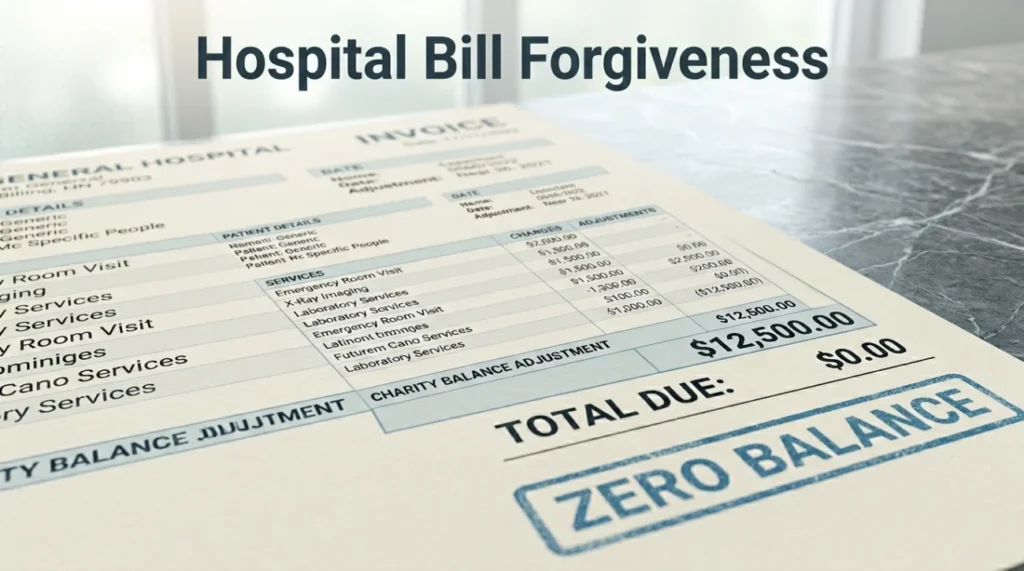
When a hospital approves you for 100% forgiveness, the balance is adjusted to zero in their system. The account is closed, you will not receive any more statements, and the debt cannot be sent to a collection agency.
🚑 Are emergency room bills included in this forgiveness?
Emergency room bills from the hospital facility itself are covered under their policy. However, bills from independent emergency physicians who contract with the hospital are separate, and you will need to ask them to match the hospital’s forgiveness determination.
🤷 Will a hospital forgive a medical bill if I already made payments?
Most hospitals will not automatically refund payments you have already made, even if you are approved for retroactive charity care. While a few states have consumer laws requiring refunds, you should generally consider past payments gone. However, it never hurts to explicitly ask for a refund in writing when your application is approved.
👨⚕️ Can they forgive doctor and clinic bills too?
If the doctor is directly employed by the hospital, their bill is usually covered by the hospital’s charity care policy. If the doctor runs a private practice, they are not bound by the hospital’s rules and you must deal with them individually.
⚖️ Will the forgiveness of hospital bills trigger a tax penalty?
In most situations, medical debt forgiven through a hospital’s official charity care program is not considered taxable income by the IRS. This is a major benefit compared to settling credit card debt, which often is taxed.
Medical Debt Relief
Every option for resolving medical debt that you cannot pay in full.
- Every option for resolving medical debt including forgiveness, relief programs, and settlement
- Medical Bill Help for Low Income: Programs That Can Reduce or Erase What You Owe
- Medical Debt Forgiveness in 2025 and 2026: What Changed, What’s Happening Now
- Can Medical Debt Be Forgiven? Yes: Here’s Who Qualifies and How
- Medical Debt Consolidation Loan: When It Makes Sense (And When It Doesn’t)
Programs That Can Help Right Now
Relief, negotiation, settlement, and credit repair. How each option actually works in practice.
- Using a HIPAA violation to reduce or eliminate what you owe before a relief program starts
- Negotiating directly with the hospital and what providers will reduce before collections
- How medical debt settlement works and what collectors will accept on accounts in collections
- How structured relief programs work for medical balances and what they actually cost you
- Cleaning up your credit report after using a relief program or settling medical debt
Disclosure: The content on this site reflects direct experience inside hospital billing and medical debt collection, and is grounded in federal law and regulation. It is informational in nature. Reading it does not constitute legal advice and does not create any professional relationship. If you are facing a lawsuit, a judgment, or a legal deadline, consult a licensed attorney in your state before taking action.