TL;DR
- The 7-year rule removes a medical collection account from your credit report, but it does not legally erase the debt.
- You still legally owe the money even after it falls off your credit file, and collectors can still contact you requesting payment.
- The timeline that determines if a collector can sue you is the statute of limitations, which operates entirely separately and is usually much shorter than seven years.
- Making a partial payment on an old, unreportable debt can accidentally restart the legal clock and give the collector the right to sue you again.
- True debt forgiveness only happens through payment, legal settlement, bankruptcy discharge, or a direct write-off by the creditor.
The Truth About the 7-Year Rule
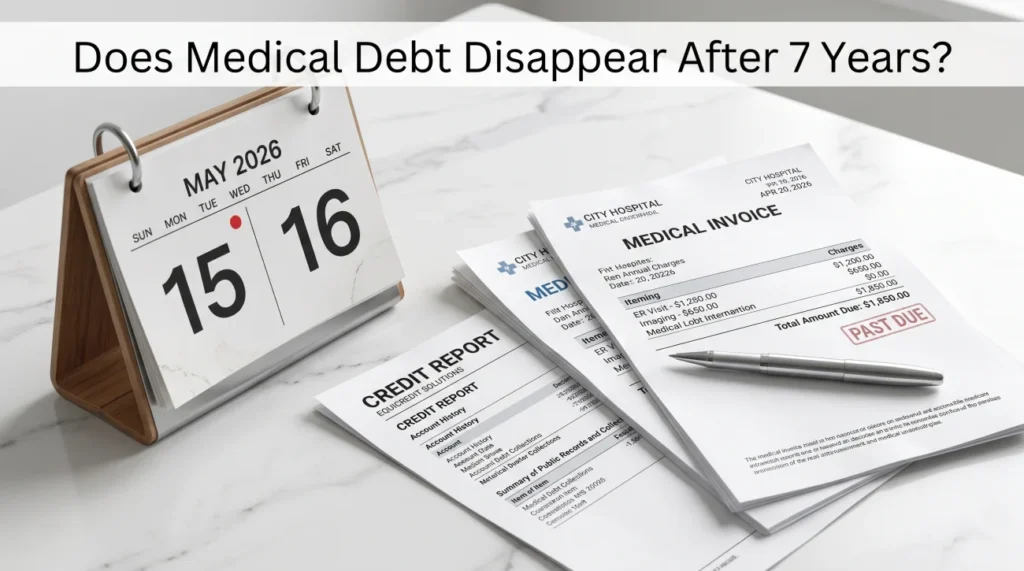
Does medical debt disappear after 7 years? The short answer is no, but the nuance behind that answer is incredibly important. If you have been waiting for the calendar to hit that seven-year mark so an old hospital bill will finally vanish, you are operating on a very common and very dangerous misunderstanding of how the collection system works.
During my time inside hospital billing departments and reviewing collection accounts, I regularly spoke with patients who assumed their old accounts were completely dead simply because a certain amount of time had passed. They confused credit reporting rules with their actual legal obligations. The seven-year rule does exist, but it only governs what can be broadcast to the world on your credit file. It does not govern whether a collection agency can still pursue you for the balance. Understanding exactly what falls off and what sticks around is the only way to avoid making an expensive mistake with an old account.
What the Credit Reporting Deadline Actually Accomplishes
To understand what happens to medical debt after 7 years, we have to look strictly at the Fair Credit Reporting Act (FCRA). This federal law dictates how long negative information can remain visible to lenders, landlords, and employers who check your credit history.
Under the FCRA, consumer reporting agencies like Equifax, Experian, and TransUnion must remove a collection account seven years from the original date of delinquency. The “original date of delinquency” is the exact date the account first became past due with the original hospital or doctor, and was never brought current again. Once that seven-year anniversary hits, the credit bureaus must scrub that specific tradeline from your file.
This is a massive relief for your credit score. If you want to buy a house, finance a car, or rent an apartment, lenders will no longer see that specific collection account holding your score down. However, the FCRA only regulates the credit bureaus. It does not regulate the underlying contract you signed when you received medical treatment.
The Danger of Assuming the Debt is Gone
The danger of confusing credit reporting with legal liability usually peaks in a very specific scenario. You check your credit report, you see that the negative mark from an old emergency room visit is finally gone, and you breathe a massive sigh of relief. You assume the medical debt erased after 7 years is finally a closed chapter. Then, just a few weeks later, you receive a stark letter from a completely new collection agency demanding payment for that exact same account.
This disconnect causes intense anxiety. Patients feel like they are being scammed. They assume the new collector is breaking the law by trying to collect on a debt that just “expired.” Because they believe the debt is legally void, they often call the agency to angrily argue their case. Without realizing it, that simple phone call can inadvertently confirm their contact information, acknowledge the debt, and sometimes even restart the legal timeline the collector has to sue them.
“Working on the compliance side of hospital billing, I routinely watched third-party debt buyers purchase massive portfolios of eight-year-old medical debt. They specifically target these accounts because they buy them for pennies. They know the debt will not show up on a credit check, but they also know that a carefully worded letter can panic a patient into making a $50 ‘good faith’ payment just to make the letters stop.”
What the 7-Year Rule Does Not Do
The misconception that medical debt gets written off after 7 years automatically is what gets patients into trouble. You must separate the concept of credit reporting from the concept of legal liability. The seven-year credit reporting expiration fails to protect you in several major ways.
- It does not forgive the balance: Dropping off a credit report does not mean the hospital or debt buyer has forgiven the money you owe.
- It does not stop collectors from calling: Agencies are perfectly within their legal rights to send letters and call you asking for voluntary payment on a debt that is ten, fifteen, or twenty years old.
- It does not change the statute of limitations: The time limit a collector has to file a lawsuit against you is determined by your state laws, completely independent of credit reporting rules.
If you are dealing with an account that is still causing issues, your next step depends on which timeline is affecting you. If the debt is old and you want to understand your actual legal exposure, you need to learn exactly how zombie medical debt operates. If the account is still actively damaging your score and you cannot wait for the seven-year mark, you should look into how to remove medical debt from your credit report directly.
The Legal Clock vs. The Credit Clock
When you are trying to figure out how long you will be dealing with a collection agency, you have to track two clocks simultaneously. If you are facing medical bills 7 years after the date of service, your actual legal exposure is almost certainly governed by the statute of limitations (SOL). The SOL is a state-level law that sets a strict deadline on how long a creditor has to sue you in court to force a payment.
In the vast majority of states, the statute of limitations for medical debt ranges from three to six years. This means that by the time your debt reaches the seven-year mark and falls off your credit report, the collector has likely already lost their right to sue you. The debt becomes what the industry calls “time-barred.”
| The Timeline | What It Controls | Typical Duration | What Happens When It Expires |
|---|---|---|---|
| Statute of Limitations | The collector’s right to sue you in court | 3 to 6 years (depends on your state) | Collector cannot legally file a lawsuit or threaten to sue. |
| Credit Reporting Window | Visibility on your credit profile | 7 years from original delinquency | Account must be removed from Equifax, Experian, and TransUnion. |
This creates a highly specific scenario for older accounts. If your state has a four-year SOL, a five-year-old medical debt is completely immune from a lawsuit, but it will still drag down your credit score for two more years. Conversely, while most states limit lawsuits to three to six years, a few rare outliers exist. If you live in one of the few states with an eight- or ten-year SOL, your debt will drop off your credit report at year seven, making you look great on paper, while the collector still retains the right to drag you into court for several more years.
The Reality of Zombie Debt and The Reset Trap
Because the debt is still legally owed even if it cannot be reported to credit bureaus or sued over, it becomes part of a secondary market known as zombie debt. Debt buyers purchase these severely aged accounts by the thousands. They know they have almost no leverage. They cannot hurt your credit. They cannot sue you. All they can do is ask nicely (or firmly) and hope you do not know your rights.
This is where patients make critical errors. If a collector contacts you about an eight-year-old account and you make a small $10 payment just to get them to leave you alone, you have made a disastrous mistake in many states. Making a partial payment on a time-barred debt acts as an acknowledgment of the contract and can instantly restart the statute of limitations clock from day one. You just took an uncollectable, invisible debt and handed the collector a brand new multi-year window to sue you for the full balance.
A collector calls about a debt from 2017. You panic, apologize, and promise to send them $20 next Friday to show good faith.
You refuse to acknowledge the debt verbally, hang up, and send a written request for validation to confirm the exact date of original delinquency.
The entire zombie debt industry relies on consumers not knowing that the legal clock and the credit reporting clock are separate. By understanding exactly when your legal liability expired, you can shut down these collection attempts without giving away your leverage.
Credit Forgiveness vs. Legal Forgiveness
Because the passage of time alone does not legally erase the debt, you might be wondering how an old account ever truly closes. True legal forgiveness requires specific actions or circumstances.
The only ways a medical debt is permanently, legally resolved are:
- Payment or Settlement: You pay the balance in full, or you negotiate a lump-sum settlement that the collector accepts as satisfying the debt completely.
- Bankruptcy Discharge: You file for Chapter 7 bankruptcy, and the court legally discharges your unsecured medical debts, making it a federal crime for anyone to ever attempt to collect them again.
- Creditor Write-off: The hospital or debt buyer internally decides the account is completely uncollectable and formally forgives the balance (sometimes issuing a 1099-C tax form if the forgiven amount is over $600).
- Permanent Abandonment: The debt becomes so old and gets resold so many times that the documentation is lost, the SOL expires, and no debt buyer finds it profitable to even spend postage mailing you a letter.
For most people dealing with aging accounts, permanent abandonment is the most likely outcome. Once the credit damage falls off and the lawsuit window closes, the debt technically exists in a legal vacuum, but it loses its teeth. You can read more about the exact paths to permanent resolution to see which one fits your financial situation best.
The Practical Reality After 7 Years
If you have crossed the seven-year threshold and the statute of limitations in your state has also expired, you are in a very specific, low-risk position. The debt still legally exists, but the collector has been stripped of their two most powerful weapons: they cannot hurt your credit score, and they cannot sue you.
At this stage, their only remaining tactic is to call or send letters asking for voluntary payment. They are hoping you either feel a moral obligation to pay or that you simply do not know your rights and will make a payment out of fear.
⚠️ Warning: Making any payment on a time-barred debt revives the account in many states. If you make a small payment just to get them to stop calling, you may accidentally restart the legal clock, giving them years to sue you for the full balance.
Because collectors have so little leverage on these severely aged accounts, you hold the power. You can choose to ignore the letters, or, if the phone calls are disruptive, you can send a simple written cease communication notice under federal law to force them to stop contacting you.
Final Thoughts: Handling Old Medical Accounts
Does medical debt fall off after 7 years? From your credit report, yes. From your life, no. Waiting for the seven-year mark is an excellent strategy for repairing your credit profile, but it requires discipline to ensure you do not accidentally mishandle the collector who still owns the paper.
Do not let a collector bully you into paying a severely aged account using threats of credit damage that are no longer legally possible. Keep your records organized, verify the original date of delinquency before having any substantive conversation, and always remember that silence and a demand for written proof are your best defenses against aggressive debt buyers who are trying to revive long-dead accounts.
❓ FAQ
🗑️ Does medical debt get written off after 7 years?
No. It gets removed from your credit report, but the creditor or debt buyer does not automatically write off or forgive the balance. You still legally owe the money.
📞 Can a debt collector still call me after seven years?
Yes. There is no time limit on how long a collector can ask you for payment, unless you explicitly send them a written cease and desist letter demanding they stop contacting you.
💳 Does paying a collection restart the 7-year credit reporting clock?
No. Making a payment on a collection account does not restart the seven-year credit reporting timeline. However, paying it could restart the statute of limitations clock, which dictates whether they can sue you.
🔄 Does the 7-year clock restart if the debt is sold?
No. The seven-year credit reporting window strictly begins on the date the account first became delinquent with the original hospital. Debt buyers cannot legally restart this specific clock when they buy the account.
⚖️ What is the medical debt 7 years rule?
It is a provision in the Fair Credit Reporting Act that limits how long negative information, including medical collections, can be displayed on consumer credit reports.
🙈 Will medical debt go away if I ignore it?
Ignoring it will not make the debt permanently disappear. However, if you ignore it long enough that the statute of limitations expires, the collector loses their legal leverage to force payment through a lawsuit.
👨⚖️ Can I be sued for a 10-year-old medical bill?
In almost all states, no. The statute of limitations for medical debt is typically three to six years. However, if you accidentally restarted the clock by making a recent partial payment, a lawsuit becomes possible again.
Medical Debt Collection
The laws governing what collectors can do and the specific situations where those laws matter most.
- The full legal framework: five federal laws governing what collectors can and cannot do
- Does Medical Debt Die With You? What Happens to Your Bills After You’re Gone
- The FDCPA and Medical Bills: What Debt Collectors Are Actually Allowed to Do
- Can Medical Debt Collectors Charge Interest? The Rule Most Patients Don’t Know
- Can Medical Debt Take Your House? Liens, Lawsuits, and Homestead Rules
When the Collector Won't Stop
Knowing your rights matters. These cover what to do when the collector does not back down.
- How to use a HIPAA violation to push back on the collector that is pursuing you
- Negotiating the original bill before the collector gains more leverage over the account
- What collectors in this situation will actually accept and why the math works for both sides
- Whether a structured relief program makes sense when a collector is already involved
- Removing the collection account from your credit report after the account is resolved
Disclosure: The content on this site reflects direct experience inside hospital billing and medical debt collection, and is grounded in federal law and regulation. It is informational in nature. Reading it does not constitute legal advice and does not create any professional relationship. If you are facing a lawsuit, a judgment, or a legal deadline, consult a licensed attorney in your state before taking action.