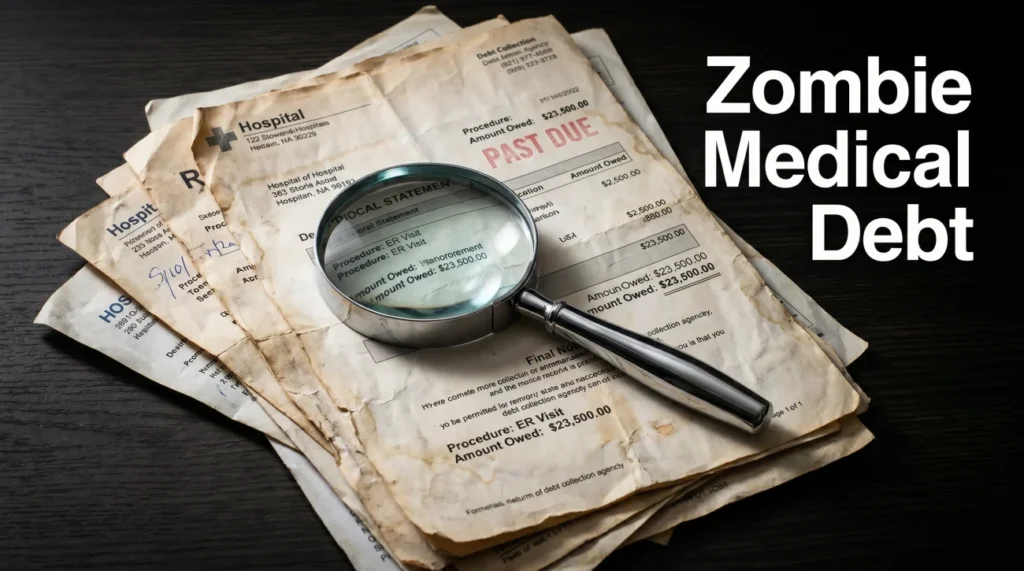
- Zombie medical debt is old, unpaid healthcare billing that a collector brings back to life, often years after you thought it was resolved or forgotten.
- Once a medical bill passes your state’s statute of limitations, it becomes time barred medical debt. Collectors can still legally ask you to pay it, but they lose the legal right to sue you.
- Making even a small “good faith” payment or acknowledging the debt in writing can reset the legal clock, completely reviving medical debt and giving collectors the right to take you to court again.
- Do not pay, sign, or promise anything on a phone call regarding an old medical collection. Always request written validation first.
- If a collector is pursuing you for the medical bills of a deceased family member, the debt belongs to the estate, not to you personally, with very few exceptions.
The Reality of Old Hospital Bills Returning
You answer the phone, or open a piece of mail, and suddenly you are looking at a hospital bill from five, seven, or even ten years ago. It is a terrifying experience. You might not even remember the clinic visit, or you might have assumed the insurance company handled it a decade ago. This is what the industry calls zombie medical debt, and it operates by a completely different set of rules than a standard, recent hospital bill.
When working inside the billing apparatus, I watched exactly how these old accounts are treated. Hospitals write off old, uncollected balances and sell them in massive spreadsheets to debt buyers for pennies on the dollar. Those buyers sell them to other buyers. By the time an old medical debt collector calling reaches you, they likely have no original medical records, no itemized bill, and no proof that your insurance was ever properly billed.
They have one goal: to get you to react. If you react the wrong way, you can accidentally turn an uncollectable, dead account back into a massive legal liability. Understanding how this system works is your absolute best defense against it.
The Core Rule: Legal to Ask, Illegal to Sue
The most confusing aspect of an old medical collection calling you is understanding how it can possibly be legal for them to pursue a debt from ten years ago. The answer lies in the difference between the right to ask and the right to sue.
Medical debt has a statute of limitations. This is a strict legal timeframe, typically ranging from three to six years depending on your state. The clock usually starts running from the date of the medical service or the date of your last payment. Once that timeframe expires, you have a complete legal defense against a lawsuit. If they try to sue you, you simply show the court that the debt is past the statute of limitations medical guidelines for your state, and the case is dismissed.
However, passing the statute of limitations does not erase the debt. It simply removes their biggest weapon. Under federal law, collectors are still legally allowed to send you letters and call you to politely ask if you would like to pay the time barred medical debt.
⚠️ Warning: While it is legal for them to ask you to pay an old debt, it is strictly illegal for them to threaten to sue you, threaten wage garnishment, or imply that legal action is imminent on a debt that is past the statute of limitations. Making false threats is a direct violation of federal consumer protection laws.
If you are trying to understand the full scope of what collectors are restricted from doing when they contact you, reviewing how federal collection rules apply is a critical step to protecting yourself from aggressive tactics.
The Three Traps That Bring Dead Debt Back to Life
Collectors do not buy zombie medical bills because they enjoy making phone calls. They buy them because they know exactly how to trick patients into medical debt resurrection. The entire business model relies on getting you to make a mistake that legally revives the debt, resetting the statute of limitations clock back to day one.
If you accidentally restart the clock, a debt that was completely safe from a lawsuit yesterday suddenly becomes grounds for wage garnishment tomorrow. You must protect your time-barred status by avoiding these three common traps.
Trap 1: Making a “Good Faith” Payment
A collector calls and says, “Look, I know this is an old hospital bill. Just pay me $10 today to show good faith, and I will stop the calls.” This sounds like a cheap way to buy peace. In reality, in many states, making a partial payment on a time-barred debt legally restarts the statute of limitations. You just gave them the legal right to sue you for the entire remaining balance.
Trap 2: Acknowledging the Debt in Writing
If you write a letter to the collector saying, “I know I owe this, but I cannot afford to pay you right now,” you have provided written acknowledgment. In many jurisdictions, admitting in writing that the debt is valid and belongs to you is enough to restart the legal clock.
Trap 3: Making a Verbal Promise to Pay
While harder to prove in court than a written statement or a payment, a recorded phone call where you explicitly promise to set up a payment plan next month can, in some specific states, be used to argue that you revived the account.
“I remember that ER visit, but the insurance was supposed to pay it. Let me just send you $20 so you close the file, and I will figure it out later.”
“I do not recognize this account. I refuse to discuss this over the phone. Send me complete written validation of this debt, including the original creditor’s name and the date of service.”
What Actually Makes a Medical Bill “Zombie Debt”?
Not every old bill is a zombie account. Zombie debt medical bills typically fall into a few specific categories that make them highly questionable, legally vulnerable, or entirely uncollectable. The defining characteristic is that the debt has been resurrected after a long period of silence.
- 📌 Debt past the statute of limitations: This is the most common type. Every state has a legal window during which a creditor can file a lawsuit to collect a debt. Once that window closes, the debt is considered time-barred.
- 📌 Debt that was already settled or paid: Because medical accounts are sold and resold as digital files, the record that you paid the hospital or a previous collector often gets lost in the transfer.
- 📌 Debt belonging to someone else: Debt buyers use automated tracking software to find phone numbers and addresses. If you have a similar name to the actual patient, or if you inherited a phone number, you become the target.
- 📌 Debt resulting from undetected billing errors: A hospital may have coded a procedure wrong five years ago, received a denial from your insurance, failed to notify you, and quietly sold the balance to a collection agency.
The Debt Chain: Why They Can’t Prove You Owe It
To understand why demanding proof is your best defense, you have to understand the “debt chain.” Hospitals rarely hold onto uncollected debt for more than a year or two. They write off the losses and sell these accounts in massive bulk spreadsheets to primary debt buyers. Those buyers skim the easiest accounts and sell the rest to secondary buyers, who then sell them to tertiary buyers.
With every single sale, the underlying data degrades. By the time an account is five or six years old, the current collector calling you likely only has your name, a last known address, and a total balance owed. They almost never have the original itemized hospital bills, notes showing what medical procedures were actually performed, or proof of whether your insurance company already paid a portion of the claim.
“I routinely saw portfolios of medical debt sold to third-party buyers after two years of internal inactivity. By the time that file reached the third or fourth buyer down the chain, the original itemized bill was completely gone. The collector on the phone is demanding payment based on nothing more than a single line item on a spreadsheet, not a verified medical record.”
This is exactly why aggressive debt buyers push for a quick credit card payment over the phone. They know that if you demand a full paper trail, they simply do not have the documents to back up their claim.
What to Do When an Old Medical Debt Collector Calls
When you find yourself on the receiving end of a collection attempt for an ancient medical bill, your immediate actions dictate the outcome. You need to force the collector to prove their claims without giving up any of your own legal leverage.
💡 The Rule of Engagement: Action + Document + Confirm
The formula for handling these accounts is simple: take defensive action, document every single interaction, and force them to confirm their legal standing in writing.
Step 1: Shift to Written Communication Immediately
Your immediate response dictates your legal exposure. If they call on the phone, tell them you are recording the call (if your state requires notification), inform them you do not recognize the debt, and instruct them to put everything in writing. Then hang up.
Step 2: Send a Written Demand for Validation
Federal law gives you the right to demand that a collector validate the debt. Because zombie accounts are often sold with incomplete files, debt buyers frequently cannot produce the required documentation. If they cannot validate it, they must stop collecting.
Subject: Demand for Debt Validation
To Whom It May Concern,
I am writing in response to your recent contact regarding account number [Insert Number]. I do not recognize this debt and I dispute it in its entirety.
Under the Fair Debt Collection Practices Act, I am requesting that you provide full validation of this debt. Specifically, you must provide:
- The name and address of the original medical provider.
- The exact date of the medical service.
- An itemized accounting of the charges.
- Proof that your company owns this debt or is legally authorized to collect it.
Until this debt is fully validated, all collection activities must cease. Furthermore, I request that all future communication regarding this matter be conducted exclusively in writing to my mailing address.
Sincerely,
[Your Name]
Step 3: Determine Your State’s Timeline
While you wait for them to attempt validation, look up the specific statute of limitations for medical debt in your state. If the date of service they eventually provide is older than your state’s timeline, you hold all the cards. You can then notify them that the debt is time-barred and demand they cease all contact.
What If They Actually Validate The Debt?
What happens if you demand validation and they actually provide it? Sometimes, a debt buyer does possess the original itemized bill and a clear chain of title showing they own the account. If they successfully validate the debt, your next step depends entirely on the age of the account.
If the validated documents prove the debt is past your state’s statute of limitations, you simply notify the collector in writing that the debt is time-barred and demand they cease all contact. Their validation just proved you cannot be sued.
If the documentation shows the debt is still within the legal window to sue, you now have a confirmed, valid debt. At this stage, your strategy shifts from disputing the account to negotiating a settlement. Because debt buyers purchase these accounts for pennies on the dollar, they are often willing to settle for a fraction of the total balance to close the file. You can read more about exactly how much to offer in our guide on how to settle medical debt in collections.
The Deceased Relative Scenario
While handling your own old debts requires a strict defensive strategy, the situation becomes even more complicated, and emotionally taxing, when collectors pursue you for someone else’s bills. One of the most predatory forms of reviving medical debt happens when collectors target the grieving family members of a deceased patient.
They will call a son, daughter, or spouse years after the death, implying that the family is morally or legally obligated to settle an old hospital balance. The legal reality is very clear: medical debt belongs to the estate of the deceased person, not to their surviving family members. When a person passes away, their estate pays what it can from available assets. If the estate runs out of money before the medical bills are paid, those debts are discharged. They do not pass onto children or relatives.
Yet, collectors will use manipulative language to bypass this fact. They will rarely say that you are legally required to pay. Instead, they will say something like, “This was your mother’s final bill. Are you going to take care of it?” They are counting on your sense of family duty, or your lack of legal knowledge, to trick you into making a payment that you do not owe.
💡 Pro Tip: There are very narrow exceptions to this rule, such as living in a community property state where a spouse might share liability, or if you explicitly co-signed a financial responsibility form at the hospital admission desk.
If a collector is harassing you over a deceased parent’s old medical bills, they are relying on your grief and confusion. Firmly state that you are not legally responsible for the debt, demand they communicate only with the estate executor, and refuse to discuss any payment options.
Recognizing the Signs of a Zombie Medical Account
Patients who are targeted by old debt buyers usually feel ambushed and stressed, unsure if ignoring the letters is safe or if picking up the phone will ruin their financial life. What you need to understand is that the aggressive tone is almost always a mask for their lack of legal leverage. Before you panic, check if your situation matches the clear signs of a zombie account:
- 📌 Unfamiliar debt you do not recognize: The company calling has no visible connection to your original hospital, and the balance seems inflated by years of unexplained “fees.”
- 📌 Date of service that is very old: The claimed medical visit happened more than four years ago, placing it dangerously close to or past the statute of limitations.
- 📌 No original creditor documentation: The collector refuses or is completely unable to produce the original itemized bill from the hospital.
- 📌 Multiple different collectors for the same account: You have received calls from several different agencies over the years regarding this exact same balance, proving the account is bouncing around the debt buyer market.
If you see these signs, you are dealing with a debt that is statistically very difficult for them to collect legally. Your priority is to force them to prove it in writing.
Parallel Tracks: Collection Calls vs. Credit Reporting
Dealing with a zombie medical collector and fixing your credit report are two parallel, independent tracks. Stopping the collector from calling you does not automatically remove the collection account from your credit file. Conversely, successfully disputing the account with Experian or Equifax does not legally prevent the debt buyer from continuing to mail you letters.
You must handle both issues independently. You send the validation and cease-contact letters directly to the collection agency to stop the harassment. Simultaneously, you file disputes with the credit bureaus to remove the reporting errors. Understanding that these are separate processes prevents the frustration of solving one problem while the other remains active. If old debt is dragging down your score, your next step is to tackle the credit reporting removal process specifically.
Final Thoughts on Stopping Old Collections
Dealing with zombie medical debt requires discipline, not money. The entire collection strategy relies on you talking too much, paying too fast, or ignoring your rights. By treating an old medical collection calling as a legal process rather than a moral failing, you protect yourself.
Never assume an old bill is valid just because it arrived on official-looking letterhead. Never make a partial payment to make them go away. Force them to prove they have the right to collect, check your state’s legal timelines, and use the law to shut down accounts that have no business coming back from the grave.
If the collector refuses to validate the debt, continues to call you after a written cease request, or threatens a lawsuit on an account you know is ten years old, you are no longer just defending yourself. At that point, the collector is breaking the law, and you need to look into whether the agency can take you to court or if you have grounds to turn the tables on them.
Related Resources on Old Medical Debt
If you are dealing with ancient hospital bills, the rules change drastically based on how old the debt is, whose name is on it, and what you want to achieve. The following guides break down exactly how to handle specific situations involving old and uncollectable medical accounts.
| Topic | What You Will Learn |
|---|---|
| Does Medical Debt Disappear After 7 Years? | The crucial difference between a debt falling off your credit report and a debt being legally erased, and why confusing the two is a costly mistake. |
| Does Medical Debt Ever Go Away? | A breakdown of the four actual ways a hospital bill permanently ends, including the statute of limitations, settlement, and bankruptcy. |
| Medical Debt Collection for a Deceased Person | How to protect yourself when collectors aggressively target grieving family members for a deceased relative’s hospital bills. |
| Where Does Medical Debt Go When You Die? | A clear explanation of how the estate probate process works for unpaid healthcare bills and what happens when an estate has no assets left. |
| Who Is Responsible for Medical Debt When Someone Dies? | The actual legal rules regarding family liability for a deceased relative’s medical bills, and the rare exceptions where you might have to pay. |
| Does Medical Debt Die With You? | A clear guide on what happens to your own medical debt after you pass away, and how to protect your assets and your family. |
❓ FAQ
🧟♂️ Can a debt collector legally try to collect a 10 year old medical bill?
Yes, federal law allows them to contact you and ask for payment regardless of how old the debt is. However, they cannot legally sue you or threaten to sue you if the debt is past your state’s statute of limitations.
📞 What should I say when an old medical debt collector calls me?
You should say as little as possible. State that you do not recognize the debt, demand that they send full written validation to your mailing address, and tell them to stop calling your phone. Then hang up.
💸 Does making a small payment on an old medical bill restart the clock?
In most states, yes. Making even a tiny partial payment on a time-barred debt legally resets the statute of limitations, giving the collector the right to sue you for the entire remaining balance.
⚖️ Is it illegal for a collector to threaten a lawsuit on zombie medical debt?
Yes. If the debt is officially past your state’s legal timeframe for litigation, threatening a lawsuit is a direct violation of the Fair Debt Collection Practices Act (FDCPA).
📄 Can I be sued if I ignore a letter about a 5 year old hospital bill?
That depends entirely on your state’s statute of limitations. If your state allows six years to collect medical debt, you can still be sued. If your state only allows three years, the debt is time-barred and a lawsuit would be invalid.
🏥 Why is a completely different company calling me about my hospital bill?
Hospitals routinely write off unpaid accounts and sell them to third-party debt buyers for pennies on the dollar. These buyers then attempt to collect the full face value of the bill for their own profit.
✍️ Does sending a dispute letter restart the statute of limitations?
No, sending a standard letter requesting validation or disputing the debt does not restart the clock. However, if your letter explicitly admits that you owe the money, that written acknowledgment could restart it.
🛑 How do I permanently stop calls about an ancient medical debt?
You must send a formal Cease and Desist letter via certified mail. Under federal law, once a collector receives a written request to stop contacting you, they must cease communication, with very few exceptions.
👨👩👧 Am I responsible for a medical debt from my deceased parent from years ago?
Generally, no. The debt belongs to your parent’s estate. Unless you co-signed a financial responsibility form or share liability under specific community property laws, you are not personally obligated to pay it.
📉 Will a 10 year old medical collection ruin my credit score?
No. Under the Fair Credit Reporting Act, negative marks like medical collections must be removed from your credit report seven years after the original date of delinquency, regardless of whether the debt is paid.
Medical Debt Collection
The laws governing what collectors can do and the specific situations where those laws matter most.
- The full legal framework: five federal laws governing what collectors can and cannot do
- Your Medical Debt Was Sold to a Collection Agency: What That Means and What Changed
- Can Medical Debt Go to Collections? Yes – Here’s Exactly When and How
- How Medical Debt Collection Actually Works: The Process Most Patients Never See
- Can Medical Collections Sue You? What Actually Has to Happen Before They Take Your Money
When the Collector Won't Stop
Knowing your rights matters. These cover what to do when the collector does not back down.
- How to use a HIPAA violation to push back on the collector that is pursuing you
- Negotiating the original bill before the collector gains more leverage over the account
- What collectors in this situation will actually accept and why the math works for both sides
- Whether a structured relief program makes sense when a collector is already involved
- Removing the collection account from your credit report after the account is resolved
Disclosure: The content on this site reflects direct experience inside hospital billing and medical debt collection, and is grounded in federal law and regulation. It is informational in nature. Reading it does not constitute legal advice and does not create any professional relationship. If you are facing a lawsuit, a judgment, or a legal deadline, consult a licensed attorney in your state before taking action.