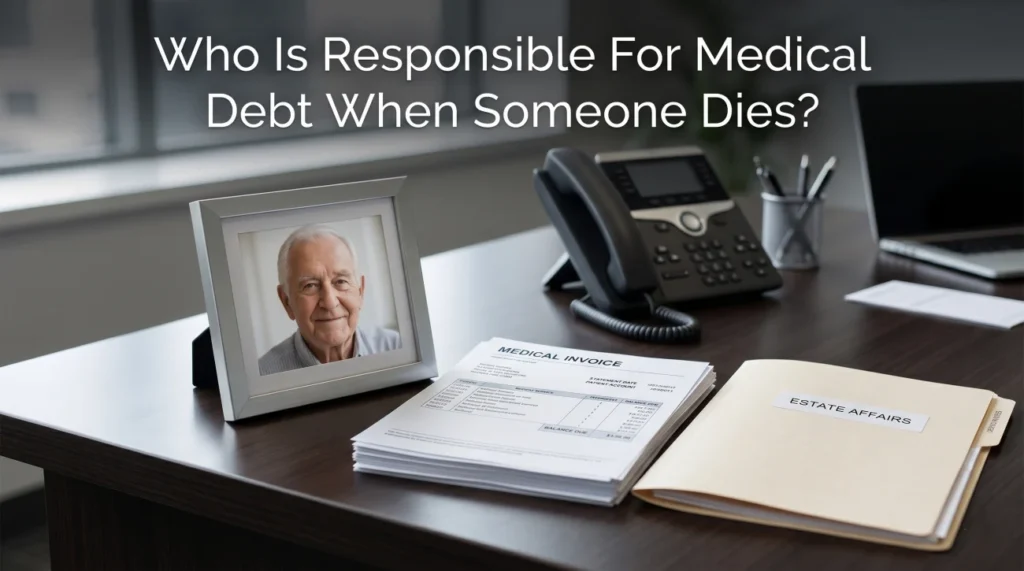
- The legal default is that a deceased person’s estate is responsible for their medical debt, not their surviving family members.
- If the estate has no assets to pay the bills, the medical debt is typically discharged and goes unpaid.
- Exceptions exist if you live in one of the nine community property states, co-signed a financial responsibility form at the hospital, or mismanaged estate funds as an executor.
- Debt collectors frequently use deceptive, guilt-based language to make family members feel legally obligated when they are not.
- You should never make a payment or verbally agree to pay a deceased relative’s account until you have verified your personal legal liability in writing.
The Confusion Over Debt After Death
When you lose a family member, the last thing you need is a phone call from a collection agency demanding money. Yet, this happens every day. In my time working inside hospital billing departments, I processed thousands of accounts belonging to patients who had passed away. I know exactly how these files are handled, transferred, and eventually assigned to third-party agencies. If you are asking who is responsible for medical debt when someone dies, you are likely feeling a mix of grief, confusion, and fear that your own financial security is at risk.
Here is the truth that collectors rarely volunteer over the phone: in the vast majority of cases, family members are not legally obligated to pay a deceased relative’s hospital bills out of their own pockets. The system relies heavily on the fact that grieving families do not know this rule.
However, “most cases” is not all cases. There are very specific, legally binding exceptions that can transfer liability to a spouse or an adult child. Knowing the difference between a collector trying to guilt you into a voluntary payment and a collector who actually has a legal claim against you is critical. This guide breaks down the legal default, the exact exceptions that matter, and how to protect yourself when the phone rings.
The Legal Default: The Estate Pays, Not the Family
The fundamental rule of debt in the United States is that a debt belongs to the person who incurred it. When that person dies, the debt does not evaporate, but it also does not automatically jump to their next of kin. Instead, it becomes a claim against their estate.
An estate is simply the legal term for everything the person owned at the time of their death. This includes bank accounts, real estate, vehicles, and personal property. If there are unpaid medical bills, the hospital or collection agency becomes a creditor of the estate. The person managing the estate (the executor or administrator) is responsible for using the estate’s assets to pay off valid creditors before distributing any remaining money to heirs.
“When a patient account was flagged as deceased in our billing system, the standard protocol was to immediately pause regular billing statements and route the file to a specialized desk. We were looking for the estate executor. If we found out the patient passed away with zero assets, we often just closed the account as uncollectable. The aggressive calls to family members usually start later, when the hospital sells that dead-end account to a third-party debt buyer for pennies on the dollar.”
If you want to understand the exact mechanics of how assets are liquidated to pay these claims, you can read our breakdown of how the estate settlement process works for unpaid hospital bills. But the core concept you must remember is this: if the estate runs out of money before the medical bills are paid, the remaining debt is discharged. It dies with the estate. The hospital takes a loss. They cannot turn around and force the children or the siblings to open their own wallets to cover the difference.
This protection is solid, but you have to actively guard it. Collectors will try to blur the line between the estate’s money and your money. They want you to assume that because you are handling the affairs, you are liable for the shortfall. Unless one of the specific exceptions below applies, you are not.
The Four Exceptions That Create Personal Liability
While the estate rule protects most people, you must verify that you have not triggered an exception. If a collector has a valid legal claim against you personally, it will almost always fall into one of these four categories.
Exception 1: Spouses in Community Property States
If you are wondering who pays medical debt when someone dies and you were married to the deceased, your geographic location dictates the answer. In the United States, nine states operate under community property laws: Arizona, California, Idaho, Louisiana, Nevada, New Mexico, Texas, Washington, and Wisconsin.
In these states, any debt incurred during the marriage by either spouse is generally considered a joint debt, regardless of whose name is on the medical chart. If your spouse passed away and received care while you were married and living in one of these nine states, the hospital or collector can likely pursue you personally for the balance. Your own income and separate bank accounts may be vulnerable.
If you live in the other 41 common law states, you are generally protected, meaning your spouse’s medical debt belongs strictly to their estate, not to you.
Exception 2: The Signed Financial Responsibility Form
This is the most dangerous exception because people trigger it entirely by accident. When someone is rushed to the emergency room or admitted for a serious procedure, the front desk staff presents a stack of digital documents or a clipboard. They usually say, “Please sign here to consent to treatment.”
Buried in that paperwork is almost always a “Guarantee of Payment” or “Financial Responsibility” clause. If you sign this form as the responsible party rather than just signing as a representative or witness, you are creating a binding legal contract. You are telling the hospital that if the patient cannot or does not pay, you will.
An adult child rushing an elderly parent into the ER quickly signs their own name on the admission tablet to expedite care, inadvertently assuming full legal liability for a $50,000 hospital stay.
When presented with paperwork for a relative, signing the patient’s name and adding “by [Your Name], acting as Power of Attorney” or explicitly writing “Not Financially Responsible” next to your signature.
If you are asking, am I responsible for deceased parent medical debt, the very first thing you need to do is demand the collector produce the original admission paperwork bearing your signature. Do not take their word for it. Make them prove it.
Exception 3: Joint Account Holders
This exception rarely applies directly to hospital bills, but it frequently applies to how those bills were managed. If you co-signed a personal loan or opened a joint credit card with the deceased, and that specific account was used to pay the medical provider, you are liable for the balance on that credit card or loan.
In this scenario, you do not owe the hospital. You owe the bank or credit card company. The debt transformed from medical debt to standard consumer debt the moment it was charged to a joint account.
Exception 4: Executor Mismanagement of Estate Funds
If you are the named executor of the estate, you have a fiduciary duty to pay creditors in a specific legal order before giving money to heirs. In most states, secured debts and taxes come first, followed by administrative costs, and then unsecured debts like medical bills.
If you ignore the medical bills and distribute the estate’s cash to yourself and your siblings, the hospital or collector can sue you personally. This is called executor liability. You are not being sued because the medical debt was yours, but because you improperly gave away money that legally belonged to the creditors.
The Pressure Tactics Collectors Use on Grieving Families
If you do not fit into any of the four exceptions above, you are not legally liable. But that will not stop debt collectors from calling. Collecting from the deceased is a specialized sub-industry within medical billing. These agencies purchase portfolios of deceased accounts for pennies and rely on psychological pressure to generate revenue.
You need to understand who owes medical debt of deceased patients in the eyes of the collector: anyone willing to write a check. They are trained to use ambiguous, guilt-inducing language that implies responsibility without making a direct legal claim, which would violate federal debt collection regulations.
- 📞 The Guilt Tactic: “We are calling to see how you plan to take care of your mother’s final obligations.” Notice they do not say you are legally required to pay. They frame it as a moral duty.
- 📞 The Assumption Tactic: “How would you like to set up the payment plan for this balance today?” They bypass the question of liability entirely and assume you are opening your wallet.
- 📞 The Credit Threat: Implying that leaving the bill unpaid will somehow reflect poorly on your family name or affect your personal credit score.
Under the Fair Debt Collection Practices Act (FDCPA), collectors are allowed to contact you to ask for the name and contact information of the estate executor. That is it. Once they know who is handling the estate, they are supposed to direct their claims there. You hold the power to stop the harassment.
⚠️ Warning: Never make a “good faith” partial payment just to get a collector off the phone. Making a payment from your personal checking account toward a deceased relative’s debt can legally be interpreted by collectors as you assuming responsibility for the entire balance. Do not open your wallet until liability is proven in writing.
If a collector crosses the line by threatening your personal credit, implying you are legally required to pay when you are not, or using deceptive guilt tactics, they are breaking the law. Learn how to identify and use these FDCPA violations to stop the collection completely.
How to Verify Liability (And What to Do Next)
When a collection agency reaches out regarding a family member who has passed away, your only goal is to force them to communicate in writing and demand proof of any claims they make about your personal liability. You must remove the emotion from the interaction and treat it strictly as a business transaction.
If you know you are the executor, you can provide the mailing address for the estate. If there is no estate because your relative died with no assets, you can state that fact clearly in writing. A simple letter stating, “The deceased left no estate and no assets subject to probate. Please close your file,” is often enough to stop reputable agencies from pursuing the matter further.
If they continue to press you personally, demand that they mail full validation of the debt, including the original hospital admission paperwork bearing your signature guaranteeing financial responsibility. Make them prove it. For specific language on exactly what to say to shut down these calls, and how to formally request they cease communication, see our guide on handling collectors calling about a deceased relative.
“A common scenario we saw involved very old accounts. A patient would pass away, the hospital would write off the balance, and five years later, a junk debt buyer would start calling the patient’s children. They had no proof, no signatures, just a phone number they scraped from a public record.”
Always check the dates on the claims they are making. Collectors frequently attempt to pursue extremely old accounts after a patient passes away. If the debt is years old, do not engage before checking if it is time-barred zombie medical debt. Making any payment or verbal agreement on these accounts could restart the clock on an otherwise dead account.
Final Thoughts: The Burden of Proof Is on Them
Figuring out who is liable for the medical debt of a deceased family member comes down to one rule: the estate owes the money, you do not, unless proven otherwise. The medical billing system is designed to collect revenue, and third-party agencies are highly incentivized to find anyone willing to pay.
Do not let grief or high-pressure tactics push you into accepting a financial burden that the law does not require you to carry. The burden of proof is entirely on the collector. Make them do their job, demand the documentation, and protect your own financial security first.
❓ FAQ
🏦 Who pays medical debt when someone dies with no money?
If a person dies with no assets and no estate, their medical debt is generally discharged. The hospital or collection agency takes a loss, and the debt cannot be forced upon surviving family members.
📝 Does being a medical Power of Attorney make me responsible for the debt?
No. Acting as a Power of Attorney allows you to make medical or financial decisions on behalf of the patient, but it does not make you personally liable for their debts using your own funds.
💍 Is family responsible for deceased person medical debt if they were married?
It depends on your state. In the nine community property states, a surviving spouse is typically responsible for medical debts incurred during the marriage. In common law states, the spouse is generally not liable unless they co-signed.
🏥 What happens if I signed the hospital admission forms?
If you signed a “Financial Responsibility” or “Guarantee of Payment” form at admission, you likely entered into a binding contract and can be held personally liable for the bill.
📞 Can a debt collector call me about my deceased parent’s bills?
Collectors can call you to find out who the executor of the estate is and how to contact them. They cannot legally harass you or falsely claim you are required to pay the debt yourself.
⚖️ Can the hospital take my inheritance to pay the medical debt?
The hospital cannot take your inheritance after you receive it, but the estate executor must use estate assets to pay the medical bills before distributing the remaining money to you as an heir.
🛡️ Are life insurance payouts protected from medical debt collectors?
Yes. Life insurance policies with a named beneficiary bypass the probate estate entirely. The money goes directly to you and cannot be touched by the deceased person’s medical creditors.
🛑 How do I stop collectors from calling about a deceased relative?
Send a written “Cease Communication” letter via certified mail. Under federal law, once a collector receives this written request, they must stop calling you.
💳 If I pay a small portion of the bill, does that mean I accept the whole debt?
It might. Making a payment from your personal account can sometimes be legally interpreted as assuming responsibility for the debt or resetting the statute of limitations. Never pay without verifying liability.
👴 Are children ever forced to pay under filial responsibility laws?
While over half of US states have filial responsibility laws on the books, they are extremely rarely enforced for standard hospital bills, though they are occasionally used by nursing homes in specific circumstances.
Medical Debt Collection
The laws governing what collectors can do and the specific situations where those laws matter most.
- The full legal framework: five federal laws governing what collectors can and cannot do
- Can Medical Debt Go to Collections? Yes – Here’s Exactly When and How
- How Long Does Medical Debt Stay in Collections? The Two Timelines
- Sued for Medical Debt? How to Settle a Medical Debt Collection Lawsuit Before It Gets Worse
- Do Collection Agencies Buy Medical Debt? The Market Economics You Need to Know
When the Collector Won't Stop
Knowing your rights matters. These cover what to do when the collector does not back down.
- How to use a HIPAA violation to push back on the collector that is pursuing you
- Negotiating the original bill before the collector gains more leverage over the account
- What collectors in this situation will actually accept and why the math works for both sides
- Whether a structured relief program makes sense when a collector is already involved
- Removing the collection account from your credit report after the account is resolved
Disclosure: The content on this site reflects direct experience inside hospital billing and medical debt collection, and is grounded in federal law and regulation. It is informational in nature. Reading it does not constitute legal advice and does not create any professional relationship. If you are facing a lawsuit, a judgment, or a legal deadline, consult a licensed attorney in your state before taking action.