- Having health insurance does not protect you from debt collectors if the hospital billing department and your insurance company fail to communicate properly.
- Most insured patients end up in collections due to administrative errors: claims submitted to the wrong payer, silent claim denials, or simple data entry mistakes.
- Never assume a collection notice is correct just because it looks official. If your insurance should have paid, you must demand validation from the collector and pull your Explanation of Benefits (EOB) immediately.
- If your bill involves out-of-network emergency care at an in-network facility after January 2022, the collection attempt itself might violate federal law.
Why Your Insurance Did Not Protect You From Collections
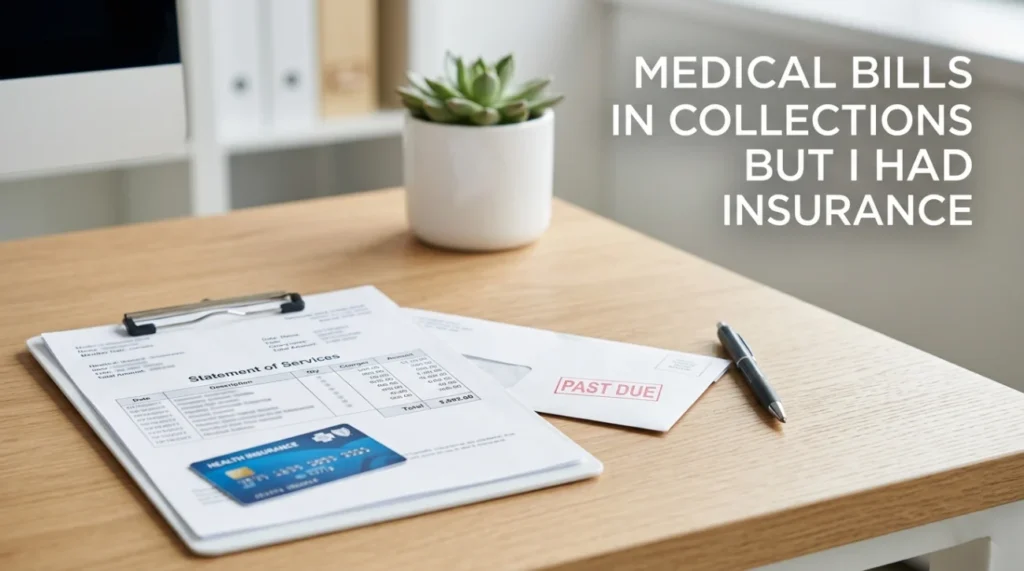
If you are staring at a notice right now and thinking about your medical bills in collections but I had insurance, you are experiencing one of the most common systemic failures in the healthcare industry. You followed the rules. You handed over your insurance card at the front desk. You paid your premiums every month. Yet somehow, a third-party debt collector is now demanding a massive payment and threatening your credit score.
From the outside, this feels like an intentional scam or a massive breach of trust. From the inside of a hospital billing department, it looks entirely different. When I processed patient accounts, I saw exactly how automated billing software handles errors. The system is designed to default to patient responsibility. If a claim hits a roadblock between the hospital’s clearinghouse and your insurance provider, the software rarely pauses to ask a human to investigate. It simply generates a bill and drops it into the mail queue addressed to you.
“I have watched patients receive a collection letter for a fully covered procedure, assume their insurance company lied to them, and just pay the collection agency out of fear. In many of those cases, the insurance company never even saw the claim because a registration clerk transposed two numbers on the patient’s member ID.”
This is where patients lose their leverage. The hospital does not call you to politely explain denial codes before the collection countdown ends. Understanding why this happens is the only way to reverse the damage. You must diagnose exactly where the communication breakdown occurred so you can force the hospital and the insurer to fix it.
Reason 1: The Claim Was Rejected, Not Denied
There is a massive operational difference between an insurance “denial” and an insurance “rejection.” If your hospital sent a bill to collections that insurance should cover, a rejection is the most frequent culprit.
A denial means the insurance company received the claim, reviewed the medical codes, and decided they are not contractually obligated to pay it. A rejection means the claim never made it into the insurance company’s processing system at all. It hit the front door and bounced back because the data was flawed.
Common reasons for a rejected claim include a misspelled name, a wrong date of birth, an outdated member ID number, or the hospital submitting the claim to the wrong payer completely (like sending a Blue Cross claim to UnitedHealthcare). When a claim is rejected, the hospital’s automated system sees an unpaid balance. After 60 to 90 days of no payment, the system flags the account as delinquent. If the billing staff is overwhelmed and fails to manually correct the data entry error, the account is automatically outsourced to a collection agency.
Reason 2: The Silent Claim Denial
The second most common pattern is the silent denial. This happens when the insurance company actually receives the claim but refuses to pay it, and nobody explicitly tells the patient why. Usually, it comes down to technicalities. The doctor may have used a diagnostic code that does not establish “medical necessity” for the procedure. The hospital may have failed to get prior authorization for an imaging test. Or the claim was submitted past the insurer’s timely filing deadline.
When this happens, the insurance company sends an Electronic Remittance Advice to the hospital indicating zero payment. The hospital software updates your account balance to reflect that you now owe the full amount. Unless you actively monitor your insurance portal, your first notification that something went wrong will be the hospital bill, followed swiftly by a collection notice.
Reason 3: No Surprises Act Violations
If you went to an emergency room that accepts your insurance, but the specific emergency room doctor who treated you did not, you might find yourself dealing with an out-of-network balance. Historically, this “surprise billing” resulted in massive medical collections.
However, if the date of your medical service was after January 1, 2022, federal law protects you. The No Surprises Act makes it illegal for providers to bill patients for out-of-network rates in emergency situations, or when receiving non-emergency care from out-of-network providers at in-network facilities without prior written consent.
Despite this law, automated billing systems still occasionally generate out-of-network bills, which then flow into collection agency portfolios. If a collector is attempting to force you to pay an amount that violates the No Surprises Act, they are not just making a billing error. They are potentially violating federal collection laws. In these specific scenarios, you need to understand how to use a regulatory violation to stop an abusive collector permanently.
Reason 4: Sent to Collections During an Active Dispute
Sometimes you catch a billing error early. You call the hospital, point out that they charged you for a medication you never received, and the representative tells you they are putting the account under review. You hang up thinking the problem is solved.
Two months later, a collection agency calls you. A medical collection insurance error often occurs because placing an account “under review” in the billing software does not always pause the automated collection timer. The clock keeps ticking in the background. While the coding department takes three months to review your chart, the collection module hits day 90 and exports your account to an external agency.
Reason 5: The EOB Misunderstanding
Not all insurance-related collections are hospital errors. A significant number of accounts end up in collections because the patient misunderstood how their policy works. Having an insurance didn’t pay medical bill now in collections situation sometimes means the insurance processed the claim exactly as designed, but the patient assumed “covered” meant “paid in full.”
If you have a $3,000 high-deductible health plan and you visit the ER in February, your insurance will process the claim, apply their contracted discount, and then pass the remaining balance entirely to you because you have not met your deductible yet. Patients often see a $2,500 hospital bill, assume there must be a mistake because they gave the registrar their insurance card, and ignore the statements. The hospital eventually sends the valid balance to collections.
The Diagnostic Key: Your Explanation of Benefits
To fix a collection account that involves insurance, you cannot rely on the hospital’s statement or the collector’s demand letter. You must obtain the Explanation of Benefits (EOB) from your insurance company for that specific date of service. The EOB is the ultimate source of truth.
| If your EOB shows… | What it means for your collection account… |
|---|---|
| No record of the claim exists | The claim was rejected or never sent. The hospital dropped the ball. |
| Claim denied: Timely filing | The hospital missed the deadline. You usually do not owe this balance. |
| Claim denied: Medical necessity | The provider failed to justify the procedure. Needs an appeal. |
| Patient Responsibility: $0 | The collector is pursuing a phantom debt. Highly actionable. |
| Patient Responsibility: Matches Collection Amount | The insurance processed it. You owe the deductible or coinsurance. |
If your EOB shows a patient responsibility of zero, or if the claim is missing entirely, you have the documentation required to halt the collection agency immediately.
Your 3-Step Immediate Action Plan
When you are facing a collection agency for bill insurance should have paid, you must act strategically. Do not call the collector to argue about your insurance coverage. Debt collectors have no power to submit claims or fix hospital billing errors. Their only job is to collect the balance on their screen.
Step 1: Pause the Collector
Your first action is to freeze the collection process by requesting formal validation. Under federal law, if you dispute a debt in writing within 30 days of the initial contact, the collector must stop collection activities until they provide verification.
From my experience on the billing side, an account with a formal FDCPA validation request gets immediately flagged and pulled from the agency’s automated dialer. It forces the collection machine to stop blindly dialing your number and requires a human to actually look at the file.
Calling the agency, explaining your insurance benefits, and asking them to call your insurance company to figure it out.
Sending a brief, written request demanding validation of the debt and instructing them to communicate only in writing.
Validation Script (Send via Certified Mail):
“I am writing in response to your collection notice regarding account #[Number]. I dispute this debt. Please provide full validation of this account, including an itemized statement from the original provider showing all charges, insurance adjustments, and payments. Until this debt is validated, all collection activities must cease. Please conduct all future communication regarding this matter in writing.”
Step 2: Force the Insurer to Investigate
While the collector is paused, you must contact your insurance company’s member services department. Insurance companies have an obligation to process valid claims according to the terms of your policy. If a claim was mishandled, you need them to document it.
When you call member services and ask for a call reference number, you create an undeniable audit trail. If the hospital later claims they submitted the bill correctly, you now have the exact status and denial code directly from the insurer’s own system.
Action: Call Member Services + Provide Date of Service + Request Claim Status
Insurance Call Script:
“I received a collection notice for a date of service on [Date] with [Provider Name]. Can you please check my file and tell me if a claim was ever received for that date? If it was received, what was the exact denial reason code, and what does my EOB list as my patient responsibility?”
Step 3: Confront the Provider’s Billing Office
If the insurance company confirms the claim was never received, or if it was denied due to a provider error like a missing prior authorization, the collection agency is not your actual problem. The hospital billing department is. You must now pivot to how to dispute a medical bill with the original provider.
You need to instruct the hospital billing supervisor to recall the account from collections. Use clear, factual language based on your insurance call. Billing departments do not like recalling accounts because it hurts their external collection metrics, but presenting the exact insurance claim status leaves them no choice.
💡 Pro Tip: Always use the phrase “recall the account.” Do not ask them to “update” the collector. Recalling the account pulls the file back from the agency completely and removes it from the collection tracking cycle.
Escalating the Dispute: Balance Billing and Grievances
If the hospital refuses to recall the account and insists you owe the money despite your insurance evidence, the dispute escalates. Often, this happens when the provider submitted a claim too late, the insurance denied it for “timely filing,” and the provider attempts to bill you anyway. This is an improper practice known as balance billing.
Insurance contracts explicitly forbid in-network providers from punishing patients for the hospital’s own administrative delays. If your provider tries to bypass their contract by using a collection agency to force a payment, you have significant leverage. You can file a grievance directly with your insurance company’s provider relations department, whose job is to enforce those contracts against non-compliant hospitals.
While you force the hospital to fix their failure, it is crucial to understand what happens when medical debt goes to collections so you know exactly what the agency can and cannot do to you in the meantime.
What If You Already Paid the Collector?
Many patients panic when they see a collection notice and immediately pay it, assuming they can just get reimbursed by their insurance company later once the dust settles. If you have already done this, you have put yourself in a very difficult administrative position.
Insurance companies generally do not reimburse patients for payments made directly to third-party debt collectors. To get your money back, you have to work backward. You must contact the hospital billing department, present your proof of insurance coverage, and demand they retroactively process the claim. If the claim clears and the insurance pays the hospital, you then have to demand the hospital recall the payment from the collection agency and issue you a refund. This process takes months and requires relentless follow-up, which is why paying to make the problem go away usually backfires.
The “I Never Knew” Trap
If you feel completely blindsided by this collection notice, you are not alone. The most common phrase I heard from frustrated patients was simply, “I never knew a claim was denied.” Providers rarely notify patients proactively when an insurance issue occurs. Instead, they bounce you between the hospital’s billing hotline and the insurance company’s hold music, with each side blaming the other. That feeling of being trapped in an endless administrative loop is exactly why so many insured patients eventually give up and pay a debt they do not owe.
Final Thoughts: Hold the System Accountable
Administrative failures are the hospital’s responsibility to fix, not yours to finance. Demand validation from the agency, pull your EOB, and put the burden of proof back on the billing department where it belongs. Do not let a system error intimidate you into covering a bill your insurance premiums were already supposed to pay.
❓ FAQ
📞 Should I give the collection agency my updated insurance information?
No. Most collection agencies cannot process insurance claims. You must give the updated information directly to the original hospital billing department and ask them to recall the account from collections so they can bill the insurance properly.
🏥 Can a hospital send my bill to collections while an insurance appeal is pending?
Unfortunately, yes. Unless the hospital has a specific internal policy that places a hold on your account, their automated system can still forward unpaid balances to collections even if you are actively appealing a denial with your insurer.
⏱️ Is there a time limit for the hospital to submit my claim to insurance?
Yes. This is called “timely filing.” Most insurance contracts require the hospital to submit the claim within 90 to 180 days. If the hospital misses this deadline, the insurance denies the claim, and in-network providers are generally prohibited from billing you for their mistake.
📉 Will this collection ruin my credit score while I fight the insurance issue?
Under current credit reporting rules, medical debt collections under $500 will not appear on your credit report. For balances over $500, collectors must wait 1 year before reporting it, giving you time to resolve the insurance dispute.
📄 What if my insurance says the hospital never sent the bill at all?
Request an itemized statement from the hospital and a written letter from your insurance confirming no claim is on file. Send both to the hospital billing manager with a demand to recall the collection account and submit the claim immediately.
⚖️ Can a collector sue me for a bill my insurance was supposed to pay?
Technically, yes, if the balance shows as patient responsibility in their system. However, successfully validating the debt and showing proof of a pending insurance dispute makes litigation highly unlikely while the issue is unresolved.
🛑 How do I stop the collection calls while the insurance investigates?
Send a written “cease communication” letter to the collection agency via certified mail. Under federal law, once they receive this written request, they must stop calling you, though they can still take legal action if they choose.
💳 If I pay the collection agency now, will my insurance reimburse me later?
Do not do this. Getting reimbursed by an insurance company for a bill you already paid to a third-party debt collector is incredibly difficult and often impossible. Resolve the insurance issue first.
📝 What does it mean if my EOB says “Patient Responsibility $0”?
It means your insurance fully covered the contracted rate, or the provider was penalized and cannot bill you. If a collector is demanding money for this specific date of service, the collection is invalid. Send a copy of the EOB to the collector as proof.
🕵️♀️ Who can help me if the hospital and insurance company keep blaming each other?
You can seek help from independent patient advocacy organizations. You can also hire a professional patient advocate to untangle the billing codes and force a resolution when the system stalls.
Medical Debt Collection
The laws governing what collectors can do and the specific situations where those laws matter most.
- The full legal framework: five federal laws governing what collectors can and cannot do
- Can Medical Debt Take Your House? Liens, Lawsuits, and Homestead Rules
- Medical Debt Collection Under $500: The Rules for Small Balances
- How to Get Out of Medical Debt Collections: The Four Paths and Which One Fits Your Situation
- Are Medical Collections Legal? What the Law Actually Allows (And Where It Doesn’t)
When the Collector Won't Stop
Knowing your rights matters. These cover what to do when the collector does not back down.
- How to use a HIPAA violation to push back on the collector that is pursuing you
- Negotiating the original bill before the collector gains more leverage over the account
- What collectors in this situation will actually accept and why the math works for both sides
- Whether a structured relief program makes sense when a collector is already involved
- Removing the collection account from your credit report after the account is resolved
Disclosure: The content on this site reflects direct experience inside hospital billing and medical debt collection, and is grounded in federal law and regulation. It is informational in nature. Reading it does not constitute legal advice and does not create any professional relationship. If you are facing a lawsuit, a judgment, or a legal deadline, consult a licensed attorney in your state before taking action.