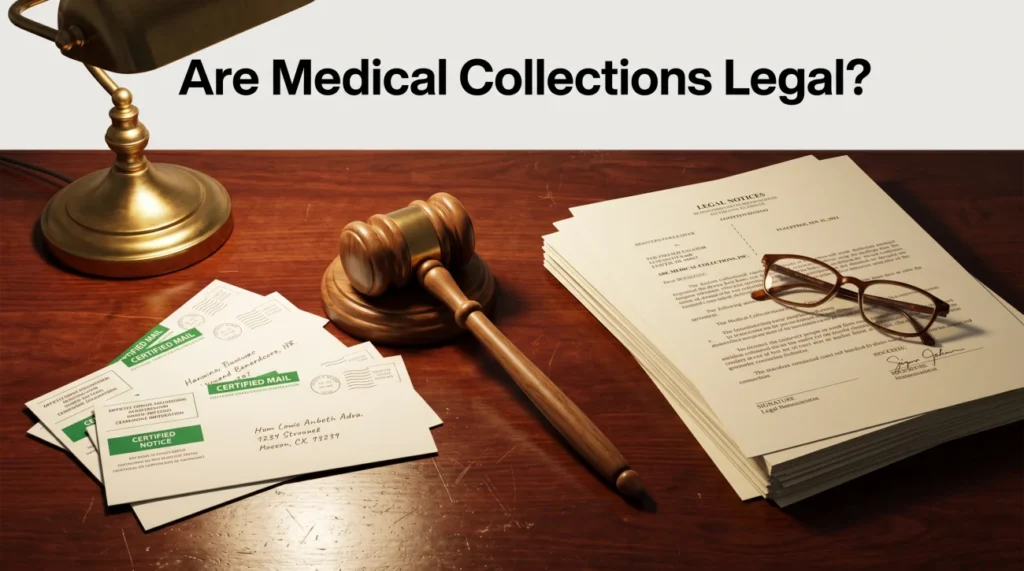
- Medical debt collections are generally legal under federal law, giving hospitals the right to outsource unpaid accounts to third-party agencies.
- However, a collection attempt becomes illegal if the agency violates the Fair Debt Collection Practices Act by harassing you or lying about what you owe.
- Nonprofit hospitals are required by federal tax law to screen patients for financial assistance before sending bills to collections.
- If an agency is trying to collect more than allowed under the No Surprises Act, or if they received protected clinical data, the collection itself can be challenged.
The Reality Behind the Collection Letters
When an aggressive letter from an unknown agency arrives in the mail, it is entirely natural to ask, are medical collections legal? The short answer is yes, but that “yes” comes with so many specific federal conditions that many collection attempts actually cross the line into unlawful territory. The real question is not whether the collection industry itself is legal. The question is whether this specific collection, for this specific amount, by this specific agency, is following the law.
During my time working inside hospital billing departments, I saw exactly how accounts move from a hospital’s internal system over to external collection agencies. Patients often assume that because a hospital initiated the process, everything about the collection must be fully compliant with the law. This is a dangerous assumption. Once an account leaves the hospital, it enters a highly regulated space where debt buyers and third-party collectors often push the boundaries of what is permitted just to secure a payment.
The Legal Baseline for Hospital Debt
To understand your rights, you first have to understand the baseline rules. Many patients wonder if it is legal for medical bills to go to collections in the first place. Under federal law, healthcare providers have the absolute right to assign or sell unpaid debts to third parties. When you sign financial responsibility forms at a clinic or hospital admission desk, you are typically agreeing to this process.
Once the debt is assigned or sold, the collection agency gains specific legal rights. They are legally permitted to contact you via mail or phone. They have the right to report the debt to consumer credit bureaus, provided they follow specific reporting timelines and thresholds. Finally, they have the right to file a lawsuit against you to seek a court judgment for the unpaid balance. These rights are real and enforceable.
However, these rights are heavily restricted. To fully understand what boundaries govern these agencies, you have to look at the broader medical debt collection laws that dictate exactly how they are allowed to operate.
When the Collection Process Breaks the Law
While people frequently ask if medical debt collection is illegal, the industry itself is not. Instead, individual collection actions become illegal when they violate one of four primary federal conditions. Understanding these four triggers is how you separate a legitimate collection effort from an unlawful one.
1. Violating the Fair Debt Collection Practices Act
The FDCPA is the most powerful tool you have. If a collector threatens you with arrest, calls outside of allowed hours, or lies about the amount you owe, their actions are illegal. For example, they are strictly limited by the 7-in-7 rule, meaning they cannot legally call you more than seven times within a seven-day period regarding the same account. You can review exactly what behaviors are prohibited under the FDCPA and medical bills guidelines to see if your collector has crossed the line.
2. Exceeding No Surprises Act Limits
If you received out-of-network emergency care, or out-of-network care at an in-network facility after January 1, 2022, federal law caps what you can be billed. If a collection agency attempts to collect a balance that exceeds these legal limits, the collection attempt itself violates federal debt collection laws because they are trying to collect an invalid amount.
3. Improper Information Transfer
Patients often ask if it is illegal to send medical debt to collections based on privacy concerns. The act of sending the debt is legal, but what information gets transferred alongside the debt is heavily restricted by HIPAA. A hospital can transfer your name, address, and balance due. If they transferred your detailed clinical notes, diagnosis codes, or treatment history to a debt buyer, that transfer is likely a severe privacy violation.
4. Skipping the Nonprofit Screening Requirement
Under IRS Rule 501(r), nonprofit hospitals must make a reasonable effort to determine if you qualify for financial assistance before taking any extraordinary collection actions. This includes selling your debt or reporting it to credit bureaus.
“This is one of the most common administrative failures I witnessed. Hospitals would run automated batch reports to send thousands of aging accounts to external collection agencies at the end of the month. Very frequently, the required financial assistance screening notices were skipped or mailed to the wrong address. If the hospital failed to screen you properly, the subsequent collection activity can be strongly contested.”
Navigating the Ethical Gray Area
Are medical collection agencies legal when they use aggressive psychology? Unfortunately, yes. There is a wide gray area where collector behavior is technically legal but feels incredibly unfair. For example, a collector might use a highly urgent tone to demand payment for a five-dollar ER copay. They might send letters with bold red lettering that look like court documents, even though they are just standard demand letters.
Another gray area involves collecting during an active insurance dispute. Unless your state has a specific law prohibiting it, a hospital can technically send your bill to collections while you are still fighting with your insurance company over a denial. This is a deeply frustrating scenario, but it is not inherently illegal. The key is not to panic. Recognizing that these are legal high-pressure tactics allows you to step back and handle the situation methodically.
Signs Your Collection Might Be Unlawful
While those aggressive tactics are technically permitted, collectors frequently cross the line from frustrating to genuinely unlawful. When you are targeted by a collection agency, the process is designed to make you feel vulnerable. The letters are formal, the phone calls are persistent, and the threat to your credit score feels immediate. Because of this pressure, many people simply pay bills they should actually be fighting. You need to know how to spot the signs that a collector is operating outside the law.
If a collector claims they are calling from a government agency or law enforcement, they are lying. If they threaten to have you arrested for an unpaid hospital bill, they are violating federal law. Similarly, if the amount on the collection letter is drastically higher than expected for an in-network facility, they may be attempting to collect an unauthorized balance. Most importantly, if your original provider was a nonprofit hospital and they never mentioned financial assistance options before sending your account out, the entire collection process may be invalid.
Arguing with the collector over the phone about whether their collection tactics are legal, which rarely produces results and often frustrates you further.
Documenting the exact statements the collector makes, noting the date and time, and using those documented violations as leverage to stop the collection completely.
What to Do When a Collector Crosses the Line
You do not have to accept illegal behavior or simply pay a questionable bill to make the harassment stop. The most effective way to test whether a collection is legitimate is to invoke your right to debt validation and force the agency to prove their claims on paper.
If you notice any of the warning signs discussed above, you need to transition from reacting to the collector to actively asserting your rights. To understand the exact steps to take during the first critical weeks, review the guide on what to do when medical debt goes to collections. If you already have documented proof of deception, improper hospital billing, or privacy breaches, you should immediately evaluate how to use these collection violations to your advantage to force the agency to close the account.
Final thoughts: Protect Your Rights by Demanding Proof
Are medical debt collectors legal? Yes, but their legal authority is strictly limited by federal rules designed to protect consumers. Knowing that the system is legal does not mean you have to accept every claim blindly. The most critical step you can take is to remove the emotion from the interaction and treat it as a paperwork process. Document every call, save every letter, and always demand that the agency proves their legal right to collect the specific amount they are demanding. When you force a collector to operate strictly within the legal framework, you neutralize their main weapon: your fear.
❓ FAQ
⚖️ Are medical debt collectors legal businesses?
Yes. Third-party collection agencies and debt buyers are legitimate legal businesses. Hospitals and clinics have the federal right to assign or sell unpaid accounts to these businesses to recover lost revenue.
🏥 Can medical bills legally go to collections if I am making small payments?
Yes, unless you have a formal, written payment plan with the hospital. Simply mailing five dollars a month does not legally prevent a provider from sending the remaining balance to a collection agency.
🛑 Is medical debt collection illegal if they call me at work?
It is not automatically illegal for them to call your workplace. However, if you explicitly tell them, either verbally or in writing, that your employer prohibits personal calls, it becomes illegal for them to continue calling you there.
📄 Are medical bills allowed to go to collections during an insurance dispute?
Surprisingly, yes. Federal guidelines do not automatically pause the billing clock just because you are actively appealing a claim denial. While it is incredibly frustrating and generally viewed as bad administrative practice, a hospital can legally outsource your account before the insurance company makes a final decision.
👮 Is it legal for medical bills to go to collections and cause my arrest?
No. Medical debt is a civil matter, not a criminal one. There is no debtors prison in the United States. Any caller who implies that the police will be involved or that a warrant will be issued over an unpaid hospital bill is breaking the law and likely running a scam.
📞 Are medical collection agencies legal if they call my family members?
They are legally allowed to contact family members strictly for the purpose of finding your phone number or address. It is entirely illegal for them to disclose to your family that you owe a medical debt.
💰 Is it legal to send medical debt to collections if I never received a bill?
Yes, it can happen if they had the wrong address on file. However, you have the right to demand written validation of the debt. If they cannot produce the original billing statements, the collection should pause and may not be able to legally proceed.
👨⚖️ Can medical bills legally go to collections and result in a lawsuit?
Yes. A collection agency has the legal right to file a civil lawsuit against you. If they win, they can obtain a court judgment that may allow them to garnish your wages, depending on your state’s specific laws.
🔒 Is sending medical debt to collections a HIPAA violation?
The transfer itself is allowed, provided the hospital only shares the minimum data necessary for billing, like your name and the amount owed. However, if the agency somehow receives your private medical charts or specific procedure details, that breaches federal privacy rules.
🗑️ Is medical debt collection illegal after seven years?
After seven years, the debt must be removed from your credit report, but it is not illegal for collectors to ask you to pay it. However, it is illegal for them to sue you if the debt is past your state’s statute of limitations.
Medical Debt Collection
The laws governing what collectors can do and the specific situations where those laws matter most.
- The full legal framework: five federal laws governing what collectors can and cannot do
- Medical Debt Collection Under $500: The Rules for Small Balances
- The FDCPA and Medical Bills: What Debt Collectors Are Actually Allowed to Do
- Can Medical Debt Collectors Garnish Your Wages? The 45-State Reality and How to Protect Yourself
- Can Medical Debt Take Your House? Liens, Lawsuits, and Homestead Rules
When the Collector Won't Stop
Knowing your rights matters. These cover what to do when the collector does not back down.
- How to use a HIPAA violation to push back on the collector that is pursuing you
- Negotiating the original bill before the collector gains more leverage over the account
- What collectors in this situation will actually accept and why the math works for both sides
- Whether a structured relief program makes sense when a collector is already involved
- Removing the collection account from your credit report after the account is resolved
Disclosure: The content on this site reflects direct experience inside hospital billing and medical debt collection, and is grounded in federal law and regulation. It is informational in nature. Reading it does not constitute legal advice and does not create any professional relationship. If you are facing a lawsuit, a judgment, or a legal deadline, consult a licensed attorney in your state before taking action.