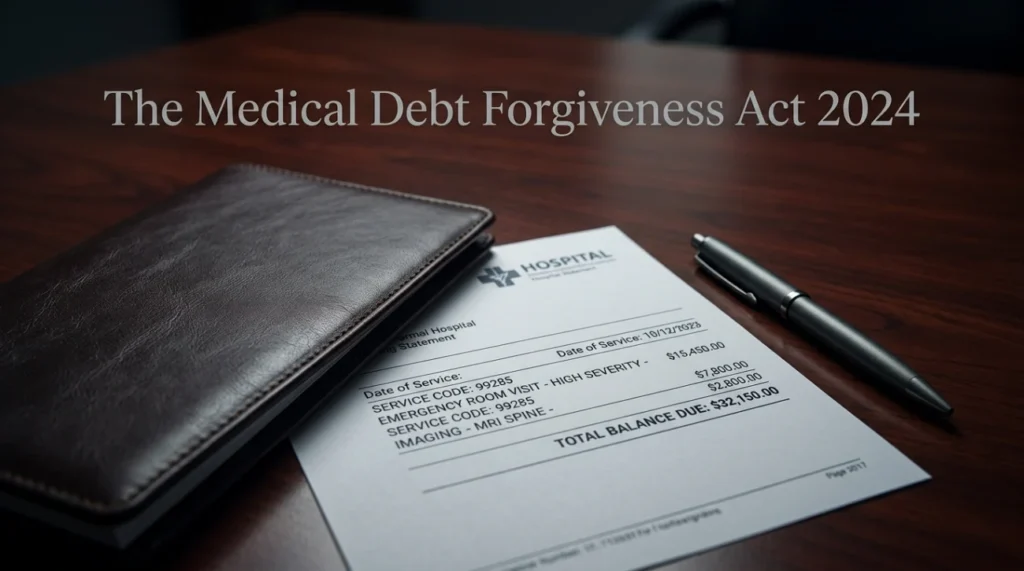
- The federal government has not signed a universal medical debt forgiveness law. Social media posts claiming otherwise are misleading.
- The CFPB rule that attempted to remove all medical debt from credit reports was struck down by a federal court in July 2025.
- Waiting for federal legislation to pass is dangerous. It often causes patients to miss the strict 240-day window to apply for existing hospital financial assistance.
- Real, immediate relief exists at the state level and through mandatory nonprofit hospital charity care programs.
The Truth About the Viral Debt Relief Rumors
If you are looking for the latest medical debt forgiveness act 2024 update because a social media post or an online ad told you the federal government just wiped out your hospital bills, I need to level with you. The healthcare system is incredibly complex, and that complexity breeds misinformation. Millions of Americans are currently sitting on unpaid medical bills, waiting for a government rescue that has not actually happened.
Working inside hospital billing departments, I saw this exact scenario play out constantly. Patients would receive collection letters and ignore them, assuming a new law protected them. They would write notes on their return envelopes stating that the government was handling it. But the billing system does not operate on rumors or proposed legislation. It operates on current, enforceable rules. By the time these patients realized the truth, their accounts had already been sold to debt buyers, and their window to apply for actual, hospital-level forgiveness had closed.
To understand your real options, we need to separate what politicians have proposed from what the billing departments are legally required to do today. If you want to clear your accounts, you have to operate within the reality of the laws that currently exist, not the ones being debated on the news.
What Was Actually Proposed (And Where It Stalled)
To understand the current medical debt forgiveness act status, we have to look at the legislative graveyard. Over the past few years, several high-profile bills were introduced in Washington. They had promising names, generated a massive amount of press, and gave patients false hope. None of them made it to the President’s desk.
The most commonly referenced proposal was the Medical Debt Relief Act of 2023 (introduced as H.R. 6003 and S. 3103). This bill was designed to prevent credit bureaus from reporting medical debt and stop lenders from using unpaid medical bills against consumers in loan evaluations. It was introduced, referred to committee, and stalled. It did not become law.
Another major proposal was the Medical Debt Cancellation Act. This was a sweeping piece of legislation that would have allowed the federal government to establish a grant program within the Department of Health and Human Services (HHS) to essentially buy and pay off hospital-held medical debt. Like the others, it was referred to the Senate HELP Committee and failed to advance.
“When patients call the billing office citing a federal medical debt forgiveness law they saw on the news, the representatives are trained to politely inform them that no such program exists in their system. The call ends, and the 240-day charity care window continues to tick down without interruption.”
Why does federal legislation keep stalling? Medical debt sits at the intersection of powerful healthcare industry lobbying, massive federal budget concerns, and deep political divisions over how healthcare should be funded in the United States. While Washington debates, the hospital revenue cycle management systems continue to auto-generate statements every 30 days.
The CFPB Rule and the July 2025 Reversal
Much of the confusion regarding whether the medical debt forgiveness act passed stems from a very real, very publicized action taken by the Consumer Financial Protection Bureau (CFPB) early in 2025. It is crucial to understand what this was, because it was a regulatory rule, not an act of Congress – and its fate changed everything.
In January 2025, the Biden administration’s CFPB finalized a rule aimed at removing medical debt from the credit reports of approximately 15 million Americans. It was a massive consumer protection move. Because it was heavily covered by the media, many patients assumed this meant their debt was forgiven. In reality, the rule only dictated how debt was reported to credit bureaus; it never erased the underlying legal obligation to pay the hospital or the debt collector.
However, that rule did not survive. In July 2025, a federal court struck down the CFPB regulation following legal challenges from the financial and collection industries. The rules immediately reverted to the previous, voluntary policies set by the three major credit bureaus (Equifax, Experian, and TransUnion).
Under those reverted rules, medical collections under $500 are generally not reported, and larger debts are given a one-year grace period before appearing on a report. But the blanket federal ban that everyone read about in early 2025 is no longer in effect. If you are banking on that CFPB rule to protect your credit score from a large hospital bill today, you are operating on outdated information.
What Actually Became Law: The State Level Shift
While the federal government stalled, individual states took action. If you want to find an actual medical debt relief act that carries legal weight, you need to look at your state legislature. State-level change has moved incredibly fast, creating a patchwork of protections that depend entirely on where you live.
For example, California enacted a comprehensive ban on medical debt appearing on credit reports, pushing through what the federal government could not. States like Colorado, Connecticut, Minnesota, and New Jersey passed stringent laws in 2024 and 2025 that strengthen financial assistance requirements, cap interest rates on medical debt, and severely restrict aggressive collection tactics like wage garnishment or placing liens on primary homes.
Beyond consumer protection laws, several states have actively partnered with organizations like Undue Medical Debt (formerly RIP Medical Debt) to erase billions in patient obligations. The money is used to purchase massive portfolios of older medical debt for pennies on the dollar and cancel it outright.
- ✅ North Carolina: Has erased over $6.5 billion in medical debt for qualifying residents state-wide.
- ✅ Illinois: Passed legislation leading to the cancellation of over $400 million in patient balances.
- ✅ Louisiana: Has used state and federal funds to cancel patient debt for qualifying low-income residents.
- ✅ Local Municipalities: Independent initiatives, such as the localized program in LA County, California, have cleared hundreds of millions without waiting for state-wide mandates.
The catch with these state-partnered forgiveness programs is that you cannot actively apply for them. The state buys specific portfolios from hospitals. If your account happens to be in that batch, you simply receive a letter in the mail stating the debt is gone. If you want to understand exactly which protections and programs came online recently in your area, reviewing what shifted in the medical debt landscape in 2025 is a necessary step.
How to Track the Laws in Your State
Because this landscape is constantly shifting at the local level, you need to know exactly what protections apply to your zip code. Do not rely on social media summaries. The most reliable way to check the status of medical debt protections in your state is to use the National Conference of State Legislatures (NCSL) database or search your state legislature’s official government website. Look specifically for enacted bills regarding credit reporting bans or expanded hospital financial assistance requirements.
The Danger of Waiting for a Federal Rescue
Understanding this patchwork of laws is critical, because making assumptions about federal legislation can be financially dangerous. Every day you spend waiting for Congress to pass a universal forgiveness bill is a day the clock ticks down on the actual rights you hold right now.
The most critical deadline in hospital billing is the 240-day window. Under IRS regulations for nonprofit hospitals, you generally have 240 days from the date of your first post-discharge billing statement to apply for financial assistance or charity care. If you qualify, the hospital is legally required to reduce or completely forgive your bill.
Receiving a $4,000 hospital bill, seeing a news headline about the medical debt forgiveness act, and tossing the bill in a drawer assuming the government will handle it.
Receiving a $4,000 hospital bill, ignoring the political news, and immediately calling the hospital’s financial counseling department to request a charity care application before the account is sold.
I have watched patients lose out on 100% financial assistance because they waited until day 250 to ask for help. Once that window closes, the hospital is fully within its rights to transfer the account to a third-party collection agency. Once a debt buyer owns the account, the hospital’s charity care policy no longer applies to you. You trade a situation where your debt could have been legally erased based on your income, for a situation where a collector is threatening your credit report.
What to Do While Washington Debates
Since there is no federal medical debt forgiveness act to save you, you have to take control of your accounts using the mechanisms that currently exist. It requires a bit of work, but these are the legitimate pathways built into the healthcare system.
Your first step is always to figure out exactly where your debt currently sits. A comprehensive strategy for getting rid of the medical bills you owe depends entirely on whether the hospital still owns the account, or if a collection agency has already bought it.
Option 1: Demand Hospital Charity Care
If the hospital still has the bill, your absolute first move is to apply for their financial assistance program. Because of IRS Section 501(r), nonprofit hospitals must offer this. It is not a suggestion; it is a condition of their tax-exempt status. Many middle-income families qualify for significant discounts without realizing it. A family of four making under $90,000 might qualify for partial or full forgiveness depending on the facility’s specific sliding scale. You must learn how to force the hospital to process your financial assistance application before they send your file to collections.
What If Your Hospital is For-Profit?
The 501(r) federal requirement only applies to nonprofit hospitals. If you were treated at a for-profit facility, they are not legally bound by the IRS to offer income-based charity care. However, from what I have seen inside billing operations, almost all major for-profit hospital systems still maintain internal financial assistance policies. They know that collecting from a low-income patient is often impossible. The rules will just be dictated by corporate policy rather than federal guidelines. You still need to ask the billing department directly for their specific financial hardship application. Even without the federal mandate, the documentation process is similar, so you should still use the core strategies to apply for hospital financial assistance to get your hardship on record.
Option 2: Seek Out Active State and Local Programs
If your income is low, or if your medical debt represents a massive percentage of your yearly earnings, you should check for organized programs operating in your specific county or state. There are patient advocacy foundations and localized initiatives that operate entirely outside the federal government. You can map out exactly which medical debt forgiveness programs are actively taking applications in your region.
Option 3: Utilize Debt Relief Programs for Collections
If you waited too long, the charity care window closed, and your accounts have been scattered across three different collection agencies, your strategy must pivot. You are no longer dealing with a hospital bound by IRS rules; you are dealing with debt buyers motivated by profit margins. If you have a high volume of medical debt (typically over $7,500) mixed with other unsecured debts, you might need professional intervention. In these cases, you need to evaluate how structured debt relief companies negotiate medical accounts down to a fraction of the original balance.
| The Myth (What People Search For) | The Reality (What Actually Works) |
|---|---|
| A federal law will automatically erase my bill. | IRS Section 501(r) forces nonprofit hospitals to forgive bills if you apply. |
| Medical debt can no longer appear on credit reports. | Federal rule was struck down in July 2025. Only certain states ban reporting. |
| The government will pay the collection agency for me. | You must negotiate settlements with debt buyers yourself or hire a relief program. |
How to Protect Yourself Today
To navigate this system successfully, you must adopt the documentation habits of a billing auditor. Do not rely on verbal promises from customer service representatives. If someone on the phone tells you your account is “on hold” while they wait for legislation, you are still at risk.
- 📋 Action: Request all account details and policies in writing.
- 📋 What to document: Log the date, time, and agent ID of every phone call.
- 📋 Confirmation step: Send any formal disputes or requests via certified mail.
If you need to buy time to figure out your state’s laws or to compile your tax returns for a financial assistance application, use a formal written request. This shows the hospital that you are engaged and aware of your rights, making them less likely to fast-track your account to a debt buyer.
Sample phrasing to buy time with a hospital billing department:
“I am writing regarding account number [12345]. I am currently reviewing my eligibility for financial assistance under the hospital’s charity care policy as required by law. Please send the complete financial assistance application and the plain language summary of your policy to my address. I request that all collection activity be paused for 30 days while I complete this paperwork.”
⚠️ Warning: Never explicitly admit the debt is valid or make a “good faith” micro-payment ($5 or $10) just to get a collector off the phone. Doing so can legally restart the statute of limitations in many states, turning an old, unenforceable debt into a brand new legal liability.
Final Thoughts: Deal With the Bill In Front of You
It is entirely understandable why so many people search for a federal medical debt forgiveness law. The system is fundamentally broken, and it feels like government intervention is the only logical solution. But as someone who has watched the revenue cycle operate from the inside, I can assure you that hoping for a legislative miracle is not a financial strategy.
The billing departments, the automated dialers, and the collection agencies are not hitting pause while Congress debates. You cannot afford to hit pause either. Stop waiting for a news alert to save you. Look at the statement in front of you, determine who actually owns the debt today, and pull the specific, legal levers you have available right now to force a reduction or a write-off. The tools exist—you just have to be the one to wield them.
❓ FAQ
🏛️ Has the medical debt forgiveness act passed?
No. Several bills have been proposed in Congress over the last few years, but none have been signed into federal law. Any claims that the federal government has universally wiped out medical debt are false.
📉 What happened to the rule removing medical debt from credit reports?
The CFPB finalized a rule in early 2025 to ban medical debt from credit reports, but a federal court struck it down in July 2025. Reporting rules have reverted to the previous standards set by the credit bureaus.
🏥 If there is no federal law, how can I get my debt forgiven?
Under IRS regulations, all nonprofit hospitals are legally required to offer financial assistance programs. Depending on your income and family size, you can apply directly with the hospital to have your bill reduced or completely erased.
⏳ How long do I have to apply for hospital financial assistance?
Generally, you have 240 days from the date of your first billing statement after discharge to submit a charity care application. If you wait for new laws to pass and miss this window, the hospital can send your account to collections.
🗺️ Are there any state medical debt forgiveness laws?
Yes. While federal law stalled, many states took action. California banned medical debt from credit reports, and states like North Carolina, Illinois, and Louisiana have funded programs to buy and forgive patient debt directly.
📞 Will a collection agency forgive my debt if I mention the proposed laws?
No. Collection agencies operate based on current, enacted law. Citing a proposed bill that has not passed will not stop collection efforts. You must use debt validation or settlement negotiation tactics instead.
💌 How do I sign up for the Undue Medical Debt forgiveness program?
You cannot apply for it. Undue Medical Debt purchases large portfolios of debt directly from hospitals on the secondary market. If your debt happens to be in a portfolio they buy, you will automatically receive a letter stating it has been forgiven.
Medical Debt Relief
Every option for resolving medical debt that you cannot pay in full.
- Every option for resolving medical debt including forgiveness, relief programs, and settlement
- Medical Debt Forgiveness in 2025 and 2026: What Changed, What’s Happening Now
- Can Medical Debt Be Forgiven? Yes: Here’s Who Qualifies and How
- Hospital Bill Forgiveness: When Hospitals Will Erase Your Bill
- Medical Debt Consolidation Loan: When It Makes Sense (And When It Doesn’t)
Programs That Can Help Right Now
Relief, negotiation, settlement, and credit repair. How each option actually works in practice.
- Using a HIPAA violation to reduce or eliminate what you owe before a relief program starts
- Negotiating directly with the hospital and what providers will reduce before collections
- How medical debt settlement works and what collectors will accept on accounts in collections
- How structured relief programs work for medical balances and what they actually cost you
- Cleaning up your credit report after using a relief program or settling medical debt
Disclosure: The content on this site reflects direct experience inside hospital billing and medical debt collection, and is grounded in federal law and regulation. It is informational in nature. Reading it does not constitute legal advice and does not create any professional relationship. If you are facing a lawsuit, a judgment, or a legal deadline, consult a licensed attorney in your state before taking action.