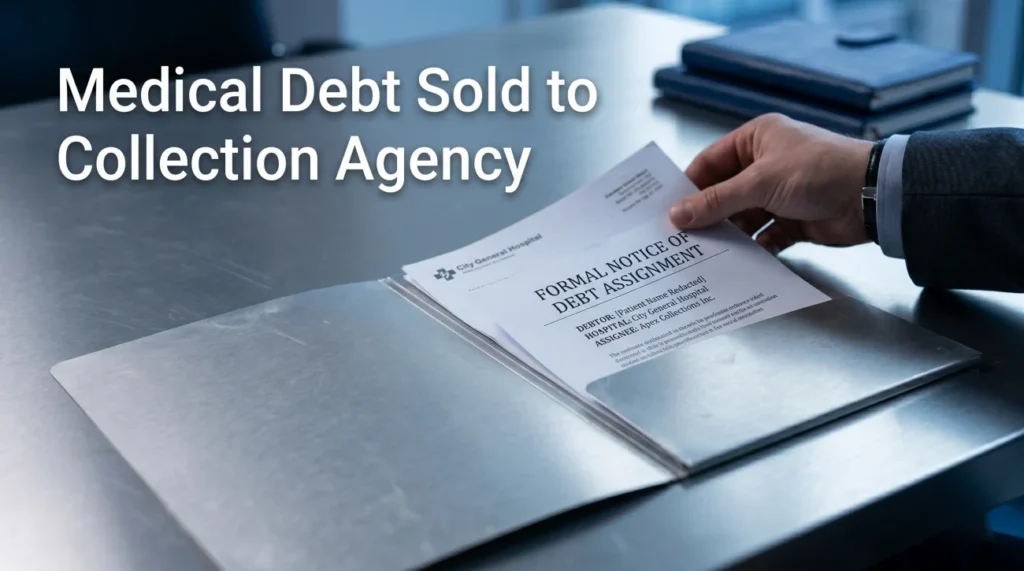
- When a hospital sells your debt, they transfer full legal ownership to a debt buyer for a tiny fraction of the original balance.
- Debt buyers typically pay between 3 and 7 cents on the dollar for medical accounts, which is why they have so much room to negotiate.
- Once sold, your account is fully covered by federal consumer protection laws, giving you strict rights regarding validation and communication.
- HIPAA still applies to sold debt. The debt buyer is only legally allowed to have basic billing information, not your detailed medical history or clinical notes.
The Reality Behind the Notice of Sale
Getting a letter from a company you have never heard of demanding money for a hospital visit is a jarring experience. The notice usually states that your medical debt was sold to a collection agency, leaving you wondering who these people are and how they got your information. From my time working inside hospital billing departments, I can tell you that selling patient accounts is a standard business practice. Hospitals are not equipped to chase down old balances indefinitely.
But that word “sold” is incredibly important. It means something very specific legally and financially. It changes who you owe, what rules they have to follow, and exactly how much leverage you have. If you understand what happens when medical debt is sold to a collector, you will realize that this transfer of ownership actually creates new opportunities for you to resolve the account on your terms.
Assigned vs. Sold: The Crucial Difference
Before you take any action, you must confirm whether your debt was actually sold or just assigned. These two scenarios operate under completely different rules.
Assigned Debt: The hospital still legally owns your account. They have simply hired a third-party medical debt collection agency to do the dirty work of calling and mailing you. The agency earns a commission on whatever they manage to collect. In this scenario, the hospital still calls the shots and can recall the debt if you qualify for financial assistance.
Sold Debt: The hospital has completely severed ties with the account. They bundled your debt with thousands of others and sold it to a debt buyer. The debt buyer now owns your account outright. They keep 100 percent of whatever they collect from you. If you want to know how the timeline usually progresses before this happens, you should review what actually happens when medical debt goes to collections.
Calling the debt buyer and begging them to return the account to the hospital so you can set up a payment plan.
Verifying in writing that the debt buyer actually owns the account, and using their low purchase price as leverage to negotiate a settlement.
The Insider Economics of Debt Buyers
Understanding why your medical debt was sold to a debt buyer is the key to resolving it. Debt buyers purchase medical accounts for pennies on the dollar. For older medical accounts, the going rate is typically between 3 and 7 cents per dollar of debt.
If you have a $3,000 hospital bill, the debt buyer may have only paid $150 to acquire it. Their cost basis is incredibly low. This is the exact reason why settling medical debt with a collection agency is a highly successful strategy. If you offer them $600 to satisfy that $3,000 account, they are still making a massive profit on their original $150 investment.
Because debt buyer medical bills are purchased in bulk, the buyer often lacks the detailed documentation to prove the debt in a court of law. This lack of documentation is a structural weakness in their business model, and you can expose it by demanding formal validation of the debt.
💡 Pro Tip: Never offer a settlement during the first phone call. Always force the debt buyer to send a validation notice first, proving they have the legal right to collect and confirming the exact balance owed.
What Changed Legally When the Debt Was Sold
The moment ownership transferred, your account fell fully under the Fair Debt Collection Practices Act (FDCPA). Hospitals are original creditors and are largely exempt from the FDCPA. Debt buyers are third-party collectors, meaning they must follow every strict rule the federal government imposes.
- 📌 The Validation Notice: Within five days of their first communication with you, the debt buyer must send a written notice detailing the amount owed, the name of the original creditor, and your right to dispute the debt.
- 📌 The 30-Day Window: You have 30 days from receiving that notice to dispute the debt in writing. If you do, they must pause all collection efforts until they provide proof.
- 📌 Interest and Fees: A debt buyer cannot legally add interest, late fees, or collection fees to your balance unless your original admission paperwork with the hospital specifically authorized those additions.
If you are ready to use these rules to clear the account, the smartest path is to learn how to effectively negotiate and settle a medical debt in collections for a fraction of the cost.
The HIPAA Dimension of Sold Debt
Patients are often horrified that a random financial company knows they were in the hospital. This brings up serious concerns about privacy. Does selling medical debt to a collection agency violate HIPAA?
The short answer is no, the transfer itself does not violate HIPAA. Hospitals are legally permitted to share information with business associates for the purpose of payment and collections. However, HIPAA places incredibly strict limits on exactly what information can be transferred in that sale.
The debt buyer is allowed to have your name, your address, the date of service, the facility name, and the final amount owed. That is all. They are strictly prohibited from holding your clinical notes, your specific diagnosis codes, or any detailed medical history. If a debt buyer mentions a specific medical condition or tries to use details of your treatment to pressure you, they may have crossed a serious legal line.
The Confusion of the First Notice
This combination of new legal rules and unfamiliar collectors creates a massive amount of confusion. Most patients experience a moment of panic when they realize a completely unfamiliar corporate entity now owns their hospital bill. You might be looking at a notice from a company claiming you owe them thousands of dollars, yet the amount might look slightly different from your last hospital statement.
You might even be dealing with multiple collectors calling about the exact same debt, creating a maze of zombie debt territory. This usually happens when an account is so old it gets resold multiple times, leaving you unsure of who actually has the legal right to collect. The immediate reaction is usually to call the hospital to figure out what happened. Here is the harsh reality: once a hospital bill is sold to a debt buyer, the hospital’s billing department will almost always refuse to speak to you about it.
Field Note: I fielded hundreds of calls from patients trying to pay us directly after they received a letter from a debt buyer. I had to tell them that their account balance in our system was literally zero. We had sold the portfolio, written off the loss, and closed the file. The patient was entirely at the mercy of the new owner, and we could no longer intervene or pull the account back.
This feeling of losing control is exactly what the debt buyer relies on to force a quick payment. To regain control, you have to understand your rights. If you want to know exactly what the new collector is legally allowed to do, read our guide on the FDCPA and medical bills. If the collector has mentioned anything about your diagnosis, treatment details, or specific medical condition, that is a separate and serious issue. You can check what your options are when a collector possesses information they were never permitted to receive.
Final Thoughts: Controlling the Outcome
Realizing your account has been sold feels intimidating, but it is actually a shift in your favor. You are no longer dealing with a hospital’s rigid billing system, but rather a financial company primarily interested in turning a quick profit. The rules have changed, and if you use them strategically, you have a strong chance to resolve the balance on your own terms.
❓ FAQ
📞 Can I just call the hospital and pay them instead?
If the debt was truly sold, no. The hospital no longer owns the account and cannot accept payment for it. You must deal directly with the debt buyer.
📈 Can a debt buyer add interest to my medical bill?
They can only add interest if the original financial agreement you signed at the hospital explicitly allowed for it, or if your specific state laws permit post-judgment interest.
⚖️ Can a company that bought my debt sue me?
Yes, as the legal owner of the debt, they have the right to file a lawsuit against you, provided the debt is still within your state’s statute of limitations.
📝 Does selling the debt restart the statute of limitations?
No. The sale of the debt between financial entities does not reset the clock. The statute of limitations generally starts from the date of your original delinquency.
📉 Will a sold medical debt hurt my credit score more?
Under current credit reporting policies, medical debts under $500 are not reported at all. For larger debts, the impact is the same regardless of whether it is assigned or sold.
🧐 How do I know if they actually bought my debt?
You must send a formal debt validation letter requesting proof of their ownership. They are required by federal law to provide documentation showing they acquired the account.
🛑 Can I stop the debt buyer from calling my workplace?
Yes. You can tell them verbally or in writing that your employer prohibits such calls, and under the FDCPA, they must immediately stop calling your workplace.
💸 Do I have to pay the full amount they are asking for?
Rarely. Because debt buyers purchase accounts for a few cents on the dollar, they are usually highly motivated to accept a lump-sum settlement for significantly less than the total balance.
🏥 Does HIPAA still protect me after the debt is sold?
Yes. The debt buyer is only legally allowed to receive basic demographic and billing information. They cannot access your medical records or clinical notes.
⏳ What happens if the debt buyer goes out of business?
If a debt buyer closes down, they will typically sell their active portfolios to yet another debt buyer. The debt does not disappear, it just gets transferred to a new owner.
Medical Debt Collection
The laws governing what collectors can do and the specific situations where those laws matter most.
- The full legal framework: five federal laws governing what collectors can and cannot do
- The FDCPA and Medical Bills: What Debt Collectors Are Actually Allowed to Do
- Can Medical Collections Sue You? What Actually Has to Happen Before They Take Your Money
- What to Say to Medical Debt Collectors: The Exact Phrases That Change the Conversation
- Medical Debt Collection for a Deceased Person: Who Is Actually Responsible
When the Collector Won't Stop
Knowing your rights matters. These cover what to do when the collector does not back down.
- How to use a HIPAA violation to push back on the collector that is pursuing you
- Negotiating the original bill before the collector gains more leverage over the account
- What collectors in this situation will actually accept and why the math works for both sides
- Whether a structured relief program makes sense when a collector is already involved
- Removing the collection account from your credit report after the account is resolved
Disclosure: The content on this site reflects direct experience inside hospital billing and medical debt collection, and is grounded in federal law and regulation. It is informational in nature. Reading it does not constitute legal advice and does not create any professional relationship. If you are facing a lawsuit, a judgment, or a legal deadline, consult a licensed attorney in your state before taking action.