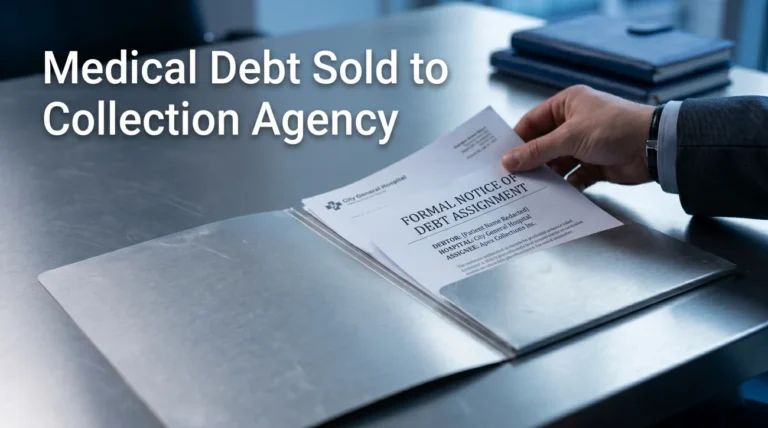

- Sending an unpaid medical bill to a collection agency is generally legal, but the exact way the hospital transfers the account is highly regulated.
- It is illegal for a hospital to transfer unnecessary clinical information, such as your specific diagnosis or treatment notes, to a debt collector under HIPAA rules.
- Nonprofit hospitals violate federal tax laws if they sell or assign your debt to a collector without first screening you for financial assistance programs.
- Transferring a balance that exceeds the No Surprises Act limits turns the collection account into an illegal pursuit from day one.
- If the transfer itself was illegal, you have powerful leverage to dispute the debt and stop collection activity entirely.
The Hidden Rules of Account Transfers
If you are looking at a notice from a collection agency and wondering if the hospital broke the law just by giving them your account, you are asking a very sharp question. Is it illegal to send medical debt to collections? The short answer is no. Providers have a well-established legal right to assign or sell unpaid balances to third parties. However, the complete answer is much more complicated.
While the act of outsourcing debt is legal, the specific manner in which that debt is transferred is surrounded by strict federal conditions. When a hospital decides to send a batch of unpaid accounts to an agency, they do not just hand over a ledger. They perform a data export from their billing software. If that export includes the wrong data, bypasses mandatory screening steps, or inflates the balance beyond federal limits, the transfer itself becomes unlawful.
During my time inside hospital revenue cycle departments, I oversaw the preparation of these exact data files. I watched automated systems pull patient accounts that never should have been sent to collections. I saw software mapping errors accidentally include clinical details in the files sent to debt buyers. Knowing exactly what makes a transfer illegal gives you a significant advantage. If you can prove the hospital violated the rules when they handed your account over, you can often shut down the collection effort entirely before you even have to argue about the balance.
The Misunderstood Privacy Angle
The most frequent reason patients question the legality of an account transfer revolves around medical privacy. Many people assume that is sending medical debt to collections illegal simply because it involves sharing private health data with a stranger. It feels like a massive breach of trust to have a third-party financial company calling you about a hospital visit.
Because of this, one of the most common questions I hear is whether is selling medical debt to collections a hipaa violation by default. It is not. The Health Insurance Portability and Accountability Act (HIPAA) contains specific exceptions that allow healthcare providers to share protected health information for the purpose of “payment operations.” This means they are legally allowed to use third-party collection agencies or debt buyers to recover unpaid balances.
However, this exception is not a blank check. The law does not allow the hospital to simply dump your entire medical chart onto a collector’s desk. The legality of the transfer hinges entirely on a concept called the “Minimum Necessary” standard, and this is exactly where hospitals frequently make illegal mistakes.
What Can and Cannot Be Legally Transferred
When a hospital transfers your account, they are only permitted to share the absolute minimum amount of information required for the agency to collect the debt. Anything beyond that crosses the line into a federal privacy violation.
Here is how the data transfer rules actually break down in practice.
- 📌 Legally Permissible to Transfer: Your full name, current and past addresses, phone numbers, Social Security number, the dates you received service, the name of the attending facility, and the total final amount owed.
- 📌 Illegal to Transfer: Your specific diagnosis codes, the names of the medications you were given, clinical notes from your doctor, detailed descriptions of surgical procedures, or the department you were treated in if that department implies a specific sensitive diagnosis (such as a psychiatric or oncology unit).
“I once had to halt an outbound file transfer of 500 patient accounts to a debt buyer because a new IT update had accidentally mapped the ‘Primary Diagnosis’ field to the ‘Account Notes’ column. If that file had gone out, every single one of those 500 transfers would have been an actionable HIPAA violation.”
If a debt collector calls you and mentions that they are collecting on the bill for your specific heart procedure or your diabetes treatment, the hospital has likely broken the law in how they transferred your account. You can learn exactly how to weaponize this error in negotiations by reviewing the steps for identifying and reporting HIPAA violations in the collection process.
Transferring Inflated or Protected Balances
Beyond the type of information that can be legally transferred, the actual dollar amount being handed over to a collector has its own strict legal limits. A standard billing error, such as a duplicate charge, does not necessarily make the act of sending the account to collections illegal. It simply makes the balance inaccurate. However, if the balance violates specific federal pricing protections, the transfer itself becomes unlawful.
Under the No Surprises Act, which took effect in January 2022, patients are protected from balance billing for out-of-network emergency services and out-of-network care provided at in-network facilities. If your insurance processed the claim and determined you only owe a $250 in-network copay, but the out-of-network anesthesiologist tries to bill you for the remaining $1,500, that extra balance is illegal.
If the provider takes that illegal $1,500 balance and transfers it to a collection agency, the transfer initiates a violation of federal law. The Fair Debt Collection Practices Act strictly prohibits collectors from attempting to collect any amount not expressly permitted by law. By transferring an amount that violates the No Surprises Act, the provider has set the collector up to commit a federal offense the moment they send their first letter.
The Nonprofit Hospital Trap
If you were treated at a nonprofit hospital, the rules for transferring debt are dramatically stricter. In exchange for not paying income or property taxes, federal law (specifically IRS Section 501(r)) requires nonprofit hospitals to offer financial assistance to low-income patients.
More importantly, the law dictates exactly when these hospitals are allowed to escalate accounts. A nonprofit hospital cannot take any “Extraordinary Collection Action” against you without first making reasonable efforts to determine if you qualify for charity care. Selling your debt to a debt buyer or assigning it to an aggressive third-party agency is legally classified as an Extraordinary Collection Action.
A nonprofit hospital sends you three generic billing statements over 90 days. You cannot afford to pay. On day 91, they sell your account to a debt buyer without ever sending you a plain-language summary of their financial assistance program.
The nonprofit hospital provides clear written notice about their charity care program, gives you at least 120 days from the first billing statement to apply, and formally notifies you 30 days before they intend to sell the account.
Are medical bills allowed to go to collections if the hospital skips this step? Absolutely not for nonprofits. If they bypass the screening requirements, the transfer is unlawful. This is one of the most powerful and least understood defenses available to patients. If you discover this happened, the transfer can often be reversed.
Signs the Transfer Itself Was Mishandled
Most patients assume the administrative machinery of a hospital is flawless. It is not. When you receive a notice from a debt collector, your first reaction is usually panic about your credit score or your bank account. Instead, your first reaction should be to audit the transfer process itself.
If you are asking is it legal to send medical debt to collections in your specific case, you need to look for the red flags that indicate a procedural failure. Often, the evidence is right in the first letter you receive or the first phone call you answer.
- 📌 The collector knows specialized medical terms regarding your treatment, rather than just the generic facility name.
- 📌 The debt buyer references clinical notes to justify why a specific procedure was billed.
- 📌 The amount they are trying to collect matches the out-of-network balance your insurance portal explicitly says you do not owe.
- 📌 You were treated at a massive nonprofit health system, but you never received a single document mentioning “charity care” or “financial assistance” before the collection agency took over.
If you spot any of these signs, you are not just dealing with a standard unpaid bill. You are dealing with a compromised account transfer. This changes your entire strategy from figuring out how to pay to figuring out how to enforce your rights.
What to Do When the Transfer Violates the Rules
If you suspect the transfer was unlawful, you must address it immediately and in writing. Do not call the collection agency to complain about the hospital’s privacy practices or administrative failures. The front-line agent answering the phone has no authority to investigate a HIPAA violation or an IRS compliance failure.
Instead, you need to dispute the collection formally in writing, which forces the agency to pause their activity and verify the legal chain of custody with the original hospital. Because alleging a federal privacy or tax violation carries significant weight, it is crucial to handle this dispute correctly. If you believe your account was transferred illegally, you should immediately review the specific steps for reporting HIPAA and procedural violations in the collection process to ensure your dispute is grounded in the correct regulations.
The Difference Between a Bad Transfer and Bad Behavior
It is important to keep your arguments clear. Is it legal to sell medical debt? Yes, under the right conditions. This article has focused entirely on the initial handover of the account. The rules governing how the hospital passes the baton are distinct from the rules governing what the collector does next.
Once the collector legally has the account, their ongoing behavior is governed by the Fair Debt Collection Practices Act (FDCPA). If the transfer was perfectly legal, but the collector starts calling you at 6:00 AM, threatening you with arrest, or talking to your neighbors about your debt, that is a separate set of violations. If you want to understand the boundary lines for their ongoing behavior, you should review exactly what is legal and illegal during the active medical collection process.
By understanding both halves of the equation, you protect yourself from the moment the hospital closes your file to the moment the collector finally gives up. For a complete map of every regulation that touches this industry, ensure you have reviewed the comprehensive breakdown of federal medical debt collection laws.
Final Thoughts on Legal Boundaries
The healthcare revenue cycle is heavily automated, and automation breeds careless errors. Hospitals and collection agencies rely on volume. They assume that if they transfer ten thousand accounts this month, the vast majority of patients will simply accept the collection notice as an absolute, unquestionable legal fact.
By asking whether the transfer itself was legal, you step out of the normal processing queue. You force them to prove their work. If a hospital bypassed a mandatory charity care screening to rush an account out the door, or if an IT glitch sent your sensitive diagnostic data to a third-party buyer, they have broken the law. You do not have to accept an illegal transfer just because it is printed on official-looking letterhead. Document the timeline, audit what the collector knows about you, and push back in writing.
❓ FAQ
📞 Is it illegal to send medical bills to collections without notifying me?
There is no strict federal law requiring a hospital to warn you before assigning a standard debt, but they must have sent the initial bills to your last known address. However, nonprofit hospitals are required to notify you 30 days before taking collection action to allow time for financial assistance screening.
🏥 Is selling medical debt to collections a HIPAA violation?
Not automatically. HIPAA allows providers to share basic demographic and billing information for payment operations. It only becomes a HIPAA violation if the provider includes unnecessary clinical information, like your specific diagnosis or doctor’s notes, in the transfer.
💳 Can a hospital send a bill to collections if I am making partial payments?
Yes, unless you have a formalized, written payment plan agreement with the hospital. Simply mailing in small, unapproved partial payments does not legally prevent a provider from sending the remaining balance to a collection agency.
🔄 Is it legal to sell medical debt multiple times to different buyers?
Yes, debt buyers can legally resell your account to other debt buyers. However, with every transfer, the risk of missing documentation increases. If a new buyer cannot produce the original billing evidence when you request validation, they cannot legally collect.
🛑 Does the No Surprises Act stop hospitals from transferring debt?
It stops them from transferring illegal balances. If a bill exceeds the allowable in-network cost-sharing limits for a protected emergency or out-of-network service, transferring that inflated balance for collection is unlawful.
⚖️ Are medical bills allowed to go to collections during an insurance appeal?
Most hospitals have internal policies to pause collection activity while a formal insurance appeal is pending, but there is no universal federal law forbidding the transfer unless your specific insurance contract mandates a hold.
⏳ How long does a hospital wait before sending debt to collections?
The standard industry timeline is between 60 and 120 days of non-payment. Nonprofit hospitals are generally required to wait at least 120 days from the first billing statement to allow patients time to apply for financial assistance.
📑 Can a nonprofit hospital sell my debt without asking about my income?
No. Under IRS rules, nonprofit hospitals must make reasonable efforts to determine if you are eligible for their financial assistance policy before selling your debt. Selling it without providing notice of these programs is a compliance failure.
🩺 What if the collection agency knows my medical diagnosis?
This is a major red flag for an illegal transfer. The agency only needs to know that you owe money to a specific provider. Knowing the details of your medical condition strongly suggests the hospital violated the HIPAA Minimum Necessary standard during the handover.
✉️ Can I dispute a collection if I prove the transfer was illegal?
Yes. If the transfer violated HIPAA or IRS nonprofit rules, you should dispute the debt in writing, demand verification of the data transfer, and file complaints with the relevant federal oversight agencies. Collectors often close these accounts to avoid liability.
Medical Debt Collection
The laws governing what collectors can do and the specific situations where those laws matter most.
- The full legal framework: five federal laws governing what collectors can and cannot do
- What to Do When Medical Debt Goes to Collections: The First 30 Days
- Zombie Medical Debt: What It Is, How It Comes Back to Life, and How to Stop It
- Do Collection Agencies Buy Medical Debt? The Market Economics You Need to Know
- Where Does Medical Debt Go When You Die? What Happens After Death
When the Collector Won't Stop
Knowing your rights matters. These cover what to do when the collector does not back down.
- How to use a HIPAA violation to push back on the collector that is pursuing you
- Negotiating the original bill before the collector gains more leverage over the account
- What collectors in this situation will actually accept and why the math works for both sides
- Whether a structured relief program makes sense when a collector is already involved
- Removing the collection account from your credit report after the account is resolved
Disclosure: The content on this site reflects direct experience inside hospital billing and medical debt collection, and is grounded in federal law and regulation. It is informational in nature. Reading it does not constitute legal advice and does not create any professional relationship. If you are facing a lawsuit, a judgment, or a legal deadline, consult a licensed attorney in your state before taking action.