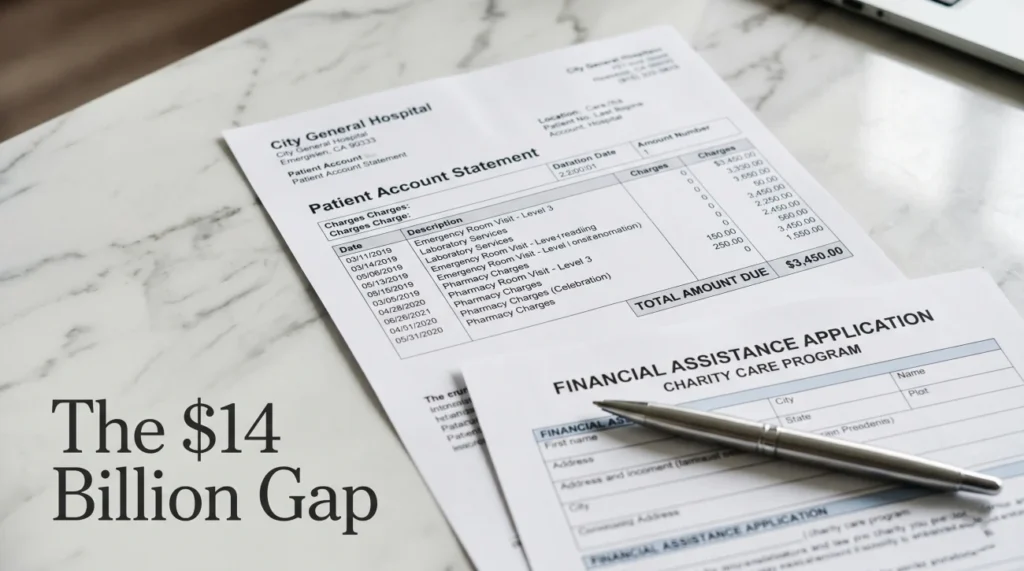
- Nonprofit hospitals fail to provide at least $14 billion in financial assistance annually to patients who legally qualify for it.
- A 2024 study found that 71 percent of eligible patients never receive this debt relief, primarily because nobody tells them the program exists.
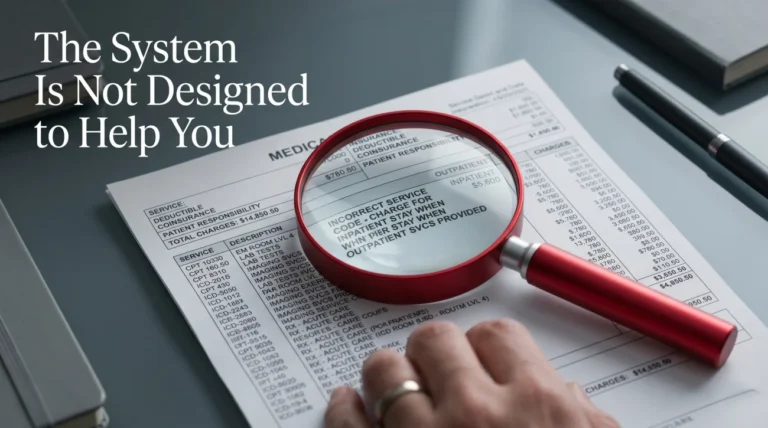
- From inside the billing department, the system is designed to collect revenue automatically, while financial assistance requires the patient to navigate a complex, hidden application process.
- Asking a simple, direct question about financial assistance is the most effective way to stop collection activity and reduce your bill.
The Gap Between Who Qualifies and Who Actually Applies
In my eight years of working inside hospital billing departments, I processed financial assistance applications for thousands of patients. I sat at a desk, reviewed income verification documents, and wiped out balances ranging from a few hundred dollars to life altering six figure sums. But for every application I approved, I also watched thousands of patients who would have easily qualified walk out the door carrying the full weight of their bills.
Recently, a 2024 research report put a concrete number on what I saw happening every single day: there is at least $14 billion annually in charity care that hospitals fail to provide to eligible patients. That is $14 billion of legal, available debt relief that never reaches the people it was designed to protect.
If you are staring at a medical bill you cannot afford, you might assume that if you qualified for help, the hospital would have told you. This is the single biggest misconception in medical billing. The money is there, but the system is not built to hand it to you. Understanding why this gap exists is the first step to making sure you do not end up paying a bill you were never supposed to owe.
The $14 Billion “Bad Debt” Illusion
To understand how so much money gets left on the table, you have to look at how hospitals report their finances to the IRS. Nonprofit hospitals are required to offer financial assistance, often called charity care, in exchange for their tax exempt status. When a patient qualifies for this care, the hospital writes off the bill.
But what happens when a patient qualifies, but never applies? The hospital still does not get paid, but instead of classifying the unpaid bill as charity care, they classify it as “bad debt.”
The nonprofit organization Dollar For recently analyzed Schedule H tax filings from over 1,000 hospital systems. They matched patient billing records to income filings in states like Maryland to see who was actually getting billed. The Dollar For research revealed a massive systemic failure: hospitals record approximately $14 billion in qualifying accounts as bad debt rather than providing the financial assistance those patients were legally eligible for.
This methodology is actually conservative. The true gap is likely much larger. For the patient, a bill classified as bad debt eventually gets sold to collection agencies, damaging credit scores and triggering aggressive phone calls. To the hospital, it is an unpaid bill. But based on the patient’s income, it never should have been a bill in the first place.
Why Hospitals Do Not Tell You (The Friction Problem)
If the money is there, why is it so hard to get? This is the frustration I hear from almost every patient I speak with. The anger is justified. When you are recovering from surgery or dealing with a chronic illness, the last thing you have the energy for is a scavenger hunt on a hospital website.
From inside the billing department, the reason is simple: the financial assistance process requires the patient to initiate it. Hospitals are not required by law to proactively identify qualifying patients and automatically offer them assistance. The system is designed around friction.
In my experience, the gap between who qualifies and who applies has almost nothing to do with eligibility. It has everything to do with awareness and administrative friction. I have watched patients start an application, hit a confusing documentation requirement like providing a specific tax transcript, and simply give up.
The application process is different at every single hospital facility. It is often buried deep in the billing portal behind multiple links. It frequently involves paperwork requirements that discourage completion. The billing system is automated to send out statements every 30 days, but the financial assistance system relies entirely on manual effort from the patient.
The hospital checks my income and automatically lowers my bill if I cannot afford it.
The hospital will bill you for the full amount until you actively request, locate, submit, and follow up on a financial assistance application.
The 71 Percent Who Never Get Help
The human cost of this administrative friction is staggering, and the numbers prove it. The 2024 Path to Charity Care report by Dollar For found that 71 percent of patients who are entitled to discounted or free care through financial assistance programs never receive it.
When researchers asked these patients why they did not apply, the primary reason was not that they were rejected. A full 52 percent reported receiving no information whatsoever from their hospital about the existence of a financial assistance program. You cannot apply for a program you do not know exists.
The data shows that the people most affected by this information blackout are the ones who need it most. Low income patients who would easily qualify for 100 percent forgiveness are the most underserved group. More than one third of the bad debt held at hospitals belongs to patients who are eligible to have their entire bill wiped clean.
If you are struggling to make ends meet and have received a massive medical bill, it is crucial to look into programs specifically designed as medical bill help for low income households.
What I Actually Saw Inside the Department
When you work the billing desk, the contrast is stark. On one screen, you see the automated collection system churning out late notices. On the other screen, you have access to the hospital’s charity care matrix.
A patient who called and asked directly almost always got an answer. If they said the right words, I could immediately pause the collection cycle, mail them the specific forms they needed, and flag their account for a hold. We wanted to approve these applications. My job was literally to process them.
But a patient who never called, or a patient who called just to say “I cannot pay this” without specifically asking about the assistance program, was often just offered a standard payment plan. The payment plan keeps the debt alive. The financial assistance program eliminates it.
This is the core reality of hospital bill forgiveness. It is not a scam, and it is not a trick. It is a highly bureaucratic process that rewards the patients who know exactly what to ask for.
The Single Highest-Return Question You Can Ask
What does this mean for anyone dealing with a hospital bill right now? It means that the hospital’s financial assistance program exists whether or not they mention it to you in their letters or on their phone calls.
You do not need a lawyer to access this $14 billion pool of relief. You just need to change how you communicate with the billing department. If you want to know how to get rid of medical debt effectively, the very first step is not negotiating a lower payoff amount. It is checking if you legally owe the money in the first place based on your income.
When you call the billing department, do not start by talking about payment plans. Use this exact phrasing:
If you prefer to handle this in writing to create a paper trail, you can use a hospital financial assistance request template. Writing a letter forces the hospital to officially document your request in their system, which is a vital step to protect yourself if the account ever accidentally slips into collections.
💡 Pro Tip: Always ask for the account to be placed on an administrative hold while your application is pending. This prevents the computer system from automatically sending your bill to a third party debt collector while you are gathering your tax returns and pay stubs.
What Happens After You Submit the Application
Many patients assume that once they mail or upload the forms, the problem is solved. In reality, submitting the application is just the first step. You need to know how the hospital handles your account while they review your paperwork.
Once your application is logged, the billing department should place an administrative hold on your account. This hold stops the automated system from sending your bill to collections or generating new late fees. However, you should call back a few days after submitting your application to verify this hold was actually placed.
The review process typically takes between 14 to 30 days. During this time, you might receive a letter requesting additional documentation. Do not ignore this letter. A missing signature or an incomplete bank statement is the most common reason a qualifying application gets stalled and eventually closed without approval.
What to Do If Your Application Is Denied
A denial letter is not always the end of the road. Inside the billing department, denials happen frequently for technical reasons rather than actual income disqualification.
If you receive a denial, look closely at the reason code. If it says the application was incomplete, find out exactly which page was missing and resubmit it. If your income was slightly over the standard threshold, you can ask to have the decision reviewed. During this review, you can provide documentation of significant living expenses like rent, childcare, or other medical bills. This proves you cannot afford the hospital debt despite your gross income.
If you hit a wall with the standard billing representatives, escalate your case by asking to speak with a patient financial counselor or a patient advocate. These senior staff members often have the authority to override automated denials or offer partial write-offs that standard phone agents cannot provide.
Final thoughts: The money is already there
The $14 billion gap is a failure of the system, not a failure of the patient. Hospitals have this money earmarked for charity care because they are legally obligated to provide it in exchange for massive tax breaks. When you apply for financial assistance, you are not asking for a special favor. You are participating in a system exactly as it was legally designed to operate.
Do not let administrative friction or a lack of communication from the hospital cost you thousands of dollars. The application might be annoying, and gathering the paperwork will be tedious. But pushing through that friction to wipe out a bill you legally should not have to pay is one of the most important financial steps you can take.
Sources Referenced
The data and statistics discussed in this article are drawn from the following primary research:
- Dollar For (2024): Bridging the Chasm. An analysis of Schedule H tax filings from over 1,000 hospital systems identifying the $14 billion gap in charity care.
- Dollar For (2024): The Path to Charity Care. A nationwide patient survey detailing why eligible patients fail to receive financial assistance.
❓ FAQ
🏥 Does every hospital have a financial assistance program?
All nonprofit hospitals are required by the IRS to have a financial assistance policy to maintain their tax exempt status. Many for profit hospitals also offer similar programs, though their requirements may be different.
💵 What income level qualifies for hospital charity care?
It varies by hospital, but many programs offer 100 percent bill forgiveness for patients making up to 200 or 300 percent of the Federal Poverty Level. Partial discounts often extend to patients making 400 percent of the poverty level.
⏱️ Can I apply for financial assistance if my bill is already in collections?
Most nonprofit hospitals allow patients to apply for financial assistance well after the initial bill, often months later, even if the account has already been sent to collections. Ask the billing department directly about their application deadline.
📄 What documents do I need to prove my income?
Most hospitals will require your most recent federal tax return, two to four of your most recent pay stubs, and sometimes recent bank statements.
🚫 What if I have no income to document?
If you are unemployed, uninsured, or a gig worker without traditional pay stubs, you can still apply. Hospitals typically accept a letter of support from whoever is helping you with room and board, an unemployment benefits statement, or a notarized letter explaining your zero income status.
🛡️ Does having health insurance disqualify me from financial assistance?
No. Having health insurance does not automatically disqualify you. If your insurance leaves you with a massive deductible or out of pocket maximum that you cannot afford based on your income, you can still apply for assistance for the remaining balance.
🛑 Will applying for hospital financial assistance hurt my credit score?
No. Applying for or receiving hospital financial assistance has no impact on your credit score. In fact, getting your bill forgiven prevents the debt from eventually damaging your credit report.
The Full Topic Map
Insights articles draw from all five topic areas. The pillar guides are the best starting point for each.
- The full legal framework: five federal laws governing what collectors can and cannot do
- Step-by-step guide to challenging a hospital bill from itemization to formal dispute
- Every option for resolving medical debt including forgiveness, relief programs, and settlement
- How medical debt gets reported, what the current rules allow, and what protects you
- State-by-state: statute of limitations, collection limits, and consumer protections
Where Most People Need Help
Five situations most people dealing with medical debt eventually face.
- How to identify and use a HIPAA violation against a medical debt collector
- How to negotiate a medical bill down from what the hospital originally billed
- What collectors will actually accept when settling medical debt in collections
- Whether national debt relief programs actually help with medical bills
- What actually works for removing medical debt from your credit report
Disclosure: The content on this site reflects direct experience inside hospital billing and medical debt collection, and is grounded in federal law and regulation. It is informational in nature. Reading it does not constitute legal advice and does not create any professional relationship. If you are facing a lawsuit, a judgment, or a legal deadline, consult a licensed attorney in your state before taking action.