- State-level medical debt relief programs in places like North Carolina and Illinois are currently erasing billions of dollars in patient debt without requiring an application.
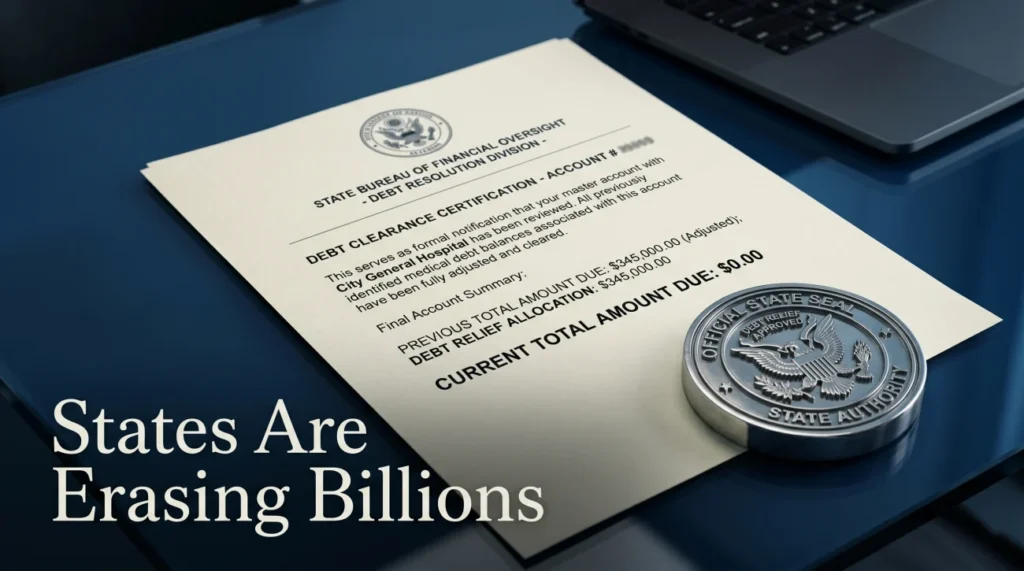
- These initiatives operate on a “passive forgiveness” model, meaning state governments purchase portfolios of hospital debt for pennies on the dollar and simply mail patients a letter stating their balance is zero.
- If you do not live in a state with an active program, your primary option remains directly navigating your hospital’s financial assistance policy, a process that still requires heavy paperwork and persistence.
The Arrival of Passive Medical Debt Erasure
As of October 2025, North Carolina has erased $6.5 billion in medical debt for over 2.5 million residents. Illinois has erased over $400 million. Los Angeles County has cleared $363 million. These are not experimental pilots or small-scale charity drives. They are active, fully funded government programs that are wiping out massive amounts of medical debt for real people.
If you have ever tried to navigate a hospital billing department, you know that getting even a minor charge removed usually requires phone calls, itemized bills, and a mountain of patience. The state-level programs rolling out right now operate on a completely different framework. Most of the people who just had their debt erased in North Carolina or Illinois never filled out a single form. They simply received a letter in the mail telling them their debt was gone.
I spent eight years working inside hospital billing departments, processing financial assistance applications. I know exactly how hard the system makes it for a patient to prove they cannot pay. To see states bypassing the hospital billing apparatus entirely is a seismic shift. It changes the landscape of medical debt forgiveness in 2025 from something patients have to fight for, into something that happens quietly in the background.
Here is what is actually happening behind the scenes, how states are doing it, and what it means for your own medical bills depending on where you live.
The Application Friction: Why Traditional Forgiveness Fails
To understand why state-level debt relief is such a breakthrough, you have to understand why standard hospital financial assistance programs fail so many of the patients they are designed to help. The problem is almost never a lack of funds; it is the friction of the application process itself.
When someone is overwhelmed by collection calls, they are often told to look into medical debt forgiveness programs offered directly by the facility. Under IRS 501(r) regulations, nonprofit hospitals are required to offer these programs. But they are not required to make them easy.
“From my desk in the billing department, I watched the friction work exactly as intended. A patient would call, desperate for help. We would mail them a financial assistance application. The application required two months of bank statements, their most recent W-2, a letter explaining their hardship, and sometimes a formal denial letter from state Medicaid. If they submitted the packet but forgot to include the back page of one bank statement, the entire application stalled. Nobody called them to tell them it stalled. Sixty days later, the account transferred to a collection agency.”
This administrative burden creates a massive gap between the people who mathematically qualify for help and the people who actually receive it. The barrier of “I didn’t know I qualified” is compounded by the barrier of “the paperwork was too complex.” Patients who are dealing with severe medical issues, missing work, and managing households simply do not have the bandwidth to play a high-stakes game of administrative ping-pong with a billing office.
This is precisely the failure point that the new state-level programs solve. They remove the patient from the administrative process entirely.
How States Buy Debt for Pennies on the Dollar
When you owe $10,000 to a hospital, the hospital treats that as an asset. But as time passes and the bill goes unpaid, the hospital knows the statistical likelihood of ever collecting that money drops close to zero. Eventually, they write it off as bad debt and sell it to the secondary market: debt buyers and collection agencies.
In the secondary market, medical debt is sold for pennies on the dollar. A debt buyer might purchase your $10,000 bill for $100. They then use collection tactics to try to squeeze a few thousand dollars out of you, turning a massive profit.
State governments recognized this market inefficiency and decided to intervene using a nonprofit partner called Undue Medical Debt (formerly known as RIP Medical Debt). Instead of letting predatory collection agencies buy the debt portfolios, state governments use federal relief funds or state budgets to buy the portfolios themselves.
Because the state is buying massive, bundled portfolios of aging, uncollected accounts, the hospitals sell it at that same steep discount, often one cent for every dollar of debt. But unlike a collection agency, when the state and Undue Medical Debt buy the portfolio, they do not initiate collections. They instantly forgive it.
The patient receives a $5,000 bill. They cannot afford it. They must find the hospital’s financial assistance policy, gather complex tax and banking documents, submit the application, and follow up for weeks to ensure it is processed before the account hits collections.
The patient receives a $5,000 bill. They cannot afford it. The hospital eventually categorizes it as bad debt. The state buys the debt portfolio. The patient receives a single letter in the mail stating the $5,000 debt has been permanently canceled. No application, no tax documents, no phone calls.
The North Carolina Blueprint: $6.5 Billion Erased
North Carolina’s approach is currently the gold standard for how this mechanism should work. The state’s Medical Debt Relief Program, launched in early 2025 and active throughout the year, achieved unprecedented scale because they secured the participation of all 99 eligible acute care hospitals in the state.
The scale of the North Carolina program is staggering: as of October 2025, it has wiped out approximately $6.5 billion in medical debt for over 2.5 million residents. The eligibility parameters were built specifically to catch the people most vulnerable to the traditional billing system’s failures.
- ✅ All Medicaid enrollees who had debt at participating hospitals dating back to January 2014 had that debt relieved automatically.
- ✅ Residents with incomes at or below 350% of the Federal Poverty Level (FPL) who had debt older than two years also qualified.
- ✅ The relief was entirely passive. Patients did not need to verify their income with the hospital; the state handled the data matching on the backend.
This proves that the mechanics of large-scale forgiveness are completely viable. The limiting factor for other states is no longer technical feasibility; it is political will and funding allocation.
The Illinois Model and the Spread of Relief
Illinois launched a similar initiative, the Medical Debt Relief Pilot Program, which has proven equally effective. Illinois targeted households with incomes at or below 400% of the FPL, or those whose medical debt exceeded 5% of their annual household income. By late 2025, the state had erased over $400 million.
What makes the Illinois program noteworthy is the inclusion of the “5% of annual income” threshold. From an operational standpoint, this is crucial. A family might earn a middle-class income that disqualifies them from poverty-based assistance, but a catastrophic $80,000 NICU bill will still bankrupt them. Illinois recognized that medical debt burden is relative to income, not just a poverty issue.
Other states expanding or launching these localized portfolio buyouts include Louisiana, Colorado, and Connecticut. The momentum suggests that passive forgiveness is becoming a standard tool for state health departments. However, your immediate options depend entirely on your current zip code.
| State / Program | Amount Erased (Est. Late 2025) | Key Eligibility Metric |
|---|---|---|
| North Carolina | $6.5 Billion | Medicaid enrollees (back to 2014) or <350% FPL |
| Illinois | $400+ Million | <400% FPL or Debt >5% of annual income |
| Los Angeles County | $363 Million | Targeted low-income local demographics |
*Note: For all active state programs listed above, no application is required. Relief is automatic via mail notification.
What If You Do Not Live in a Participating State?
If you live in a state like North Carolina or Illinois, you might simply receive a branded letter from Undue Medical Debt stating your account has been resolved. Keep it in your permanent records as documentation that the debt no longer exists. You can also proactively contact your state health department to check if your specific hospital’s debt portfolio was included in the buyout. Just remember you are checking your eligibility status, not applying for a program.
However, if you live in a state that has not implemented a portfolio buyout program, you are still operating in the traditional system. You cannot simply wait for the state to save you. You must actively investigate how to get rid of medical debt using the tools available directly through the billing entity.
This is the point where desperation often pushes people toward risky decisions. I frequently see patients exploring whether third-party companies like National Debt Relief can help with medical bills. While debt settlement companies exist, you should always exhaust the hospital’s internal charity care programs first, as these do not charge you a percentage fee or intentionally tank your credit score.
If you are facing a massive bill today, you must mimic the state’s intent but do the legwork yourself:
- Request the policy immediately: Do not wait for the bill to age. Call the billing department and say, “I need to apply for your financial assistance program. Please send me the policy and the application today.”
- Treat the paperwork like a job: The application friction is real. If they ask for two pay stubs, send three. If you are unemployed, provide a sworn letter stating you have zero income. Leave no blank spaces on the application.
- Pause the collection clock: Once you submit a financial assistance application, hospital billing systems are usually designed to pause active collections while the paperwork is under review. Get confirmation of this pause in writing.
Key Point: Do not assume a hospital has reviewed your account for financial assistance. The default setting of a hospital billing system is to send the bill to the patient, then send it to collections. Assistance only happens if you aggressively insert yourself into the process.
Final Thoughts: A Glimpse of a Better System
From my perspective as a patient financial counselor, state programs represent the clearest example I’ve seen of medical debt relief that actually reaches the people who need it. It proves a fundamental truth that those of us in the billing industry have known for years: the money being chased by collection agencies is largely uncollectible phantom debt.
This debt stresses families to the breaking point, damages credit reports, and prevents people from seeking follow-up medical care, all while yielding very little actual revenue for the hospitals. North Carolina and Illinois have demonstrated that when a state decides to treat medical debt as a systemic failure rather than a personal moral failing, billions of dollars of burden can evaporate almost overnight. The mechanism works. The blueprint is public. Until this becomes a federal standard, patients must remain vigilant: either checking their state’s eligibility, or fighting the administrative battle on their own.
❓ FAQ
📝 Do I need to apply for state medical debt relief?
No. In active programs like those in North Carolina and Illinois, the process is entirely passive. The state works with hospitals and data partners to identify eligible accounts. If you qualify, you will simply receive a letter in the mail confirming the debt has been erased.
🏥 Does state medical debt relief cover private doctors and clinics?
Usually, no. Most of these state programs purchase debt portfolios directly from large acute-care hospitals and health systems. Independent physician groups, private clinics, and private ambulance companies often hold their own debt and may not participate in the state buyout.
📫 How do I know if my medical debt was forgiven by the state?
You will receive a formal notification letter via US Mail, usually sent by Undue Medical Debt (the nonprofit that states partner with). The letter will clearly identify the original hospital, the date of service, the account number, and state that the balance has been paid and canceled.
⏱️ What happens if my account is already with a collection agency?
It depends on who owns the debt. If the collection agency is just acting as a vendor for the hospital (the hospital still owns the debt), the state can still buy it. If the hospital already permanently sold the debt to a third-party debt buyer, it may be harder for the state program to acquire and forgive it.
⚖️ Can a hospital refuse to participate in the state relief program?
Yes. These programs require hospitals to agree to sell their debt portfolios. While many states create strong incentives (like enhanced Medicaid reimbursement rates) to encourage participation, a specific hospital can choose not to sell their bad debt to the program.
Sources Referenced
- North Carolina Department of Health and Human Services: Medical Debt Relief Program data and eligibility guidelines. ncdhhs.gov/medicaldebt
- Illinois Department of Healthcare and Family Services: Medical Debt Relief Pilot Program data and parameters. hfs.illinois.gov/info/medicaldebtrelief.html
The Full Topic Map
Insights articles draw from all five topic areas. The pillar guides are the best starting point for each.
- The full legal framework: five federal laws governing what collectors can and cannot do
- Step-by-step guide to challenging a hospital bill from itemization to formal dispute
- Every option for resolving medical debt including forgiveness, relief programs, and settlement
- How medical debt gets reported, what the current rules allow, and what protects you
- State-by-state: statute of limitations, collection limits, and consumer protections
Where Most People Need Help
Five situations most people dealing with medical debt eventually face.
- How to identify and use a HIPAA violation against a medical debt collector
- How to negotiate a medical bill down from what the hospital originally billed
- What collectors will actually accept when settling medical debt in collections
- Whether national debt relief programs actually help with medical bills
- What actually works for removing medical debt from your credit report
Disclosure: The content on this site reflects direct experience inside hospital billing and medical debt collection, and is grounded in federal law and regulation. It is informational in nature. Reading it does not constitute legal advice and does not create any professional relationship. If you are facing a lawsuit, a judgment, or a legal deadline, consult a licensed attorney in your state before taking action.