
- A 2024 JAMA Health Forum study reveals that 74% of patients who disputed a medical billing error had the mistake corrected.
- Despite this high success rate, 38.5% of patients with a problematic bill never contacted the billing office at all.
- Of those who stayed silent, 86% assumed calling would not make a difference. From inside the billing system, I can tell you this assumption is exactly what costs patients billions.
- How you phrase your call matters: specific complaints get routed to specialized reviewers, while vague complaints get routed to payment plans.
The Success Rate Nobody Talks About
A 2024 JAMA Health Forum study found that 74% of patients who disputed a medical billing error got the mistake corrected. But the study also revealed a massive gap: 38.5% of patients with a problematic bill never contacted the billing office at all. When researchers asked those patients why they stayed silent, 86% of them gave the exact same reason: they assumed it wouldn’t make a difference.
Having spent years working inside hospital billing departments on the other side of that phone call, I can tell you that assumption is fundamentally wrong. It is the single most expensive mistake a patient can make.
Every day, I watched accounts move from our system to collection agencies simply because patients accepted the balance printed on the paper. The data confirms what I saw from the inside: the system will correct its mistakes, but only if you force it to look at them.
The Assumption That Costs Patients Billions
When you receive a hospital bill with a logo at the top and a standardized payment portal link at the bottom, it looks final. It looks like a mathematical certainty generated by a flawless computer system. Patients look at a $4,000 balance and feel completely powerless. They think, “The hospital has my records, they know what they did, who am I to tell a doctor they billed this wrong?”
This is the exact moment where patients lose their leverage.
“From inside a billing department, I can tell you that the 86% assumption, the belief that pushing back won’t change anything, is essentially built into the system. Hospitals know patients assume the bill is final. Most of the time, it isn’t final until you pay it.”
Medical bills are not generated by infallible systems. They are generated by humans entering billing codes, software attempting to match those codes against complex insurance contracts, and automated scrubbing tools that frequently miss nuance. Errors are not the exception; they are a routine operational reality. If you do not push back, the system defaults to assuming the charge is valid.
What the JAMA Data Actually Shows
Published on August 30, 2024, the cross-sectional survey in JAMA Health Forum examined how US households respond to medical bills they disagree with or cannot afford. The researchers’ findings mirror exactly what I saw during my time in financial counseling.
About 1 in 5 people surveyed had recently received a problematic bill. Here is what happened to the 61.5% of people who actually picked up the phone or sent a letter to the billing office:
| Patient Action / Situation | Outcome Reported in Study |
|---|---|
| Reported a specific billing error | 74% had the error corrected |
| Reported the bill was unaffordable | 76% received some financial relief |
| Attempted to negotiate the price | 62% had the price reduced |
The numbers prove that the system is responsive, but only to friction. If you create friction, the system adjusts. If you remain passive, the system collects.
What Actually Happens When You Call the Billing Office
Many patients who read this study might think, “I called once and they didn’t help me.” This brings us to a crucial operational reality: not all calls to a billing department are treated equally. The outcome depends almost entirely on how specific your dispute is, not on whether the hospital “wants” to help you.
When you call the main number on your statement, you reach a general customer service representative. Their primary metric is call resolution time, and their default tool is setting up a payment plan.
“This bill just seems way too high. I was only in the room for twenty minutes. Can you lower it?”
Result: The rep hears an inability to pay, not a billing error. They will offer you a 12-month payment plan. The total balance remains unchanged.
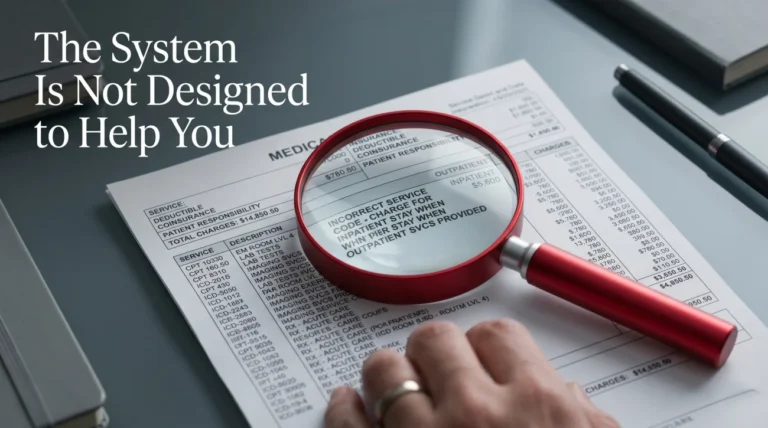
“I am looking at my itemized bill. Line 7 shows a level 4 emergency visit, but I did not receive any imaging or IV medications. I am formally requesting a coding review for upcoding.”
Result: The rep cannot answer this. They must route your account to a specialized billing reviewer or coder. You have successfully moved your account out of the collection pipeline and into the audit pipeline.
This is why understanding how to spot a hospital bill overcharge is so important. You have to give the representative a procedural reason to pause your account. They need a specific line item to question, not just a general expression of frustration.
The Escalation Path: Who Actually Reviews Your Bill
Once you trigger that specific dispute, your account leaves the frontline call center. Knowing where it goes next gives you an immense advantage. The frontline rep does not have the authority to alter a clinical charge. Instead, your dispute is routed to a coding specialist or a revenue cycle reviewer.
These reviewers look at the doctor’s chart notes and compare them to the CPT codes billed. If the chart doesn’t support the code, they correct it. If the reviewer denies your dispute, that is still not the end of the road. Your next escalation path is often the hospital’s Patient Relations department (sometimes called Patient Advocacy). Patient Relations has a different mandate than the billing department – their focus is grievance resolution, not revenue collection. This makes them highly effective when a valid billing dispute is stuck in administrative red tape.
Your Strongest Tool: The EOB Match
If you have insurance, the hospital statement is only half the story. Your strongest tool in any dispute is the Explanation of Benefits (EOB) sent by your insurance company. The EOB is not a bill; it is official documentation of how your insurance processed the claim.
When patients came to me with a dispute, the first thing I did was put the hospital’s itemized bill side-by-side with the insurance EOB. If the hospital bill showed a $500 balance, but the EOB explicitly stated “Patient Responsibility: $150,” the hospital’s billing system had a posting error. You don’t have to argue clinical codes in this scenario; you simply provide the EOB and require the billing department to adjust their ledger to match the contracted rate.
Where Disputing Fails (And How to Prevent It)
The JAMA study noted that many patients assumed the process was too complex or time-consuming. Interestingly, most people who did call said it took less than an hour. The perception gap between “this will take forever” and “it took 45 minutes” is enormous. However, patients do make tactical errors that cause their disputes to fail.
- ❌ Disputing without the itemized bill. You cannot successfully argue a summary statement that just says “Laboratory Services – $800.” You must request the itemized bill with CPT codes first, so you know exactly what you are fighting.
- ❌ Not getting things in writing. A phone call is a good start, but a written dispute submitted to the billing department creates a legally documented paper trail. If the debt later goes to collections, that paper trail is your strongest defense.
- ❌ Confusing an error with an inability to pay. If the bill is technically correct, meaning you received all the services and your insurance processed it properly, but you simply cannot afford it, you are no longer disputing. You need to shift your strategy to learn what your options are to negotiate the total balance or apply for financial assistance.
⚠️ Warning: Never let a billing department tell you they cannot provide an itemized bill. They generate them automatically; they just don’t mail them by default because itemized bills expose errors.
The Hidden Disparity in Who Asks for Help
Even when patients know how to avoid these tactical errors, there is still a systemic hurdle that stops many from picking up the phone in the first place. The JAMA researchers found that lower-income patients and those with Medicaid were significantly less likely to contact billing offices, even though they are statistically more likely to have problematic or unaffordable bills.
When you are working two jobs, dealing with health issues, and navigating complex Medicaid renewals, sitting on hold with a hospital billing department for 45 minutes feels impossible. The people who are most equipped to fight these bills, those with flexible schedules and administrative confidence, are the ones securing those high correction rates. The patients who need the corrections the most are often the ones making up the 38.5% who never call.
If you are helping a family member manage their care, this is where you can step in. With their permission (often requiring a signed HIPAA release form at the hospital), you can make these calls and demand the itemized reviews on their behalf.
What Happens After a Successful Dispute?
If your dispute is successful, the process doesn’t end with a verbal confirmation over the phone. A common point of failure is assuming the system instantly updates. It does not.
If you have not paid the bill yet, request a newly generated statement showing the adjusted balance before you make any payments. If you have already overpaid the account, the hospital must issue a refund. Refund processing in hospital billing is notoriously slow, often taking 30 to 60 days to cut a check. Always ask the representative to document your refund request with a specific reference number, and set a calendar reminder to follow up if the check hasn’t arrived in four weeks.
Final Thoughts: The Worst They Can Say Is No
The most important takeaway from this research is the realization that the medical billing system is highly fallible and relies heavily on patient compliance.
If you look at your statement and something feels wrong, do not let the fear of a complex system stop you. The data proves that speaking up works the majority of the time. Get the itemized statement, find the specific error, and force the system to review its own math. If you think something on your bill is wrong, it almost certainly is worth a call. For a complete breakdown of the exact steps to take, read our comprehensive guide on how to dispute a medical bill from start to finish.
Research Referenced
- JAMA Health Forum: Patient Contact With Billing Offices and Outcomes After Receiving a Problematic Medical Bill (Published August 30, 2024).
❓ FAQ
📞 Should I call the hospital or my insurance company first to dispute a bill?
Call the hospital billing department first to request an itemized bill. You need to see exactly what the hospital is charging for before you can ask your insurance company why they didn’t cover it. Once you have the itemized bill, compare it to the Explanation of Benefits (EOB) from your insurance.
⏳ How long do I have to dispute a hospital bill?
There is no universal federal deadline to dispute a bill directly with a hospital, but practically, you should start the dispute before the account is sent to collections (typically 90 to 120 days after the first statement, though this varies by hospital). If your insurance is involved, check your plan’s appeal window, which is typically measured in months from the date of service.
📝 What exactly should I say when I call to dispute?
Be specific. Do not just say “it’s too high.” Say, “I am reviewing my itemized statement and I am requesting a coding review for line item [X] because I believe it is a duplicate charge/service I did not receive.” Ask for a reference number for your call.
⚖️ Do I need a lawyer to dispute a medical bill?
Most patients navigate the routine dispute process without legal help. Finding coding errors, requesting itemized bills, and submitting a written dispute to the hospital’s billing review department can all be done by the patient. If you are unsure whether your situation warrants professional advice, that is a judgment call only you can make.
🏥 What happens if the hospital refuses to change the bill after my dispute?
If the hospital denies your dispute and the bill is technically accurate, your next step is to ask directly for their financial assistance application (charity care). If you do not qualify for assistance, you can attempt to negotiate a lump-sum settlement or set up a zero-interest payment plan.
The Full Topic Map
Insights articles draw from all five topic areas. The pillar guides are the best starting point for each.
- The full legal framework: five federal laws governing what collectors can and cannot do
- Step-by-step guide to challenging a hospital bill from itemization to formal dispute
- Every option for resolving medical debt including forgiveness, relief programs, and settlement
- How medical debt gets reported, what the current rules allow, and what protects you
- State-by-state: statute of limitations, collection limits, and consumer protections
Where Most People Need Help
Five situations most people dealing with medical debt eventually face.
- How to identify and use a HIPAA violation against a medical debt collector
- How to negotiate a medical bill down from what the hospital originally billed
- What collectors will actually accept when settling medical debt in collections
- Whether national debt relief programs actually help with medical bills
- What actually works for removing medical debt from your credit report
Disclosure: The content on this site reflects direct experience inside hospital billing and medical debt collection, and is grounded in federal law and regulation. It is informational in nature. Reading it does not constitute legal advice and does not create any professional relationship. If you are facing a lawsuit, a judgment, or a legal deadline, consult a licensed attorney in your state before taking action.