- Debt collectors frequently use high-pressure tactics, like calling at unexpected hours, to create a false sense of emergency and force immediate payments.
- Under federal law, phone calls from collectors before 8:00 a.m. or after 9:00 p.m. in your local time zone are illegal and can be documented as violations.
- Fear costs patients money. By requesting an itemized bill and sending a written validation request, you can pause collection activity and uncover costly billing errors before paying a dime.
The Call That Changed My Perspective
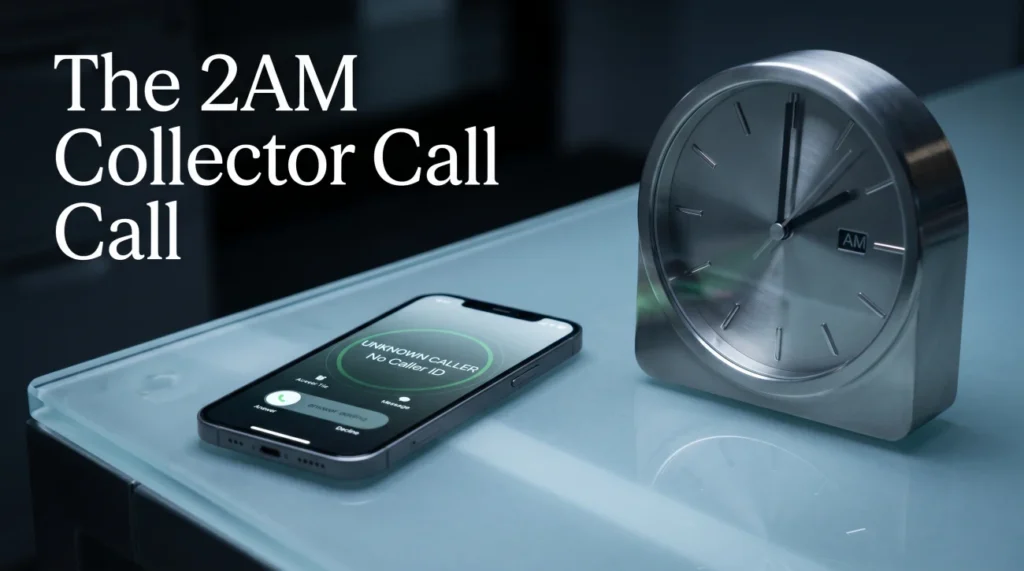
I spent many years working inside hospital billing departments, processing financial assistance applications and reviewing accounts for compliance. I know the mechanics of how a hospital bill moves from a zero-balance expectation to a third-party debt buyer. But the phone call that fundamentally changed how I think about medical debt did not come to a patient in my office. It came to someone I know personally. It was 2:00 a.m. on a Tuesday. The caller ID showed a blocked number, and an automated voice demanded an immediate callback regarding a serious financial matter.
The debt in question was a $2,100 bill from an emergency room visit fourteen months earlier. From my side of the desk, a 14-month-old account usually hits third-party collections simply because internal hospital cycles have exhausted their standard mailings and automatically transferred it to an outside vendor. But to my friend, the sudden, aggressive calls felt entirely personal. She had been ignoring them for three weeks because she did not know what to say, assuming that answering the phone would instantly trigger a lawsuit.
This interaction clarified the massive gap between knowing how the system works and being able to navigate it when it is happening to you in the middle of the night. The fear of doing the wrong thing is just as paralyzing as not knowing what to do at all. Here is exactly what was happening behind the scenes, what my friend did not know about her rights, and how we stopped the harassment.
The Cost of Fear: Why Patients Pay Blindly
When my friend finally told me about the calls, she was exhausted. She was ready to drain her modest savings account to pay the full $2,100 just to make the harassment stop. This is exactly the psychological state the collection agency was trying to induce. The medical debt collection industry relies heavily on this panic.
From my desk in the hospital billing department, I saw accounts transfer to collections every week. Once an account leaves the hospital’s internal system, the patient’s relationship shifts from dealing with a healthcare provider to dealing with a financial recovery machine. The collection agency does not care if your insurance processed the claim incorrectly. They do not care if the hospital coded a routine exam as a complex procedure. Their only objective is to secure a payment.
I frequently watched patients panic, assume a bill in collections was legally absolute, and set up payment plans that inadvertently validated debts containing hundreds of dollars in hospital coding errors.
My friend did not know that she had a specific set of rights designed to protect her from this exact scenario. She did not know that the 2:00 a.m. call was not just annoying. It was a direct violation of federal law.
What She Didn’t Know: The FDCPA Reality
The collection agency was counting on her ignorance of medical debt collection laws. They assumed she would be too frightened to challenge their authority. But the rules governing third-party debt collectors are strict, and they are highly actionable if you know how to use them.
First, the timing of the call was illegal. Under the rules of the Fair Debt Collection Practices Act applied to medical bills, a debt collector cannot contact you before 8:00 a.m. or after 9:00 p.m. in your local time zone. A call at 2:00 a.m. is a blatant violation of the FDCPA. Furthermore, the sheer volume of calls she was receiving over a three-week period was rapidly approaching the legal definition of harassment.
Second, and most importantly, she had missed a crucial window of opportunity. When a collection agency first contacts you, they are legally required to send a written notice detailing the debt. From the date of that initial communication, you have a 30-day window to request validation of the debt in writing. If you submit this request, the collector must pause all collection activity until they provide adequate proof that you actually owe the money.
Because my friend had ignored the letters and the calls for nearly a month out of fear, that initial 30-day window had closed. The collector knew this, which is why their tactics escalated. They felt legally safe turning up the pressure. As an insider, I recognize this pattern: collectors often use tactics like blocked numbers, odd hours, and scripted automated urgency specifically to test if a patient knows their rights. If you panic and pay, their tactic worked.
The Strategy: Taking Back Control
Just because the initial 30-day window had closed did not mean she was out of options. When dealing with aggressive collectors, the first step is to completely remove emotion from the equation. I told her not to panic and, crucially, not to pay a single dollar immediately.
We needed to shift from defense to offense. If you are ever in this situation, what to do when medical debt goes to collections comes down to forcing the agency to prove their claims on paper.
- Step 1: Document everything. I had her start a log. Every time the phone rang, she recorded the date, the exact time, the phone number, and the content of any voicemail. We specifically highlighted the 2:00 a.m. call.
- Step 2: Bypass the collector for the details. We contacted the original emergency room billing department to request a fully itemized bill for the date of service. Collection agencies rarely have the line-by-line itemization; they usually just have a total balance.
- Step 3: Send a written communication. Even though the 30-day window had passed, we sent a certified letter to the collection agency demanding they cease all phone communication and only contact her via US Mail. In the same letter, we requested full validation of the debt.
I also had to explain the reality of wage garnishment. She was terrified that the agency would simply drain her checking account the next morning. I explained that a collection agency has no power to touch your bank account or your wages without a court judgment. Getting a judgment requires filing a lawsuit, serving you with papers, and winning in court. This process takes months, and for a $2,100 debt, it is rarely the first step an agency will take.
The Actual Outcome and The Hidden Errors
The moment the collection agency received the certified letter demanding communication only by mail, the phone calls stopped immediately. Forcing a collector to communicate in writing removes their ability to use tone, urgency, and aggressive timing against you. It is a critical part of what to say to medical debt collectors to regain your leverage.
Two weeks later, the itemized bill arrived from the hospital. We sat at her kitchen table and went through it line by line. We found a duplicate charge for a lab test and a supply fee that should have been included in the base emergency room visit code. The total amount of the billing errors was $340.
If she had paid the collector out of fear, she would have paid for the hospital’s administrative mistakes. We also checked the dates to ensure the hospital had not sent the debt to collections while an insurance appeal was pending. We were looking closely to see if the hospital had shared inappropriate medical data with the collector, which can trigger an investigation into a HIPAA violation during the medical debt collection process. In her case, the data sharing was minimal, but the financial errors were glaring.
We disputed the $340 in errors directly with the hospital. Once those were removed and the balance was updated with the collection agency, the actual legitimate debt was closer to $1,700. Because we were now communicating in writing and calmly negotiating, she was able to set up a zero-interest payment plan of $100 a month, entirely on her own terms.
The relief was palpable. The sheer panic of the 2:00 a.m. calls was replaced by the calm realization that the debt was manageable, the harassment was over, and the collector’s power was only an illusion built on fear.
Final Thoughts: Recognizing the Illusion of Emergency
The collector calling at 2:00 a.m. was not a rogue employee making a mistake. It was a calculated strategy that works entirely because most people do not know their rights. A patient financial counselor understands these tactics because we see the aftermath, but a patient at home only feels the isolation and the threat.
If there is one thing I want anyone facing medical collections to understand, it is this: the call is designed to feel like an emergency. It is not an emergency. You have time. You have rights. The 30-day validation window is the most important protection you possess, and it begins the moment the collector first contacts you, not whenever you finally decide to deal with it. Do not let the artificial urgency of a ringing phone rush you into paying for a hospital’s billing mistakes.
❓ FAQ
🌙 Can a medical debt collector legally call me at night?
No. Under the Fair Debt Collection Practices Act (FDCPA), debt collectors are prohibited from calling you at unusual or inconvenient times. This is legally defined as before 8:00 a.m. or after 9:00 p.m. in your local time zone.
🛑 How do I stop a collection agency from calling my phone?
You have the right to request that a collector stop contacting you by phone. Send a formal “Cease Communication” letter via certified mail, stating that they may only contact you in writing through the US Postal Service.
⚖️ Can a medical collector garnish my wages immediately?
No. While collection laws vary by state, a collection agency generally cannot simply decide to take money from your paycheck or bank account. They must first file a lawsuit against you, win a judgment in court, and then obtain a garnishment order from a judge.
⏱️ What happens if I ignore the 30-day validation window?
If you do not request validation in writing within 30 days of their initial notice, the debt collector can assume the debt is valid and continue their standard collection efforts. However, you can still dispute the debt later; you just lose the automatic pause on collection activity.
📝 Does asking for an itemized bill stop collections?
Asking the hospital for an itemized bill does not automatically stop a third-party collection agency. To legally pause collection activity, you must send a formal debt validation request directly to the collection agency.
💸 Should I pay a small amount just to keep the collector happy?
Usually, no. Making a partial payment can be interpreted as acknowledging the debt, which may affect your negotiating position.
🏥 Can I still negotiate with the hospital if it is in collections?
It depends on whether the hospital still owns the debt. If they hired the agency just to collect on their behalf, you can often still deal with the hospital. If the hospital permanently sold the debt to a debt buyer, you must deal directly with the buyer.
The Full Topic Map
Insights articles draw from all five topic areas. The pillar guides are the best starting point for each.
- The full legal framework: five federal laws governing what collectors can and cannot do
- Step-by-step guide to challenging a hospital bill from itemization to formal dispute
- Every option for resolving medical debt including forgiveness, relief programs, and settlement
- How medical debt gets reported, what the current rules allow, and what protects you
- State-by-state: statute of limitations, collection limits, and consumer protections
Where Most People Need Help
Five situations most people dealing with medical debt eventually face.
- How to identify and use a HIPAA violation against a medical debt collector
- How to negotiate a medical bill down from what the hospital originally billed
- What collectors will actually accept when settling medical debt in collections
- Whether national debt relief programs actually help with medical bills
- What actually works for removing medical debt from your credit report
Disclosure: The content on this site reflects direct experience inside hospital billing and medical debt collection, and is grounded in federal law and regulation. It is informational in nature. Reading it does not constitute legal advice and does not create any professional relationship. If you are facing a lawsuit, a judgment, or a legal deadline, consult a licensed attorney in your state before taking action.