- A patient came to my desk having already paid $8,600 toward a $34,000 post-surgical hospital bill she assumed was mathematically correct.
- By reviewing her itemized statement, we found a No Surprises Act violation, duplicate charges, upcoded surgical fees, and a stalled charity care application.
- Her actual legitimate balance was $0, and the hospital owed her a full refund for the $8,600 she had already paid.
- This case highlights the core structural problem in medical billing: the system relies heavily on patients assuming they are not allowed to question the machinery behind the math.
The Folder That Held a $34,000 Mistake
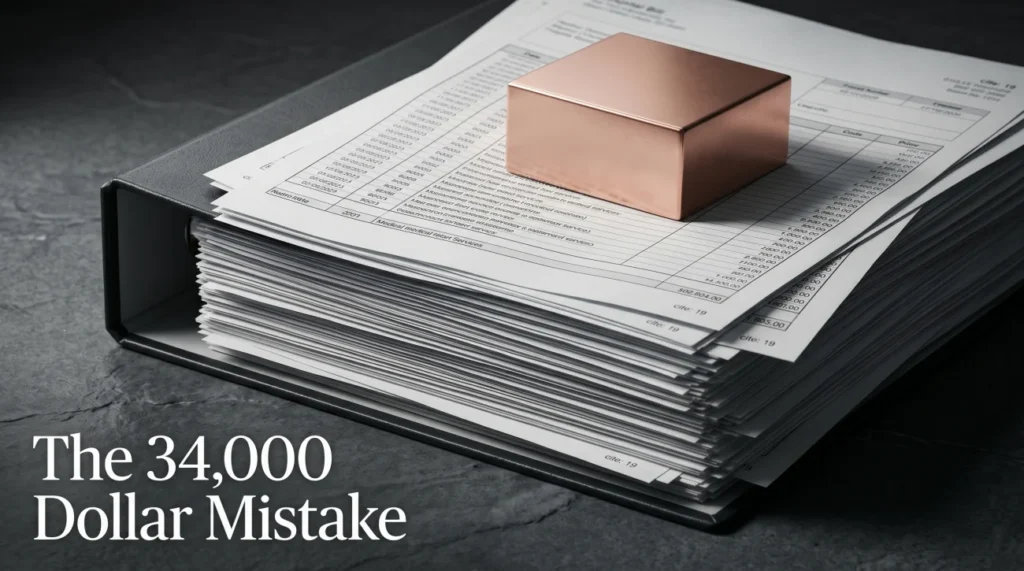
She came in on a Thursday afternoon with a folder three inches thick. She had been getting hospital bills for six months, had dutifully made several large payments, and had finally started to wonder if she had made a mistake somewhere in her paperwork.
The total she had paid out of pocket so far was $8,600. The total still outstanding on her hospital account was $26,000. She sat across from my desk, exhausted, and simply wanted to know exactly what she owed and why the balance never seemed to go down.
Most billing disputes involve a few hundred dollars. But this particular account stands out because it shows exactly what happens when a patient trusts a broken system implicitly.
The Burden of the Unquestioned Bill
When you receive a hospital statement for $34,000, the sheer size of the number is paralyzing. The bill arrives with a formal logo, a barcode, and a standardized payment portal link. It looks final. It looks like a mathematical certainty generated by a flawless computer system.
The patient in front of me felt completely powerless. Like most people, she assumed the hospital had her records, the doctors knew what they did, and the billing department simply calculated the sum. She thought it was her responsibility to figure out how to pay it, not her right to question if she actually owed it.
This is the exact moment where patients lose their leverage. Medical bills are not generated by infallible systems. They are compiled by human coders and automated software attempting to interpret complex surgical notes. Errors are not an exception. They are a routine operational reality.
The Fragmentation of a Single Surgery
Part of her confusion stemmed from the way the American medical system bills for surgery. She went into the hospital for one procedure, but she did not get one bill. She got a bill from the facility, a bill from the anesthesiologist, a bill from the primary surgeon, and a bill from the surgical assistant.
None of these billing entities talk to each other. They each process claims through insurance independently. If one provider makes a coding error, or if one entity operates out-of-network, the other departments do not catch it. From inside a billing department, you see one slice. The patient is the only one holding all the pieces, and nobody tells them that.
Finding the Errors Hidden in Plain Sight
What I found in her thick folder was a perfect storm of administrative failures. The facility fee itself was correct, but everything else was fractured.
First, the anesthesiologist was out-of-network. Because of her specific procedure date and location, billing her for that out-of-network balance was a violation of the No Surprises Act. Second, two of the CPT codes billed by the surgical assistant were upcoded, meaning they were billed for a higher-complexity procedure than what was actually documented in the operative notes. Third, there was a blatant duplicate charge where the exact same code had been billed twice on the same day.
Finally, she had started the paperwork for the hospital’s financial assistance program four months earlier. It was missing a single income verification document. Because nobody from the billing office called to tell her, the application sat frozen while the billing cycle continued.
The $0 Balance and the Sentence I Will Never Forget
Once we applied the regulatory corrections, reversed the upcoding, deleted the duplicate charge, and finalized the charity care application she already qualified for, her legitimate balance was zero.
She did not owe the remaining $26,000. Furthermore, the hospital owed her a refund for the $8,600 she had already sacrificed from her savings.
When I explained this to her, she did not look relieved or triumphant. She just looked tired. She stared at the corrected ledger for a long time, and then she said something that has stayed with me ever since.
“I didn’t know I was allowed to look at these things.”
Not “I didn’t know I qualified.” Not “I didn’t know about the billing errors.” She fundamentally believed she was not allowed to look at the machinery behind the bill.
A System Built on Patient Compliance
The most disturbing part of her situation was the complete lack of malice. There was no fraud involved here. There was no bad faith conspiracy on the hospital’s part to steal her money.
It was simply a collection of standard billing errors, a regulatory protection she did not know she had, and a stalled paperwork process she did not know how to unblock. The system relies heavily on patient compliance. If a hospital makes a $500 posting error and you write a check, the hospital keeps the $500.
Sometimes these errors drag on until the account is transferred to a third-party collector. When that happens, the problem compounds. Patients suddenly have to figure out how to dispute a medical bill with an agency, or determine what options exist if a collector is using private information inappropriately just to halt the collection process.
What “Knowing Where to Look” Actually Means
I do not share this story because $34,000 reversals happen every day. They do not. I share it because some scaled-down version of this exact case happens constantly. There is the patient who has overpaid. There is the patient making monthly payments toward a balance that a hospital bill forgiveness program would have wiped out completely.
Knowing where to look does not mean becoming a coding expert. It simply means verifying the summary statement instead of accepting it as flawless. It means asking for the fully itemized bill and comparing it to the insurance Explanation of Benefits. It means realizing that an identifiable hospital bill overcharge is often hiding behind a vague, generalized line item that no one bothered to question.
The Reality of Getting $8,600 Back
Fixing the balance was only half the battle. Now the hospital had her money. The billing system is engineered to collect funds instantly, but refunding overpayments requires an act of sheer persistence.
The front-line billing representatives cannot simply reverse a six-month-old payment. It required routing requests through the finance department, waiting through 60-day processing windows, and calling every two weeks just to ensure the check request had not been quietly archived. It took nearly three months of follow-up calls before the $8,600 check finally arrived in her mailbox.
Final Thoughts: You Have the Right to Check the Math
The patient who sat at my desk eventually got her money back, but she lost six months of sleep to a problem that never should have been hers to solve in the first place.
The hospital billing system is not going to audit itself. The financial assistance department is not going to call you to remind you about a missing tax return. You are allowed to look at these things. You are allowed to demand the itemized statement, ask for a coding review, and require the hospital to prove its math.
❓ FAQ
📞 How do I get an itemized hospital bill?
Call the hospital billing department directly and request a fully itemized statement with CPT codes. Do not accept a summary bill. You need to see the individual charges to verify accuracy.
🏥 Can a hospital cancel a bill if I complain?
Hospitals do not simply cancel bills because of general complaints. However, they will correct billing errors or apply financial assistance if you submit the proper documentation and point out specific discrepancies.
⏱️ How long does it take to get a refund from a hospital?
If you overpaid due to a billing error, refund processing is notoriously slow. It often takes 30 to 60 days for a hospital to cut a check after the dispute is formally resolved, and usually requires active follow-up from the patient.
📝 What happens if my financial assistance application is incomplete?
Most billing departments will pause the application and wait for you to provide the missing documents. They rarely call to remind you, which is why you must follow up proactively to ensure your file is moving forward.
⚖️ Does the No Surprises Act apply to all medical bills?
The No Surprises Act provides protections against certain unexpected out-of-network charges, but its application depends on the date of service, the type of facility, and your specific insurance plan. It is not a blanket protection for all older or existing medical debt.
The Full Topic Map
Insights articles draw from all five topic areas. The pillar guides are the best starting point for each.
- The full legal framework: five federal laws governing what collectors can and cannot do
- Step-by-step guide to challenging a hospital bill from itemization to formal dispute
- Every option for resolving medical debt including forgiveness, relief programs, and settlement
- How medical debt gets reported, what the current rules allow, and what protects you
- State-by-state: statute of limitations, collection limits, and consumer protections
Where Most People Need Help
Five situations most people dealing with medical debt eventually face.
- How to identify and use a HIPAA violation against a medical debt collector
- How to negotiate a medical bill down from what the hospital originally billed
- What collectors will actually accept when settling medical debt in collections
- Whether national debt relief programs actually help with medical bills
- What actually works for removing medical debt from your credit report
Disclosure: The content on this site reflects direct experience inside hospital billing and medical debt collection, and is grounded in federal law and regulation. It is informational in nature. Reading it does not constitute legal advice and does not create any professional relationship. If you are facing a lawsuit, a judgment, or a legal deadline, consult a licensed attorney in your state before taking action.