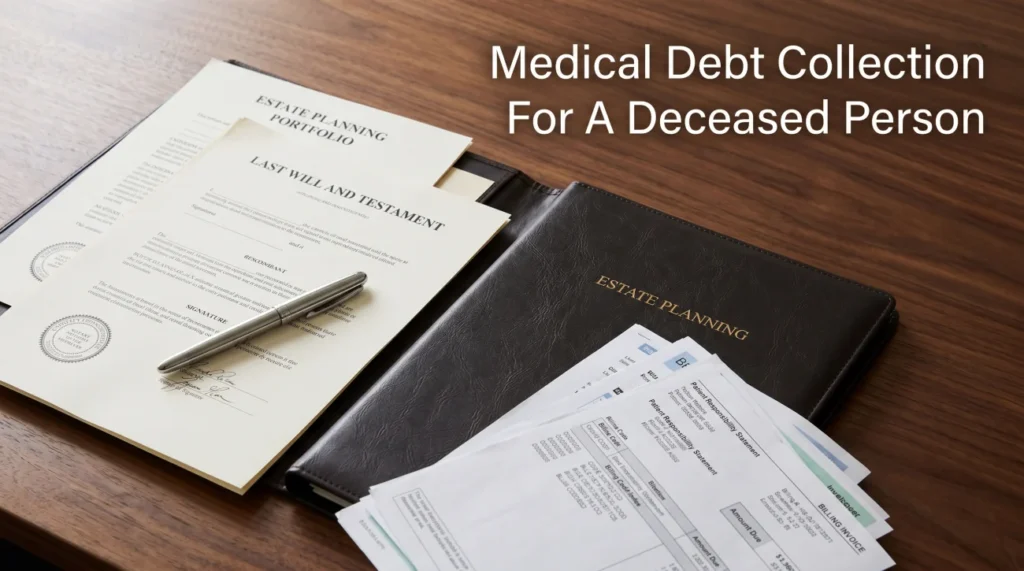
- Family members are typically not personally responsible for paying a deceased relative’s medical bills out of their own pockets.
- Medical debts belong to the deceased person’s estate, which must pay valid claims using the assets left behind before distributing inheritances.
- Collectors often use guilt or vague language to make grieving families feel obligated to pay. Recognizing these deceptive tactics is your strongest defense.
- If the deceased person used Medicaid for long-term care, the state government has separate recovery rights (MERP) that operate differently from private debt collectors.
The Reality of Medical Bills After a Loved One Passes
Navigating medical debt collection for a deceased person is one of the most stressful experiences a family can face. You are grieving, trying to manage funeral arrangements, and suddenly the mail is filled with hospital invoices and letters from aggressive collection agencies. Many families panic, assuming they are now legally on the hook for tens of thousands of dollars in final medical expenses.
During my time working inside hospital billing departments, the accounts that bothered me the most were those belonging to deceased patients. I frequently reviewed call logs and account notes where third-party collectors targeted surviving children or spouses. The underlying strategy in these calls was almost always the same: rely on the family’s assumption that debts are inherited just like property.
In the chaotic days following a death, it is easy to write a check just to make the phone calls stop. But doing so without understanding the legal boundaries can be an expensive mistake. Knowing exactly how the estate system works is the only way to protect your own financial security.
The Estate vs. The Family: Who Actually Owes the Money
The fundamental rule of debt after death is straightforward: debts belong to the estate, not the family. When a person passes away, everything they owned (their bank accounts, property, vehicles) becomes part of their legal estate. Simultaneously, all of their liabilities (credit card balances, mortgages, and medical bills) become claims against that same estate.
If you are the executor or the administrator of the estate, your job is to use the estate’s assets to pay off valid creditors in a specific order dictated by state law. You are paying them with the deceased person’s money, not your own.
“A common pattern I saw in collections was agencies rushing to get family members to agree to a payment plan before the estate went through probate. They do this because they know unsecured medical debt is often at the bottom of the priority list. If the estate runs out of money paying secured debts and funeral costs, the medical collectors get nothing.”
If the deceased person left behind no assets, or if the assets are exhausted before the medical bills are paid, the remaining debt is typically discharged. The creditors write it off as a loss. To understand the exact mechanics of this probate timeline and priority list, see our guide on where medical debt goes when someone dies.
⚠️ Warning on Medicaid (MERP): There is one major exception to standard collection rules. If the deceased person used Medicaid for long-term care (like a nursing home) after age 55, the state is federally mandated to seek reimbursement from the estate through the Medicaid Estate Recovery Program (MERP). This operates under completely different rules than private medical debt and is a common reason families are forced to sell inherited homes. If Medicaid was involved, consult an elder law attorney immediately.
The Exceptions: When Family Members Become Liable
While the legal default protects most relatives, private collectors look for specific traps that shift liability directly to a family member’s personal bank account. The most common exceptions that create personal liability include:
- Surviving spouses in community property states.
- Family members who unknowingly signed a “financial responsibility” guarantor clause at hospital admission.
- Joint financial account holders.
- Estate executors who improperly distributed assets before paying creditors.
Because these scenarios are legally complex, we have a complete breakdown of exactly who is legally responsible for a deceased person’s medical debt to help you determine your true personal exposure.
Critical Step: DO consult an estate attorney if the estate has significant assets (like a home or large savings accounts) before you distribute anything or speak to a collector. An attorney will ensure you do not accidentally trigger one of these liability traps.
What Collectors Are Allowed to Do (And What They Exploit)
Even if you are completely protected by estate laws, collection agencies will still reach out. When they do, you will start to notice how carefully they script their communications. Medical debt collection is governed by a broad set of medical debt collection laws. Collectors are legally permitted to contact the deceased person’s spouse, the parents of a deceased minor child, or the appointed executor of the estate to discuss the account.
However, the law prohibits collectors from using deceptive, false, or misleading tactics to collect a debt. Many collection agents are trained to walk right up to the edge of deception without explicitly crossing it.
Here is a classic example of a script used on family members:
Notice what the collector did not say. They did not say “You are legally required to pay this.” If they said that to a non-liable family member, it would be an illegal misrepresentation of the debt. Instead, they framed it as a moral obligation and assumed the family member would simply volunteer their credit card number. If you agree to pay it, they will process the payment immediately without mentioning that you legally didn’t have to.
Signs You Are Being Manipulated (The Pressure Points)
If you are dealing with a collector who knows the estate has no money, they will pivot entirely to emotional pressure. This is where their behavior often crosses the line from aggressive negotiation into illegal misrepresentation. Watch out for these specific patterns:
- ⚠️ Calls implying responsibility without stating it directly: Using phrases like “We need to clear this up before it affects you” without ever explaining the legal basis.
- ⚠️ Guilt-based language: Saying things like, “Didn’t your mother want her affairs left in order?” or “Most families prefer to handle these final debts quietly.”
- ⚠️ Threatening tone about ‘your mother’s/father’s debt’: Suggesting that unpaid medical bills will somehow damage your personal credit score or result in legal action against you personally.
If a collector uses these deceptive tactics, refuses to validate the debt, or reveals sensitive medical information inappropriately, their behavior crosses into a potential violation of privacy and debt collection laws. Documenting these specific FDCPA violations gives you immense power to demand the agency cease all contact.
How to Handle the Phone Calls and Letters
When you recognize those pressure tactics, your response strategy has to shift. Emotional reactions generate admissions or payments that can complicate the estate. You must force the collector to operate entirely on paper.
- 📌 Do not make a “good faith” partial payment. Even $10 from your personal account can sometimes be twisted into an acknowledgment of liability.
- 📌 Do not provide details about the deceased person’s assets, life insurance policies, or estate value over the phone.
- 📌 Do not provide the contact information of other grieving family members to the collection agency.
If you answer the phone and realize it is a medical collector, you need to control the conversation immediately.
“I don’t have the money to pay my mother’s hospital bill. You need to leave me alone, she just passed away and we are trying to figure everything out.”
“I am not confirming any personal responsibility for this account. If you believe I am personally liable for this debt, please send the original signed documentation proving my liability, along with a full validation of the debt, to my mailing address. Do not call this number again.”
By using this exact language, you invoke specific rules outlined in the Fair Debt Collection Practices Act. You force the agency to pause verbal harassment and produce the actual paperwork. In many cases, they know they have no proof of your personal liability, and the letters will simply stop.
Final Thoughts on Protecting the Estate
The urgency collectors project after a death is entirely artificial. The probate process takes months, and sometimes years, to resolve. You do not need to make financial decisions on the phone with a stranger.
Keep meticulous records of every letter you receive, route all communication through the formal estate probate process, and always demand written proof of liability. If an agency’s tactics become deceptive or harassing, remember that old accounts are often zombie medical debts that lack proper documentation. Send a formal written cease and desist letter to force them to step back, and focus your energy where it belongs during a difficult time.
❓ FAQ
👨👩👧👦 Am I responsible for my deceased parent’s medical debt?
Generally, no. Your parent’s estate is responsible for their debts. Unless you co-signed a financial agreement or shared a joint account, their medical debt does not legally transfer to you.
💍 Does a surviving spouse have to pay medical bills?
If you reside in one of the nine community property states (like Texas, California, or Arizona), state law may hold you responsible for debts incurred during the marriage. Otherwise, spouses are typically only liable if they co-signed.
🏦 What happens if the deceased person had no money to pay medical bills?
If the estate is insolvent (meaning there are no assets left to pay creditors), the medical debt is uncollectable. The collection agency or hospital must write off the unpaid balance as a loss.
📞 Can a debt collector call family members after someone dies?
Yes, but under the FDCPA, they are generally limited to contacting the spouse, parents of a minor, or the estate executor to discuss the debt. They are not allowed to call random family members repeatedly to demand payment.
✍️ What if I signed the admission papers at the hospital for my relative?
This is a common trap. If the paperwork you signed contained a “financial guarantor” clause, you may have legally agreed to pay their bills. Always demand the collector produce the exact signed document to prove your liability.
🏠 Can a hospital put a lien on a house after death?
Private hospitals must file a claim against the estate, which could force a sale. However, if the deceased used Medicaid for nursing home care, the government’s Medicaid Estate Recovery Program (MERP) has strong legal rights to place a claim on the home to recover costs.
📉 Will my deceased spouse’s medical debt ruin my credit score?
A deceased person’s medical debt cannot be reported on your personal credit report unless you were legally liable as a co-signer or joint account holder. If a collector threatens your credit over an estate debt, it is an FDCPA violation.
🛡️ Can life insurance be used to pay medical debt after death?
Life insurance payouts with a named beneficiary bypass the estate process entirely. This means the money goes directly to you, and medical creditors cannot force you to use those funds to pay the deceased person’s bills.
⚖️ Do I need a lawyer for medical debt after a death?
If the estate includes significant assets (like real estate or large savings), or if you live in a community property state, consulting an estate attorney is critical before you pay any collectors or distribute any inheritances.
🛑 How do I stop a medical debt collector from calling about a deceased relative?
Send a written “Cease and Desist” letter via certified mail. Provide the contact information for the estate executor (if that is someone else), state clearly that you do not accept personal responsibility, and demand all verbal contact stop.
Medical Debt Collection
The laws governing what collectors can do and the specific situations where those laws matter most.
- The full legal framework: five federal laws governing what collectors can and cannot do
- The FDCPA and Medical Bills: What Debt Collectors Are Actually Allowed to Do
- Medical Debt Collection Under $500: The Rules for Small Balances
- Should I Pay Medical Debt in Collections? The Strategic Framework
- Can Medical Collections Sue You? What Actually Has to Happen Before They Take Your Money
When the Collector Won't Stop
Knowing your rights matters. These cover what to do when the collector does not back down.
- How to use a HIPAA violation to push back on the collector that is pursuing you
- Negotiating the original bill before the collector gains more leverage over the account
- What collectors in this situation will actually accept and why the math works for both sides
- Whether a structured relief program makes sense when a collector is already involved
- Removing the collection account from your credit report after the account is resolved
Disclosure: The content on this site reflects direct experience inside hospital billing and medical debt collection, and is grounded in federal law and regulation. It is informational in nature. Reading it does not constitute legal advice and does not create any professional relationship. If you are facing a lawsuit, a judgment, or a legal deadline, consult a licensed attorney in your state before taking action.