- An overcharge is rarely a random high number; it is usually a specific, disputable data entry or coding error.
- The five most common errors are duplicate charges, upcoding, unbundling, billing for services not rendered, and patient information mix-ups.
- You cannot spot these mistakes on a summary statement. You must request a fully itemized bill and compare it against your Explanation of Benefits (EOB).
- Finding the error is only the first step. Knowing whether the mistake impacts your actual out-of-pocket cost or just your insurance limits will dictate how you fight it.
The Reality of Errors on Your Hospital Statement
Hospital billing errors are not rare edge cases. Federal government audits routinely find improper charges on nearly half of all Medicare claims. The exact same errors happen on private insurance and self-pay accounts every single day. The only difference is whether anyone takes the time to check.
When you are looking at a balance that seems impossibly high, your first thought might be that a hospital bill overcharge has occurred. From my time sitting inside hospital billing departments, I can tell you that patients usually assume the hospital’s pricing is just inherently unfair. While healthcare costs are high, an actual overcharge is usually something much more concrete: a specific mistake in how your services were coded and entered into the system.
Understanding what those mistakes look like changes your entire approach. You stop arguing about whether a charge is fair and start looking for the data entry errors that you have the legal right to challenge.
What an Overcharge Actually Is (The 5 Main Types)
When someone says the hospital overcharged me, they are usually expressing frustration at the total amount due. But to a billing reviewer, an overcharge only exists if it falls into one of several specific categories. Understanding these types changes what you look for when you review your documents.
Type 1: Duplicate Charges
This happens when the exact same service is billed twice. Sometimes it appears on the same line item, and other times it is scattered across different departments or billing entities. Duplicate charges are incredibly common in multi-day hospital stays where daily care routines get logged multiple times by different shift nurses.
Type 2: Upcoding
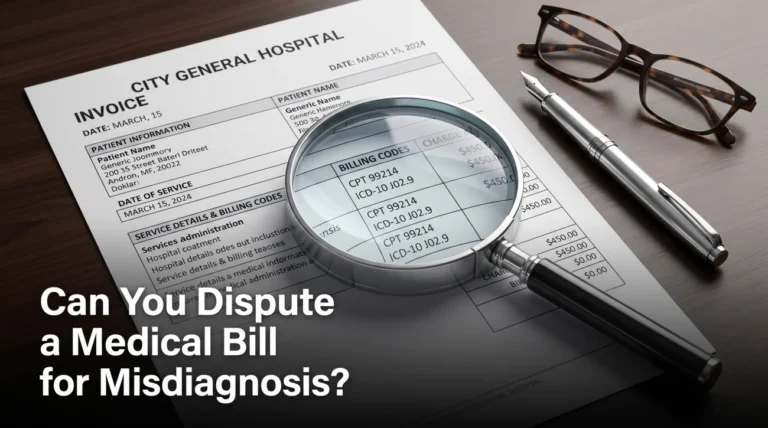
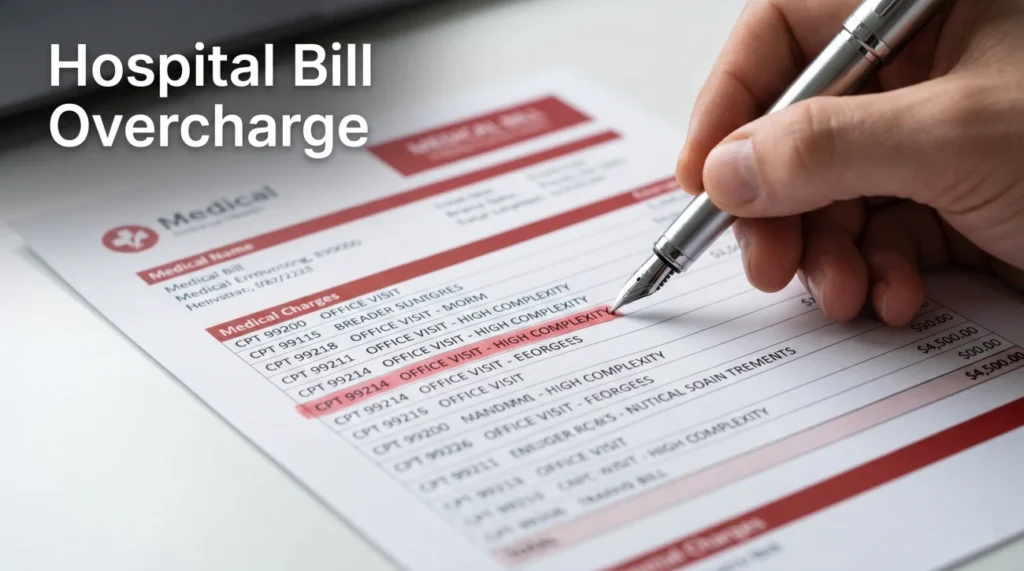
Upcoding is one of the most common medical billing errors. This occurs when a provider bills for a more complex and more expensive service code than what was actually performed. For example, a routine 15-minute office visit (CPT code 99213) might be improperly billed as a moderate-to-high complexity evaluation (CPT code 99214). It is a subtle shift on paper, but it causes your bill to jump significantly.
Type 3: Unbundling
Certain medical procedures are meant to be billed as a single comprehensive package. Unbundling happens when a hospital separates that package into individual charges, assigning each piece its own line item and cost. The combined total of these unbundled parts always exceeds what the single bundled code would have cost.
“I’ve reviewed accounts where a standard routine procedure was unbundled into separate charges for the room, the basic supplies, and the standard prep work that should have been included in the main fee. That is a clear error you can push back on.”
Type 4: Services Not Rendered
This is exactly what it sounds like. You are billed for medications you never received, tests that were canceled, or supplies that appear on the final invoice but nowhere in your clinical notes. If a service does not appear in your medical records, that is a massive red flag and a strong foundation for a formal dispute.
Type 5: Wrong Patient Information
Administrative mistakes often result in incorrect hospital bills. I have seen simple typos in a Date of Birth push a patient into the wrong insurance tier, leaving them with the full balance. In other cases, patients with similar names have their files accidentally merged, resulting in another person’s lab work showing up on your statement.
How to Spot Medical Billing Errors
You cannot find errors on the summary statement the hospital mails to your house. That piece of paper only shows a vague total. To figure out how to find errors in a medical bill, you have to gather the right documents and compare them line by line.
Your first step is to request an itemized bill. Hospitals are generally required to provide this document within 30 days of your request. This document breaks down every single pill, procedure, and facility fee alongside its specific CPT (Current Procedural Terminology) code.
Verifying the Codes and Your Costs
If you see a billing code on your itemized statement but do not know what it means, you can look it up using the CMS website or standard online CPT lookup tools. Once you know what the code represents, take these steps:
- 📋 Match each line item against your personal memory and treatment records.
- 📋 Compare the billed amount against the Explanation of Benefits (EOB) sent by your insurance company.
- 📋 Flag any discrepancies where the hospital bill shows a service that your EOB does not acknowledge.
From an insider perspective, it is important to note that not all errors actually impact your wallet. Some errors only inflate the portion your insurance pays. Focus your energy on errors that directly hit your deductible, copay, or out-of-pocket maximum.
Where to Route Your Dispute Based on the Error
Finding a hospital bill mistake is only the beginning. Taking action requires knowing the exact rules of engagement. Because the process changes depending on what stage you are in, we have built a complete library covering every angle of challenging an incorrect balance. If you need a high-level view of the entire landscape first, start with our complete guide to disputing medical bills.
If you have already identified an issue, use the specific guides below to navigate your next move.
| Topic | What You Will Learn |
|---|---|
| Valid Reasons for Dispute | Clarifies exactly what counts as a legitimate reason to challenge a charge and what does not. |
| Is Disputing Worth It? | A practical framework to help you decide if the time investment matches the potential financial return. |
| The Step-by-Step Process | The core guide on how to document an error and get it corrected by the billing department. |
| What to Say on the Phone | Exact phrases to use when speaking to a representative to ensure your account gets flagged for review. |
| Maximizing Your Success Rate | Advanced tactics that separate a successful challenge from one that gets ignored. |
| Services Not Rendered | How to use your clinical records to eliminate charges for treatments you never received. |
| Understanding Deadlines | A breakdown of the overlapping time limits you have before your window to challenge a charge closes. |
| Inside the Review Process | What actually happens on the hospital’s end once you submit your paperwork. |
| Protection from Collections | The rules regarding debt collection activity while your account is under active review. |
| Disputing After Payment | How to request a retroactive refund if you already paid a balance that contained errors. |
Once you know what kind of error you are dealing with and which path to take, the next hurdle is getting the billing office to actually listen to you.
What Makes a Billing Department Take You Seriously
There is a massive difference between filing a generic hospital bill overcharge complaint and submitting a formal dispute. When a patient calls and vaguely says a charge seems too high, the representative’s primary goal is to close the call. The account might get routed to a general queue where nothing happens.
However, when you submit a written dispute identifying a specific CPT code error, the dynamic shifts completely. A written document pointing out that CPT code 99214 was billed when 99213 was appropriate cannot be easily dismissed. It gets routed to a specialized reviewer because the hospital now has a documented compliance issue on its hands.
A strong dispute requires three elements:
- 📌 Identify the specific CPT code: Name the exact line item that you are challenging.
- 📌 State why medical records do not support it: Briefly explain the discrepancy using your clinical notes or EOB.
- 📌 Make a written request for correction: Ask for a specific adjustment to the balance, not just a general explanation.
A written dispute creates a paper trail. It timestamps your concerns and forces the hospital to either prove the charge is valid or adjust the balance.
The Trap of Assuming the Hospital is Always Right
The most frustrating pattern I see involves patients who spot something suspicious but give up before they even start. They look at an incorrect hospital bill, feel completely overwhelmed by the wall of medical jargon, and assume the printed numbers must be accurate simply because they came from a large medical institution.
The billing system relies heavily on this exact kind of exhaustion. I have watched patients start investigating, get confused by the codes, and just write a check to make the anxiety go away. They assume fighting it will take months of legal battling. Do not let the complexity of the paperwork bully you into paying for a mechanical error. The burden of proof is on the hospital to justify the charge, not on you to accept it blindly.
Evaluating Your Options After Finding an Error
Once you have identified a mistake, your next move depends on the situation. If you have found clear evidence of duplicate billing or incorrect codes, you need to initiate a formal correction immediately. For the exact steps on doing this, read our guide on how to document and submit a specific billing error.
If you are looking at the bill and simply feel unsure if the discrepancy is worth your time, our framework on weighing the value of a dispute will help you decide.
Sometimes, a patient goes through the entire review process, gets the errors fixed, and finds that the remaining legitimate balance is still far beyond their ability to pay. When the bill is technically accurate but financially impossible, challenging the codes will no longer work. At that point, you need to pivot your strategy and focus on how to negotiate the remaining valid charges directly with the financial office.
As you dig into these billing records, you might occasionally uncover secondary issues. For instance, I have seen cases where patients investigating a bill realize that the hospital carelessly transferred highly sensitive diagnostic information to an aggressive third-party collection agency before the dispute was even settled. If you uncover that a collector is using private clinical data against you, you are no longer just dealing with a billing error. You need to know how to leverage HIPAA privacy rules to halt their activity entirely.
Final Thoughts on Protecting Your Wallet
An overcharge is not a mystery. It is a mechanical failure in the revenue cycle. Whether it is a typo in a patient ID or an unbundled surgical kit, these errors happen because healthcare billing is incredibly complex and largely automated. By securing an itemized bill, verifying the codes, and putting your concerns in writing, you strip away the confusion and force the system to answer for its math.
When I was reviewing accounts from the inside, the files that got fixed the fastest were the ones where the patient stripped away the emotion and just pointed to the discrepancies. You do not need to be a medical expert to catch an overcharge. You just need to be willing to look at the itemized details and ask the hospital to prove its work.
❓ FAQ
📋 How do I prove I was overcharged on a hospital bill?
You must request an itemized bill that includes CPT codes. Compare those codes against your medical records and your insurance Explanation of Benefits (EOB) to find services you did not receive or charges that were duplicated.
⚖️ Can I get in trouble for disputing a medical charge?
No. Patients are generally entitled to request an itemized breakdown and question any charges that do not match the clinical care they received.
🏥 What are the most common hospital billing errors?
The most frequent mistakes include duplicate charges for a single service, upcoding a basic visit to a complex one, unbundling a comprehensive procedure into separate fees, and billing for medications that were never administered.
⏱️ How long does a hospital have to fix a billing mistake?
While there is no strict federal timeline for fixing an error, most hospital billing departments aim to resolve written disputes within 30 to 60 days. It is crucial to set a response deadline in your initial letter.
🚩 Is medical billing fraud common?
While intentional medical billing fraud does exist, the vast majority of overcharges are simple administrative data entry errors, miscommunications between departments, or automated software glitches.
💳 Do I have to pay my bill while I am disputing it?
Policies vary widely by provider. Some hospitals will place a temporary hold on your account while a formal written dispute is being reviewed, but there is no universal federal law requiring them to do so. Always contact the billing department to explicitly ask about your account status and request a hold during the review period to protect yourself from collections.
Medical Bill Dispute
How to challenge a hospital bill from the initial dispute through the collections process.
- Step-by-step guide to challenging a hospital bill from itemization to formal dispute
- How to Dispute a Surprise Medical Bill: The Federal Process Step by Step
- Can a Disputed Medical Bill Be Sent to Collections? The Rules During Active Dispute
- What Happens When You Dispute a Medical Bill? The Process and Possible Outcomes
- Can You Dispute a Medical Bill for Misdiagnosis? What’s a Billing Dispute vs a Medical Claim
When Disputing Is Not Enough
A successful dispute resolves some situations. These cover when the bill or the collector remains.
- Using a HIPAA violation to challenge how your bill was transferred to the collector
- Negotiating the bill you are disputing and what hospitals are actually willing to reduce
- Settling the remaining balance when a dispute does not fully resolve the account
- Debt relief programs that can handle disputed and overbilled medical accounts
- How a successful bill dispute can result in removing the collection from your credit report
Disclosure: The content on this site reflects direct experience inside hospital billing and medical debt collection, and is grounded in federal law and regulation. It is informational in nature. Reading it does not constitute legal advice and does not create any professional relationship. If you are facing a lawsuit, a judgment, or a legal deadline, consult a licensed attorney in your state before taking action.