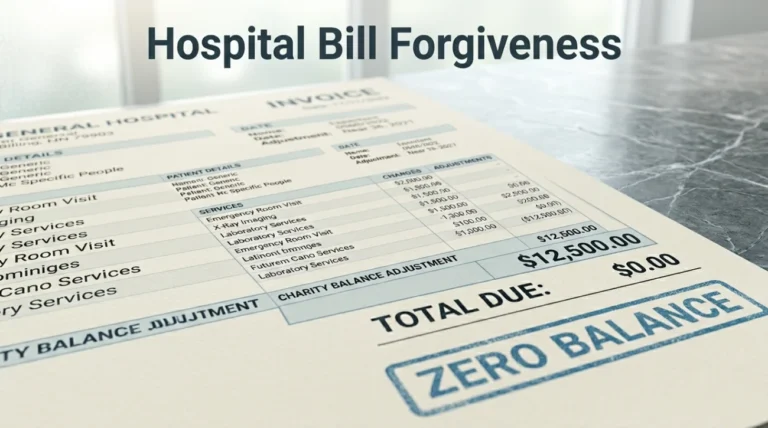

- The term “medical debt relief” is used interchangeably by hospitals offering free charity care and commercial companies charging fees for debt settlement. Knowing the difference is critical.
- Always apply for hospital forgiveness programs before you consider paying a third party to negotiate your balances.
- Commercial debt settlement is a valid tool, but it is generally designed for large balances that have already defaulted and moved to collection agencies.
The Hidden Differences Between Relief Options
The phrase “medical debt relief program” is used by nonprofit hospitals offering free debt forgiveness and by commercial companies charging you a percentage of your balance to do the exact same job. They are not the same thing. When you search for a way out of overwhelming hospital bills, you will immediately encounter hundreds of organizations, but knowing the difference between them is the only way to protect your finances.
During my time inside hospital billing departments, I saw exactly how this terminology confuses patients. The billing office lives by a rulebook most patients never see: deciding what gets written off, what gets discounted, and what gets handed to a collection agency. Understanding the types of medical debt relief programs available allows you to align your specific financial situation with the right internal process.
Why Choosing the Wrong Type Costs You Thousands
Before we break down the four specific types of relief programs below, you need to understand why mixing them up is so dangerous. The most devastating mistake I witnessed on the administrative side of healthcare is what I call the category mismatch. This happens when a patient enrolls in a commercial settlement program (Type 3) to manage a debt that the hospital would have erased for free (Type 1) if the patient had simply submitted the correct two-page form.
Commercial settlement companies are heavily marketed. Hospital financial assistance programs are usually buried in the fine print on the back of your statement. Because of this visibility gap, patients routinely agree to pay thousands of dollars in settlement fees to resolve accounts that actually qualified for 100% charity care.
“I frequently reviewed accounts where a commercial debt relief agency sent a letter of representation, offering to settle a $10,000 balance for $5,000. When I looked at the patient’s stated income on the settlement paperwork, it was clear they were well below the federal poverty line threshold for our hospital. If they had bypassed the settlement agency and applied directly with us, the balance would have been adjusted to zero.”
Before you sign a contract with a third party or commit to paying a percentage of your balance, you must determine whether your situation qualifies for complete forgiveness directly from the source.
Type 1: True Forgiveness and Charity Care Programs
If you want to know how medical debt relief programs work in their most powerful form, you start with charity care. As a condition of their tax-exempt status, nonprofit hospitals are required by the government to maintain financial assistance policies. These are true medical debt reduction programs that eliminate the principal balance based on your household income relative to the Federal Poverty Level.
These programs are entirely free to use. There are no enrollment fees and no percentage cuts taken from your savings. In addition to hospital-level charity care, this category includes massive nonprofit efforts like Undue Medical Debt, which purchases portfolios of defaulted accounts and abolishes them without any application required from the patient.
- ✅ Best for: Patients with lower to middle incomes whose debt is still held by the original medical provider.
- ✅ Cost: Zero.
- ✅ Action step: Look at the full list of active programs available right now.
To take advantage of this, you have to initiate the process. You can learn exactly how to apply for hospital financial assistance and secure the required documentation before the hospital decides to forward your account to an external collection agency.
Type 2: Nonprofit Navigation and Advocacy
Sometimes you do not need an entity to pay your bill. You need someone to help you fight the bureaucracy to get the bill adjusted. This is where nonprofit advocacy organizations step in. Groups like the Patient Advocate Foundation or Dollar For do not write checks to clear your balance. Instead, they provide expert navigators who know exactly how to force hospitals to honor their own financial assistance policies.
These medical debt assistance programs are vital when a hospital wrongly denies your charity care application or when you are dealing with complex billing errors tied to chronic illnesses. They can also connect you with disease-specific grants that help cover high insurance deductibles.
💡 Pro Tip: If you are overwhelmed and do not know where to start, dial 211. This connects you with a local United Way operator who can point you toward free advocacy resources in your specific county.
Type 3: Commercial Debt Settlement Programs
When most people hear radio advertisements for the best medical debt relief programs, they are listening to pitches for commercial debt settlement. Companies operating in this space do not forgive your debt. They negotiate it down.
The standard model works like this. You stop paying your medical creditors and instead deposit a monthly amount into an escrow account managed by the settlement company. Once the account grows large enough, and your medical bills have aged deeply into collections, the company contacts the debt collectors. They offer a lump-sum payment from your escrow account in exchange for considering the debt satisfied.
Enrolling a fresh, 30-day-old hospital bill into a settlement program, which will intentionally force the account into default and damage your credit.
Using settlement specifically for multiple, older accounts that are already sitting in third-party collections and totaling several thousands of dollars.
These medical debt relief program options are not free. Settlement firms typically charge between 15% and 25% of the total enrolled debt as their fee. However, if they successfully negotiate a balance down to 40% of its original value, the math can still work heavily in your favor. If you have significant balances already in default, you should research how these specific settlement structures work for medical collections.
Type 4: Internal Hospital Payment Assistance
If your income is too high to qualify for complete charity care forgiveness, you still have options before turning to third-party settlement. Almost every billing department has internal programs to help pay medical bills through structured management.
Hospitals routinely offer extended, interest-free payment plans. While this does not reduce the principal balance, it prevents the account from moving to collections and protects your credit report. Furthermore, many facilities have unadvertised hardship policies that cap monthly payments based on a percentage of your income. For example, a hospital might cap your required monthly payment at 10% of your monthly gross income, making a massive bill manageable without draining your living expenses.
Before setting up a long-term payment arrangement, you should always attempt to negotiate a reduction on the principal balance directly with the billing supervisor. Hospitals prefer getting a guaranteed lower amount today over risking a default tomorrow. If neither a direct reduction nor a manageable payment plan resolves the issue, it is time to look at the broader order of operations.
Final Thoughts: The Order of Operations
Choosing the right path is simply a matter of following a strict hierarchy. You must always start by checking your eligibility for free hospital forgiveness. If that fails, look for nonprofit advocates to review the denial. Try to negotiate directly with the provider or set up an interest-free payment plan next.
Only after exhausting the options that keep the debt with the original provider should you consider commercial settlement programs for accounts that have hit the collection phase. By moving through these steps methodically, you will ensure you are using the most efficient broader strategies for getting rid of medical debt without paying unnecessary fees.
❓ FAQ
💳 Do medical debt relief programs hurt my credit?
It depends on the type. Hospital charity care does not hurt your credit at all. However, commercial debt settlement programs often require you to stop paying your bills to force a negotiation, which will result in severe negative marks on your credit report during the process.
🆓 Are there free programs to help pay medical bills?
Yes. Nonprofit hospital financial assistance programs are completely free to apply for and use. Nonprofit advocacy groups like Dollar For also provide free assistance in navigating these hospital applications.
⚖️ What is the difference between debt consolidation and debt relief?
Debt consolidation involves taking out a new loan to pay off your medical bills, leaving you with one monthly payment but the same total debt. Debt relief usually refers to either forgiving the debt entirely (charity care) or settling it for less than you owe (commercial settlement).
🔍 How do I know if a medical debt relief program is legitimate?
A legitimate commercial settlement company will never guarantee a specific outcome. Legitimate companies explain their fee structure before you enroll and collect fees only after a debt is actually settled, not before.
🏥 Will a hospital lower my bill if I cannot afford it?
Often, yes. If you do not qualify for complete forgiveness based on income, you can ask the billing department for a prompt-pay discount or a hardship reduction. They frequently accept a lower lump sum to avoid sending the account to collections.
⏳ Can I use a debt relief program if my bill is not in collections yet?
You can use hospital forgiveness programs while the bill is still current. However, commercial debt settlement companies generally only work with accounts that have already gone to collections, as active hospital accounts rarely negotiate settlements with third parties.
🏦 Do these programs work for credit card debt used to pay medical bills?
Once you pay a medical bill with a credit card, it is no longer considered medical debt. It becomes standard unsecured credit card debt. Hospital charity care will no longer apply, but commercial debt settlement programs can still negotiate the credit card balance.
🏛️ Is there a government program that pays off medical debt?
There is no single federal program that pays off your specific bills directly. However, the government requires nonprofit hospitals to offer charity care as a condition of their tax-exempt status, and several individual states have launched programs to purchase and abolish medical debt for their residents.
🗓️ How long do medical debt reduction programs take?
A hospital financial assistance application typically takes 14 to 30 days to process. A commercial debt settlement program is a much longer commitment, often taking 24 to 48 months to accumulate enough funds and negotiate all enrolled accounts.
📝 Do I have to pay taxes on forgiven medical debt?
In most cases, the IRS does not treat medical debt forgiven through hospital charity care or programs like Undue Medical Debt as taxable income. This is a unique protection compared to settled credit card debt, which is often taxed.
Medical Debt Relief
Every option for resolving medical debt that you cannot pay in full.
- Every option for resolving medical debt including forgiveness, relief programs, and settlement
- Hospital Bill Forgiveness: When Hospitals Will Erase Your Bill
- Can Medical Debt Be Forgiven? Yes: Here’s Who Qualifies and How
- Medical Debt Consolidation Loan: When It Makes Sense (And When It Doesn’t)
- Medical Bill Financial Assistance: Every Type and Where to Find It
Programs That Can Help Right Now
Relief, negotiation, settlement, and credit repair. How each option actually works in practice.
- Using a HIPAA violation to reduce or eliminate what you owe before a relief program starts
- Negotiating directly with the hospital and what providers will reduce before collections
- How medical debt settlement works and what collectors will accept on accounts in collections
- How structured relief programs work for medical balances and what they actually cost you
- Cleaning up your credit report after using a relief program or settling medical debt
Disclosure: The content on this site reflects direct experience inside hospital billing and medical debt collection, and is grounded in federal law and regulation. It is informational in nature. Reading it does not constitute legal advice and does not create any professional relationship. If you are facing a lawsuit, a judgment, or a legal deadline, consult a licensed attorney in your state before taking action.