- A surprise medical bill usually happens when you are treated at an in-network hospital but billed by an out-of-network provider you did not choose (like an anesthesiologist or radiologist).
- Under the No Surprises Act, you are generally only responsible for your standard in-network copay or deductible for these specific situations. The provider and insurer must resolve the rest.
- Do not sign a “consent waiver” during admission unless you fully understand that it strips away your federal protections against out-of-network balance billing.
The End of the “Out-of-Network” Trap at In-Network Hospitals
For years, one of the most frustrating things I had to explain to patients from my desk in the billing department was how they could do everything perfectly right and still owe thousands of dollars. A patient would carefully verify that their hospital was in-network, confirm their surgeon was in-network, and undergo a procedure. A month later, they would receive a massive bill from an anesthesiologist or a pathologist they never met, simply because that specific doctor did not contract with their insurance.
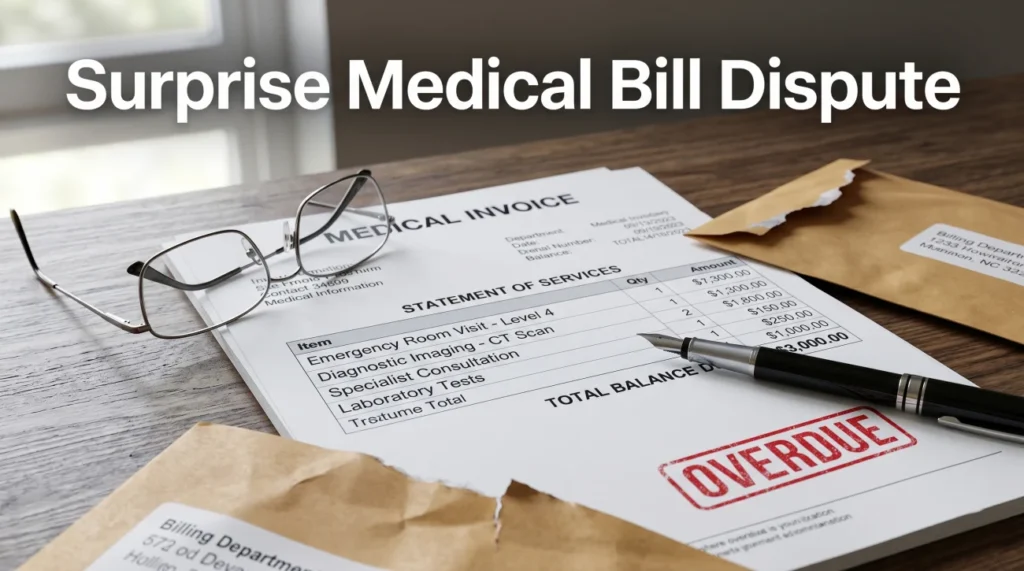
Before 2022, this practice, often called balance billing, was standard operating procedure. We had to tell patients that, legally, they owed the balance. Today, the landscape is entirely different. If you need to initiate a medical bill dispute regarding an unexpected out-of-network charge, you now have heavy federal backing.
The No Surprises Act changed the rules of the game. However, a law only protects you if you know how to invoke it, and billing systems are slow to catch up to federal mandates. I still see out-of-network bills slipping through the cracks and landing in patient mailboxes. Here is exactly what you need to know about your balance billing rights, how to recognize an illegal charge, and how to fight a surprise medical bill effectively.
What Actually Counts as a Surprise Medical Bill
Not every bill that surprises you qualifies for federal protection. A high deductible or an expensive copay is certainly unpleasant, but it is not technically a “surprise bill” under the law. The legal definition targets a very specific gap in the healthcare system: lack of patient choice.
A true surprise medical bill dispute arises in scenarios where you had no reasonable ability to choose an in-network provider. The most common situations include:
- Emergency room care: You go to the nearest ER during a crisis, and the facility or the ER doctors happen to be out-of-network.
- Anesthesia during surgery: You are at an in-network hospital with an in-network surgeon, but the anesthesiologist assigned to your room is out-of-network.
- Radiology and pathology: You get an MRI or a biopsy at your in-network clinic, but the physician who actually reads the scan or examines the tissue sample in the lab is out-of-network.
- Assistant surgeons: A secondary doctor you never met is called in to assist with your operation and bills you separately at out-of-network rates.
“When I reviewed disputed accounts, pathology and radiology were the worst offenders. Patients never see these doctors, never sign an agreement with them directly, and are shocked when the bill arrives. If this happens to you post-2022, the law is almost always on your side.”
How the No Surprises Act Is Supposed to Work
When the No Surprises Act (NSA) applies to your situation, the financial responsibility shifts off your shoulders. The law dictates that for covered out-of-network services, you can only be billed for your standard in-network cost-sharing amount.
If your normal in-network copay for an ER visit is $150, that is all you should owe, even if the hospital itself is completely out of your insurance network. If your coinsurance for an in-network surgery is 20%, you only pay 20% of the in-network rate for the out-of-network anesthesiologist.
What happens to the rest of the out of network bill dispute? The provider and your insurance company are required to negotiate the remaining balance between themselves through an independent dispute resolution process. You are completely removed from that fight. You do not have to mediate, you do not have to pass messages between them, and you certainly do not have to pay the difference. In my experience, once an account is flagged for NSA review, the hospital’s billing system automatically puts a hold on patient statements while the back-end arbitration happens.
Who Is Protected (and Who Falls Through the Cracks)
While the NSA is sweeping, it does not apply universally to every healthcare transaction. Understanding whether your specific coverage falls under the umbrella is the first step in determining your leverage.
The No Surprises Act protections apply to almost anyone with an employer-sponsored health plan, individuals who buy their own insurance through the Affordable Care Act marketplace, and people with standard commercial health insurance.
Uninsured patients, or those who choose to pay out-of-pocket without using their insurance, have a different set of rights under the NSA. Instead of network protections, self-pay patients are entitled to a Good Faith Estimate (GFE) before scheduling care. If the final bill exceeds that estimate by $400 or more, they have a federal right to dispute the charge.
Who is not covered by the NSA? Patients on Medicare, Medicaid, TRICARE, or Veterans Affairs (VA) health care. However, you do not need the NSA if you are on these programs, because they already have their own strict, pre-existing prohibitions against balance billing. There is also one critical gap you must verify: some self-funded employer health plans have opted out of these protections. If you work for a large company that funds its own claims, check your plan documents specifically for NSA coverage.
Complete Guides to Resolving Your Surprise Medical Bill
Because every billing situation requires a different strategy, I have broken down the exact steps, timelines, and leverage points you need based on your specific scenario. If you already have a bill in hand and need to take immediate action, jump straight to the exact steps on how to dispute a surprise medical bill. If the provider billed correctly but your plan processed it wrong, see our guide on how to dispute a medical bill with insurance.
| Detailed Guide | What You Will Learn |
|---|---|
| How to Dispute a Surprise Medical Bill | The exact step-by-step No Surprises Act process, how to escalate to the federal Help Desk, and what to write to the provider. |
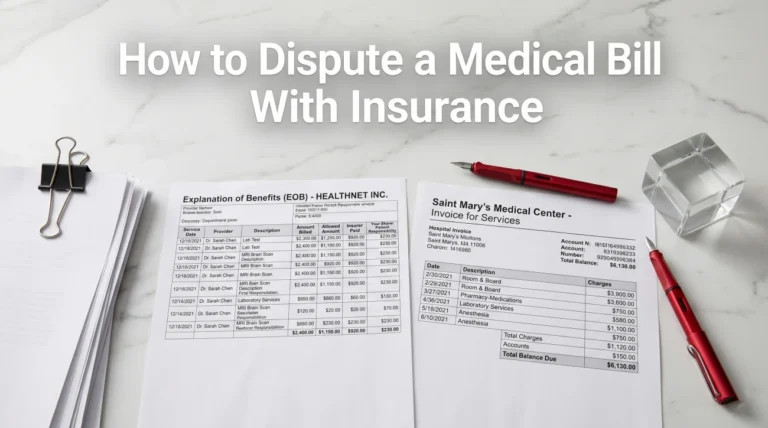
| How to Dispute a Medical Bill With Insurance | How to navigate internal and external insurance appeals when the error is on your insurer’s side, rather than the hospital’s. |
| How to Dispute a Medical Bill Without Insurance | Your specific federal rights as a self-pay patient, including how to enforce a Good Faith Estimate violation. |
| Can You Dispute a Medical Bill for Misdiagnosis? | The critical difference between a billing error you can fight with the hospital and a clinical error requiring different legal action. |
| How to Dispute Hospital Bills | Navigating layered facility vs. physician fees, utilizing patient advocates, and triggering formal CMS grievance processes. |
The Consent Waiver Trap: How Providers Bypass the Law
This is where the system gets tricky, and where I have seen countless patients unknowingly sign away their rights. Providers are allowed to ask you to waive your NSA protections, but only for certain non-emergency services, and only if they follow strict disclosure rules.
If you schedule a procedure with an out-of-network specialist at an in-network facility, they might hand you a document titled something like “Surprise Billing Protection Form” or “Notice and Consent.”
It is important to note that providers are legally prohibited from asking you to waive your rights for emergency medicine, anesthesiology, pathology, radiology, or neonatology. If an anesthesiologist tries to slip a consent waiver into your surgical packet, that document is largely unenforceable.
If you believe a hospital pressured you into signing a waiver under duress, or if sensitive medical information was handled improperly during an aggressive collection attempt on a disputed surprise bill, you may need to look into whether the situation crosses the line into a HIPAA violation in medical debt collection.
The Reality of the “Perfect Patient” Paradox
Even if you never sign a waiver and do everything perfectly by the book, the system can still fail you. The most agonizing conversations I had in billing were not with people who ignored their health coverage. They were with patients who did everything we asked them to do. They called their insurer. They checked the directories. They stayed in-network. And they still got burned.
When you receive a surprise billing dispute after doing everything right, the instinct is often to just pay it to make the anxiety go away, assuming the hospital’s computers must be correct. They often are not. Billing systems are highly automated, and sometimes a claim simply processes out-of-network before a human reviewer ever looks at it to apply the No Surprises Act modifier.
Your job is to force a human to look at the account. By formally disputing the bill and citing your No Surprises Act rights, you freeze the collection clock and route your account out of the automated payment queue and onto a compliance specialist’s desk.
Final Thoughts: Don’t Let the System Intimidate You
Getting a massive, unexpected medical bill is terrifying. The system relies on that fear to generate compliance. But the legal landscape has shifted dramatically in favor of the patient when it comes to out-of-network surprise billing.
If you are holding a bill that feels wrong, compare it to your Explanation of Benefits. If the provider is demanding more than your insurer says you owe for an emergency or an in-network facility service, do not reach for your checkbook. Instead, prepare to push back. Even if the dispute successfully removes the out-of-network penalties, your valid in-network portion might still be a financial burden. If you are struggling with the corrected balance, you still have options to negotiate your medical bills directly with the hospital.
❓ FAQ
🛡️ What is the No Surprises Act?
It is a federal law enacted in 2022 that protects patients from unexpected balance billing when they receive emergency care or are treated by out-of-network providers at in-network facilities.
🚑 Does the No Surprises Act apply to ground ambulances?
No. Currently, the federal No Surprises Act covers air ambulances but explicitly leaves out ground ambulances. However, some individual states have their own protections against surprise ground ambulance bills.
⚖️ Can a provider sue me for a surprise medical bill?
If the bill violates the No Surprises Act, they cannot legally collect the out-of-network balance from you, let alone sue you for it. They must resolve the payment dispute with your insurance company.
📞 How do I file a No Surprises Act complaint?
If your provider or insurer ignores your dispute, you can escalate the issue by calling the federal No Surprises Help Desk at 1-800-985-3059 or filing a complaint online through the CMS portal.
📝 What is a Good Faith Estimate?
It is a legally required document for uninsured or self-pay patients that outlines the expected costs of scheduled care. If your final bill is $400 or more above this estimate, you can formally dispute it.
🏥 Are non-profit hospitals exempt from the No Surprises Act?
No. The No Surprises Act applies to providers and facilities regardless of their tax status. Non-profit hospitals must comply with both the NSA and their IRS 501(r) financial assistance obligations.
✍️ Can a doctor force me to sign a consent waiver?
No. While they can ask you to waive your rights for certain non-emergency out-of-network care, you always have the right to refuse. For emergency services and ancillary providers (like anesthesiologists), asking for a waiver is entirely prohibited.
⏳ How long do I have to dispute a Good Faith Estimate discrepancy?
Uninsured or self-pay patients have exactly 120 days from the date on their medical bill to initiate the federal patient-provider dispute resolution process if the bill exceeds the estimate by $400 or more.
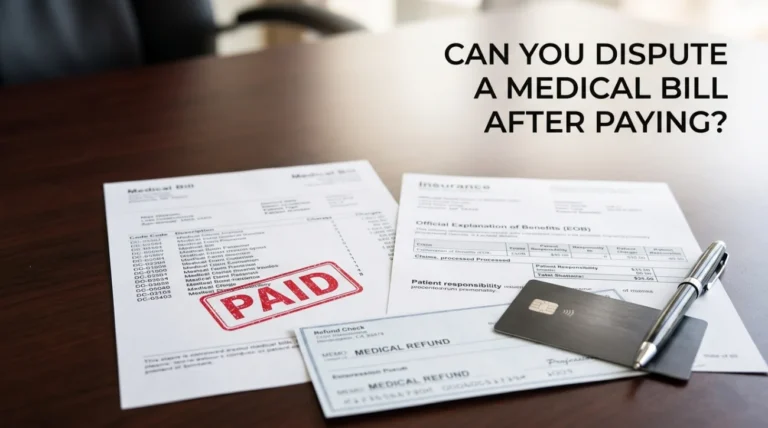
💳 What if I already paid a surprise medical bill?
If you paid a bill that was later found to violate the No Surprises Act, the provider is legally required to refund the excess amount you paid, typically with interest, depending on how long the overpayment was held.
📄 Do I contact the hospital or my insurance first about a surprise bill?
Contact the hospital’s billing department first in writing to state that the bill appears to violate the No Surprises Act. If they refuse to adjust it, immediately contact your insurance company to request they enforce the NSA protections on the claim.
Medical Bill Dispute
How to challenge a hospital bill from the initial dispute through the collections process.
- Step-by-step guide to challenging a hospital bill from itemization to formal dispute
- How to Dispute a Medical Bill for Services Not Rendered: The Strongest Ground You Have
- How to Dispute Hospital Bills: The Hospital-Specific Process Most Patients Don’t Know Exists
- How to Dispute a Medical Bill With Insurance: The Appeal Process That Most Patients Skip
- Can You Dispute a Medical Bill for Misdiagnosis? What’s a Billing Dispute vs a Medical Claim
When Disputing Is Not Enough
A successful dispute resolves some situations. These cover when the bill or the collector remains.
- Using a HIPAA violation to challenge how your bill was transferred to the collector
- Negotiating the bill you are disputing and what hospitals are actually willing to reduce
- Settling the remaining balance when a dispute does not fully resolve the account
- Debt relief programs that can handle disputed and overbilled medical accounts
- How a successful bill dispute can result in removing the collection from your credit report
Disclosure: The content on this site reflects direct experience inside hospital billing and medical debt collection, and is grounded in federal law and regulation. It is informational in nature. Reading it does not constitute legal advice and does not create any professional relationship. If you are facing a lawsuit, a judgment, or a legal deadline, consult a licensed attorney in your state before taking action.