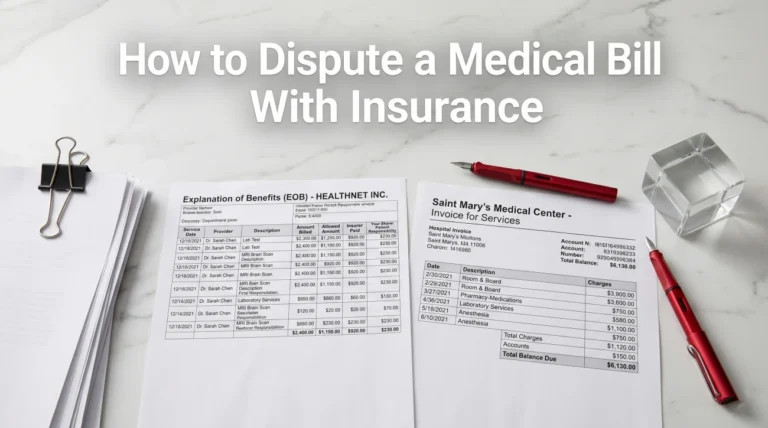
- A successful medical bill dispute letter relies on specific billing codes and factual errors, rather than emotional explanations about financial hardship.
- You must include your account number, the exact date of service, the specific line item in question, and a clear deadline for their response.
- Sending your document via both email and certified mail creates an undeniable paper trail that forces the hospital billing department to formally log your dispute.
The Document That Forces the Billing Department to Act
A medical bill dispute letter is the most important document in your entire challenge process, and easily the most misunderstood. Working inside hospital billing departments, I read thousands of patient letters. Most of them failed. They did not fail because the patient was wrong about the charges. They failed because the patient assumed a three-page letter explaining their difficult situation would be more effective than three sentences citing a specific billing code.
The difference between a letter that gets your account corrected and one that gets a generic denial comes down to strict formatting. Billing reviewers process specific data points. If those data points are missing, the dispute goes nowhere.
Before you dive into the broader guide on how to dispute a medical bill, you need to understand how to write a letter that the system cannot ignore. We will break down exactly what must be on the page, what you should leave out, and how to deliver it so it triggers a mandatory review.
The Frustration of the Generic Denial
The most frustrating part of disputing a bill is not writing the letter itself. It is waiting weeks only to receive a standardized, one-paragraph denial in the mail. You poured your energy into explaining exactly why the bill was unfair or why the care felt inadequate, and the hospital simply replied that the charges were “valid as billed.”
This happens because you are speaking human, and the billing system only speaks data. When you receive a generic denial, it usually means your letter did not translate your problem into a format the reviewer could actually process. If your letter lacks the specific triggers a billing department looks for, your dispute hits a brick wall.
The Difference Between a Complaint and a Dispute
The most common reason a dispute letter for medical bill charges gets dismissed is because it is actually a complaint. It is completely normal to feel overwhelmed and frustrated by a massive hospital invoice. However, putting those feelings into your letter guarantees it will be routed incorrectly.
A complaint describes your feelings about the bill. A dispute identifies a specific error, cites the billing code, states the correct code or a zero amount, and requests a specific action. Reviewers fix disputes. They route complaints to patient relations, where they often stall.
“I am writing because this bill is way too high. I was only in the room for ten minutes and you charged me thousands of dollars. I cannot afford this and I believe it is incorrect.”
“I am disputing line item #4, CPT code 99285, for the date of service 10/12. My medical records do not support a Level 5 emergency visit. I am requesting a coding review and an updated statement reflecting the correct lower-acuity code.”
When I reviewed incoming correspondence, any letter that started with a specific CPT code and a line item number was immediately flagged for a clinical coding review. Letters that only mentioned the total balance being ‘too high’ were simply sent a standardized reply stating the charges were valid as billed.
What Your Letter Must Contain
A successful letter gives the reviewer exactly what they need to open your file and spot the error immediately. Every effective medical bill letter of dispute contains the following core elements.
The essential data points:
- Your full legal name, current address, and phone number.
- The exact patient account number or guarantor ID. Billing departments do not search by your name; they search by account numbers. Without this, your letter might sit in an unassigned queue.
- The specific date of service in question.
- The exact line item and billing code (CPT or HCPCS code). This tells the reviewer exactly where to look on a multi-page invoice. From my desk, a letter citing “CPT 99285” was instantly actionable, while a letter citing “the ER charge” required manual digging that slowed the entire process down.
- The specific basis for the dispute. This could be a duplicate charge, an out-of-network charge violating the No Surprises Act, a service not rendered, or a charge exceeding your Good Faith Estimate.
- Your requested action. Be direct. Ask for the charge to be removed, the claim to be reprocessed with insurance, or the balance to be adjusted to zero.
- A firm deadline for their response. Stating a 30-day deadline establishes a clear timeline for your next escalation step.
- Your physical signature and the date.
What Your Letter Does Not Need
Just as important as what you include is what you leave out. Adding unnecessary information gives the billing department reasons to dismiss your primary claim. I have seen clear-cut billing errors get lost because the patient buried the actual mistake inside a two-page story about their hospital stay.
Do not include a detailed history of your medical care or symptoms unless it directly proves a service was not rendered. The billing team cannot evaluate clinical necessity; they only evaluate whether the code matches the doctor’s notes. We could not override a charge because a patient had a difficult recovery, we could only override it if the billing code was factually wrong.
Additionally, avoid threats of legal action in your very first letter. If you threaten to sue immediately, many hospitals will lock down the account and forward it to their legal department, completely freezing the normal billing review process. You can always escalate later if they refuse to correct a documented error. If you are unsure how to frame the issue professionally, reviewing what makes a dispute successful from a strategic standpoint will keep you focused on the facts.
How to Send It (And What Not to Do)
How you deliver your hospital bill dispute letter is just as critical as what it says. You need to establish a verified timeline. If you convert your document into a medical bill dispute letter pdf, you ensure the formatting remains intact, but you still need a delivery paper trail.
The strongest approach is a two-channel delivery system. First, send the letter via email to the official billing department address. This creates an immediate, undeniable digital timestamp. Second, print the letter and send it via certified mail with a return receipt requested to their physical mailing address. The return receipt provides legal proof that the hospital received your correspondence.
There are several common delivery mistakes you must avoid. Do not fax the document unless you receive a confirmed, printed transmission receipt. Do not send your dispute to the clinical department or your doctor’s office, as they do not process financial claims. Finally, do not make phone calls your primary follow-up method. Phone calls do not create an undeniable paper trail, whereas a documented written dispute forces accountability.
The Escalation Version: When the First Letter Fails
If thirty days pass without a response, or if you receive a generic denial that does not address your specific billing code evidence, you must escalate. The escalation version of your letter is not just a second request; it changes the audience.
Address your second letter directly to the Director of Revenue Cycle or the Director of Patient Financial Services, and CC the hospital’s Patient Relations department. In this letter, explicitly reference your original dispute date. You can also note that a copy of the correspondence is being forwarded to your state’s insurance commissioner or the state attorney general’s office.
This changes the dynamic. A frontline reviewer might ignore a standard dispute, but hospital directors track regulatory exposure closely. When an escalated letter crossed our department with a CC to a regulatory body, it was immediately pulled from the standard queue and handed to a senior-level auditor for review.
Final Thoughts: What Happens Next
Writing a clear, factual, code-specific letter removes the emotion from the equation and forces the hospital to defend their math. Once your certified mail receipt returns, you have officially paused the standard billing cycle in most reputable hospital systems. To prepare for their response, you should understand exactly how billing departments process disputes internally.
Keep in mind that if the hospital eventually corrects the error but the remaining balance is still unaffordable, your strategy shifts. You transition from disputing a mistake to learning how to negotiate the remaining medical bill balance. Furthermore, if the hospital aggressively sends your account to an outside collection agency while your written dispute is still pending, they may have crossed a legal line. In those scenarios, exploring how HIPAA privacy rules impact aggressive medical debt collectors can provide the leverage you need to shut down the collection attempt.
❓ FAQ
📄 Can I use a medical bill dispute letter example I found online?
You can use an example for structure, but you must rewrite the core paragraphs to reflect your exact date of service, your specific CPT billing codes, and your precise reason for disputing. A generic template that lacks your specific account details will be rejected.
⏱️ How long does the hospital have to respond to my letter?
While federal law does not mandate a strict timeline for simple hospital billing disputes, requesting a response within 30 days is the industry standard. If you are disputing a No Surprises Act violation, specific federal timelines apply.
✉️ Should I send my dispute letter for medical bill charges by regular mail?
No. You should always use certified mail with a return receipt requested. This provides documented proof that the hospital received your dispute and establishes the exact date your response clock started.
🛑 Will sending a dispute letter stop my bill from going to collections?
In most reputable hospital systems, logging a formal, written dispute places a temporary hold on the account that prevents automatic transfer to a collection agency until the review is complete.
🏥 Who exactly should I address the letter to?
Your first letter should be addressed to the specific “Billing Disputes Department” at the address listed on your statement. If you must escalate a second letter, address it to the “Director of Patient Financial Services.”
📞 Why can’t I just dispute the bill over the phone?
When you call, the representative might simply type a brief note on your account. That note does not trigger the formal “active dispute” flag in the billing software that pauses automatic collection escalation. A written letter forces a formal status change.
📝 Do I need to hire a lawyer to write a dispute letter?
No. For standard billing errors, duplicate charges, or coding mistakes, a clear, factual letter identifying the specific error is all that is required. Lawyers are typically only needed if you are facing a lawsuit or complex malpractice issues.
Medical Bill Dispute
How to challenge a hospital bill from the initial dispute through the collections process.
- Step-by-step guide to challenging a hospital bill from itemization to formal dispute
- How to Dispute a Medical Bill With Insurance: The Appeal Process That Most Patients Skip
- Can a Disputed Medical Bill Be Sent to Collections? The Rules During Active Dispute
- How to Dispute a Surprise Medical Bill: The Federal Process Step by Step
- How Long Do You Have to Dispute a Medical Bill? The Deadlines That Matter
When Disputing Is Not Enough
A successful dispute resolves some situations. These cover when the bill or the collector remains.
- Using a HIPAA violation to challenge how your bill was transferred to the collector
- Negotiating the bill you are disputing and what hospitals are actually willing to reduce
- Settling the remaining balance when a dispute does not fully resolve the account
- Debt relief programs that can handle disputed and overbilled medical accounts
- How a successful bill dispute can result in removing the collection from your credit report
Disclosure: The content on this site reflects direct experience inside hospital billing and medical debt collection, and is grounded in federal law and regulation. It is informational in nature. Reading it does not constitute legal advice and does not create any professional relationship. If you are facing a lawsuit, a judgment, or a legal deadline, consult a licensed attorney in your state before taking action.