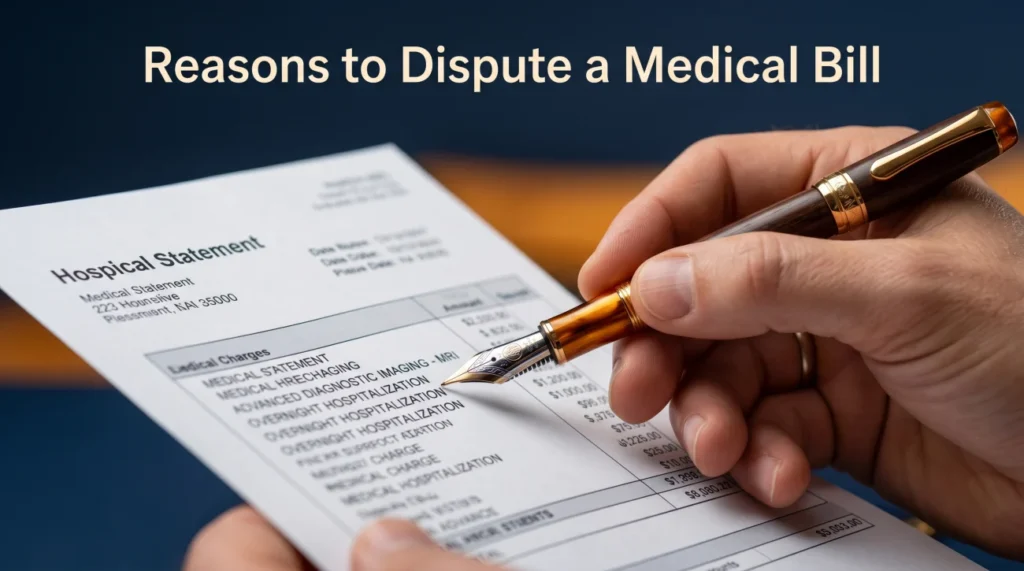
- Not every expensive medical bill qualifies for a formal dispute, but there are specific legal and factual grounds that force a hospital to correct your balance.
- Valid reasons include concrete coding errors, services you never received, insurance processing failures, and violations of the federal No Surprises Act.
- Financial hardship is not a valid basis for a billing dispute, but it is the perfect starting point for a negotiation or financial assistance application.
Not Every High Bill Is an Error, But Many Are
When you open a piece of mail from a hospital and see a balance that makes your stomach drop, your first instinct is often to fight it. You want to call the billing department and tell them there is no way the charges are correct. However, figuring out the legitimate reasons to dispute a medical bill is the crucial first step before you ever pick up the phone or write a letter. If you approach a billing reviewer with the wrong argument, your case will be closed before it even gets investigated.
During my time working inside hospital billing departments, I reviewed thousands of patient accounts. I saw firsthand how the system categorizes incoming complaints. We did not have a system function to reduce a bill simply because a patient felt it was too expensive. But when a patient presented a dispute grounded in a specific factual error, a coding rule, or a federal billing regulation, the entire dynamic shifted. The account was pulled from the general payment queue and placed into a specialized review status.
The secret to successfully challenging a medical charge is understanding what counts as disputable on a medical bill and what does not. More situations qualify than most patients realize, and some grounds for a dispute are surprisingly powerful because they are backed by federal law. This guide will walk you through the six valid reasons that force a hospital to review your account, as well as the scenarios where you need to change your strategy entirely.
Valid Reason 1: Administrative and Billing Errors
The most common and straightforward valid reasons to dispute a medical bill are mechanical coding mistakes. These are objective errors where the data on the bill does not match the reality of your visit. Because medical billing relies on thousands of specific CPT (Current Procedural Terminology) codes, human error during data entry is rampant.
These errors typically fall into a few clear categories:
- Duplicate Charges: The exact same service, medication, or facility fee is billed twice. This often happens if you are transferred between departments, such as moving from the emergency room to an inpatient floor, and both departments log the same basic intake supplies.
- Upcoding: You are billed for a more complex and expensive service than what you actually received. For example, a nurse practitioner spends ten minutes with you for a minor rash, but the billing code reflects a highly complex, 45-minute physician evaluation.
- Unbundling: Procedures that are supposed to be billed together under one comprehensive code at a set price are separated into individual line items, artificially inflating the total cost.
These are not just simple typos. Under CMS (Centers for Medicare & Medicaid Services) guidelines, deliberate upcoding or unbundling can trigger False Claims Act audits if patterned. When you point out a specific coding mismatch, the hospital’s compliance risk forces them to act. If you need help identifying these mistakes, learning the taxonomy of a typical hospital bill overcharge will show you exactly what these codes look like on paper.
While mechanical errors are incredibly common, finding a charge for a service that never occurred at all elevates your dispute to a completely different level.
Valid Reason 2: Services Not Rendered
Being billed for something that never happened is the absolute strongest ground you have in a medical billing dispute. If a provider bills you for a service, they are legally required to have clinical documentation proving that the service was performed.
I frequently saw accounts where a doctor ordered a specific lab test or medication early in the day, but then canceled the order later because the patient’s condition improved. However, the initial order had already crossed over into the billing software. The patient was automatically billed for a medication they never took.
Calling the billing department and saying, “I don’t remember getting an IV, so I shouldn’t have to pay this $200 charge.”
Submitting a written dispute stating, “I am disputing the IV administration charge on line item 12. I have reviewed my medical records and there is no clinical documentation or nursing note indicating an IV was ever placed or administered during my visit.”
When you base your dispute on services not rendered, the burden of proof shifts entirely to the hospital. If their own medical records do not contain a note confirming the service, the charge must be removed.
Beyond services that were not rendered, you also have strict federal protections regarding who renders the service and how much they are allowed to charge you.
Valid Reason 3: No Surprises Act Violations
Federal law dictates when to dispute a medical bill based on network status. If you received care after January 1, 2022, the No Surprises Act provides powerful, federally enforced grounds for a dispute. This law makes it illegal for providers to bill you at out-of-network rates in specific situations where you had no choice in who treated you.
You have a valid dispute under this law if you experience either of the following:
- You receive emergency services at an out-of-network facility or from an out-of-network provider.
- You receive non-emergency services from an out-of-network provider at an in-network hospital or surgical center (such as an out-of-network anesthesiologist or radiologist working inside your approved hospital).
I have watched patients blindly pay massive out-of-network anesthesia charges simply because the hospital’s logo was on the envelope. From a compliance perspective, a written dispute referencing the No Surprises Act is treated like an alarm bell inside the billing office because the federal penalties for violations are severe. If you receive a bill that violates this rule, understanding how to enforce your protections against surprise medical bills is essential.
But even if the hospital followed every federal rule and billed you perfectly, the amount you owe might still be completely wrong if the next link in the payment chain breaks.
Valid Reason 4: Insurance Processing Errors
Sometimes, the hospital billed everything perfectly, but the amount you owe is still wrong. This happens when your insurance company makes an error in processing the claim. This is a highly common dispute, but the target of your dispute changes from the hospital to your insurer.
I spent countless hours on the phone with insurance representatives who auto-denied legitimate claims. The hospital knows when your insurer is playing games, but the billing department cannot force them to pay. Only you, the patient, can trigger the formal internal appeal required to overturn their denial.
You have valid medical bill dispute reasons against your insurer if they:
- Denied a service as “not medically necessary” when your doctor clearly documented the necessity.
- Applied the wrong benefit tier, such as processing an in-network provider as out-of-network.
- Failed to apply a primary care copay correctly, pushing the cost to your deductible instead.
To identify this reason, you must compare the hospital bill to the Explanation of Benefits (EOB) sent by your insurance company. If the hospital bill says you owe $500, but your EOB clearly states your patient responsibility is only $50, you have a processing discrepancy. You must dispute this by filing an internal appeal directly with your insurance provider.
If you do not have insurance to appeal to, the rules change entirely, but you are not left without leverage.
Valid Reason 5: Good Faith Estimate Violations
If you are uninsured or paying for your care entirely out-of-pocket, federal law grants you a very specific dispute mechanism. Providers are required to give uninsured and self-pay patients a formal Good Faith Estimate of expected charges before a scheduled service is performed.
If the final billed amount exceeds that Good Faith Estimate by $400 or more, you have explicit legal grounds to dispute the bill. This is handled through a specific federal process called the Patient-Provider Dispute Resolution (PPDR) system. You must initiate this process within 120 days of receiving the initial bill.
Inside the billing office, we had strict alerts on self-pay accounts to monitor that exact $400 threshold. If a final bill crossed it, we knew the patient had absolute grounds for a federal PPDR dispute, but we also knew most patients never utilized this mechanism. Keeping your original written estimate is critical, as that single piece of paper is the entire foundation of your dispute.
Finally, there are disputes that have nothing to do with medical codes or estimates, and everything to do with administrative chaos.
Valid Reason 6: Wrong Patient or Wrong Date
While it sounds impossible, administrative mix-ups are a daily occurrence in large health systems. Medical records can be crossed, especially if you share a common name or a similar date of birth with another patient in the system.
I once audited an account where a male patient was billed for a maternity ultrasound simply because a front-desk registrar mistyped one digit of a medical record number. These demographic mix-ups happen every day, generating automatic bills for services the recipient never scheduled.
If you see a date you were not at the facility, or a procedure that makes no biological sense, do not waste time looking for coding errors or writing an appeal to your insurance. Call the hospital’s medical records department or privacy officer immediately. Report a mixed patient file. Once the demographic error is flagged, the billing department must retract the statement, separate the records, and restart the billing cycle properly.
The Tragedy of the Valid Dispute Ignored
The most heartbreaking scenario I witnessed from the inside was not a patient disputing a bill incorrectly. It was a patient paying a bill that contained a perfectly valid dispute reason, simply because they assumed the hospital’s paperwork was flawless.
Patients often look at a massive total, feel overwhelmed, and immediately set up a payment plan. They assume “expensive” equals “correct.” That assumption is incredibly profitable for health systems. Here is the hard truth I learned from watching thousands of accounts process:
“Inside the revenue cycle, billing software is designed to capture maximum revenue based on the data entered by busy clinical staff. There is no automated alert that tells us a charge is unfair. Unless you, the patient, spot the specific error and file a targeted dispute, the hospital will legally collect that money without ever knowing a mistake occurred.”
You must separate your frustration over the cost of healthcare from the mechanical errors on the page. Failing to dispute a valid error costs you money, but disputing a bill for the wrong reasons wastes your time entirely.
What Does NOT Qualify as a Dispute
Knowing what qualifies is only useful if you also know when you are heading into a dead end.
| Your Situation | Is It a Dispute? | The Correct Path |
|---|---|---|
| “I simply cannot afford to pay this amount.” | No. This is financial hardship. | Apply for financial assistance or negotiate a settlement. |
| “I disagree with the doctor’s treatment decision.” | No. This is a clinical or malpractice issue. | File a clinical grievance or consult legal counsel. |
| “My insurance deductible is way too high.” | No. This is your benefit design. | You owe the contracted amount. Set up a payment plan. |
| “The hospital charges too much for basic supplies.” | No. Prices are set by the chargemaster. | Request a self-pay discount or negotiate the total. |
The most frequent dead-end I encountered was a patient writing a heartfelt letter explaining that a $3,000 emergency room bill would ruin them financially. While their situation was absolutely genuine, the billing review team could not process that letter as a dispute because no actual billing error was identified. The codes were correct, and the insurance processed it correctly. In these scenarios, demanding a correction is the wrong mechanism.
When the bill is factually accurate but financially devastating, you must change your approach. Instead of demanding a correction, you must request a reduction. You need to explore avenues to negotiate your medical bills effectively, asking for self-pay discounts, lump-sum settlement reductions, or charity care waivers based on your income.
Final Thoughts on Choosing Your Path
Knowing when to dispute a medical bill requires looking at your statement like an auditor rather than a patient. You have to remove the emotional shock of the dollar amount and look purely at the data. If your situation points to a factual mistake, an insurance processing failure, or a federal protection violation, you have a strong case.
Once you have identified solid medical bill dispute reasons, start by understanding the complete framework of how to challenge a medical bill from start to finish. From there, you can follow step-by-step instructions on disputing an incorrect charge in writing to ensure your valid reason actually results in a corrected balance.
❓ FAQ
🩺 Can I dispute a bill if the doctor didn’t cure my problem?
No. Medical billing is based on the services provided, not the clinical outcome. If the exam or procedure was actually performed, the hospital is legally allowed to bill for it regardless of whether your condition improved.
🚑 Are emergency room bills automatically disputable because I had no choice?
Not automatically, but emergency room bills have strong protections under the No Surprises Act. If your insurance covers emergency care, you cannot be balance-billed at out-of-network rates for an ER visit, making any out-of-network surcharge highly disputable.
📄 What if I don’t know the specific billing code to dispute?
You must request a detailed itemized bill from the hospital. Once you have it, you do not necessarily need to know the complex medical code; simply pointing out the plain-English description of a service you did not receive is enough to initiate the dispute.
⏱️ How long do I have to decide if I want to dispute a bill?
While hospital policies vary, it is best to file your written dispute within 30 to 60 days of receiving the first statement. If your dispute involves a Good Faith Estimate violation for uninsured care, federal law gives you exactly 120 days from the bill date.
💳 Can I dispute a charge if my insurance company already paid part of it?
Yes. If you spot a duplicate charge or a service you did not receive, you can and should dispute your remaining patient responsibility. If the hospital confirms the error, they will also have to refund the overpayment to your insurance company.
⚖️ Is it illegal for a hospital to upcode my visit?
Yes, deliberate upcoding to inflate revenue is a form of medical billing fraud. While occasional coding mistakes happen due to human error, a pattern of upcoding is a serious compliance issue that warrants a formal dispute and potentially a regulatory complaint.
🏥 Can I dispute a facility fee just because I think it is too high?
No. Facility fees are standard operational charges applied by hospitals to cover overhead. Unless the facility fee was billed for a date you were not present, or billed twice for the same continuous visit, the high price alone is not a valid dispute reason.
📝 What if the hospital says I signed a financial consent form?
A general financial responsibility form does not waive your right to dispute factual billing errors or services you never received. However, if you signed a specific No Surprises Act waiver agreeing to out-of-network rates, your ability to dispute those specific charges will be severely limited.
📞 Should I dispute a bill verbally or in writing?
You must always submit a billing dispute in writing. Verbal complaints over the phone rarely trigger the formal audit process inside the billing department and leave you with no paper trail to prove you challenged the debt.
🛑 Will my account go to collections while I am trying to find a dispute reason?
If you simply ignore the bill while researching your options, the account will eventually progress to collections. You must officially notify the billing department in writing that you are formally disputing the charges to pause the collection clock.
Medical Bill Dispute
How to challenge a hospital bill from the initial dispute through the collections process.
- Step-by-step guide to challenging a hospital bill from itemization to formal dispute
- How to Dispute an Incorrect Medical Bill: The Steps That Actually Get Errors Corrected
- Surprise Medical Bill Dispute: Your Rights Under the No Surprises Act and How to Use Them
- How to Dispute a Surprise Medical Bill: The Federal Process Step by Step
- How to Dispute a Medical Bill With Insurance: The Appeal Process That Most Patients Skip
When Disputing Is Not Enough
A successful dispute resolves some situations. These cover when the bill or the collector remains.
- Using a HIPAA violation to challenge how your bill was transferred to the collector
- Negotiating the bill you are disputing and what hospitals are actually willing to reduce
- Settling the remaining balance when a dispute does not fully resolve the account
- Debt relief programs that can handle disputed and overbilled medical accounts
- How a successful bill dispute can result in removing the collection from your credit report
Disclosure: The content on this site reflects direct experience inside hospital billing and medical debt collection, and is grounded in federal law and regulation. It is informational in nature. Reading it does not constitute legal advice and does not create any professional relationship. If you are facing a lawsuit, a judgment, or a legal deadline, consult a licensed attorney in your state before taking action.