- Being uninsured grants you specific federal protections, including the right to a Good Faith Estimate for scheduled services.
- If your final bill exceeds your Good Faith Estimate by $400 or more, you can initiate a federal dispute to lower the cost.
- Nonprofit hospitals are legally required to screen uninsured patients for financial assistance before attempting to collect on full-price bills.
- Never accept the “chargemaster” list price. Self-pay patients have significant leverage to negotiate rates down to what Medicare or major insurers would pay.
Uncovering Your Self-Pay Protections
Receiving an expensive hospital bill when you do not have health coverage can feel completely paralyzing. Without an insurance company to act as a buffer, the numbers on the page look final. However, being uninsured does not mean having no rights regarding your medical bill. It simply means your rights are different, and some of them are specifically designed to protect self-pay patients from price gouging. If you are trying to figure out how to dispute a medical bill without insurance, you have to look beyond traditional insurance appeals and use the regulatory tools built specifically for your situation.
During my time working inside hospital billing departments, I saw a stark contrast between how insured and uninsured accounts were processed. When a patient had no coverage, the billing system automatically defaulted to the highest possible price tier. Most self-pay patients assumed this number was non-negotiable. It is not. You have federal protections regarding surprise costs, specific rights concerning charity care, and massive leverage when it comes to the actual price of the care provided. Here is exactly how to assert those rights.
Right 1: The Good Faith Estimate Protection
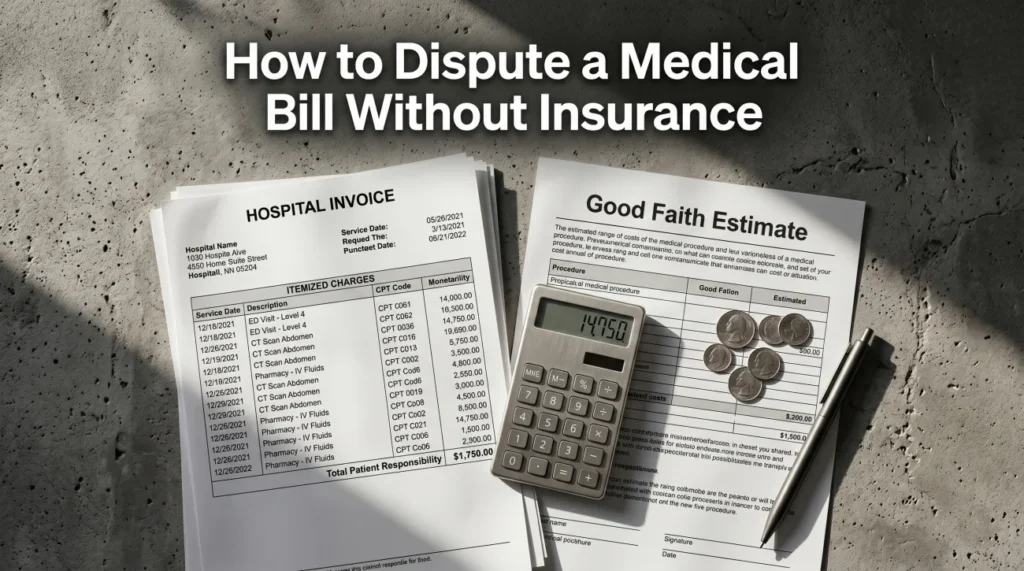
If you scheduled your care in advance or explicitly asked for an estimate beforehand, your most powerful tool is the Good Faith Estimate. Starting in January 2022, federal law required all healthcare providers to give uninsured and self-pay patients a clear, written estimate of expected charges before delivering scheduled care.
This is not just a courtesy document. It is a legally binding baseline. If your final bill exceeds that Good Faith Estimate by $400 or more, you have a federal right to dispute the charges. This applies to hospitals, independent clinics, and specialized treatment centers.
The standard dispute timeline: Identify the $400+ discrepancy → Contact the provider to request a reduction → File a formal federal dispute within 120 days of the bill date if the provider refuses.
Before launching a federal complaint, you should always give the provider a chance to correct the bill internally. When initiating a no insurance medical bill dispute over an estimate discrepancy, keep your communication purely factual.
Hello Billing Department,
I am writing to dispute the total balance on my recent bill dated [Date]. Prior to my procedure, I was provided a Good Faith Estimate of [Estimate Amount]. The final bill I received is [Final Amount], which exceeds the estimate by more than $400.
Under federal law, I am requesting that my final balance be adjusted to match the Good Faith Estimate provided to me. Please place a hold on this account while this dispute is reviewed.
Thank you,
[Your Name]
The Federal Dispute Resolution Process
If the billing department refuses to honor the estimate, you do not have to just accept their decision. You can escalate the issue through the Patient-Provider Dispute Resolution (PPDR) process. This is a system established by the federal government specifically for an uninsured medical bill dispute.
You can file this dispute online through the official Centers for Medicare and Medicaid Services (CMS) portal. An independent arbitrator will review your Good Faith Estimate alongside the final bill. If the provider cannot demonstrate a legitimate, medically necessary reason for the drastic increase in costs (such as an unforeseen emergency during the procedure), the arbitrator will typically force the provider to lower the bill to the original estimate.
You must act relatively quickly, as the window to file a PPDR claim closes 120 days from the date on your initial bill. If you are dealing with a broader dispute regarding out-of-network providers that does not involve a Good Faith Estimate, you may need to evaluate how to handle a surprise medical bill dispute under different regulatory guidelines.
Right 2: Mandatory Charity Care Screening
The Good Faith Estimate primarily covers scheduled care, but even without an estimate, you may have another avenue entirely if the hospital is a nonprofit facility. Under IRS rule 501(r), nonprofit hospitals are federally mandated to screen patients for financial assistance eligibility before taking any extreme collection actions against them.
If a nonprofit hospital simply sent you a massive bill and then pushed your account to collections without ever checking if you qualified for their charity care program, they committed a severe process violation. You can dispute the billing process itself on these grounds.
“One of the most frequent administrative failures I saw involved charity care documentation. The system would automatically print a tiny, easily missed sentence about financial assistance on the back of page three of the invoice. Patients would miss it, fail to apply, and end up in collections. We frequently had to recall accounts from collection agencies when a patient finally submitted a written dispute noting they were never properly screened for assistance.”
Even if you think you make too much money to qualify for “free” care, you should still apply. Most nonprofit hospitals offer sliding-scale discounts for patients making up to 300% or 400% of the federal poverty level. If you discover a process failure while preparing your documents, checking the standard reasons to dispute a medical bill can help you build a stronger case.
Right 3: Defeating the Chargemaster Rate
The biggest secret in medical billing is that the listed price on your invoice is largely a fiction. It is called the “chargemaster” rate. Insurance companies never pay this rate; they negotiate massive discounts. Medicare pays a fraction of this rate based on strict federal fee schedules. The only people who are ever asked to pay the full chargemaster rate are the people who have no insurance at all.
When disputing medical bill without insurance coverage, your primary objective is to refuse this artificial rate. You have the right to request the hospital’s standard “self-pay rate” or ask them to match the “Medicare allowable rate.”
Calling the billing department, stating you cannot afford the $10,000 bill, and asking for a payment plan for the full amount.
Calling the billing department, noting that the $10,000 chargemaster rate is unreasonable, and asking them to adjust the balance to the self-pay discount rate before you discuss any payment terms.
Hospitals know the chargemaster rate is inflated. If you challenge it logically, they will almost always offer an immediate self-pay discount, which typically reduces the total balance by 40% to 60%. This is the fastest way to shrink the number before you even begin a formal dispute.
How Uninsured Disputes Differ from Insured Disputes
If you have previously learned how to dispute a medical bill under a traditional health plan, you must adjust your strategy for a self-pay medical bill dispute. You do not have an Explanation of Benefits (EOB) from an insurer to show what was covered. You do not have an insurance company appeal process to fall back on, and the concept of in-network versus out-of-network pricing does not apply to your situation.
- 📌 You must rely entirely on the Good Faith Estimate, if one was provided.
- 📌 You must scrutinize the itemized bill for basic clinical errors, such as duplicate charges or incorrect billing codes.
- 📌 You must actively check for services not rendered, demanding clinical proof for every single charge on the invoice.
- 📌 You must leverage charity care requirements to halt aggressive collection timelines.
If you find clear clinical errors, the process of challenging them is very similar to an insured dispute. You must request the detailed, coded invoice and challenge the specific line items. For a complete walkthrough of that documentation process, refer to the core guide on how to dispute a medical bill from the beginning.
The Shock of the Uninsured Hospital Bill
The most overwhelming moment for a self-pay patient is opening a letter to find a five-figure hospital bill with a strict 30-day due date. Because you do not have an insurance portal to check or a benefits coordinator to call, the isolation can cause panic. The immediate reaction is often either to ignore the envelope entirely or to drain a savings account trying to pay it off.
You must resist both urges. Ignoring the bill ensures it will escalate to an external collection agency. If it has already reached that stage, you will need to evaluate whether the collector has crossed legal lines, and a medical debt HIPAA violation review might be your best defense against aggressive pursuit. On the other hand, paying the bill in full without investigating your rights guarantees you will overpay by thousands of dollars. The system is counting on your exhaustion. Your best defense is a methodical, step-by-step review of your specific protections.
Final thoughts: Protect Yourself with Persistence
Being uninsured does not strip you of your power in the medical billing system. While you may lack an insurance company’s negotiating weight, you have federal Good Faith Estimate protections, charity care laws, and the fundamental right to challenge inflated chargemaster pricing. How to dispute a hospital bill without insurance relies entirely on your willingness to demand itemized records and refuse the initial asking price. If you have exhausted the formal dispute options and the balance is still far beyond your financial capacity, it is time to pivot strategies. You should explore exactly how to negotiate medical bills downward, or, if the debt is already overwhelming multiple aspects of your life, evaluate if a structured medical debt relief program fits your specific crisis.
❓ FAQ
📄 How to dispute self pay medical bill charges if I never got an estimate?
If you did not schedule the service in advance or it was an emergency, you do not have Good Faith Estimate protections. However, you can still dispute the bill by requesting an itemized statement to check for duplicate charges, coding errors, or services you never received.
🏥 Can a hospital force me to pay the chargemaster rate?
No hospital can force you to pay the chargemaster rate if you actively contest it. Uninsured patients should immediately request the hospital’s standard self-pay discount, which is typically designed to mimic the lower rates accepted by major insurance companies.
🛑 How do I start an uninsured medical bill dispute?
Start by requesting an itemized bill containing all billing codes. Then, submit a written letter to the hospital’s billing department detailing exactly which line items you are contesting, whether due to an estimate discrepancy or a factual error in the treatment listed.
Yes. Under the No Surprises Act, if your final bill exceeds the Good Faith Estimate by $400 or more, you have a federal right to dispute the charges and potentially force the provider to lower the bill to match the original estimate.
💼 Who helps with disputing hospital bill if uninsured?
You can seek help from independent patient advocates, medical billing advocates, or use the federal Patient-Provider Dispute Resolution (PPDR) portal if your dispute involves a Good Faith Estimate violation.
📉 Does disputing medical bill without insurance hurt my credit?
Disputing a bill directly with the hospital does not hurt your credit. In fact, a formal written dispute should pause the internal collection timeline. Because credit reporting rules change frequently, you should always check the current policies with the billing department, but initiating a dispute early is the best way to prevent the account from reaching a credit bureau in the first place.
🕰️ How long do I have to file a Good Faith Estimate dispute?
You must file a dispute through the federal PPDR process within exactly 120 days from the date listed on your initial medical bill. Missing this window removes your federal protection regarding the estimate.
🩺 Can I dispute an out-of-network bill if I have no insurance?
The concept of “out-of-network” only applies to people with insurance. As an uninsured patient, your primary federal protections regarding unexpected costs are the Good Faith Estimate rules and your right to apply for hospital charity care.
✉️ What should I say in a no insurance medical bill dispute letter?
State your account number, the date of service, and the specific reason for the dispute. If it involves pricing, mention that the chargemaster rate is unreasonable and request an adjustment to the Medicare allowable rate or a self-pay discount.
👨⚖️ What happens if the hospital ignores my self pay medical bill dispute?
If the billing department ignores your written dispute, you should escalate the issue to the hospital’s patient relations department or the facility administrator. If a federal estimate rule was violated, escalate directly to the CMS No Surprises Help Desk.
Medical Bill Dispute
How to challenge a hospital bill from the initial dispute through the collections process.
- Step-by-step guide to challenging a hospital bill from itemization to formal dispute
- Can You Dispute a Medical Bill for Misdiagnosis? What’s a Billing Dispute vs a Medical Claim
- Can a Disputed Medical Bill Be Sent to Collections? The Rules During Active Dispute
- Can You Dispute a Medical Bill After Paying? Yes, Here Is How
- How to Dispute an Incorrect Medical Bill: The Steps That Actually Get Errors Corrected
When Disputing Is Not Enough
A successful dispute resolves some situations. These cover when the bill or the collector remains.
- Using a HIPAA violation to challenge how your bill was transferred to the collector
- Negotiating the bill you are disputing and what hospitals are actually willing to reduce
- Settling the remaining balance when a dispute does not fully resolve the account
- Debt relief programs that can handle disputed and overbilled medical accounts
- How a successful bill dispute can result in removing the collection from your credit report
Disclosure: The content on this site reflects direct experience inside hospital billing and medical debt collection, and is grounded in federal law and regulation. It is informational in nature. Reading it does not constitute legal advice and does not create any professional relationship. If you are facing a lawsuit, a judgment, or a legal deadline, consult a licensed attorney in your state before taking action.