- The strategy shift: Asking “should I pay” is the wrong starting point. The better questions are how much to pay, when to pay, and what you get in return for that payment.
- The credit reality: Paying a collection account in full does not erase it from your credit report. It simply changes the status to “paid collection,” which may not give you the score boost you expect.
- The leverage factor: Collectors, especially debt buyers, often purchase accounts for pennies on the dollar. You rarely have to pay the full balance if you understand how to negotiate strategically.
Moving Beyond the “Always Pay Your Debts” Lecture
When you receive a notice from a collection agency, the immediate pressure is intense. Family members might tell you to just pay it to protect your credit. Financial blogs often default to moral lectures about honoring your obligations. If you are sitting there wondering, “should i pay medical debt in collections,” you need a strategic framework, not a guilt trip.
During my time inside hospital billing departments, I watched how accounts transitioned from standard patient balances to third-party collection portfolios. The moment an account crosses that line, the rules of engagement completely change. The hospital is no longer managing a patient relationship; a financial firm is managing an asset.
If you find yourself asking, “should i pay medical collections in full, negotiate a settlement, or pursue a different path?” you must treat this as a financial calculation. It should be based on the age of the debt, the accuracy of the bill, the specific collector involved, and your current financial reality. Here is exactly how to evaluate your options like an insider.
The Pressure of a Damaged Credit Score
The most common reason people rush into a bad payment decision is the sheer anxiety of watching their credit score drop, coupled with relentless phone calls. You might be trying to get approved for a mortgage or an apartment, and the lender tells you that a single medical collection is standing in your way. The fear of losing a home or being harassed at work can push you to write a check immediately, hoping the problem disappears overnight.
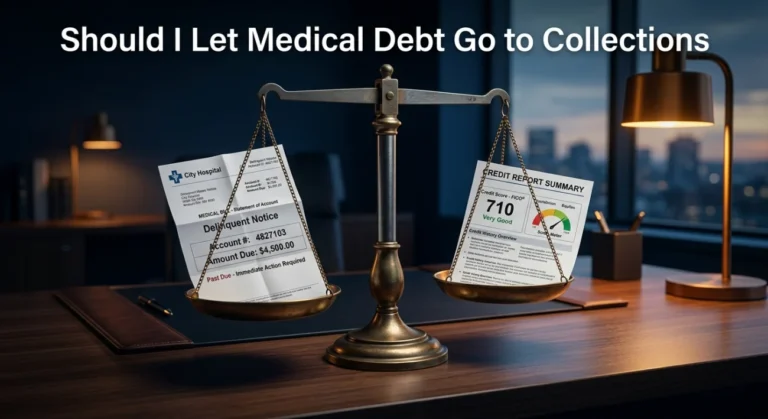
But the collection system is not designed to be that simple. If you act on the sudden thought of “should i pay off medical debt in collections” without validating it first, you might be paying a bill your insurance was supposed to cover. Making a blind payment surrenders all of your leverage before the negotiation even begins. If credit restoration is your primary goal, you need to learn how to properly structure a pay-for-delete request so your payment actually achieves the credit outcome you desperately need.
“I have seen patients drain their limited savings to pay a four-year-old collection account in full, thinking it would instantly boost their credit score for an upcoming apartment application. Instead, the payment simply updated the activity date, the account remained visible as a ‘paid collection,’ and their score barely moved. They lost their cash and gained almost no credit benefit because they didn’t know they could ask for a deletion first.”
Factor 1: The Account Age and the Danger of Revival
Before you ever ask, “should i pay medical debt sent to collections?” you must know exactly how old the debt is. Every state has a statute of limitations (SOL) – a legal window during which a collector can sue you. Once that window passes, the debt becomes time-barred. They lose the right to take you to court.
Here is the trap: in many jurisdictions, making even a $5 “good faith” payment on a time-barred account will restart that legal clock from day one. You can accidentally hand the collector a brand new window to sue you. If the bill is several years old, you must identify your state’s timeline. This is why understanding the specific risks associated with reviving old medical accounts is your mandatory first step.
Factor 2: Bill Accuracy and the EOB Check
Never assume a collection balance is correct just because it is printed on official letterhead. Error rates in medical billing are staggering. Wrong billing codes, duplicate charges, and uncredited insurance payments are routine.
Before deciding the answer to “is it worth paying medical debt in collections?” you must validate it. Request an itemized bill from the collector and compare it directly to the Explanation of Benefits (EOB) from your insurance company. If you find a discrepancy, you have grounds to dispute the collection entirely rather than paying it.
Factor 3: Credit Impact and Meaningful Resolution
If your primary motivation for paying is to fix your credit, you need to understand how reporting works. Paying an account does not magically erase it. It updates the status to “paid collection.” While newer credit scoring models treat paid medical collections favorably, older models (which many mortgage lenders still use) penalize you simply for having the collection on your record, paid or unpaid.
As covered earlier, your real goal is a deleted tradeline, not a paid status – and that requires securing a written deletion agreement before any money changes hands.
Factor 4: Settlement Leverage and Debt Economics
You rarely have to pay the full face value of a medical collection. Many third-party agencies are debt buyers – meaning they purchased your account from the hospital for pennies on the dollar. If they bought your $2,000 bill for $80, they do not need $2,000 to make a profit.
This is where your leverage lies. They want to close the file quickly with a guaranteed return. If you have a lump sum of cash available, you can often resolve the account for 30% to 50% of the original balance. Learning the mechanics of offering a lower lump-sum payment to close a medical file can save you thousands.
Factor 5: Affordability and the Consumer Debt Trap
If you are asking, “should i pay medical bills in collections by putting them on a high-interest credit card or taking out a personal loan?” the answer is almost always no. Trading interest-free medical debt for a personal loan or consumer credit card that compounds at high interest rates is a disastrous financial move.
Taking out a payday loan, a personal loan, or using a high-interest credit card to pay a collector in full just to stop the harassing phone calls.
Validating the debt, utilizing your legal rights to demand all communication be in writing to stop the calls, and negotiating a settlement you can actually afford with cash on hand.
When to Pay vs. When to Hold Back
Applying this framework makes the decision much clearer. You are not deciding based on fear; you are deciding based on financial outcomes.
Situations Where Paying (or Settling Quickly) Makes Sense
- The debt is recent, accurate, and you have verified the balance matches your EOB.
- The balance is relatively small, and the time spent fighting it outweighs the cost.
- You are applying for a mortgage in the next few months, and your loan officer has explicitly stated that resolving this specific account is a condition for approval.
Situations Where Not Paying (or Negotiating Deeply) Makes Sense
- The debt is older than your state’s statute of limitations.
- The account has been resold multiple times to different debt buyers, making the documentation questionable.
- Your credit is already severely damaged by other factors, meaning a single paid collection will offer zero marginal benefit.
- The balance is massive, and you simply cannot afford it.
If you fall into the latter category, you need to understand the legal limits of what they can do next. It is highly recommended to review what actual steps a collector must take before they can force a payment, as it is much harder than their letters imply. You should also confirm whether there are any legal obligations tying you to the debt based on your state’s specific guidelines. Finally, if you are balancing multiple overwhelming accounts, you should evaluate whether structured relief programs make more financial sense for your specific situation than trying to tackle each agency alone.
Final thoughts: Making Your Decision
When you sit down to search for answers on “should i pay debt collector for medical bills,” remove the emotion from the table. Treat it as a business transaction, because that is exactly how the collection agency views it. Verify the age of the account, confirm the accuracy of the charges, and never offer a payment without securing an agreement that benefits your credit file or significantly reduces the balance.
Your next step is to request complete validation of the debt in writing. Once you have the actual data in front of you, you can choose the path that protects your finances rather than just satisfying the collector.
❓ FAQ
💸 Should I pay a medical collection in full or try to settle?
You should almost always try to settle first. Collection agencies frequently purchase debts for a fraction of their value and expect to negotiate. Paying in full is rarely required to close the account.
📈 Will paying a medical collection raise my credit score?
Not always. Simply paying it changes the status to “paid collection,” which remains on your report. To guarantee a score improvement, you need to negotiate a “pay-for-delete” agreement before making the payment.
⏳ What happens if I just ignore a medical bill in collections?
Ignoring it can lead to negative credit reporting and increases the risk of the collector escalating the file to a lawsuit. However, ignoring it is still better than making a blind payment on a time-barred debt.
💳 Should I use a credit card to pay off a medical debt collector?
Generally, no. Medical debt does not typically accrue interest while in collections. Transferring that balance to a credit card means you will immediately start paying high consumer interest rates.
📞 If I pay the collector a small amount, will they stop calling?
A small payment might temporarily stop calls, but it is dangerous. In many states, making any payment restarts the statute of limitations clock, giving them years of renewed legal leverage to sue you for the rest.
🛑 Can I force a medical debt collector to stop contacting me without paying?
Yes. Under the Fair Debt Collection Practices Act (FDCPA), you can send a written “cease communication” letter. By law, the collector must stop calling and writing, though they can still choose to sue you.
🏥 Is it better to pay the hospital directly or the collection agency?
If the hospital still owns the debt and simply assigned it to an agency, paying the hospital directly can sometimes allow you to bypass the collection mark. If the hospital sold the debt entirely, you must deal with the buyer.
⚖️ Can a collector sue me if I am making $10 monthly payments?
Yes. Unless you have a formal, written payment agreement that explicitly states they will not take legal action as long as you make your $10 payments, they retain the right to sue you for the full balance.
📝 Does a paid medical collection eventually fall off my credit report?
Yes. Under federal law, medical collections fall off your credit report 7 years from the original date of delinquency, regardless of whether they are paid or unpaid.
🤔 Why would a collector settle for less than I owe?
Because it costs them money to pursue you. Debt buyers purchase accounts at massive discounts, and litigation is expensive. Accepting a 40% lump sum today is often more profitable for them than chasing you for years.
Medical Debt Collection
The laws governing what collectors can do and the specific situations where those laws matter most.
- The full legal framework: five federal laws governing what collectors can and cannot do
- How Long Before Medical Debt Goes to Collections? The Real Timeline (And How to Use It)
- Medical Bills in Collections But I Had Insurance: Why This Happens and How to Fix It
- How to Fight Medical Debt Collection: When It’s Worth Pushing Back (And How)
- Medical Debt Collection Under $500: The Rules for Small Balances
When the Collector Won't Stop
Knowing your rights matters. These cover what to do when the collector does not back down.
- How to use a HIPAA violation to push back on the collector that is pursuing you
- Negotiating the original bill before the collector gains more leverage over the account
- What collectors in this situation will actually accept and why the math works for both sides
- Whether a structured relief program makes sense when a collector is already involved
- Removing the collection account from your credit report after the account is resolved
Disclosure: The content on this site reflects direct experience inside hospital billing and medical debt collection, and is grounded in federal law and regulation. It is informational in nature. Reading it does not constitute legal advice and does not create any professional relationship. If you are facing a lawsuit, a judgment, or a legal deadline, consult a licensed attorney in your state before taking action.