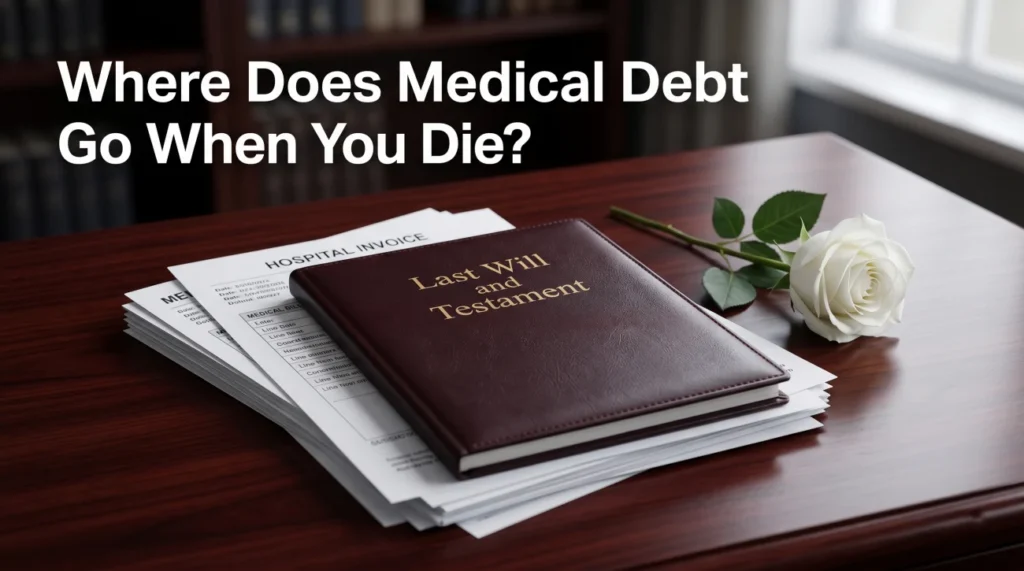
- Medical debt does not automatically transfer to your family members when you pass away.
- Unpaid hospital bills become a claim against the deceased person’s estate, which pays what it can from available assets.
- If the estate has no assets, the unsecured medical debt is typically discharged and goes uncollected.
- Collectors can contact the estate executor for payment, but they cannot legally force non-liable family members to pay.
The Reality of Hospital Bills After a Loss
When families are grieving, the last thing they want to deal with is a stack of hospital invoices. One of the most common questions I hear from anxious relatives is where does medical debt go when you die. The assumption is often that the financial burden automatically passes down to the children or the surviving spouse. From my time working inside hospital billing departments, I can tell you that this assumption is usually wrong.
Your medical debt does not disappear the moment you pass away, but it also does not jump onto your family members’ credit reports. What actually happens to medical debt after death involves a specific administrative process. Knowing how this process works from the inside can save surviving family members from making payments they are not legally obligated to make.
The Estate Takes Over the Financial Responsibility
When a patient dies, their unpaid debts become the responsibility of their estate. The estate includes everything the person owned at the time of their death, such as bank accounts, property, and personal belongings. It is the estate that owes the money, not the grieving family.
During the probate process, the executor or administrator of the estate is responsible for gathering these assets, notifying creditors, and paying off valid claims. Hospital billing departments have dedicated workflows for this. When an account is flagged as a deceased patient, it is moved out of standard collections and into an estate-handling queue. The collectors working these queues must operate within the boundaries of the federal rules governing medical debt collection, which specifically dictate how and when they can submit claims to an estate.
“When I worked the deceased patient queue, the tactics completely changed compared to active collections. We were not allowed to use urgency scripts or threaten credit damage. Our main job was simply monitoring probate courts to see if an estate was opened. We knew that if there was no estate, the account was functionally dead, and our expected recovery rate dropped to near zero.”
The Priority of Claims: Who Gets Paid First
Even if an estate has some money in it, medical bills are not always the first things to be paid. Estates pay creditors in a legally specified order of priority, which varies slightly by state but generally follows a standard pattern.
Secured debts, like a mortgage or a car loan, and administrative costs for the estate itself are typically paid first. Tax liabilities and final funeral expenses also sit at the top of the list. Medical debt is almost always classified as an unsecured debt. This means hospital bills and collection agency claims are pushed to the back of the line.
If the estate pays the priority creditors and runs out of money before getting to the medical bills, those remaining health care debts are left unpaid. The hospital or debt buyer cannot then turn around and demand the rest of the money from the patient’s children.
What Happens When the Estate Has No Assets
This is the most common outcome I have seen in medical billing. Many people who pass away after a long illness have already depleted their savings on medical care. They leave behind significant hospital bills but no real estate, no savings, and no financial accounts.
If there is no estate, or if the estate is completely insolvent (meaning it has zero assets), there is nothing for the creditors to pursue. In these cases, the debt goes unpaid and is eventually discharged by the provider or the collection agency. It is simply written off as a loss.
However, an internal hospital write-off is not always the end of the story. If you are managing the affairs of someone who passed away with no assets, holding onto the proper paperwork is your best defense. Keep copies of the death certificate and any official documents showing the estate had no value.
⚠️ Warning: Just because an account is written off by a hospital does not mean a third-party debt buyer will not try to collect it later. Having written proof of the estate’s insolvency on hand is the fastest way to prevent it from becoming revived old debt years down the line when a new agency buys the old portfolio.
The Exceptions: When Family Might Be Liable
While the general rule is that family members are safe from the deceased person’s debts, there are four specific exceptions that hospital billing departments will look for to establish personal liability.
The first exception involves community property states. If the deceased patient lived in Arizona, California, Idaho, Louisiana, Nevada, New Mexico, Texas, Washington, or Wisconsin, a surviving spouse might be held responsible for medical debts incurred during the marriage. Because community property rules vary significantly, this is a scenario where speaking with a probate professional is essential.
The second is if a family member signed a financial responsibility form at the hospital. I have watched families sign admission paperwork in a panic without realizing they were acting as a financial guarantor for the treatment. If your name is on the contract as a responsible party, the debt belongs to you just as much as it belonged to the patient.
Third, joint account holders can sometimes be held liable. If you were a joint owner on a specific financial account or line of credit used to directly guarantee or pay for the medical care, creditors may pursue you for the remaining balance.
Finally, there is a legal trap specifically for estate executors. If you are the executor and you distribute the estate’s money or assets to heirs before paying valid creditors, you can be held personally liable for those unpaid medical bills up to the amount you improperly distributed. This is why following the formal probate sequence is critical.
Asset Protection and Estate Planning Implications
For patients who are chronically ill and trying to plan ahead, the fear of leaving a financial mess is overwhelming. They want to know if medical debt will wipe out the modest inheritance they hoped to leave for their children.
This is where understanding the limits of the estate process is highly practical. Creditors can only go after assets that are officially part of the estate. Certain types of financial accounts bypass the estate entirely if they are set up correctly.
💡 Pro Tip: Life insurance policies and retirement accounts (like a 401k or IRA) that have a named beneficiary transfer directly to that person. They do not pass through probate, which means medical debt collectors generally cannot touch those funds.
Handling the Pressure Tactics from Collectors
Understanding this estate process is only half the picture. The other half is knowing how to handle the collection calls that almost always come. The deepest frustration I hear from families dealing with a recent death is the aggressive nature of these contacts. Surviving relatives are worried about losing their own homes or savings because a collector told them the bill “needs to be settled immediately.”
Collectors know that families are vulnerable and often unaware of the estate process. They will call a surviving child and use careful language. They might say, “We are calling about your father’s outstanding balance, how would you like to take care of this today?” They stop short of illegally saying the child is legally required to pay, but the implication is designed to make you open your wallet out of guilt or fear.
Arguing with the collector on the phone or making a small “good faith” payment just to make them stop calling. A payment can sometimes be construed as accepting liability.
Informing the collector that the patient has passed away, providing the contact information for the estate executor, and requesting that all future communication be done in writing.
The reality is that you are almost certainly not personally responsible, despite what the collector’s tone implies. The estate process actually has specific timelines and procedures that protect families when followed correctly. Letting the probate process handle it is your strongest shield.
It is crucial to understand the rules about who collectors can actually target. They are allowed to contact the executor or administrator of the estate to seek payment. They are not allowed to harass non-liable family members into paying from their personal bank accounts.
Final Thoughts: Protecting Yourself While Grieving
When someone dies, their medical bills transition into a highly regulated legal space. The most important thing you can do as a surviving relative is to pause and let the formal process work.
If you receive a call from an agency about a deceased loved one’s account, use a simple, neutral script to redirect them:
If an agency continues to harass you, or if they falsely state that you will face legal consequences for your parent’s or spouse’s unpaid bills, they have crossed a legal line. Pushing back against deceptive collection tactics that violate federal guidelines is entirely within your rights. Take the time to understand the rules, consult an estate professional if there are significant assets, and let the administration process handle the medical debt exactly as it was designed to.
❓ FAQ
📉 Does medical debt go away when you die?
No, it does not automatically disappear. It becomes a claim against your estate. If your estate has enough money, the bills are paid from those assets. If there are no assets, the debt is then written off and goes uncollected.
🏦 What happens to medical debt after death if there is no money?
If the deceased person left behind no assets and no estate can be opened, the unsecured medical debt is typically discharged. Creditors cannot force family members to pay the balance out of pocket.
⚖️ Who pays medical debt when you die?
Your estate pays the debt. The executor of the estate uses the assets left behind (like bank accounts or property sales) to settle valid creditor claims based on state priority rules.
💍 Can collectors collect medical debt after death from a spouse?
Generally no, unless you live in a community property state (like Texas or California) or if the surviving spouse co-signed financial responsibility documents at the hospital admission desk.
🛡️ Does medical debt die with you if you have a life insurance policy?
Life insurance payouts go directly to the named beneficiary and do not enter the probate estate. Because of this, medical debt collectors cannot access those life insurance funds to satisfy hospital bills.
👨👩👧 Is family responsible for a deceased person’s medical debt?
In almost all cases, children and extended family are not personally responsible. Collectors may call asking for payment, but unless the family member signed as a guarantor, they are not legally obligated to pay.
🏥 What happens to unpaid hospital bills after death?
The hospital’s billing department will move the account to an estate queue. They will wait for an estate to be opened in probate court and then file a formal claim to get paid from whatever assets are available.
Medical Debt Collection
The laws governing what collectors can do and the specific situations where those laws matter most.
- The full legal framework: five federal laws governing what collectors can and cannot do
- Sued for Medical Debt? How to Settle a Medical Debt Collection Lawsuit Before It Gets Worse
- Medical Debt Collection Under $500: The Rules for Small Balances
- Are Medical Collections Legal? What the Law Actually Allows (And Where It Doesn’t)
- Medical Debt Collection for a Deceased Person: Who Is Actually Responsible
When the Collector Won't Stop
Knowing your rights matters. These cover what to do when the collector does not back down.
- How to use a HIPAA violation to push back on the collector that is pursuing you
- Negotiating the original bill before the collector gains more leverage over the account
- What collectors in this situation will actually accept and why the math works for both sides
- Whether a structured relief program makes sense when a collector is already involved
- Removing the collection account from your credit report after the account is resolved
Disclosure: The content on this site reflects direct experience inside hospital billing and medical debt collection, and is grounded in federal law and regulation. It is informational in nature. Reading it does not constitute legal advice and does not create any professional relationship. If you are facing a lawsuit, a judgment, or a legal deadline, consult a licensed attorney in your state before taking action.