- When your out-of-pocket cost is higher than expected, the problem is often how your insurance company processed the claim, not a hospital billing error.
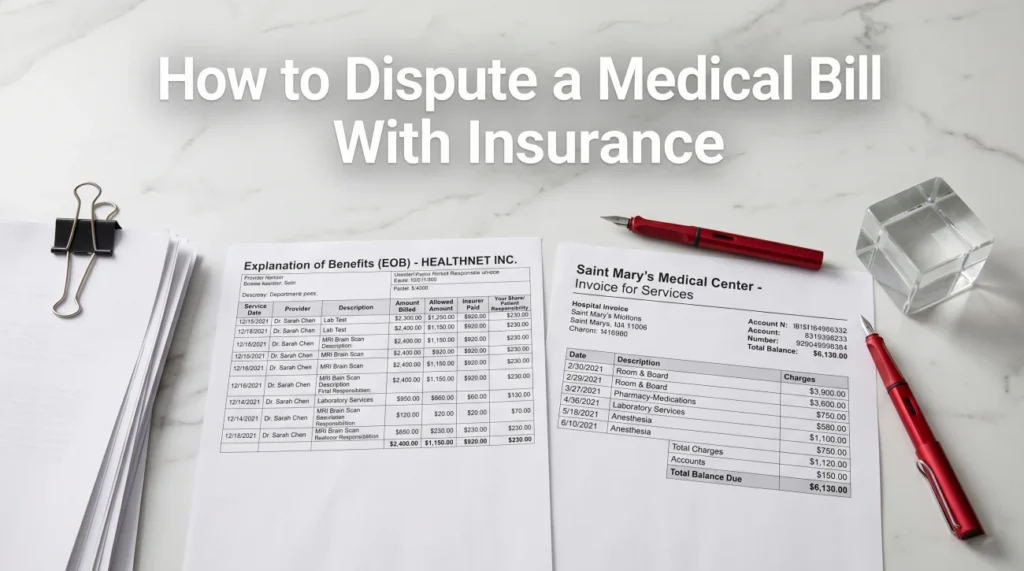
- Comparing your itemized hospital bill to your insurance Explanation of Benefits (EOB) is the quickest way to diagnose exactly who you need to dispute with.
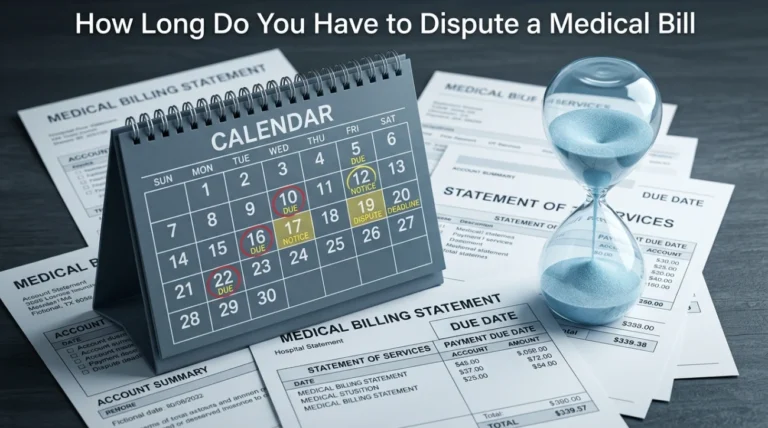
- Under federal law, you have 180 days from a denial notice to file a formal internal appeal with your health insurance company, and the right to an external review if that fails.
The Difference Between a Billing Error and a Processing Error
During my time inside hospital billing departments, I routinely took calls from patients who were furious about a massive out-of-pocket charge. They would point to the total and demand that the hospital fix the error. In many of these cases, the hospital had actually billed everything perfectly. The massive charge was entirely due to the insurance company denying the claim or processing it incorrectly.
If you want to know how to dispute a medical bill with insurance, you first have to understand that an insurance dispute is fundamentally different from a hospital billing dispute. You are dealing with a different corporate entity, a different set of federal regulations, and an entirely different appeal process.
Before you spend hours writing letters or navigating phone menus, you need to confirm that your insurance company is actually the party at fault. Understanding this distinction is the cornerstone of any comprehensive guide on how to dispute a medical bill, because picking the wrong target simply wastes your time.
How to Diagnose the Problem: The EOB Comparison
You do not need to be a medical coding expert to figure out if your insurance company messed up. You only need two documents: the itemized bill from your healthcare provider and the Explanation of Benefits (EOB) mailed or emailed to you by your insurance company.
The EOB is not a bill. It is a statement showing what the provider charged, what the insurer agreed to pay based on their negotiated contract, and what portion is designated as “Patient Responsibility.”
The amount the hospital is demanding from you is higher than the “Patient Responsibility” amount listed on your EOB. In this scenario, the hospital is charging you more than your insurance determined was allowable. You must dispute this directly with the hospital billing department.
The hospital bill perfectly matches the “Patient Responsibility” amount on your EOB, but that amount is much higher than your plan coverage dictates. The hospital is simply billing you what the insurer told them to bill. This means you must dispute the medical claim with your insurance company.
Common Reasons Insurance Companies Deny Claims
When an insurance company denies a claim or processes it at a lower benefit tier, it usually falls into one of several recognizable patterns. Recognizing these patterns helps you formulate exactly what to say in your appeal.
The most frequent trigger is a denial based on “medical necessity.” Insurers will frequently reject a costly scan or procedure, claiming it was not clinically required, even if your doctor ordered it. Another extremely common issue is the “wrong provider category” trap. This happens when a specialist visit is incorrectly processed as out-of-network, or when a pre-authorization that your doctor secured is somehow not credited to your file during processing.
A third frequent issue is the coding mismatch trap. Your provider might have coded the claim incorrectly, causing the insurer to process it at the wrong benefit level. The hospital billed the right service but used a mismatched diagnostic code, causing the insurer to apply the cost to your deductible instead of covering it fully. This sits right at the intersection of a hospital error and an insurance error.
“I have reviewed hundreds of insurance denials that were ultimately overturned simply because the patient submitted a copy of the original pre-authorization letter that the insurer’s automated system had somehow lost. The hospital cannot fix that; the patient has to force the insurer to look at their own paperwork.”
If a claim gets stuck in a prolonged dispute because of any of these triggers, the hospital might refer the unpaid balance to a third-party collection agency prematurely. If patient data or diagnostic codes are transferred improperly during this messy process, you need to understand how to hold collectors accountable for HIPAA violations. However, dealing with collectors is the worst-case scenario. To prevent the account from ever reaching that point, your primary weapon is attacking the root cause via the insurance denial itself.
The Internal Appeal Process
Once you have identified the trigger on your EOB, your next step is filing a formal internal appeal. From my experience reviewing correspondence between billing offices and insurers, the appeals that actually succeed do not sound like angry customer complaints. They sound like compliance requests.
Under the Affordable Care Act, you have 180 days from the date you receive the denial notice to file this request. Because there are strict deadlines for disputing medical bills, you should initiate this process the moment you gather your documentation.
A formal appeal requires specific information to ensure it is processed correctly. You must include your claim number, the specific denial reason quoted directly from your EOB, and documentation proving the service should have been covered. This documentation could be your plan’s benefit booklet, a letter of medical necessity from your doctor, or an approved pre-authorization code.
When writing your appeal letter, be direct and precise about what you want the insurer to do.
The Clinical Shortcut: Peer-to-Peer Review
Before you even mail your appeal letter, ask your doctor to initiate a peer-to-peer review. This is a phone call between your treating physician and the medical director at your insurance company. Insurers rarely highlight this option, but from an operational standpoint, it is often the most effective tool you have. A doctor arguing medical necessity directly with another doctor bypasses the administrative red tape that traps patient-submitted paperwork.
Response Timelines You Should Track
Insurance companies are not allowed to stall your appeal indefinitely. By law, insurers must respond to internal appeals for non-urgent care within 30 to 60 days. If the appeal involves urgent medical care that is currently ongoing, they must respond within 72 hours. You must track these dates closely and follow up if the deadline passes without a written decision.
When the Dispute Involves a Surprise Medical Bill
Sometimes, what looks like an insurance processing error is actually a federal law violation. I have seen countless patients assume an out-of-network bill at an in-network hospital was just their bad luck. From the billing side, we know this falls under a strict federal framework.
For out-of-network emergency services or out-of-network care provided at in-network facilities after January 1, 2022, federal law dictates that you can only be charged your standard in-network cost-sharing amount. If your insurer processed this claim incorrectly or the provider balance-billed you, you should review your rights regarding surprise medical bills.
In these specific cases, the standard insurance appeal is just one tool. You may also need to know how to effectively dispute a surprise medical bill through the federal No Surprises Help Desk, which forces the provider and the insurer to settle the out-of-network cost dispute without involving you.
What to Do When the Internal Appeal Is Denied
It is incredibly frustrating to submit a well-documented internal appeal only to receive a letter stating that the insurance company has reviewed its own decision and decided it was right all along. Inside the billing industry, it is a known reality that insurers count on exhaustion. They fully expect you to give up after the first internal denial.
After losing an internal appeal, or if the insurer completely fails to respond within the mandated timeframe, you have the right to request an independent external review. Taking the decision to an independent third party removes the insurer’s home-court advantage. You typically have four months from the date you receive your internal appeal denial to file for this review. The insurance company is legally bound by the decision of the external reviewer. If the independent reviewer says the claim must be paid, the insurer must pay it.
ERISA Plans vs. ACA Marketplace Plans
Your exact external review path depends heavily on your insurance type. If your insurance comes through a large private employer rather than a marketplace or government program, you likely have an ERISA plan. While marketplace plans use standard state or federal external review processes, self-funded ERISA plans follow slightly different federal appeal deadlines and review procedures. You must check your specific plan benefit booklet to verify your exact filing window and review authority.
Final Thoughts: What Happens If the Bill Still Stands
Disputing a medical claim with your insurance company requires patience and meticulous record-keeping. Treat the insurance appeal not as an emotional battle of wills, but as a procedural transaction. By relying on your EOB, forcing the insurer to justify their denials with plan documents, and utilizing the external review process, you maximize your chances of getting the coverage you paid for.
Remember that the billing ecosystem is designed to be confusing. Do not let a single denial letter convince you that a bill is final. Keep pushing through the procedural steps.
However, there are times when an external review upholds the denial, or when the insurance claim is processed correctly but your high deductible simply leaves you with an enormous balance. If your insurance resolution is complete but the remaining hospital bill is still more than you can realistically afford, your next strategic move is learning how to negotiate medical bills effectively to reduce the final out-of-pocket cost.
❓ FAQ
📞 Who do I call first, the hospital or my insurance company?
You should compare your hospital bill to your insurance Explanation of Benefits (EOB) first. If the bill is higher than the “Patient Responsibility” amount on your EOB, call the hospital. If the bill matches the EOB but the insurance denied the claim, call your insurance company.
⏱️ How long does an insurance appeal process usually take?
By federal law, insurance companies must respond to internal appeals within 30 to 60 days for non-urgent standard claims, and within 72 hours for urgent care situations.
📝 Can I just write a letter saying the medical bill is too high?
No. An insurance appeal must address a specific claim processing error, such as a wrongfully denied service or a misapplied deductible. Simply stating the bill is too expensive is a complaint, not a formal dispute that will trigger a review.
🏥 Will the hospital help me appeal a denied claim to my insurance?
In many cases, the hospital’s billing department or your doctor’s office will assist by providing letters of medical necessity or resubmitting the claim with corrected billing codes, but you are ultimately responsible for initiating the appeal if the hospital refuses.
💳 Should I pay the hospital bill while I am appealing with my insurance?
It is generally safer to contact the hospital billing department, inform them that an active insurance appeal is underway, and request a hold on your account to prevent it from being sent to collections while the insurer reviews the claim.
⚖️ What exactly is an independent external review?
An external review is a process where a third-party medical professional, who does not work for your insurance company, reviews your denied claim. If they decide your insurer should have covered the service, the insurer is legally required to pay.
🗣️ Can my doctor talk directly to the insurance company for me?
Yes. Your doctor can often request a “peer-to-peer” review, which is a phone call between your physician and a doctor who works for the insurance company, to explain why a specific procedure or medication is medically necessary. This is often the fastest route because it bypasses standard administrative red tape and gets two clinicians talking directly.
🛑 What if my insurance company tells me I missed the appeal deadline?
If you missed the 180-day deadline, the formal appeal process is usually closed. At that point, your best remaining option is to negotiate directly with the hospital billing department for a reduced self-pay rate or financial assistance.
Medical Bill Dispute
How to challenge a hospital bill from the initial dispute through the collections process.
- Step-by-step guide to challenging a hospital bill from itemization to formal dispute
- What Happens When You Dispute a Medical Bill? The Process and Possible Outcomes
- How to Dispute Hospital Bills: The Hospital-Specific Process Most Patients Don’t Know Exists
- Reasons to Dispute a Medical Bill: What Counts (And What Doesn’t)
- How to Dispute an Incorrect Medical Bill: The Steps That Actually Get Errors Corrected
When Disputing Is Not Enough
A successful dispute resolves some situations. These cover when the bill or the collector remains.
- Using a HIPAA violation to challenge how your bill was transferred to the collector
- Negotiating the bill you are disputing and what hospitals are actually willing to reduce
- Settling the remaining balance when a dispute does not fully resolve the account
- Debt relief programs that can handle disputed and overbilled medical accounts
- How a successful bill dispute can result in removing the collection from your credit report
Disclosure: The content on this site reflects direct experience inside hospital billing and medical debt collection, and is grounded in federal law and regulation. It is informational in nature. Reading it does not constitute legal advice and does not create any professional relationship. If you are facing a lawsuit, a judgment, or a legal deadline, consult a licensed attorney in your state before taking action.