- Federal regulations, specifically for nonprofit hospitals, generally prohibit sending an account to a collection agency while a formal billing dispute or financial assistance application is actively pending.
- Verbal complaints made over the phone often fail to trigger the system “hold” needed to stop automated collection sweeps, leaving your account vulnerable.
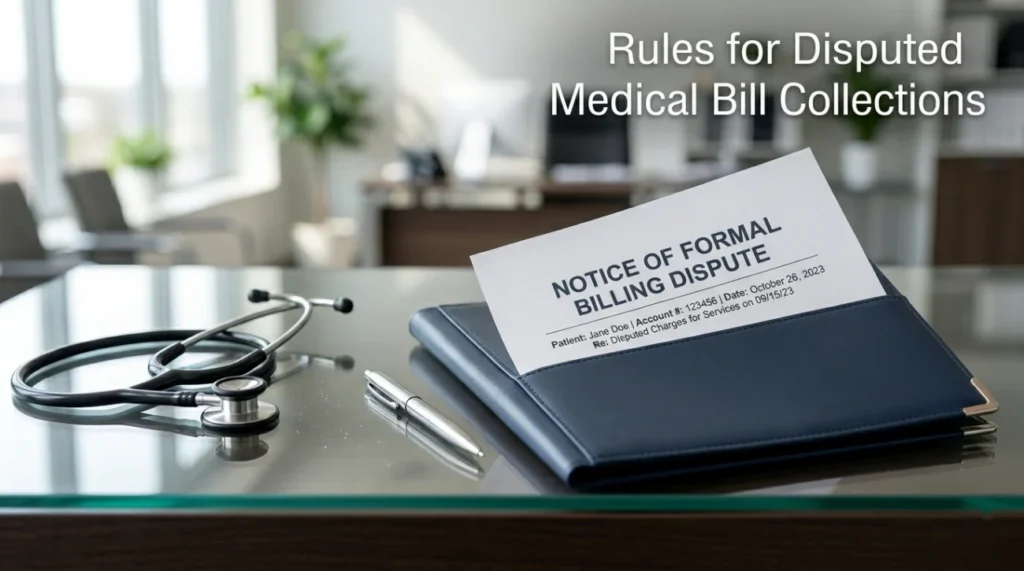
- If a collection agency contacts you regarding a bill you are currently disputing with the hospital, you must notify the collector in writing immediately to preserve your rights.
The Anxiety of the Collection Threat During a Dispute
I have processed thousands of patient accounts from inside hospital billing departments, and one of the most common and anxiety-producing questions I hear is straightforward: can a disputed medical bill be sent to collections? When you are in the middle of fighting a charge that you believe is wrong, the last thing you want is for that same incorrect bill to damage your credit or result in harassing phone calls.
The answer to this question is far more protective of the patient than most people realize. Enterprise billing systems are designed to move unpaid accounts into the collection pipeline automatically. However, there are specific federal rules and internal system mechanisms designed to stop that process when a patient formally challenges the charges. The problem is that patients often do not know how to trigger those protections properly.
Understanding the rules about collection activity during an active billing dispute can save you from a massive headache.
The Federal Shield: Rules During an Active Dispute
Can a hospital send a disputed bill to collections? In many cases, federal law and regulatory frameworks say no. The protection comes from a combination of consumer rights laws and tax regulations that dictate how hospitals must behave before taking aggressive action against a patient.
For patients dealing with surprise out-of-network charges, the No Surprises Act creates a strict framework. While an account is being reviewed for compliance with this act, aggressive collection actions are generally paused. But an even broader protection applies to the majority of hospital patients through tax law.
The 501(r) Requirement for Nonprofit Hospitals
Most hospitals in the United States operate as nonprofit entities. To maintain their tax-exempt status, these facilities must comply with IRS section 501(r). This regulation is one of the most powerful tools a patient has, yet it is rarely mentioned outside of billing compliance meetings.
Under 501(r), a nonprofit hospital cannot take what the IRS calls an “Extraordinary Collection Action” (ECA) without first making a reasonable effort to determine if the patient qualifies for financial assistance. Selling an account to a debt buyer, reporting to credit bureaus, or sending the account to a third-party collection agency all count as ECAs.
“From a compliance standpoint, nonprofit billing departments are terrified of 501(r) violations. If an account is actively being reviewed for a billing error, that process almost always involves verifying the patient’s financial status. Pushing an account to collections while that review is incomplete creates serious regulatory exposure for the hospital.”
If a nonprofit hospital blatantly violates this rule by sending your account to collections while a written dispute or assistance application is pending, you actually have a direct line of recourse: you can file a complaint with the IRS using Form 13909. The threat of a tax compliance review is often enough to force a hospital to recall the account immediately.
For patients at for-profit facilities where 501(r) does not apply, protections still exist. Standard billing compliance and state consumer protection laws generally prohibit debt collection on actively disputed balances, as the exact amount owed has not been legally established. Regardless of the hospital type, you can learn more about how this fits into the broader picture of how to dispute a medical bill in our complete guide.
While these regulations provide a strong legal shield, the practical reality is often dictated by software rather than human compliance officers.
What “Active Dispute” Actually Means to a Billing System
The gap between what the law requires and what actually happens often comes down to software. Hospital billing systems do not have human beings manually reviewing every account on day 90 or day 120. They use automated sweeps.
When an account hits a certain age of non-payment, the system automatically sweeps it into a file that gets securely transmitted to a third-party collection agency. The only thing that stops this automated sweep is a specific status code on your account: a “hold” or a “pause” flag.
If you have submitted a formal, written dispute to the billing department and they have acknowledged receiving it, a billing compliance specialist will manually apply that hold flag to your account. As long as that flag is active, the system will bypass your account during its automated collection sweeps. This is exactly what happens when you dispute a medical bill properly. The account remains frozen until the internal review is complete.
The Pain Point: The Unrecorded Verbal Complaint
This brings us to the most dangerous scenario, and the most frequent reason patients end up dealing with a collection agency by surprise. You called the billing department, waited on hold, and verbally argued the charge. The representative said they would “look into it.” You hung up feeling relieved, assuming the account was safe.
However, an informal note typed into a text field does not change the account status code. Without the formal hold flag, the automated sweep simply picks up the account on day 120 and sends it to collections anyway. You cannot rely on a phone conversation to protect your credit.
Calling the hospital, arguing about a duplicate charge over the phone, and assuming the account is safe from collections while you wait for a callback.
Mailing or emailing a specific, documented dispute identifying the exact billing code error, which forces the department to officially log the account into a formal review status.
You must establish a paper trail. Using a structured medical bill dispute letter is the most reliable way to ensure the hospital applies the correct hold status to your account.
What to Do If the Bill Goes to Collections Anyway
Sometimes, despite your best efforts and a perfectly written letter, a hospital billing error or an administrative glitch results in disputed medical bill collections. You open your mail and find a demand letter from an agency you do not recognize.
When this happens, you must act quickly, but you must direct your actions to the right party. The collection agency is not the entity to resolve the underlying clinical or administrative error. They only know what the hospital sent them. Your goal with the collector is simply to force them to pause their activity.
You need to contact the collection agency in writing immediately. State clearly that the underlying bill is currently in an active dispute with the original provider.
Sample Communication to Collector
“I am in receipt of your collection notice dated [Date] regarding account number [Number] from [Hospital Name]. This entire account is currently in an active, documented billing dispute with the original provider due to [state brief reason, e.g., a billing code error]. I am requesting that you cease all collection activity and return this account to the original provider, as it was assigned to your agency in error while under active review.”
There is also a critical distinction to look for: was your account assigned to an agency, or was it sold outright to a debt buyer? If the hospital merely assigned it, they still own the debt and can easily pull it back. If they sold a disputed account to a debt buyer, that is a massive compliance failure. Debt buyers must be notified that the debt is disputed, which forces them to return the account to the seller as uncollectable.
If the hospital transferred your account while it was actively disputed, they may have also transferred protected health information improperly. If your disputed bill was transferred in a way that seems legally questionable, you need to understand how medical debt collection violations happen and how to use them as leverage to stop the harassment.
Can Disputed Medical Bills Affect Credit?
The credit reporting angle is another massive source of stress. Patients often fear that a stubborn hospital will ruin their credit score as punishment for disputing a hospital bill overcharge.
Under good billing practices and federal regulations, a bill in active dispute with the provider should not be reported to the credit bureaus during the dispute period. Furthermore, modern credit reporting rules provide a significant buffer. Currently, medical debt cannot be reported to the major credit bureaus until it has been in collections for a full year. Medical debts under $500 cannot be reported at all.
This one-year delay means that even if a hospital mistakenly sends your disputed account to an agency, you have a massive window of time to force the hospital to pull the account back before it ever touches your credit report. If an active, documented dispute is somehow reported to your credit file, that is a separate regulatory violation that you can dispute directly with Experian, Equifax, or TransUnion.
Final Thoughts: Navigating the Resolution
Pushing back against a medical charge does not automatically ruin your credit or trigger endless harassment, provided you establish a paper trail that forces the system to pause. Once your formal dispute is logged and the account is frozen, the hospital’s internal review begins. Knowing what happens when you dispute a medical bill on the hospital’s side will help you anticipate their response timeline and next steps.
If you successfully navigate the process, the hospital will correct the error and issue a new statement. If they confirm the bill is technically accurate but the balance remains completely unaffordable, the dispute process ends, and your strategy must shift. At that point, you should transition your efforts and learn how to negotiate medical bills effectively based on financial hardship.
❓ FAQ
🛑 Can a hospital legally send my bill to collections while I am disputing it?
Generally, no. For nonprofit hospitals, doing so without resolving pending financial assistance or dispute reviews violates IRS 501(r) regulations. For other facilities, it violates standard billing compliance practices, though automated system errors do happen.
📞 Does calling the billing department stop the collection clock?
Rarely. A phone call often results in a simple text note on your file, which does not trigger the system “hold” flag required to stop an automated collection sweep. Always dispute in writing.
✉️ What should I do if a collector contacts me about a bill I am already disputing?
Send a written notice to the collection agency immediately stating that the account is in an active dispute with the original provider and request that they cease collection activity and return the account.
📉 Will my credit score drop while my medical bill is in dispute?
It should not. Federal reporting guidelines require a one-year waiting period before medical debt can be reported to credit bureaus, giving you ample time to resolve the dispute before your credit is affected.
⏳ How long does a hospital have to respond to my written dispute?
While federal timelines vary based on the specific type of dispute, most hospital policies aim to acknowledge a written dispute within 15 days and provide a resolution within 30 to 60 days.
🏥 Can I dispute a bill if it has already been sent to a collection agency?
Yes. You have a 30-day window from the first contact by a collector to demand validation of the debt. If you find a billing error upon validation, you can still dispute the underlying charge.
💵 Should I make a partial payment while my bill is in dispute?
It is generally safer to wait until the dispute is fully resolved before making payments. Paying a portion of a disputed charge can sometimes complicate the refund process or accidentally acknowledge validity.
⚖️ Do the No Surprises Act protections pause collection efforts?
Yes. If your bill qualifies for the federal patient-provider dispute resolution process under the No Surprises Act, aggressive collection actions are paused while the arbitrator reviews the case.
📝 What proof do I need to show a collector that my bill is in dispute?
Provide a copy of the written dispute letter you sent to the hospital, along with proof of delivery such as a certified mail receipt or an email confirmation timestamp.
🗑️ If the hospital admits an error, will they pull the account back from collections?
Yes. If the hospital determines the bill was incorrect or sent prematurely, their billing department will instruct the collection agency to close the account and return it to the facility for correction.
Medical Bill Dispute
How to challenge a hospital bill from the initial dispute through the collections process.
- Step-by-step guide to challenging a hospital bill from itemization to formal dispute
- Can You Dispute a Medical Bill for Misdiagnosis? What’s a Billing Dispute vs a Medical Claim
- How to Dispute Hospital Bills: The Hospital-Specific Process Most Patients Don’t Know Exists
- Medical Bill Dispute Letter: What to Include, How to Send It, and What Makes It Work
- How Do You Dispute a Medical Bill Successfully? What Actually Works
When Disputing Is Not Enough
A successful dispute resolves some situations. These cover when the bill or the collector remains.
- Using a HIPAA violation to challenge how your bill was transferred to the collector
- Negotiating the bill you are disputing and what hospitals are actually willing to reduce
- Settling the remaining balance when a dispute does not fully resolve the account
- Debt relief programs that can handle disputed and overbilled medical accounts
- How a successful bill dispute can result in removing the collection from your credit report
Disclosure: The content on this site reflects direct experience inside hospital billing and medical debt collection, and is grounded in federal law and regulation. It is informational in nature. Reading it does not constitute legal advice and does not create any professional relationship. If you are facing a lawsuit, a judgment, or a legal deadline, consult a licensed attorney in your state before taking action.