
- The rule preventing medical collections under 500 dollars from appearing on your credit report is a voluntary credit bureau policy, not a legal exemption from the debt itself.
- Collectors can still legally call you, send letters, and demand payment for small balances.
- Because they cannot report these small debts to the credit bureaus, collectors lose their most powerful piece of leverage against you.
- The economics of litigation make it incredibly rare for a debt collector to file a lawsuit over a balance this small.
The Truth About Small Balance Medical Debt
If you are researching medical debt collection under 500 dollars, you have likely heard a rumor that small hospital bills disappear automatically. This is one of the most common and dangerous misconceptions in the healthcare billing system. The reality is much more nuanced. There is a very real rule that protects you from credit damage, but it does not mean your legal obligation to pay has vanished.
During my time working inside hospital billing departments, I processed thousands of these small balance accounts. Patients would often call the billing office, confused and angry, after receiving a collection letter for a $150 lab fee or a $250 emergency room copay. They assumed that because the balance was small, it was illegal for the hospital to send it out for collection. That assumption is incorrect. The billing system operates on rigid automated cycles, and an unpaid $75 bill triggers the exact same internal collection countdown as an unpaid $75,000 surgical bill.
However, once that small account leaves the hospital and lands on a debt collector’s desk, the rules of the game shift significantly in your favor. If you have a medical debt under 500 collection account, you need to understand exactly what the credit bureaus have agreed to do, what collectors are still legally allowed to do, and why you actually have the upper hand in this specific situation.
Understanding the Medical Debt Collection 500 Threshold
To navigate this situation, you must separate credit reporting policies from debt collection laws. The confusion almost always stems from a major policy change that took effect in 2022. Equifax, Experian, and TransUnion (the three major credit reporting bureaus) voluntarily agreed to stop reporting medical debt balances under $500.
This means that any medical bill collection under 500 dollars is invisible to the credit scoring algorithms. It will not show up on your credit report. It will not drag down your FICO score. If you are applying for a mortgage, an auto loan, or a new apartment, the lender will not see this small medical debt on your file.
Even if your bill happens to cross that line, you still have a buffer. Under current rules, medical debt over $500 must sit in collections for a full year before it can be reported. You have plenty of time to address the issue before it ever touches your credit score.
This is a massive consumer protection victory, but it has boundaries. The $500 medical debt collection limit is strictly a credit reporting rule. It is not a federal law that erases your debt. If you want to understand the actual federal statutes that govern your legal rights, you need to review the full federal legal framework for medical debt collection. The credit bureaus only control what appears on your credit profile; they do not control what a debt collector can legally ask you to pay.
The Threshold Loophole: Aggregation and Fees
There is a specific tactic that collectors sometimes use to bypass this reporting protection. If you have three separate $200 medical bills from the same hospital visit, a debt buyer might try to bundle them together into a single $600 collection account to force it onto your credit report. Alternatively, they might add collection fees or interest to a $480 bill to push it past the $500 mark.
If you see a bundled or inflated account suddenly appear on your credit profile, this is a legitimate basis for dispute. You can often successfully challenge the mark with the credit bureaus by demanding they unbundle the individual dates of service, or by forcing the collector to prove they have a signed contract authorizing the added interest.
To summarize how the $500 threshold impacts your overall situation:
| The Small Balance Rule | What It Actually Means |
|---|---|
| Credit Reporting | Balances under $500 will not appear on your credit report. |
| Debt Forgiveness | The debt is not forgiven. You still technically owe the money. |
| Collection Activity | Collectors can still call you and send demand letters. |
| Legal Action | Collectors can technically sue you, though it is highly unlikely. |
What Collectors Can Still Do on Sub-$500 Accounts
Because the debt is still legally valid, debt collection agencies are well within their rights to pursue you for the money. When evaluating the medical debt under $500 rules, it is important to know exactly what tactics are still on the table for the agency.
They can call your phone number during approved hours. They can send you formal collection letters in the mail. They can ask you to set up a payment plan. From an operational standpoint, small balance accounts are almost always handled by automated systems. Debt collectors do not assign their most experienced human negotiators to chase down a $120 balance. Instead, your file is loaded into an automated dialer that will call you at scheduled intervals.
In the collection industry, small balances are a numbers game. The agency knows they cannot hurt your credit, so they rely entirely on automated persistence. They will set a machine to call you twice a week, hoping that you will eventually pay the small amount just to make the annoyance stop.
You also need to understand the full reality of what happens when medical bills go to collections. A debt collector can legally file a lawsuit against you for a $300 balance. There is no law preventing them from doing so. However, filing a lawsuit requires paying court fees, hiring a local attorney to draft the summons, and paying a process server to deliver the paperwork. The absolute minimum cost to file a lawsuit often exceeds $300. Therefore, the business math simply does not support litigating small medical balances.
The Practical Reality: Why You Have the Leverage
Knowing that your credit score is safe and a lawsuit is highly improbable changes everything about how you should handle these calls. The primary weapon that a debt collector uses to secure payment is fear. They imply that your financial future will be ruined if you do not pay them immediately.
When dealing with medical collections under 500 dollars, that weapon is completely neutralized. The collector has virtually zero leverage. They are holding an unreportable, un-suable debt. Their only remaining tool is the mild annoyance of sending you letters and making phone calls.
Answering a collection call for a $200 bill, panicking about your credit score, and instantly giving the collector your debit card number over the phone without verifying the debt.
Ignoring the automated calls, waiting for the official letter to arrive in the mail, verifying that the billing codes match your original hospital visit, and calmly deciding if you want to negotiate the balance or dispute it.
Because they lack real enforcement power, collection agencies are highly motivated to close these small accounts quickly. If they bought your $400 medical debt from a hospital for pennies on the dollar, their actual cost basis might be less than $20. This leaves a massive margin for you to negotiate a heavily reduced settlement on the medical bill if you choose to pay it.
Why Small Balances Cause Outsized Anxiety
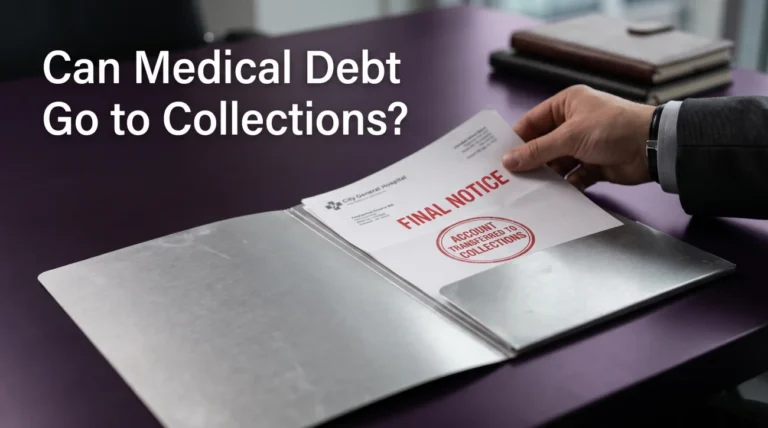
Despite holding this leverage, it is incredibly common for patients to feel overwhelmed by a relatively small bill. The fear usually stems from the aggressive language printed on the collection notice. Collectors use bold red ink, capitalize words like “FINAL NOTICE,” and reference their “legal department” to create a sense of impending doom.
Because their actual enforcement power is so limited on small accounts, collectors compensate by using intimidating phrasing. The urgency you feel is manufactured. The letters are designed to make you panic and pay before you realize how little leverage they actually hold. Once you internalize that the threat is mostly psychological, you can handle the paperwork logically instead of emotionally.
How to Respond to a Low-Leverage Situation
Once you understand the psychological game and the lack of real threat, you still need to resolve the situation. Just because you have the leverage does not mean you should ignore the collector entirely. Ignoring an active collection account allows the automated dialer to keep targeting your phone number indefinitely. You need a specific strategy to manage the contact without accidentally restarting old collection clocks or admitting fault.
Your first step is always to validate the debt. Even if the amount is only $50, you have the right to demand written proof that the agency actually owns the account and that the amount is accurate. Medical billing error rates are notoriously high, and a small balance is just as likely to be a mistake as a large one.
- 📋 Action: Demand validation in writing via certified mail so you have a paper trail.
- 📋 What to document: Log the exact date the collector received your request.
- 📋 Confirmation step: Keep a copy of their validation response alongside your original insurance statement to check for discrepancies.
If the debt is verified and you decide not to pay it, or if you simply want the automated phone calls to stop, you can utilize your federal rights. Under federal law, you have the authority to control how and when a collector communicates with you. If you understand the federal collection laws that dictate what debt collectors can and cannot do, you can force them to cease communication entirely.
Sample phrasing to stop collection calls on a small balance:
“I am writing in response to account number [12345]. I am requesting that you immediately cease all phone communication regarding this account. You are instructed to communicate with me strictly in writing at my mailing address moving forward. Do not contact my employer or any third parties.”
⚠️ Warning: Never make a “good faith” micro-payment of five or ten dollars just to get the agent off the phone. In many states, making a partial payment on an old debt will legally restart the statute of limitations, giving the collector a brand new window to pursue you.
Final Thoughts: The Cost of Peace of Mind
The healthcare billing apparatus is terrifying by design, but a small balance collection account is one of the few areas where the patient holds the structural advantage. Resolving a sub-$500 medical collection ultimately comes down to deciding what your time and peace of mind are worth.
Since the threat to your credit is neutralized and legal action is practically off the table, you have the luxury of choosing your battles. If the bill is completely inaccurate, fight it on principle. If the bill is valid but you cannot afford it, use your leverage to offer a fraction of the total balance to close the account permanently. You are not at the mercy of the collection agency’s timeline. You are in control of how and when this account is resolved.
❓ FAQ
📉 Does the medical collections 500 rule mean my debt is forgiven?
No. The rule only prevents the debt from appearing on your credit report. It is a credit bureau policy, not a debt forgiveness program. You still legally owe the money to the original provider or the debt buyer.
📞 Can debt collectors still call me for a $150 medical bill?
Yes. Collectors are legally allowed to pursue balances of any size through phone calls and letters, as long as they follow federal communication guidelines and do not harass you.
⚖️ Is it legal to sue over a $300 hospital bill?
It is technically legal, but it is exceptionally rare. The costs associated with filing a lawsuit, serving the papers, and paying attorney fees usually far exceed the $300 they are trying to collect.
💳 Will paying a small medical bill boost my credit score?
No. Because medical collections under $500 are not reported to the credit bureaus in the first place, paying the bill will not result in a positive mark or a score increase on your credit file.
🏥 Do hospitals actually sell small debts to collection agencies?
Yes. Hospitals frequently bundle thousands of small unpaid accounts together and sell them as a single massive portfolio to debt buyers for a fraction of their face value.
✉️ Should I ignore a collection letter if the balance is under $500?
You should not ignore it completely. It is always best to send a written request for validation to ensure the bill actually belongs to you and that the amount is mathematically correct before deciding on your next step.
📝 Can I still request debt validation for a $50 medical charge?
Absolutely. Your federal right to demand debt validation applies to all collection accounts regardless of the balance size. The collector must prove they have the right to collect that $50.
🚫 How do I stop collectors from calling about a small balance?
You can send a written “cease communication” letter to the collection agency via certified mail. Under federal law, once they receive this written request, they must stop calling you.
🛡️ Are there state laws that protect small medical debts?
Some states have added additional protections regarding interest rates and collection fees, but the $500 reporting threshold is a nationwide policy enacted by the major credit bureaus.
⏱️ Is there a statute of limitations for small balance medical debt?
Yes. All medical debt, regardless of size, is subject to your state’s statute of limitations. Once that specific time period passes, the collector can no longer legally file a lawsuit against you for the balance.
Medical Debt Collection
The laws governing what collectors can do and the specific situations where those laws matter most.
- The full legal framework: five federal laws governing what collectors can and cannot do
- How Long Before Medical Debt Goes to Collections? The Real Timeline (And How to Use It)
- How to Get Out of Medical Debt Collections: The Four Paths and Which One Fits Your Situation
- Should I Let Medical Debt Go to Collections? The Trade-offs Most Answers Get Wrong
- Can Medical Debt Take Your House? Liens, Lawsuits, and Homestead Rules
When the Collector Won't Stop
Knowing your rights matters. These cover what to do when the collector does not back down.
- How to use a HIPAA violation to push back on the collector that is pursuing you
- Negotiating the original bill before the collector gains more leverage over the account
- What collectors in this situation will actually accept and why the math works for both sides
- Whether a structured relief program makes sense when a collector is already involved
- Removing the collection account from your credit report after the account is resolved
Disclosure: The content on this site reflects direct experience inside hospital billing and medical debt collection, and is grounded in federal law and regulation. It is informational in nature. Reading it does not constitute legal advice and does not create any professional relationship. If you are facing a lawsuit, a judgment, or a legal deadline, consult a licensed attorney in your state before taking action.