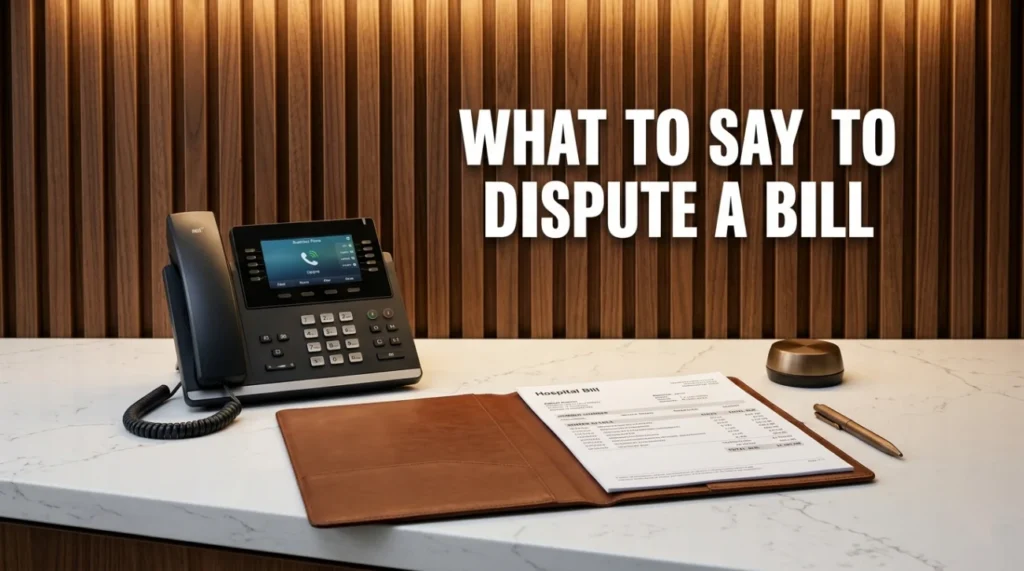
- Most medical bill disputes start with a phone call, but the majority of those calls fail because patients use language that gets them routed to a payment plan instead of an error review.
- Never start by saying “this is too expensive” or “I cannot afford this.” Those are complaints, not disputes. A dispute must point to a specific error.
- The most effective way to open the call is to state you have your itemized bill in front of you and want to dispute a specific line item.
- Always ask for the representative’s name, a dispute ticket number, and an exact timeline for a response before you hang up the phone.
- If the call goes nowhere, do not argue. Ask for the correct mailing address to submit a formal written dispute and end the conversation politely.
The Make-or-Break First Phone Call to Billing
Almost every attempt to challenge a hospital charge begins the exact same way. A patient looks at a number they cannot believe, picks up their phone, dials the number on the top right corner of the statement, and waits on hold. But what happens when the representative finally answers is what determines whether the bill gets fixed or remains exactly the same.
When I sat at a desk inside a hospital billing department, I answered thousands of these calls. The difference between a call that resulted in an account review and a call that I closed with no action was almost never about the actual merit of the patient’s claim. It was entirely about how the caller framed the problem.
If you want to know what to say to dispute a medical bill, you have to understand the person on the other end of the line. Billing representatives are trained to close calls quickly and secure payment. If you do not use the right terminology, they will categorize your call as a simple complaint. This guide covers the exact phrases to use, the traps to avoid, and the insider dynamics of how your account is handled when you challenge a charge.
What NOT to Say: The Language That Kills Your Dispute
Before we cover what do you say to dispute a medical bill, we have to eliminate the phrases that guarantee failure. When you call a hospital, the representative is listening for keywords to figure out which drop-down menu to click on their screen to log the call.
If you use emotional or vague language, the representative will not open an error investigation. They will route you to a completely different department.
“This bill is way too expensive. There is no way a fifteen-minute visit should cost this much.”
👉 Why it fails: This is logged as a complaint about pricing. The representative will tell you that the charges align with the hospital’s standard pricing guidelines, and the call will end.
“I am looking at line item four. This charge does not reflect the level of service I received in the room.”
👉 Why it works: This challenges the accuracy of the coding, not the hospital’s general pricing strategy.
Here are the three most dangerous phrases you can use on a call:
- “I can’t afford this.” The moment a billing representative hears this, they stop thinking about billing errors. Their training kicks in, and they will immediately try to set you up on a monthly payment plan or transfer you to financial counseling. While financial hardship programs are valuable, bringing this up first destroys your leverage to fix an actual mistake.
- “Someone told me I could dispute this.” This signals to the representative that you do not actually know what is wrong with the bill. It makes you sound uninformed, which makes it very easy for them to dismiss your concerns with a generic explanation.
- “This is a scam.” Emotional framing, yelling, or accusing the hospital of fraud forces the representative into a defensive posture. They are not the ones who coded your chart, and getting angry at them will only make them want to get you off the phone as quickly as possible.
How to Open the Call and Signal You Are Prepared
The first thirty seconds of your conversation dictate the entire outcome. You need to immediately establish that you have done your homework and that you are initiating a formal process. When wondering what to tell billing department when disputing, the key is to sound like an auditor, not an angry customer.
“When a caller started the conversation by mentioning their itemized bill, I immediately sat up straighter. It meant they were looking at the exact same billing codes I was looking at. That completely changes the dynamic of the call.”
If you do not already have an itemized bill, your only goal for the first call is to request one. You cannot effectively argue a summary statement. Assuming you have it in hand, here is the exact formula for how to approach billing dispute conversations right from the start.
This opening is incredibly effective. It tells the representative that you possess the detailed records and that you understand hospital hierarchy. By asking if they are the “right department,” you respectfully give them the option to transfer you to someone with more authority if they are just a front-line payment collector.
Phrases to Dispute Medical Bill Errors Specifically
Once you are speaking to the right person, you have to frame the error. You must keep your explanation tight. Do not tell a ten-minute story about how long you waited in the lobby or how the doctor’s bedside manner was lacking. Clinical complaints are irrelevant to the billing code.
Instead, focus strictly on the complete mechanics of a medical bill dispute. Point directly to the line item, state what it says, and state why your medical record or memory contradicts it.
Here are specific phrases to use depending on the type of error you found:
When You Find a Duplicate Charge
When You Suspect Upcoding (Wrong Level of Service)
When Billed for Something You Did Not Receive
Notice the common thread in these phrases. They do not ask the representative for their opinion. They state a discrepancy and request a specific internal action, such as a “chart audit” or a “coding review.” If you want to know what your specific error is called, you can check our breakdown of the most common hospital overcharges to find the right terminology.
The Insider Dynamic: How Your Account Actually Gets Flagged
To truly understand how to speak to billing about dispute resolution, you need to picture what is happening on the representative’s computer screen while you are talking.
When a call comes in, the representative opens your account ledger. As you speak, they are typing notes into a free-text box. More importantly, when the call ends, they have to select a “disposition code” from a menu to categorize the interaction.
If you call and complain about prices but do not give specific line items, the representative might select a code like INQ-GEN (General Inquiry) or COMP-PRC (Pricing Complaint). These codes usually just close the ticket. No one else looks at your account.
If you use the structured phrases we discussed, name specific CPT codes, and ask for an audit, the representative is forced to select a code like DISP-CODING (Coding Dispute) or AUDIT-REQ (Audit Requested). These codes trigger an automatic workflow. The account leaves the front-line representative’s queue and drops into the queue of a senior billing compliance specialist or a medical coder. That is exactly where you want your account to go.
What to Ask For Before You Hang Up
The most dangerous part of the phone call is the end. Many patients state their case, the representative says something agreeable, and the patient hangs up feeling victorious. A month later, they get a past-due notice.
When you are figuring out how to talk to billing department about dispute follow-ups, you have to realize that verbal promises mean nothing without documentation. Before the call ends, you must force the representative to commit to the system.
Always ask these five questions before disconnecting:
- 📌 “What is the reference number for this dispute?” Every hospital software system generates a ticket, interaction, or reference number when a file is updated. Get this number. It proves the conversation happened.
- 📌 “Can I please get your first name and your direct extension?” Write this down next to the date and time of the call.
- 📌 “Do you need anything in writing from me to process this?” You need to establish exactly what is expected. If they say no, document it. If they say yes, ask what specific documentation is required.
- 📌 “Will my account be placed on a billing hold while this is reviewed?” You need to know if the automatic collection clock is paused. If they say no, you are still at risk of being sent to a debt collector while they investigate.
- 📌 “What is the exact timeframe I should expect a resolution by?” Do not accept “we will get back to you.” Ask if it takes thirty days, forty-five days, or sixty days.
The Dead End Call: How to Pivot to a Written Dispute
Despite your best efforts, you will sometimes reach a representative who refuses to help. They might stubbornly insist that the computer says you owe the money, so you must owe the money. They might talk in circles, interrupt you, or simply say, “Well, I will send a note to the back office and we will look into it.”
This is the trap where most patients lose their leverage. A vague promise to look into the matter is a polite way of getting you off the phone. If they will not give you a dispute ticket number and confirm a billing hold, nothing is actually happening behind the scenes.
When you realize the call is going nowhere, do not escalate into a shouting match. Threatening to sue the hospital or call the local news will not intimidate a front-line call center worker. It just gets your account noted as “hostile caller.” Instead, if the representative is unresponsive or dismissive, what should i say to dispute medical bill charges effectively? You stop trying to convince them and you move the dispute to a channel they cannot ignore: written correspondence.
You use a phrase that signals escalation readiness without direct confrontation. It shows the representative that shutting you down verbally did not solve their problem.
This is a powerful pivot. A patient asking for the billing director’s mailing address is a patient who is going to create a permanent paper trail. Sometimes, simply asking this question causes the representative to suddenly “find” a way to escalate your ticket internally.
If they provide the address, take it, thank them, and hang up. Your next step is to immediately learn exactly how to structure the steps of a documented dispute. You will bypass the call center entirely and send a targeted medical bill dispute letter straight to the reviewers who actually have the power to alter the balance.
Final Thoughts: Controlling the Conversation
Knowing what to say on the phone is about controlling the flow of information. You are not calling to ask for a favor; you are calling to point out a factual error in a financial document. Keep your emotions out of it, stick to the line items, and always demand a reference number.
If the phone call works, you will see a revised statement in a few weeks. If the billing department remains completely unresponsive even after you follow up in writing, you have to look at the bigger picture. Understand what successful dispute escalation actually looks like. And remember, even if a dispute is ultimately denied and the charge stands, you still have options. At that point, you can shift your strategy entirely and learn how to negotiate the remaining medical bill balance based on financial realities.
❓ FAQ
📞 Who do I actually call to dispute a hospital charge?
Always call the number listed specifically for “Billing” or “Patient Financial Services” on your statement. If the hospital uses a third-party billing company, you must call that company, not the main hospital switchboard.
🗣️ What should I say to dispute medical bill overcharges on the phone?
State that you are opening a formal dispute, identify the exact date of service and the specific line item from your itemized bill, and clearly explain why the charge does not match the clinical services you received.
😡 How to talk to billing department about dispute if they are rude?
Do not argue back. Calmly ask for their name and a reference number for the call, state that you will be continuing the dispute in writing, ask for the mailing address for the billing director, and disconnect.
⏰ How long does a phone dispute take to process?
If the representative actually submits an audit request during your call, a standard review usually takes between 30 and 45 days. You must ask them for this specific timeline before you hang up so you know when to follow up.
📝 Do I need to send a letter if I already called?
Yes, highly recommended. Phone calls leave no paper trail on your end. Sending a brief certified letter referencing the date and ticket number of your phone call locks your dispute into a legal timeframe.
🤷♀️ What if the representative says the charge is correct?
A front-line representative’s opinion does not close a dispute. Tell them you respectfully disagree with their assessment and request that the account be forwarded to a senior medical coder for an official chart audit.
🏥 Should I call my insurance company or the hospital first?
If the error is how the service was coded (e.g., duplicate charge), call the hospital billing department. If the hospital coded it correctly but your insurance unexpectedly denied coverage, you need to call your insurance company.
🎙️ Can I record my phone call with the billing department?
Because recording laws vary significantly depending on where you and the call center are located, relying on audio recordings can be legally complicated. The safest and most effective strategy is to always take detailed written notes during the call, including the date, time, representative’s name, and the dispute reference number.
Medical Bill Dispute
How to challenge a hospital bill from the initial dispute through the collections process.
- Step-by-step guide to challenging a hospital bill from itemization to formal dispute
- Can a Disputed Medical Bill Be Sent to Collections? The Rules During Active Dispute
- How to Dispute a Surprise Medical Bill: The Federal Process Step by Step
- Can You Dispute a Medical Bill After Paying? Yes, Here Is How
- How to Dispute a Medical Bill Without Insurance: Rights for Self-Pay Patients
When Disputing Is Not Enough
A successful dispute resolves some situations. These cover when the bill or the collector remains.
- Using a HIPAA violation to challenge how your bill was transferred to the collector
- Negotiating the bill you are disputing and what hospitals are actually willing to reduce
- Settling the remaining balance when a dispute does not fully resolve the account
- Debt relief programs that can handle disputed and overbilled medical accounts
- How a successful bill dispute can result in removing the collection from your credit report
Disclosure: The content on this site reflects direct experience inside hospital billing and medical debt collection, and is grounded in federal law and regulation. It is informational in nature. Reading it does not constitute legal advice and does not create any professional relationship. If you are facing a lawsuit, a judgment, or a legal deadline, consult a licensed attorney in your state before taking action.