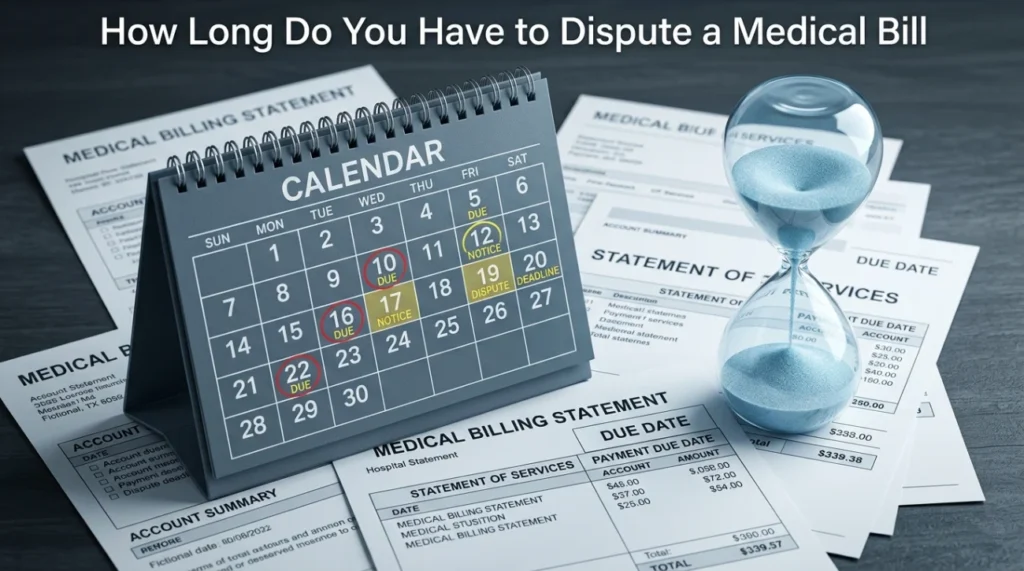
- There is no single universal deadline for medical billing disputes. You must track overlapping timelines for the hospital, your insurance company, and federal regulatory protections.
- For internal insurance appeals, federal law guarantees you at least 180 days from the date you receive the denial notice, not from the date of your medical service.
- Missing a formal dispute deadline closes your ability to formally challenge an error, but it does not eliminate your ability to negotiate the remaining balance.
The Complex Web of Medical Billing Deadlines
When a confusing hospital invoice arrives in the mail, the initial shock often gives way to a very practical question: how long do you have to dispute a medical bill before it is permanently locked in? Patients frequently assume there is a single, legally defined expiration date for all billing complaints. Unfortunately, the healthcare system is not structured that simply.
During my time working inside hospital billing departments, I watched patients lose out on thousands of dollars simply because they confused the facility’s internal deadline with their insurance company’s appeal deadline. The clock is always ticking, but there are actually multiple clocks running simultaneously. Missing one of these specific windows can close a door that is incredibly difficult to force back open.
Understanding your time limit to dispute a medical bill requires separating the hospital’s policies from your insurance provider’s legal obligations and federal consumer protections. This guide breaks down the five distinct timelines you must monitor and explains exactly how to protect your rights before the system automatically rules against you.
Timeline 1: The Hospital Billing Window
The first and most immediate timeline is the one set by the healthcare provider itself. Hospitals do not have a federally mandated dispute window for general billing complaints. Instead, they operate on their own internal policies.
Most hospital billing departments allow you to challenge a charge for 90 to 180 days from the date of service or the date the first statement was generated. This timeline exists because hospitals need to close their accounting ledgers for the quarter and determine which accounts are moving into the active collections pipeline.
“From the billing side of the desk, I saw exactly how rigid these internal software systems are. At day 91 or day 121, depending on the facility, the software automatically shifts the account status. A flag is added, the account is moved from active review to delinquent, and the ability for a front-line representative to simply adjust a coding error is locked out. Once that status shifts, correcting an overcharge requires manager override.”
If you suspect a coding error or a duplicate charge, contacting the billing department immediately to ask about their specific policy is your crucial first step. You need to know exactly what your deadline is to submit a formal challenge.
The immediate action flow is simple: call the billing office, ask for their exact internal dispute deadline, and request a detailed itemized statement so you have the documentation needed to meet that deadline.
⚠️ Warning: Beyond the hospital’s internal policy, there is a legal backstop: your state’s statute of limitations on billing disputes (often based on written contract law). While a state might give you several years to legally challenge an invalid charge in court, relying on litigation is expensive and exhausting. Resolving the error within the hospital’s 90 to 180-day internal window is always the primary goal.
Do not rely on a verbal promise that someone will look into your account. A documented, written challenge is the only reliable way to pause the internal clock. If you need a comprehensive overview of how to build that documentation, reviewing the complete mechanics of the entire medical bill dispute process is essential.
Timeline 2: The 180-Day Insurance Internal Appeal
If your bill involves a claim that was denied or underpaid by your health insurance, you are dealing with a completely different timeline. Under the Affordable Care Act, insurance companies must give you at least 180 days to file an internal appeal. For employer self-funded health plans, the Employee Retirement Income Security Act requires a very similar six-month window.
The single most important detail about this 180-day window is when the clock actually starts.
Thinking the 180-day countdown begins on the day you had your surgery or doctor appointment.
Knowing the 180-day countdown begins on the exact date you receive the official denial notice or Explanation of Benefits from your insurer.
It can sometimes take an insurance company 30 to 45 days just to process the initial claim and issue an Explanation of Benefits. If the 180-day clock started on the date of your medical procedure, you would lose a quarter of your appeal window just waiting for the paperwork. Federal law protects you by anchoring the deadline to the date of the formal denial.
“From the billing compliance side, I saw how strictly insurers enforce this deadline. If your appeal fax arrives on day 181, the insurance company’s intake software automatically kicks it back as a denial based on timeliness, regardless of how obvious the coverage error might be. They will not grant leniency because you were overwhelmed by the paperwork.”
Once you file an internal appeal, the insurer is bound by their own strict deadlines. They must respond to urgent care appeals within 72 hours, pre-service appeals within 30 days, and post-service appeals within 60 days. If you are dealing with a complex claim denial, understanding the specific mechanics of challenging a health plan coverage decision will help you navigate this specific six-month window.
Timeline 3: The External Review Window
If you exhaust the internal appeal process and your insurance company upholds their original denial, you have the right to take the dispute outside of the company. This is known as an external review, where an independent third party evaluates the clinical evidence and the plan documents.
Your deadline to dispute a medical bill at this stage is typically four months from the date you receive the final internal appeal denial. The exact timeframe can vary slightly depending on your specific state insurance regulations, but four months is the standard baseline for federally regulated plans.
💡 Pro Tip: The external review process is highly clinical and administrative. The independent review organization will look strictly at medical necessity and plan terminology. Ensure your doctor provides a letter of medical necessity before this four-month window closes.
If the independent review organization rules in your favor, the insurance company is legally required to comply and pay the claim. They cannot appeal an external review decision that favors the patient.
Timeline 4: The Federal Good Faith Estimate Window
If you are uninsured or paying entirely out of pocket, the No Surprises Act guarantees your right to a Good Faith Estimate prior to scheduled care. If your final invoice exceeds that official estimate by $400 or more, you have a federal right to dispute the charges through the patient-provider dispute resolution process.
The deadline here is strict. You have exactly 120 days from the date on the final bill to initiate this federal review. If you miss this 120-day cutoff, the federal arbitrator will not accept the case, and your ability to force a billing correction under this specific law evaporates.
Timeline 5: The Post-Payment Refund Window
Many patients assume that once a bill is paid, the transaction is permanently closed. That is incorrect, but the recovery process becomes significantly harder. If you pay a bill and later discover a clear documentation discrepancy or duplicate charge, you can still request a refund.
Most hospitals will process documented refund requests within 12 months of the payment date. Refunding money requires moving funds from accounts receivable back to accounts payable, which involves multiple layers of managerial approval. If you try to secure a refund for an error that is over a year old, you will likely find that the hospital’s accounting software has archived the transaction, making recovery practically impossible without legal intervention.
The Delay Trap: Why Most People Miss Their Window
The most dangerous thing a patient can do with a confusing medical bill is put it in a drawer. The assumption that you can simply deal with it later when you have more mental energy is exactly how these overlapping deadlines expire.
In my experience reviewing disputed accounts, patients often failed because they assumed a phone call paused the clock. A patient would call the hospital, a representative would say they were looking into the coding, and the patient would wait two months for a callback. Meanwhile, the 180-day internal insurance appeal clock was silently running out. By the time the hospital confirmed the coding was correct and the insurance company was at fault, the insurance appeal window had permanently closed.
You must actively manage these timelines. If you find a mistake, you need to understand the exact documentation steps required to lock in your challenge. Submitting everything in writing with delivery confirmation ensures that neither the hospital nor the insurance company can claim you missed the cutoff.
What Happens When Time Runs Out
If you discover a massive error but your 180-day insurance window has closed and the hospital’s 90-day dispute policy has passed, you might feel entirely defeated. However, it is vital to understand what the expiration of a deadline actually means.
When a deadline passes, the formal dispute mechanism closes. You can no longer force the insurance company into a regulated internal review, and you can no longer utilize the federal arbitrator for a Good Faith Estimate violation. You lose your leverage to demand a correction based on rules.
However, the expiration of a dispute window does not mean the debt magically disappears, nor does it mean your options are entirely exhausted. You still owe the balance, but your strategy must pivot from formal dispute to financial negotiation.
Hospitals and collection agencies still prefer to recover some portion of a delinquent account rather than writing it off entirely as bad debt. Even if your formal challenge window is permanently closed, you can still pursue effective methods for negotiating a reduced settlement based on financial hardship or a lump-sum cash offer.
Final thoughts: Track Every Date
Time is the one variable in the medical billing process that you cannot negotiate. Hospitals rely on rigid internal policies, insurance companies enforce strict 180-day mandates, and federal protections like the Good Faith Estimate review vanish at exactly 120 days. The moment you receive an invoice that looks incorrect, your first action must be to identify which entity is at fault and verify their specific deadline for a formal, written challenge.
Keep a detailed log of when you received your Explanation of Benefits and document every piece of correspondence. Above all, never let the clock run out while waiting for a customer service representative to return a phone call.
❓ FAQ
⏳ Is there a legal deadline to dispute hospital charges?
There is no single federal law dictating how long you have to dispute a hospital’s internal coding error. Hospitals set their own policies, usually ranging from 90 to 180 days from the date of the service or the first billing statement.
📅 When does the 180-day insurance appeal clock actually start?
The 180-day window for an internal insurance appeal begins on the date you receive the official denial notice or the Explanation of Benefits from your health plan, not on the date you received the medical care.
🛑 What if the hospital sends my bill to a collector while I am disputing?
Under good billing practices, a hospital should pause collection activity during an active, written dispute. If they transfer the account anyway, you must notify the collection agency in writing immediately that the underlying balance is actively contested.
🧾 Can I still challenge a bill if I already set up a payment plan?
Yes, entering a payment plan does not forfeit your right to challenge a coding error. However, you are still bound by the hospital’s standard dispute timeline, so you must submit your written challenge promptly.
🔄 Does asking for an itemized statement pause the dispute clock?
Typically, no. Simply requesting documentation does not formally freeze the timeline. You must explicitly state in writing that you are formally disputing the account while waiting for the requested documents to arrive.
📞 Do verbal extensions from billing reps count?
No. Never rely on a phone representative telling you that you have extra time. Verbal extensions are almost impossible to prove later. Always demand confirmation of any timeline extension in writing.
🏥 Are deadlines different for nonprofit and for-profit facilities?
While the dispute window for a coding error might be similar, nonprofit hospitals are bound by federal IRS regulations requiring them to screen patients for financial assistance before taking aggressive collection actions, giving you an additional layer of process protection.
💸 How late is too late to ask for a refund on a billing mistake?
If you paid a bill and later discovered a clear error, most hospital finance departments will process documented refund requests within 12 months of the payment date. Beyond one year, recovery is extremely difficult.
⚖️ What is the absolute final deadline for a Good Faith Estimate review?
If you are uninsured and your final bill exceeds the Good Faith Estimate by $400 or more, federal law gives you exactly 120 days from the date on the final invoice to initiate the federal dispute resolution process.
📝 Can my insurance company deny an appeal just because I was one day late?
Yes. Insurance companies strictly enforce the 180-day deadline for internal appeals. If your paperwork arrives after the window has closed, they have the legal right to deny the appeal based entirely on the missed deadline.
Medical Bill Dispute
How to challenge a hospital bill from the initial dispute through the collections process.
- Step-by-step guide to challenging a hospital bill from itemization to formal dispute
- How to Dispute an Incorrect Medical Bill: The Steps That Actually Get Errors Corrected
- How to Dispute a Medical Bill for Services Not Rendered: The Strongest Ground You Have
- How to Dispute a Medical Bill Without Insurance: Rights for Self-Pay Patients
- How to Dispute a Medical Bill With Insurance: The Appeal Process That Most Patients Skip
When Disputing Is Not Enough
A successful dispute resolves some situations. These cover when the bill or the collector remains.
- Using a HIPAA violation to challenge how your bill was transferred to the collector
- Negotiating the bill you are disputing and what hospitals are actually willing to reduce
- Settling the remaining balance when a dispute does not fully resolve the account
- Debt relief programs that can handle disputed and overbilled medical accounts
- How a successful bill dispute can result in removing the collection from your credit report
Disclosure: The content on this site reflects direct experience inside hospital billing and medical debt collection, and is grounded in federal law and regulation. It is informational in nature. Reading it does not constitute legal advice and does not create any professional relationship. If you are facing a lawsuit, a judgment, or a legal deadline, consult a licensed attorney in your state before taking action.