- Finding a billing error is only the first step; getting it fixed requires a formal, written dispute that forces the billing department to review the specific coding rules.
- Never rely solely on a phone call to dispute a charge, as verbal complaints rarely trigger the formal review queue and often leave no paper trail.
- A successful dispute requires specific documentation, including the exact line item, the relevant CPT code, and a clear request for a corrected statement.
Finding the Error Is Only Half the Battle
Spotting a mistake on your hospital statement is a frustrating moment, but figuring out exactly how to dispute an incorrect medical bill is where most people hit a wall. You might be staring at a duplicate charge, an absurdly expensive code for a routine visit, or a bill for a medication you never even received. Recognizing the problem is critical, but the system is not designed to fix itself just because you noticed a discrepancy.
When I was working inside hospital billing departments, I watched thousands of accounts move through the system. I saw the massive gap between what patients thought they were doing when they called to complain, and what the billing software actually required us to do to process a correction. A phone call saying “this charge seems wrong” is almost always treated as a complaint, not a formal request for an audit. The patient hangs up thinking the problem is being investigated, while the account simply keeps moving closer to the collection cycle.
If you want to know how to dispute a medical bill charge effectively, you have to stop acting like a frustrated consumer and start acting like an auditor. You need to speak the language of the billing department, document your findings in a way that cannot be easily dismissed, and route your request so it lands on the desk of a senior reviewer rather than a front-line phone representative. This guide will walk you through the exact steps to build a dispute that actually gets errors corrected.
Why Most Disputes Fail Before They Even Start
The most common scenario I saw from the inside was a patient calling the main billing number listed on their statement. They would wait on hold, finally reach a representative, and explain their entire medical situation, finishing with a plea that the bill had to be a mistake. The representative would listen, check the system, and say something like, “I am looking at the account, and the charges match what the doctor submitted.”
That is usually where the patient gives up. They assume that if the hospital says the bill is correct, there is nothing left to do. They either pay the bill out of fear, or they ignore it until it goes to collections.
“The front-line billing representative’s primary job is to resolve the call and collect payment, not to conduct a clinical audit of your medical records. When you call without specific codes and written proof, you are asking someone who doesn’t have the authority to change your bill to do the work of finding the error for you. They won’t.”
The billing department’s initial response is almost always going to be a defense of the charges. To overcome that default stance, you have to change the mechanism of your approach. You must bypass the phone queue entirely and build a case that forces a formal review. Here is exactly how to do that.
Step 1: Document the Specific Error
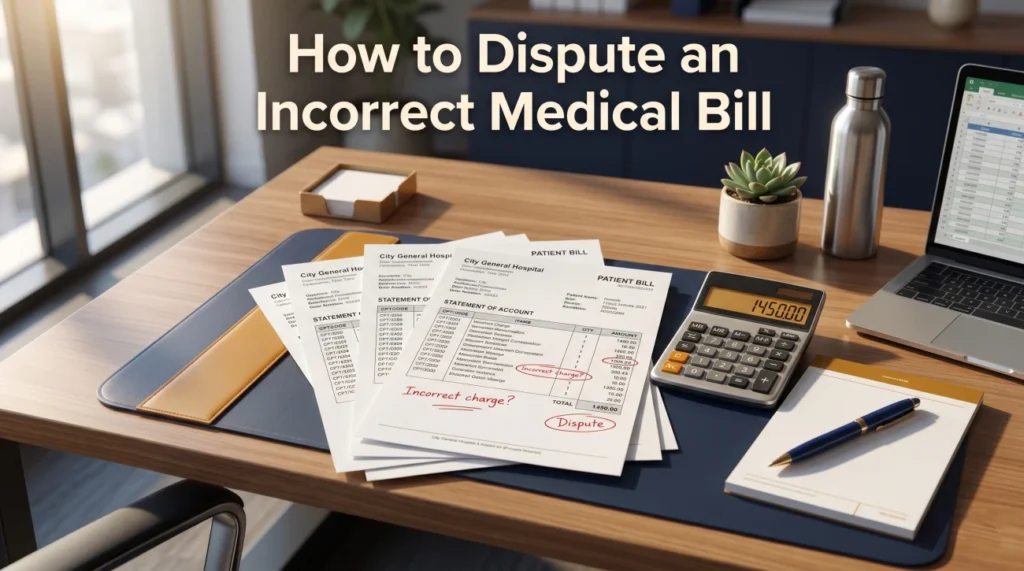
To successfully dispute an incorrect medical bill, you have to pinpoint exactly what is wrong. You cannot dispute a total balance; you can only dispute individual line items that make up that balance. This requires looking past the summary page of your statement and digging into the specific billing codes.
If you do not have an itemized bill, request one immediately. Hospitals are required to provide this. Once you have it, you need to identify the exact nature of the error. Is it a duplicate charge where the same service is listed twice on the same day? Is it a charge for a service not rendered? Or is it an issue of upcoding, where a simple service was billed using a complex code?
Calling billing and saying, “My bill for my emergency room visit is $4,000, and I was only there for an hour. This has to be a mistake.”
Writing to billing and stating, “I am disputing line item #4 on the attached itemized bill. CPT code 99285 was billed for a high-complexity emergency visit, but my medical records show I only received a basic evaluation corresponding to CPT code 99283.”
Identifying the exact line item gives the billing department a targeted problem to investigate rather than a general complaint to dismiss. If you need help identifying the different types of mistakes that commonly occur, reviewing the landscape of a typical hospital bill overcharge is a good place to start before you formalize your claim.
Step 2: Gather Your Supporting Documentation
A claim without evidence is just an opinion. When a senior billing reviewer looks at your account, they are going to compare your dispute against the documentation in their system. You need to assemble your own evidence package before you make contact.
Here is what you need to gather to prove how to dispute a charge on a medical bill:
- 📋 The Itemized Bill: Highlight or circle the specific line items you are contesting.
- 📋 Your Explanation of Benefits (EOB): If there is a discrepancy between the EOB and the bill, the EOB is your strongest piece of leverage.
- 📋 Relevant Medical Records: Your clinical notes (like an operative report or a discharge summary) are the ultimate proof of what actually happened.
- 📋 A Call Log: Type up your notes including dates, times, representative names, and reference numbers for any prior contact.
“From inside the billing department, an account flagged with a patient-provided EOB is handled differently. The EOB is a legally binding processing document from your insurer. If the hospital bill contradicts it, the hospital is almost certainly in the wrong, and the reviewer knows they cannot simply brush the dispute aside. Furthermore, providing your own copies of medical records saves the reviewer from having to request them internally, which often speeds up your correction by weeks.”
📌 Note: Never send your original documents to the billing department. Always send copies and keep the originals in a secure file at home.
Step 3: Contact the Billing Department in Writing
Once you have your documentation, the channel you use to submit it dictates how the hospital’s software routes your problem. When you submit your dispute in writing, the document itself must be scanned or attached directly to your digital account file. This creates a permanent, timestamped record.
More importantly, written correspondence containing specific billing terms is automatically flagged by most modern revenue cycle systems. It is routed away from the general customer service queue, where representatives only have authority to take payments, and sent to a dedicated correspondence team or a senior compliance reviewer.
A formal written dispute makes it significantly harder for the hospital to ignore the problem, because bypassing a documented error creates compliance risks that management wants to avoid. The unavoidable paper trail is the mechanism that actually forces action, and understanding how to dispute a medical bill successfully is what separates disputes that get resolved from those that disappear into the queue.
Step 4: State the Specific Error and Request Action
Your written communication should be clinical, direct, and free of emotion. You are not writing a letter to complain about the cost of healthcare; you are writing a business letter to correct a transactional error.
When you need to know how to dispute medical bill charges, your correspondence must follow a specific logic to force a review. Here is the framework you must include:
- The Anchor: Start with your account number, the date of service, and explicitly state the exact line item and CPT code you are contesting.
- The Evidence: State exactly why the charge is wrong based on your documentation (e.g., “This code reflects a complex visit, but my attached medical records show only a standard evaluation”).
- The Demand: Request a specific action. Do not ask them to “look into it.” Ask them to remove the incorrect charge and issue a revised statement.
- The Protection: Explicitly request a courtesy hold on the account to prevent automated collections while the dispute is actively being investigated.
This structure works because it removes all guesswork for the reviewer and dictates the terms of the investigation. If you need a complete, copy-paste format to ensure you include every necessary detail and address it properly, review our full guide on writing a medical bill dispute letter to formalize your approach.
Step 5: Set a Response Deadline and Follow Up
Once your written dispute is submitted, the clock starts. Setting a reasonable deadline, typically 30 days, establishes an expectation of action. In most modern billing systems, an incoming written dispute triggers a status flag on your account that temporarily pauses automated billing escalation, giving the review team time to investigate.
However, you cannot assume the system will work perfectly without supervision. If 30 days pass and you have not received a revised statement or a written explanation defending the charge, you must follow up. Do not start over from scratch. Reply to your original email or send a second letter referencing the exact date of your first communication.
If the billing department remains unresponsive, or if they deny the dispute without addressing the specific evidence you provided, it is time to escalate. Escalation in a hospital setting is not about yelling at a manager; it is a routing mechanism. When front-line billing fails to resolve a documented error, your next stop is the hospital’s Patient Relations or Patient Advocacy department. These departments exist specifically to handle grievances that the standard operational departments cannot or will not resolve.
Key Point: Escalating a well-documented dispute to Patient Relations almost guarantees that a senior revenue cycle manager will finally look at your account. They are highly motivated to correct obvious errors internally before the issue turns into a formal regulatory complaint.
If your dispute involves an error in how your insurance processed the claim, rather than a mistake by the hospital, your escalation path shifts to your state’s insurance commissioner. Knowing the precise phrases to use during these follow-ups ensures that you maintain control of the conversation, keeping the focus entirely on the unresolved error.
Final Thoughts on the Dispute Process
Figuring out how do i dispute my medical bill without getting caught in an endless loop of hold music requires discipline. The medical billing system heavily relies on patient exhaustion. It is designed to wear you down until paying the bill seems easier than fighting it. By communicating in writing, pinpointing exact billing codes, and providing documentation, you flip the script entirely. You transition from a frustrated consumer asking for help to an informed auditor demanding a correction, and that is the shift that actually produces results.
It is important to remember that even after a successful dispute, you might still face a balance that is difficult to manage. Getting a duplicate charge removed is a victory, but if the remaining legitimate balance is still overwhelming, your strategy must shift from disputing to asking for financial relief. Understanding how to properly discuss a reduction of your valid charges is the logical next step once the errors are cleared away.
Furthermore, if during your dispute process you discover that the hospital has already transferred your account to a third-party agency, and they shared sensitive diagnostic information that was not necessary for the collection of the debt, you may be dealing with a completely different issue. In those specific scenarios, exploring your rights regarding a potential privacy breach during the collection transfer can provide entirely new leverage to halt collection activity.
❓ FAQ
📞 Should I call the billing department before sending a letter?
You can call to request an itemized bill or to ask exactly where written disputes should be sent, but you should not attempt to resolve a complex coding error verbally. Phone calls do not create the necessary paper trail to protect your rights, and front-line representatives usually lack the authority to change clinical coding.
⏱️ How long does the hospital have to respond to my dispute?
There is no universal federal deadline for a hospital to answer a billing dispute, but standard industry practice is 30 to 60 days. Setting a specific 30-day deadline in your written letter establishes a clear timeline, making it obvious when it is time for you to escalate the issue to Patient Relations.
🏥 Can I just tell my doctor the bill is wrong?
Doctors rarely handle their own billing, especially in large hospital settings. While a doctor can add an addendum to your medical record clarifying a service, the actual financial dispute and coding correction must be processed through the hospital’s revenue cycle or dedicated billing department.
💳 Should I pay the bill while I am disputing it?
In most cases, paying the bill closes the account in the active billing system and removes your leverage. If you pay an incorrect bill, you must navigate a much slower, bureaucratic refund process through accounts payable rather than securing a simpler pre-payment correction.
📉 What if they fix the error but the bill is still too high?
Once the specific errors are corrected, the formal dispute phase ends. If you cannot afford the remaining, legally valid balance, you must pivot your approach. Your next step is to initiate a negotiation strategy or immediately apply for the hospital’s financial assistance program.
📄 Do I need a lawyer to dispute medical billing?
No. The vast majority of standard billing errors, like duplicate charges, upcoding, or services not rendered, can be resolved directly with the billing department using specific written documentation. Legal help is typically only necessary for complex malpractice litigation or severe regulatory violations.
🔍 How do I prove I did not receive a specific service?
The legal burden of proof is actually on the provider. If they billed for a service, it must be thoroughly documented in your clinical medical records. If you request your complete records and the service is not listed, the hospital has no foundation to charge you, and the line item must be removed.
📧 Is it better to email or mail my dispute?
Doing both simultaneously is the safest and most effective approach. Emailing provides an instant, digital timestamp for their records, while sending a physical copy via certified mail, return receipt requested, provides you with undeniable legal proof that the document was received.
⚖️ What if the hospital simply refuses to correct the error?
If the billing department ignores your evidence or denies the claim without explanation, escalate the issue to the hospital’s Patient Advocate or file a formal grievance. If the error involves how your insurance processed the claim, you can also file a complaint with your state’s department of insurance.
🛑 Will disputing my bill cause it to be sent to collections?
A formal, written dispute usually triggers a temporary hold on your account, pausing the collection clock while the internal investigation happens. However, verbal complaints over the phone often fail to trigger this protective hold, which is exactly why submitting your dispute in writing is essential.
Medical Bill Dispute
How to challenge a hospital bill from the initial dispute through the collections process.
- Step-by-step guide to challenging a hospital bill from itemization to formal dispute
- What Happens When You Dispute a Medical Bill? The Process and Possible Outcomes
- How to Dispute a Medical Bill Without Insurance: Rights for Self-Pay Patients
- How to Dispute a Surprise Medical Bill: The Federal Process Step by Step
- How Do You Dispute a Medical Bill Successfully? What Actually Works
When Disputing Is Not Enough
A successful dispute resolves some situations. These cover when the bill or the collector remains.
- Using a HIPAA violation to challenge how your bill was transferred to the collector
- Negotiating the bill you are disputing and what hospitals are actually willing to reduce
- Settling the remaining balance when a dispute does not fully resolve the account
- Debt relief programs that can handle disputed and overbilled medical accounts
- How a successful bill dispute can result in removing the collection from your credit report
Disclosure: The content on this site reflects direct experience inside hospital billing and medical debt collection, and is grounded in federal law and regulation. It is informational in nature. Reading it does not constitute legal advice and does not create any professional relationship. If you are facing a lawsuit, a judgment, or a legal deadline, consult a licensed attorney in your state before taking action.